


Most traders get the ADX completely wrong.

Rajesh Sharma
Senior Forex Analyst ·  India
India
☕ 11 min read
What you'll learn:
- 1What the ADX Actually Measures (Hint: Not Direction)
- 2Setting Up the ADX for Indian Day Trading
- 3Core ADX Trading Strategies for Intraday
- 4What to Pair With the ADX (The Dream Team)
- 5Indian Market Realities: Costs & Rules You Can't Ignore
- 6ADX Day Trading Mistakes That Will Cost You Money
- 7Putting It All Together: A Sample Trade Walkthrough
Most traders get the ADX completely wrong. They slap it on a chart, see a high number, and jump in, only to get stopped out immediately. They treat it like a crystal ball for direction, when it's really a strength meter. I've blown up a small account or two making that exact mistake. Let's set the record straight on how to use the ADX indicator for day trading, with the specific costs, rules, and broker quirks you face in India.
The Average Directional Index (ADX) is the most misunderstood tool in the box. It does not tell you if the market is going up or down. Full stop. It tells you how hard it's moving in whatever direction it's already going. Think of it like the volume knob on your stereo. A high ADX means the trend is loud and clear. A low ADX means it's background noise, a messy sideways chop.
The indicator has three lines: the ADX line itself (trend strength), the +DI line (bullish pressure), and the -DI line (bearish pressure). The default setting is 14 periods, which is fine for starters, but for day trading on lower timeframes, we'll tweak that later. The magic number everyone talks about is 25. An ADX reading above 25 generally suggests a tradable trend is present. Below 20, you're in no-man's-land, and your trend-following strategies should be shelved.

Warning: A rising ADX does NOT mean "buy." It means whatever is happening is gaining momentum. That momentum could be a vicious sell-off. You must use the +DI and -DI lines, or another tool like a moving average, to determine the direction.

💡 Winston's Tip
The ADX is your trend strength thermostat. Don't try to heat the room when the thermostat reads 'cold' (ADX<20). Wait for it to signal 'warming up' (ADX rising through 25).
You can't just use the default 14-period ADX on a 5-minute Nifty chart and expect clean signals. The Indian market has its own rhythm, influenced by global cues, FII/DII flows, and news events that can cause wild intraday swings. Your settings need to be tighter.
Timeframes and Periods
For pure intraday, I focus on the 3-minute, 5-minute, and 15-minute charts. On these, I reduce the ADX period from 14 to 10 or even 7. This makes the indicator more sensitive to intraday momentum shifts. The trade-off? You'll get more false signals, so confirmation is key. I always have a higher timeframe (like the 1-hour) open to see the broader trend context.
Which Instruments?
The ADX works best on instruments that trend well. For Indian traders, that's often:
- Nifty 50 Index (and its futures/options)
- Bank Nifty Index (futures/options)
- Liquid large-cap stocks like Reliance, TCS, HDFC Bank
- USD/INR pair (with a regulated international broker like Exness or IC Markets)
Avoid using it on highly volatile, low-volume small-caps for day trading. You'll just get whipsawed.

Pro Tip: Don't chart ADX in isolation. Put it below your main price chart, alongside a simple volume indicator. If ADX is rising with rising volume, that's a high-confidence signal. If ADX is rising on thin volume, be suspicious - it might be a fakeout.
“The ADX doesn't tell you if the market is going up or down. It tells you how hard it's moving in whatever direction it's already going.”
Here’s where we get practical. These are the two setups I've used to pay my bills.
Strategy 1: The DI Crossover with ADX Filter
This is the classic. You wait for the +DI to cross above the -DI for a buy signal, or the -DI to cross above the +DI for a sell signal. But here's the filter that most amateurs skip: you only take the trade if the ADX is above 25 and preferably rising. If the crossover happens while ADX is below 20, it's almost always garbage - a fake move in a choppy market.
My Trade Example: On April 3rd, 2026, I was watching Bank Nifty Futures on the 5-minute chart. The ADX had been languishing around 18 (no trend). At 10:45 AM, the +DI crossed above -DI. Amateurs would have bought. I didn't, because ADX was at 19. The price rallied 50 points and reversed. At 11:15 AM, the ADX climbed to 26, and the +DI crossed -DI again. That was my signal. I entered long at 48,210. My stop was below the recent swing low, and I used the ADX as my exit guide. I closed half at 48,350 when ADX started to curl down from 42, and the rest at 48,420. The ADX told me when the trend strength was peaking.
Strategy 2: The ADX Breakout
This is for catching the start of a strong move. You identify a period of consolidation where the ADX is below 20 for an extended time (the market is sleeping). Then, you watch for a sharp price move out of the range accompanied by the ADX line breaking decisively above 25. This signals the sleepy period is over and a new trend is launching.
Entry: Enter in the direction of the breakout candle once ADX clears 25. Exit: Consider exiting when the ADX turns down from a level above 40, indicating the explosive momentum is fading. This pairs beautifully with a scalping strategy for quick profits.
Remember, the ADX is a lagging indicator. It confirms strength; it doesn't predict it. Always use a stop-loss. A good rule is to never risk more than 0.5% of your capital on a single intraday trade, which you can calculate precisely with a position size calculator.
The ADX is a team player. It needs friends. Using it alone is a surefire way to lose money.
1. Moving Averages for Direction: Since ADX doesn't give direction, use a simple moving average (like the 20-period EMA) on your price chart. Only take long ADX signals when price is above the EMA, and short signals when price is below it. This filters out counter-trend ADX spikes.
2. RSI for Overbought/Oversold Context: The RSI indicator is perfect alongside ADX. In a strong trend (ADX > 30), the RSI can stay overbought or oversold for a long time. So, don't use RSI to reverse a trade. Instead, use it for entries: in an uptrend with high ADX, look for RSI pullbacks to 40-50 as buying opportunities.
3. Price Action & Support/Resistance: This is non-negotiable. An ADX buy signal that fires right at a major historical resistance level is a trap. The trend might be strong, but it's about to slam into a brick wall. Always know where the key S&R levels are on your chart.
Here’s a comparison of how these combos work:
| Scenario | ADX Reading | Companion Indicator | Action |
|---|---|---|---|
| Strong Uptrend | Rising, above 30 | Price above 20 EMA, RSI pulls back to 50 | High-Probability Long |
| Weak Chop | Below 20 | Price bouncing between S&R, RSI choppy | Stay Out / Range Trade |
| Trend Exhaustion | ADX peaks above 50, starts curling down | Price at major resistance, RSI > 80 | Take Profits, Don't Enter New |
I learned this the hard way in early 2023. I saw a beautiful +DI crossover on USD/INR with ADX at 28. I went all in long, ignoring that it was happening at a 6-month high resistance. The trend was strong until it wasn't. I got stopped out for a 45-pip loss, which was about 1.8% of my account. A costly lesson in ignoring the bigger picture. For forex pairs like this, understanding the pip value and the broker's spread is critical, which is why I prefer brokers like Pepperstone for tight spreads on majors.
💡 Winston's Tip
In India, your broker's auto-square-off is your friend. It saves you from yourself. Never let an intraday trade become overnight hoping for a miracle. The ADX resets with the session.
“A rising ADX does NOT mean 'buy.' It means whatever is happening is gaining momentum. That momentum could be a vicious sell-off.”
Trading in India isn't just about the charts. The taxman and SEBI have a say in your profits.
The Cost of Doing Business (Per ₹1 Lakh Intraday Trade): Let's say you make 10 intraday trades today, each worth ₹1 lakh (total turnover ₹10 lakh).
- Brokerage: With a discount broker (flat fee), say ₹20 per order. That's ₹200.
- STT: 0.025% on the sale value. Roughly ₹250.
- Exchange Charges: ~₹50.
- SEBI Fee: ~₹1.
- GST: 18% on brokerage + transaction charges. ~₹45.
- Stamp Duty: ~₹3.
Total Direct Costs: ~₹549. That's 0.55% of your turnover gone before you even make a rupee. To be profitable, your strategy needs to overcome this friction. This is why a high-probability setup from a tool like the ADX is so important - you can't afford many small, scratch trades.
Tax on Profits: Your intraday profits are taxed as Speculative Business Income under your income tax slab. If you're in the 30% slab, nearly a third of your net profit goes to taxes. Losses can only be set off against other speculative income (like F&O losses), not your salary.
The Big Rule: You must square off all intraday equity positions before 3:20 PM. If you don't, your broker will do it for you, often at the worst possible price. This forces a discipline that actually helps day traders avoid overnight risk. For swing trading positions, you'd use a different account type.
I've made these. You will too, but let's try to minimize the pain.
1. Trading the First DI Crossover. The first crossover in a low ADX environment (<20) is almost always a fakeout. Wait for the ADX to confirm strength.
2. Ignoring the ADX Slope. A value of 30 is good, but a value of 30 that's falling from 45 is a warning sign of fading momentum. A value of 22 that's rising sharply from 15 is often better - it shows a new trend is gathering steam.
3. Using it on All Timeframes Equally. The ADX works poorly on very low timeframes like the 1-minute chart for anything other than scalping. There's too much noise. Stick to 3-min and above for cleaner readings.
4. Forgetting About the Session. The ADX often resets overnight. The first hour of the Indian market (9:15-10:15 AM) is usually chaotic. Let the ADX settle down and show its hand after the initial volatility. Some of my worst trades were trying to catch a "trend" in the first 30 minutes based on a jumpy ADX.
5. No Exit Plan. You entered on a high ADX. When do you get out? If you wait for the DI lines to cross back, you'll give back most of your profit. Use a trailing stop, or exit when the ADX starts to turn down from an extreme (above 40). Managing this manually is stressful, which is why automation helps.

Example: You buy Nifty at 22,500, ADX at 28 (rising). Your risk is 50 points (₹3,750 per lot). Your first profit target could be at 22,600 (100 points), and you trail the rest with a stop that moves up only when the ADX is above 30. This locks in profits while letting winners run.
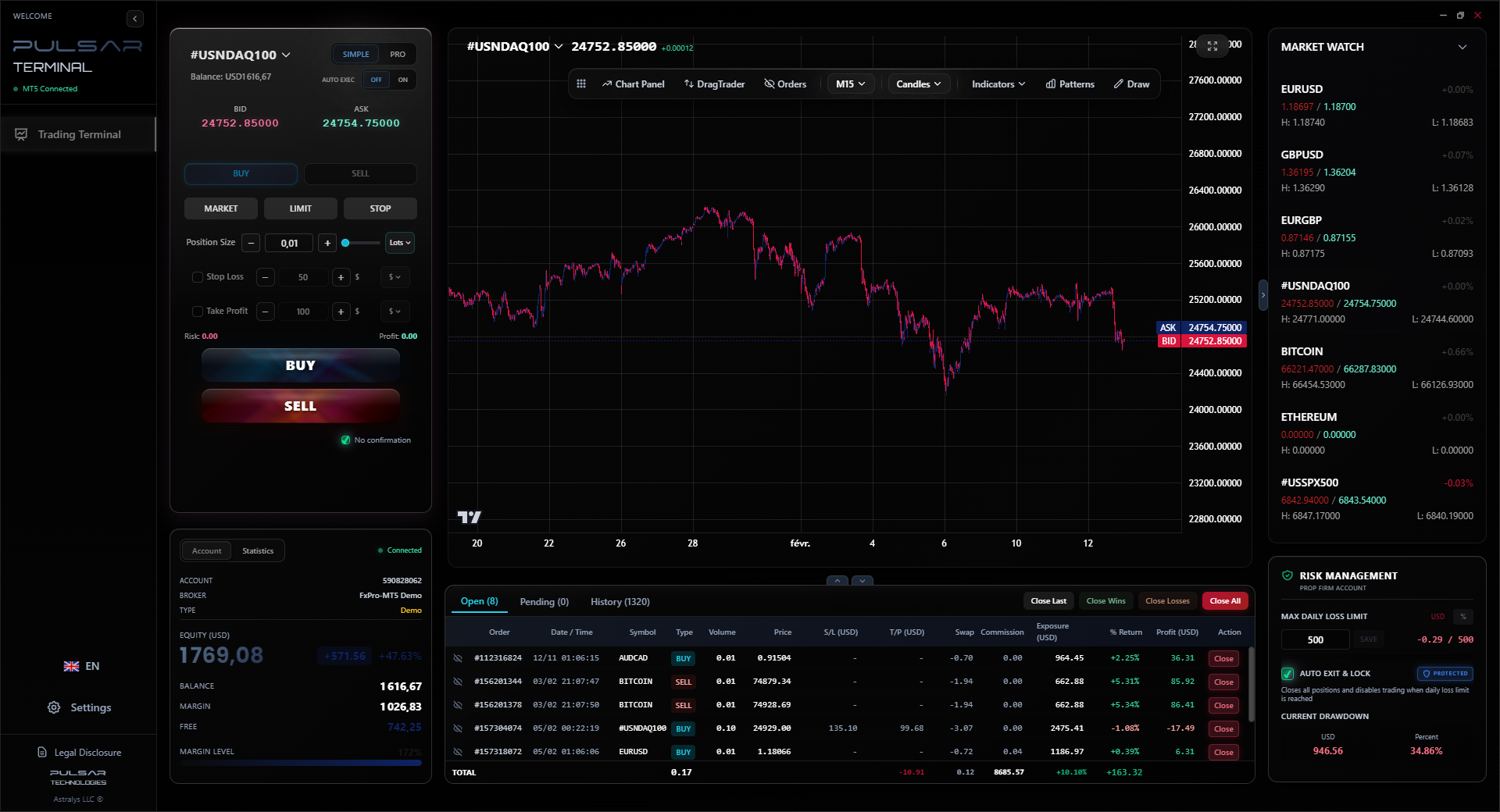
Managing multiple profit targets and a trailing stop based on ADX levels is complex manually, but Pulsar Terminal automates this directly on your MT5 platform, letting you focus on finding the next setup.
Pulsar Terminal
The all-in-one MT5 companion: drag-and-drop orders, multi-TP/SL, trailing stop, grid trading, Volume Profile, and prop firm protection. Used by 1,000+ traders daily.
“Your intraday profits are taxed as Speculative Business Income. If you're in the 30% slab, nearly a third of your net profit goes to taxes before you see it.”
Let's walk through a real hypothetical trade from last week, with all the Indian context.
Instrument: Reliance Industries Futures. Time: 11:00 AM. Chart: 5-minute, ADX(10), 20 EMA, Volume.
Step 1: The Setup. Price has been grinding sideways between ₹2,950 and ₹2,970 for 90 minutes. The ADX has been flatlining between 16 and 18 (no trend). Volume is average.
Step 2: The Trigger. At 11:05, a large green candle breaks above ₹2,970 on above-average volume. I immediately check the ADX. It has jumped to 22 and is pointing sharply up. The +DI line is at 25 and the -DI line is at 18, with +DI clearly on top. Price is now above the rising 20 EMA.
Step 3: Entry & Risk. This is an ADX Breakout setup. I enter a long at ₹2,972. My stop-loss goes at ₹2,965 (just below the consolidation range and the EMA), risking ₹7 per share. For 100 shares, that's ₹700 risk. My capital is ₹2 lakh, so this risk is 0.35% - acceptable. I use my position size calculator to confirm this instantly.
Step 4: Management. The trend continues. By 11:30, ADX hits 32. I move my stop to breakeven (₹2,972). At 12:00, ADX hits 40 and price is at ₹2,990. I take 50% of my position off, booking ₹18 profit per share on 50 shares (₹900). I leave the rest running.
Step 5: Exit. At 1:15 PM, I notice the ADX has peaked at 43 and is now curling down to 41, even though price is making a slight new high at ₹2,993. This is a classic momentum divergence. The +DI and -DI lines are also starting to converge. I exit my remaining position at ₹2,992. Total profit: ₹900 (first half) + ₹1,000 (second half) = ₹1,900. Minus brokerage, taxes, and fees (~₹120), net is ~₹1,780.
This is how to use the ADX indicator for day trading: as a filter for strength, a guide for entry, and a warning bell for exit. It's not the star of the show, but the most important supporting actor.
FAQ
Q1What is the best ADX setting for day trading in India?
For Indian intraday markets on 3-min to 15-min charts, I use an ADX period of 10. It's responsive enough to catch intraday momentum without being too jumpy. The default 14 is better for longer-term analysis like swing trading.
Q2Can I use the ADX alone for trading?
Absolutely not. That's a recipe for disaster. The ADX only measures strength. You must combine it with something to determine direction (like moving averages or the +DI/-DI lines) and something for timing/confirmation (like price action at support/resistance or volume).
Q3Is a high ADX always good for trading?
Not always. A very high ADX (above 50) often indicates a trend that is mature and may be nearing exhaustion. It's great if you're already in the trade, but it can be risky to enter new positions at extremes, as a sharp reversal (and subsequent margin call risk) is possible.
Q4How do I avoid false signals with the ADX?
Two main filters: 1) Only act on signals when the ADX is above 25 (for trends) or below 20 (for anticipating breakouts). 2) Ensure the price action confirms the signal - a +DI crossover should happen during a clear up-move, not while price is stuck at resistance.
Q5Does the ADX work for scalping?
It can, but you need to adjust. On a 1 or 2-minute chart, use a lower period like 7 or 8. Signals will be frequent and noisy, so your risk management must be impeccable - tiny stop-losses and quick profit-taking. It's a high-stress approach.
Q6What's the biggest mistake beginners make with the ADX?
They see a +DI crossover and buy immediately, ignoring the ADX value. If the crossover happens while ADX is low (say, 18), it's almost always a fake move in a choppy, trendless market. Always check the trend strength first.
Prof. Winston's Lesson
Key Takeaways:
- ✓ADX measures trend strength, not direction. Use +DI/-DI or a moving average for direction.
- ✓Only trade trend signals when ADX > 25. Below 20, the market is choppy and treacherous.
- ✓In India, direct costs eat ~0.55% of turnover. Your edge must overcome this friction.
- ✓Combine ADX with RSI or price action. Never use it as a standalone signal generator.
- ✓Exit when ADX curls down from above 40, even if price is making new highs.
How useful was this article?
Click a star to rate
Weekly Trading Insights
Free weekly analysis & strategies. No spam.
About the Author
Rajesh Sharma
Senior Forex Analyst
Trading Indian and South Asian markets for over 10 years. Started with NSE currency derivatives before moving to international forex. Specializes in USD/INR and emerging market pairs.
Comments
Risk Disclaimer
Trading financial instruments carries significant risk and may not be suitable for all investors. Past performance does not guarantee future results. This content is for educational purposes only and should not be considered investment advice. Always conduct your own research before trading.
You Might Also Like

Cara Trading Forex Sukses: 7 Prinsip dari Trader Profesional
Cara trading forex sukses dengan 7 prinsip trader pro: manajemen modal, disiplin, journal trading, backtest. Data nyata, bukan janji profit palsu.
Jam Trading Forex Terbaik untuk Trader Indonesia: Panduan Lengkap dengan Tabel Waktu
Panduan jam trading forex untuk trader Indonesia. Tabel 4 sesi dunia, jam emas 20:00-00:00, sesi mana yang harus dihindari. Data akurat + tips dari trader berpengalaman.
Top 5 Sàn Forex Uy Tín Nhất 2026: Review Jujur dari Trader Indonesia
Top 5 sàn forex uy tín 2026 untuk trader Indonesia. Review jujur: spread, deposit, withdraw, dukungan lokal. Exness, XM, IC Markets & lebih.
Get Pulsar Terminal
All these calculators are built into Pulsar Terminal with real-time data from your MT5 account. One-click position sizing, automatic risk management, and instant calculations.
Get Pulsar Terminal