


Let's cut through the noise.

David van der Merwe
Emerging Markets Trader ·  South Africa
☕ 13 min read
What you'll learn:
- 1Regulation & Safety: Where IBKR Really Stands in SA
- 2The Real Costs: It's Not Just About the Spread
- 3Platforms & Tools: Overwhelming Power
- 4Account Funding in ZAR: The Practicalities
- 5Who Should (And Shouldn't) Use IBKR for Forex
- 6The Tax Implications for South Africans
- 7How IBKR Stacks Up Against Local Alternatives
- 8Getting Started: A Step-by-Step Reality Check
Let's cut through the noise. For most South African retail traders dreaming of tight spreads and direct market access, Interactive Brokers (IBKR) is a terrible fit. It's like using a Formula 1 car to run errands in Sandton – powerful, but you'll probably crash before you get to the mall. I've seen too many locals get dazzled by the low fees, only to get chewed up by a platform built for institutions, not for someone trading EUR/ZAR from their couch in Cape Town. But, if you're a specific type of trader, it can be the only game in town. I'll prove why, and show you exactly who should – and absolutely shouldn't – use Interactive Brokers Forex.
This is the first point of confusion, so let's clear it up. Interactive Brokers LLC, the main entity, is not regulated by our Financial Sector Conduct Authority (FSCA). For many, that's an immediate red flag. But here's the nuance: they don't need to be. They're regulated by some of the toughest watchdogs on the planet – the US SEC and CFTC. For South African clients, they often onboard through Interactive Brokers Ireland Limited, which is regulated by the Central Bank of Ireland under MiFID rules.
What does this mean for you? Protection, but of a different flavor. Your funds are segregated. In the US, accounts have SIPC protection (up to $500,000 for securities). The safety standards are higher than many FSCA-regulated brokers. The catch? Your recourse is international. Got a complaint? You're dealing with Irish or American procedures, not popping into the FSCA's offices in Pretoria.

Warning: Just because IBKR is reputable doesn't mean every 'international' broker is. Many offshore buckets shops target South Africans with fake 'regulation'. IBKR's pedigree is the real deal, but always verify a broker's actual licensed entity.
I once had a client who insisted on only FSCA brokers after a bad experience. I showed him the capital requirements and client money rules for a top-tier EU broker versus a local one. He was shocked. The international framework was stricter. IBKR operates in that world. So, while you miss the local comfort of the FSCA, you're getting a globally recognized standard of safety. It's a trade-off, but for sophisticated traders, it's often a worthwhile one. If you want the local hand-holding, you might prefer an FSCA-regulated broker like XM or Pepperstone.
Everyone talks about IBKR's low costs. They're right, but you need to understand how they charge. This isn't a 'spread-only' broker like many you're used to.
Forex Pricing Structure: IBKR primarily uses a tiered commission model for forex. You pay a tiny commission per million currency units traded, and you get the raw interbank spread. For a major pair like EUR/USD, the spread might be 0.1 pips, and you'd pay a commission of about $2.00 per $1 million traded. For a standard lot ($100,000), that's about $0.20 in commission. Sounds cheap, right? It is.
But let's translate that to your ZAR pairs. Trading USD/ZAR or EUR/ZAR? The liquidity is lower. The spread might be wider naturally (10-30 pips isn't unusual), and the commission still applies. Your total cost is spread + commission. For a scalping strategy on these pairs, this model can still be competitive, but you must calculate it.
The Hidden (And Not-So-Hidden) Fees:
- Inactivity Fees: This is a big one for casual traders. If you don't generate enough in commissions each month (around $10), you'll pay a monthly inactivity fee. For a part-time trader, this can eat you alive.
- Data Fees: Want real-time data for the JSE, or specific forex feeds? You'll likely pay for it. These can be waived if your commissions are high enough, but for the average Joe, it's an extra cost.
- Currency Conversion: Funding your account in ZAR? IBKR will convert it to your base currency (e.g., USD) at a spot rate plus a tiny markup. It's very fair, but it's a cost.

Example: Let's say you trade 5 standard lots of EUR/USD in a month. Commission: 5 lots * $100,000 * $2/$1,000,000 = $1.00 total commission. You're now $9 short of the $10 minimum to avoid the inactivity fee. If you don't trade more, you'll get hit with a $10 fee. Your 'low cost' trading just cost you $9 net.
I learned this the hard way early on. I opened an account, traded a few times, got distracted by other markets. Three months later, I'd been charged $30 in inactivity fees for doing nothing. My own fault for not reading the fine print, but it's a classic trap for the unwary.
“The inactivity fee isn't just a charge; it's a filter designed to keep casual traders off a professional-grade platform.”
This is IBKR's greatest strength and its biggest barrier to entry. Forget MetaTrader's relative simplicity. You're stepping into Trader Workstation (TWS).
Trader Workstation (TWS): A Love/Hate Relationship TWS looks like it was designed by engineers in the 90s (because it was). The learning curve is vertical. We're talking hundreds of windows, complex order types, algorithmic trading suites, and a interface that will make you weep for the first week. But once you learn it... oh boy.
You have direct market access. You can see the order book. You can create complex, multi-leg option strategies (if you trade forex options). You can program your own trading bots in Java or Python. The charting is functional but not beautiful. It's a tool for execution and analysis, not for pretty drawings.
The Mobile App & Other Platforms: Their mobile app, IBKR Mobile, is actually pretty good for monitoring and basic trades. They also have a web platform called Client Portal which is more user-friendly. But if you want the real power, you need TWS.
The South African Reality Check: Are you a full-time trader or fund manager running complex strategies? TWS is your paradise. Are you a retail trader who checks charts on your phone and wants to place a quick trade? TWS will destroy your will to live. Most South Africans I know who tried IBKR for forex quit because of the platform. They missed the simplicity of MT4/MT5, where setting a trailing stop is two clicks. In TWS, it's a configuration menu.

Pro Tip: If you commit to IBKR, spend your first week on a paper trading account. Don't even think about real money. Learn how to place a basic limit order, attach a stop-loss, and modify a position. It's not intuitive, but it's mandatory.
For most, the sheer power is overkill. I use TWS for my equity and options trading, but for pure forex swing trading, I often find myself using other platforms connected to IBKR's API or just using a different broker altogether for its simplicity.

💡 Winston's Tip
If you can't explain how to place a bracket order (entry, stop-loss, take-profit) in TWS with your eyes closed on a demo account, you have no business trading real money on it yet.
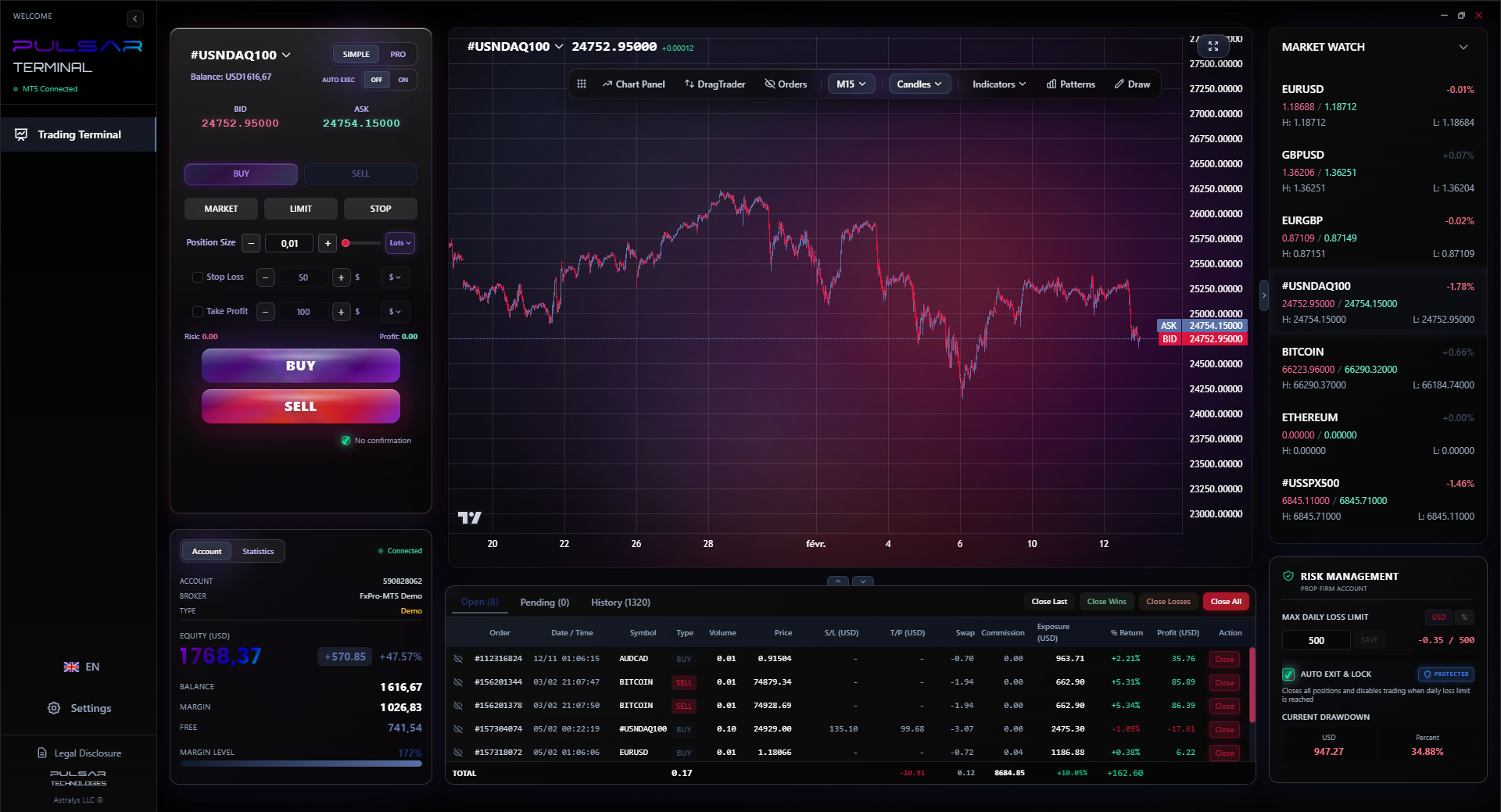
If you find TWS's order management clunky for forex, tools like Pulsar Terminal bring advanced drag-and-drop orders and multi-take-profit systems to the MT5 platform you might prefer.
Pulsar Terminal
The all-in-one MT5 companion: drag-and-drop orders, multi-TP/SL, trailing stop, grid trading, Volume Profile, and prop firm protection. Used by 1,000+ traders daily.
Can you fund in Rands? Yes. Is it seamless? Mostly.
IBKR allows you to hold a ZAR cash balance. You can make a local EFT (Electronic Funds Transfer) directly into their South African bank account (they have one with FirstRand Bank, for instance). This is huge. No need for international wire transfers with their hefty bank fees.
The Process:
- Initiate a deposit from your IBKR account management page.
- You'll get IBKR's local South African banking details and a unique reference number.
- Make an EFT from your SA bank account using those details.
- Funds typically reflect in 1-2 business days.
The Conversion Catch: If you deposit ZAR but want to trade USD-based pairs (like most forex pairs), you need to convert your ZAR to USD. IBKR's currency converter is excellent and offers spot rates with a minuscule markup. It's one of the cheapest ways to convert currency globally. But you must remember to do it. You can't just buy EUR/USD with your ZAR balance; the platform will automatically convert at trade time, which is fine, but it's good to be aware.
Withdrawals: Just as easy. Request a withdrawal in ZAR to your linked SA bank account. It's a local EFT back to you.
This local banking facility is a massive advantage over many other international brokers and eliminates a major headache for South African traders. It's one of IBKR's most underrated features for our market.
“If you're not using at least two of IBKR's advanced features, you're paying for a Ferrari to only ever drive in first gear.”
Let's be brutally honest.
You SHOULD use Interactive Brokers Forex if:
- You're a professional or semi-professional trader with a significant account size (think $20,000+).
- You trade multiple asset classes (stocks, options, futures) and want everything in one account. IBKR shines as a unified hub.
- You need direct market access and complex order types for your strategies.
- You are algorithmic or systematic in your approach and will use the API.
- You trade frequently enough to easily waive the monthly minimums in commissions.
- You are comfortable with technical complexity and have the patience to learn TWS.
You should AVOID Interactive Brokers Forex if:
- You are a beginner. Just don't. It's a surefire way to lose money confused.
- You are a casual or part-time retail trader who places a few trades a month. The inactivity fee will eat your lunch.
- You only trade forex and love the MetaTrader environment. You're paying for a Ferrari to only ever drive in first gear.
- You need a lot of hand-holding or prefer simple, modern charting interfaces.
- Your primary strategy relies heavily on community scripts or indicators specific to MT4/MT5.
My personal rule? If you're not using at least two of IBKR's advanced features (like smart routing, complex options, or the API), you're probably better off with a dedicated forex broker. For pure forex, I've found brokers like IC Markets offer a better experience on MT5 with raw spreads and no fuss. But when I'm trading a macro view – going long Aussie equities, short AUD/JPY as a hedge, and selling options on the side – IBKR is the only platform that lets me manage that whole portfolio on one screen.
💡 Winston's Tip
That $10 monthly minimum commission isn't a fee, it's a test. If your trading activity can't cover a cheap lunch for the broker each month, you're not their target client. Be honest with yourself.
This is critical. Trading with an offshore broker like IBKR doesn't make you tax-exempt. SARS still wants its share.
Dividend Tax: As mentioned in the briefing, IBKR will withhold 15% US dividend tax at source for US stocks. You can claim this as a foreign tax credit in South Africa. Because of the Double Taxation Agreement (DTA), your effective SA tax on those dividends is 20%, so you may owe SARS an additional 5%. You must declare this.
Forex Trading Profits: This is where most traders get tripped up. Profits from forex trading are generally considered revenue in nature by SARS, not capital. This means they are added to your other income (salary, business income) and taxed at your marginal income tax rate (up to 45%).
You cannot use the capital gains tax (CGT) exclusion for individuals (R40,000 annual exclusion) for typical forex trading. If you're trading frequently, SARS will see it as a business. You need to keep careful records: a trade journal with entry/exit prices, dates, profit/loss in ZAR.
Converting to ZAR: You must convert all your profits and losses to Rand using the spot rate on the day of the transaction. IBKR's reports can help, but they won't do this for you automatically. You need to calculate your total net profit/loss in ZAR for the tax year (March to February).
I'm not a tax advisor, but I've been through audits. My advice: get a proper accountant who understands forex trading. The few thousand Rand it costs will save you a world of pain. Trying to explain your IBKR statement to a confused SARS auditor is not a fun way to spend an afternoon.
“Trying to explain your IBKR statement to a confused SARS auditor is not a fun way to spend an afternoon.”
Let's put it in a table for clarity. This is based on the typical retail forex trader's needs.
| Feature | Interactive Brokers (IBKR) | Typical FSCA-Regulated Broker (e.g., Pepperstone, FXTM) |
|---|---|---|
| Primary Regulation | US SEC/CFTC, EU MiFID | FSCA (South Africa) |
| Platform | Trader Workstation (TWS) - Complex | MetaTrader 4/5, cTrader - User-Friendly |
| Forex Pricing | Commission + Raw Spread | Mainly Spread-Only, or Commission + Raw Spread |
| Min. Deposit | Low or None | $50 - $500 common |
| Inactivity Fee | Yes (if under min. commissions) | Often No |
| Local ZAR Support | Yes (Local EFT) | Yes (Local EFT, Credit Card) |
| use on Forex | Based on entity (e.g., 50:1 for EU) | Determined by broker, can be high (e.g., 500:1) |
| Best For | Multi-asset pros, algorithmic traders | Retail forex specialists, beginners, MT4/5 lovers |
| Worst For | Beginners, casual traders | Traders needing stocks/options in same account |
The Verdict: If forex is your side gig or main retail activity, an FSCA broker is usually the smoother path. You get local support, familiar platforms, and structures designed for retail. If trading is your serious business and you're diversifying into global markets, IBKR's strengths become overwhelming. The choice isn't about which is 'better,' but which is better for you. Don't get ego-driven into using a 'pro' platform if your needs are simple. I've made that mistake, chasing prestige over practicality. Use the right tool for the job.
💡 Winston's Tip
Your first withdrawal request is a good systems check. Do it with a small amount first. If it hits your SA bank account in 48 hours, you've mastered the basics. Then scale up.
If you've read this far and still think IBKR is for you, here's your roadmap. This isn't a sales pitch, it's a survival guide.
- Open the Account: Go to the Interactive Brokers website. The application is detailed. They'll ask about your trading experience, income, net worth. Be honest. This is a regulated entity; they're not messing around. You'll need your SA ID, proof of residence (utility bill), and bank details.
- Fund It: Once approved, use the local EFT method I described. Start with a smaller amount than you plan to use. Get comfortable first.
- The Paper Trading Phase (NON-NEGOTIABLE): Log into TWS. Find the paper trading mode. Spend at least 10 hours in it. Learn to: place a market order, a limit order, attach a stop-loss (not a simple task in TWS!), modify an order, and close a position. Find the forex quote window. It's not obvious.
- Configure Your Workspace: TWS is all about custom layouts. Build a simple one: a chart, an order entry ticket, and your portfolio window. Save it. This will be your lifeline.
- Start Small for Real: When you go live, trade sizes that are laughably small. Your goal is not to make money on this first trade, but to successfully execute the mechanics without a margin call due to a misclick.
- Use the Resources: IBKR has a vast library of tutorials and webinars. They are dry but essential. Watch the ones on TWS basics and forex trading.
Remember, the goal in the first month is not profitability. It's operational competence. I funded my first IBKR account with $5,000. My first ten trades were all 0.01 lots (micro lots). I lost on a few, won on a few, but more importantly, I learned how the machine worked without blowing up the engine. That patience is the price of admission to one of the most powerful trading platforms in the world.
FAQ
Q1Is Interactive Brokers legal for South African residents?
Yes, it is completely legal. Interactive Brokers actively accepts clients from South Africa. They are regulated by top-tier international authorities like the US SEC and the Irish Central Bank, which provides a legal framework for offering services globally, including to South Africans.
Q2What is the minimum deposit for a South African?
There's no official universal minimum, but for most individual accounts, you can start with a relatively small amount. In practice, due to the complexity and potential fees, I wouldn't recommend opening an account with less than $2,000 (approx. R40,000). This gives you enough buffer to trade sensibly and absorb the learning curve without being wiped out by small mistakes or fees.
Q3Can I trade USD/ZAR on Interactive Brokers?
Yes, you can. USD/ZAR is available for trading. Remember, you'll be trading on the raw interbank spread plus a small commission. Liquidity can vary, so spreads may be wider than for majors like EUR/USD. Always check the live market depth in TWS before placing a large order.
Q4How do I avoid the monthly inactivity fee?
Generate at least $10 (or equivalent) in monthly commissions. This means you need to be trading actively enough that the broker's cut from your trades adds up to ten bucks. For a casual trader, this can be a significant hurdle. If you're not hitting this, the fee will be automatically deducted from your cash balance.
Q5Is MetaTrader 4 or 5 available on Interactive Brokers?
No, not directly. Interactive Brokers does not support the MetaTrader platform suite. Their flagship platform is Trader Workstation (TWS). They do offer a web-based platform and mobile apps, but the full power - and complexity - is in TWS. If MT4/5 is essential to your strategy, IBKR is not the right broker for you.
Q6How are my funds protected with Interactive Brokers?
Client funds are held in segregated accounts at top-tier global banks. For the US entity, securities accounts are protected by SIPC up to $500,000. More importantly, their regulatory requirements (SEC, CFTC, MiFID) mandate strict daily segregation and reporting of client assets, which is a strong form of protection. This is different from the FSCA's guarantee funds but is considered a very high standard.
Q7What's the biggest mistake South Africans make with IBKR?
Underestimating the platform. They see the low costs and prestigious name, fund an account, log into TWS, and freeze. They then either blow up their account trying to figure it out under pressure or give up and eat the inactivity fees. The mistake is not doing the paper trading homework first. Respect the learning curve.
Prof. Winston's Lesson
Key Takeaways:
- ✓IBKR's $10 monthly minimum commission is a hard filter for casual traders.
- ✓Spend 10+ hours in paper trading on TWS before risking a single cent.
- ✓Forex profits are revenue, not capital gains, for SARS. Tax at up to 45%.
- ✓Use IBKR's local ZAR EFT for deposits/withdrawals to save on bank fees.
- ✓If you only trade forex, a dedicated MT5 broker is almost always a better fit.
How useful was this article?
Click a star to rate
Weekly Trading Insights
Free weekly analysis & strategies. No spam.
About the Author
David van der Merwe
Emerging Markets Trader
Johannesburg-based trader with 11 years in emerging market currencies. Specializes in ZAR pairs, FSCA-regulated trading, and South African market analysis.
Comments
Risk Disclaimer
Trading financial instruments carries significant risk and may not be suitable for all investors. Past performance does not guarantee future results. This content is for educational purposes only and should not be considered investment advice. Always conduct your own research before trading.
You Might Also Like

Cara Trading Forex Sukses: 7 Prinsip dari Trader Profesional
Cara trading forex sukses dengan 7 prinsip trader pro: manajemen modal, disiplin, journal trading, backtest. Data nyata, bukan janji profit palsu.
Jam Trading Forex Terbaik untuk Trader Indonesia: Panduan Lengkap dengan Tabel Waktu
Panduan jam trading forex untuk trader Indonesia. Tabel 4 sesi dunia, jam emas 20:00-00:00, sesi mana yang harus dihindari. Data akurat + tips dari trader berpengalaman.
Top 5 Sàn Forex Uy Tín Nhất 2026: Review Jujur dari Trader Indonesia
Top 5 sàn forex uy tín 2026 untuk trader Indonesia. Review jujur: spread, deposit, withdraw, dukungan lokal. Exness, XM, IC Markets & lebih.
Get Pulsar Terminal
All these calculators are built into Pulsar Terminal with real-time data from your MT5 account. One-click position sizing, automatic risk management, and instant calculations.
Get Pulsar Terminal