


Let's cut through the noise.

Sarah Collins
Trading Strategist ·  Australia
☕ 10 min read
What you'll learn:
- 1The ASIC Rulebook: Your Trading Bible
- 2use Limits & Negative Balance Protection: Your Safety use
- 3The Real Cost of Trading in Australia
- 4How to Pick an ASIC-Regulated Broker (The Right Way)
- 5Trading the AUD: Local Knowledge is Power
- 6The ATO is Watching: Tax & Record Keeping
- 7Classic Aussie Trader Mistakes (I've Made Most)
Let's cut through the noise. The biggest risk to your trading account in Australia isn't a bad trade, it's your own ignorance of the rules. I've seen too many 'traders' blow up because they didn't understand the legal cage they were operating in. Yes, forex trading is 100% legal here, but ASIC has built one of the world's toughest playgrounds. This isn't the wild west. It's a highly regulated financial market with traps designed to protect you from yourself, and from dodgy operators. I'll walk you through exactly what that means for your money, your strategy, and your chances of survival.
Forget everything you've heard from offshore broker ads. In Australia, the game is governed by the Corporations Act 2001, with the Australian Securities and Investments Commission (ASIC) as the head referee. Their job isn't to help you make money, it's to ensure the market isn't rigged and you don't get completely fleeced.
Think of an Australian Financial Services License (AFSL) as a broker's passport to operate here. No AFSL? They're illegal. It's that simple. This license forces brokers to meet insane standards: they need at least $1 million in operating capital (so they don't go bust with your cash), and by law, your money must be kept in segregated accounts at top-tier banks. If the broker collapses, your funds are theoretically safe. I say theoretically because the system is strong, but never get complacent.
The Real Cost of Protection
These rules come with trade-offs. The transparency and safety mean brokers have higher compliance costs. You might pay slightly higher spreads or commissions compared to some unregulated offshore havens. But ask yourself: is saving 0.1 pip worth the risk of your broker vanishing overnight? I learned this lesson early. I once chased 'zero spread' with a sketchy offshore firm. The spread was zero, until it wasn't, and my stop-loss was magically ignored during a news event. That $500 lesson was cheap, in hindsight.
ASIC's power is real. They monitor everything from misleading ads to how brokers handle your orders. They've shut down operations for providing inappropriate advice. This framework is why Australia is considered a global safe haven for retail traders. You're playing on a field where the grass is cut and the lines are painted, but the game is just as hard to win.
“The biggest risk to your trading account in Australia isn't a bad trade, it's your own ignorance of the rules.”
This is where ASIC really flexes its muscles. In March 2021, they slammed the door on the crazy use days. If you're a retail client, your maximum use is now capped. Here’s the breakdown:
| Instrument Type | Maximum use | Effective Margin Required |
|---|---|---|
| Major Forex Pairs (e.g., EUR/USD) | 30:1 | 3.33% |
| Minor Forex Pairs, Gold, Major Indices | 20:1 | 5% |
| Other Commodities (Oil, etc.) | 10:1 | 10% |
| Shares (Stocks) | 5:1 | 20% |
| Crypto Assets | 2:1 | 50% |
These rules are a gift and a curse. The curse is obvious: you can't throw $1,000 on a trade and control a $100,000 position anymore. That dream of a 1000-pip move making you rich overnight is dead. The gift? It forces you to trade with proper position size calculator discipline. You can't accidentally over-use yourself into a margin call with one click.

Warning: These limits are for retail clients. If you qualify as a 'wholesale client' (over $2.5 million in net assets or $250k annual income), you can access higher use. But with great power comes great responsibility, and far less regulatory protection. Don't chase this status unless you truly understand the risks.
The other huge rule is Negative Balance Protection. This is non-negotiable. It means you can never lose more than the balance in your account. If your trade goes catastrophically south, your account hits zero, not negative $10,000. The broker absorbs the loss. This alone makes trading in Australia infinitely safer than in jurisdictions without this rule. I've had trades gap through my stop on weekend opens. In Australia, my account went to zero. A friend with an offshore broker got a nasty email demanding he cover a negative balance. Guess who slept better?

💡 Winston's Tip
The 30:1 use cap isn't a limit, it's a teacher. It forces you to build a strategy that doesn't rely on a financial sledgehammer. A precise scalpel is more effective.
“Negative Balance Protection means you can lose your shirt, but the broker can't come for your pants too.”
Let's talk numbers. Your profit isn't just about being right on direction, it's about overcoming the costs. In Australia, the main costs are spreads, commissions, and swap fees.
Spreads on majors like the EUR/USD guide are tight. A top-tier broker like Pepperstone review or IC Markets review might offer an average spread of 0.1 pips on the EUR/USD on their raw accounts, but you'll pay a commission per lot. For the AUD/USD, the average might be 0.3 pips. That's the cost of entry.

Example: You buy 1 standard lot (100,000 units) of AUD/USD at a 0.3 pip spread. The cost is 0.00003 (3 pips) * 100,000 = AUD 3.00. On a $10,000 account, that's 0.03% gone before the trade even moves.
Overnight financing (swap) is calculated based on the interest rate differential between the two currencies, plus the broker's admin fee. Holding a long AUD/JPY position overnight pays or costs you depending on the rate difference. If you're a swing trading holding for weeks, this adds up.
Bonuses? Forget them. ASIC banned all financial inducements - deposit bonuses, prize draws, you name it - for CFD products. This is brilliant. It removes the temptation to sign up with a rubbish broker just for a $100 bonus that has impossible withdrawal conditions. Your choice of broker should be based on execution, costs, and platform, not a cheap lure.
“Negative Balance Protection means you can lose your shirt, but the broker can't come for your pants too.”
With over 100,000 Aussies trading, the broker market is crowded. Here’s my blunt filter. First, verify the AFSL number on the broker's website, then cross-check it on ASIC's professional registers (Moneysmart website). If it's not there, walk away.
Look at the practical stuff:
- Platform: Do they offer MT4/MT5, cTrader, or TradingView? Your strategy might depend on specific tools. I'm an MT5 guy, so I lean towards brokers like IC Markets review that support it natively.
- Fees: Is it a commission-based raw spread account, or a wider spread with no commission? Do the math for your typical trade size. Scalping strategy needs ultra-low costs; a swing trader can tolerate slightly more.
- Deposits/Withdrawals: They should support PayID, BPAY, and bank transfers. All funds must come from an account in your name. Third-party payments are a red flag for money laundering and will be rejected.
- Customer Service: Call them. See how long it takes to get a real person in your timezone.
I made a mistake years ago picking a broker solely for their fancy charting tools. The execution was slow, and my fills were terrible. I lost more on slippage than I ever gained from the charts. Now, execution quality is my number one criteria. A broker like Pepperstone review has built a reputation for this.

Pro Tip: Open a demo account and test the execution during a volatile period (like the US open). Place market orders and see the slippage. That demo will tell you more than any sales brochure.
💡 Winston's Tip
Your first call to a potential broker shouldn't be to sales. It should be to the support desk with a technical question. Their speed and knowledge tell you everything about how they'll handle a real problem.
“Moaning about the 30:1 use limit is a sign of a weak strategy. Good traders don't need 500:1.”
You're trading from Australia. The AUD is in your blood, your economy. Use that. The Aussie dollar is a commodity currency. Iron ore, coal, and gas prices move it. China's economic health moves it. The RBA's tone moves it. This is your home-field advantage.
Pairs like AUD/USD and XAU/USD guide (Gold, often traded against the USD) are heavily influenced by these factors. When the RBA sounds hawkish, the AUD often strengthens. When Chinese PMI data disappoints, it often weakens. I once caught a 150-pip rally on AUD/JPY simply by listening to an RBA governor speech and hearing a shift in language the algorithms hadn't fully priced in yet. That's an edge.
Your trading hours also matter. The Asian session (Sydney/Tokyo) can see good movement in AUD and JPY pairs. The EUR/USD guide might be quieter then. Align your strategy with the market's rhythm. Don't try to scalp the EUR/USD at 3 AM Sydney time expecting big volume.
Payment methods are a local perk. Using PayID, your deposit is often instant and free. Withdrawal to an Australian bank account is usually next business day. This operational ease matters when you need to move money.
Remember, the AUD is the 7th most traded currency globally. It's liquid, it's volatile, and it's yours to understand better than a trader sitting in London or New York. Don't waste that insight.
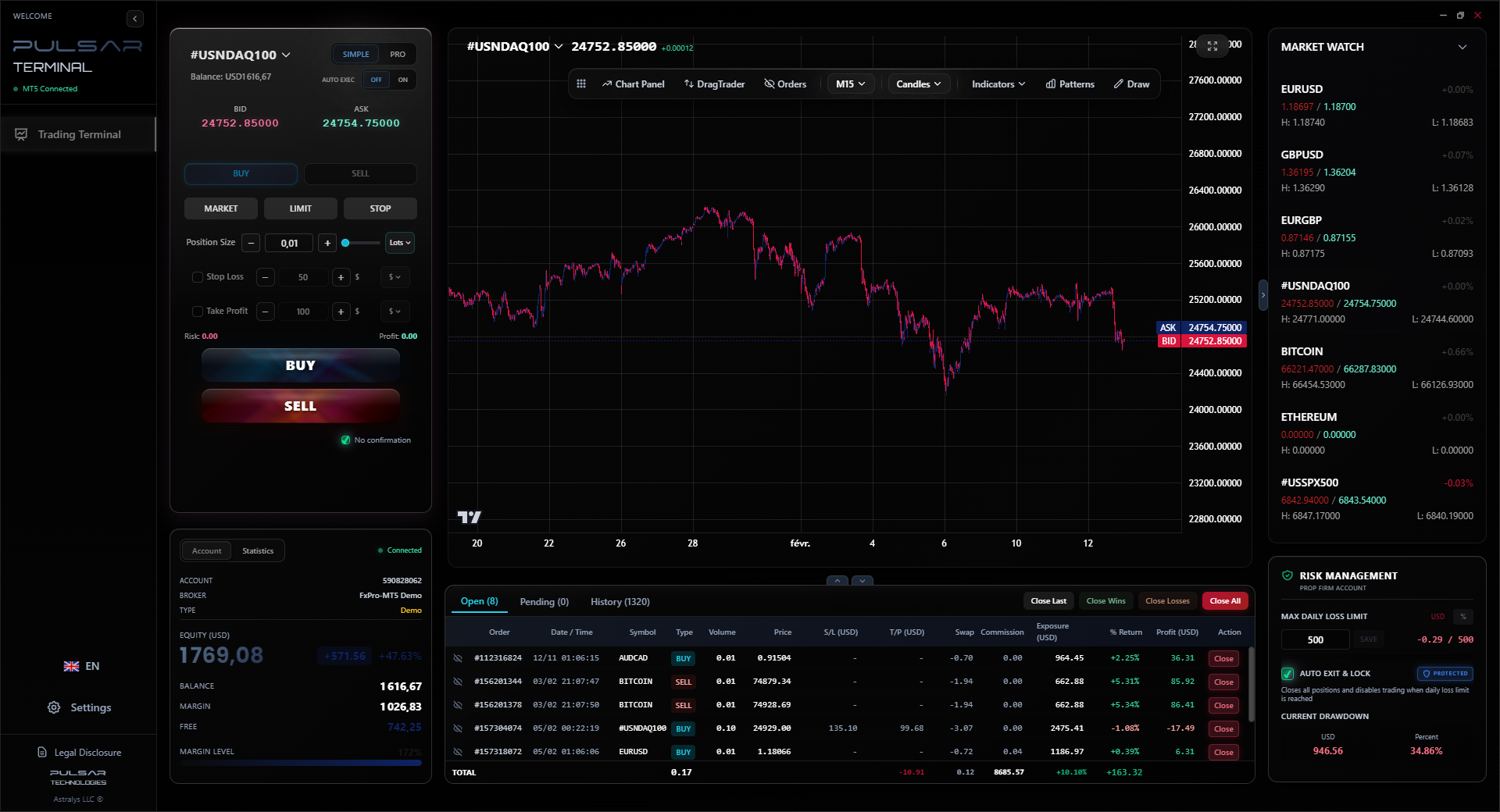
When trading volatile pairs like the AUD, managing multiple take-profit levels and trailing stops manually is a headache; Pulsar Terminal automates this directly on your MT5 platform.
Pulsar Terminal
The all-in-one MT5 companion: drag-and-drop orders, multi-TP/SL, trailing stop, grid trading, Volume Profile, and prop firm protection. Used by 1,000+ traders daily.
“Moaning about the 30:1 use limit is a sign of a weak strategy. Good traders don't need 500:1.”
Here's the part everyone hates, but it's non-negotiable. Forex trading profits are considered taxable income by the Australian Taxation Office (ATO). Losses are generally deductible. You're running a business, even if it's from your kitchen table.
You need to keep careful records for five years:
- A trading journal (entry/exit price, date, time, instrument, pip definition gain/loss).
- Broker statements (every single trade confirmation).
- Bank records for all deposits and withdrawals.
- Records of any interest (swap) paid or received.
I use a simple spreadsheet. Column A: Date. Column B: Pair. Column C: Long/Short. Column D: Entry Price. Column E: Exit Price. Column F: Pips. Column G: Profit/Loss (AUD). At tax time, I just sum Column G. My accountant does the rest.
The ATO looks for patterns. Are you genuinely trying to make a profit (a trader), or are you just speculating occasionally (an investor)? The tax treatment can differ. If you're trading frequently, using technical analysis, and treating it like a business, you're likely a trader. Keep a log of your market analysis, too - it helps prove your intent.
Don't try to hide it. The ATO has data-matching agreements with brokers. It's not worth the stress or the penalties. Factor tax into your profit targets. If you aim for a 10% annual return, remember a chunk of that goes to the tax man. Plan for it.
💡 Winston's Tip
Set up your tax spreadsheet on day one. Log every trade, even the losers. The discipline of record-keeping will improve your trading psychology more than any indicator.
“The ATO has data-matching agreements with brokers. It's not worth the stress or the penalties.”
Let me save you some pain and money. Here are the traps I see Aussies fall into every day.
- Chasing Offshore 'High use': The number of emails I get for '500:1 use!' is a joke. The moment you sign up with an unregulated broker in Cyprus or the Seychelles, you surrender all the protections we just discussed. No negative balance protection, no segregated funds, no ASIC to complain to. The spread definition might be great until they manipulate it during news.
- Ignoring the use Caps: Moaning about the 30:1 limit on majors is a sign of a weak strategy. Good traders don't need 500:1. They need good risk management. The caps force you to be better.
- Not Understanding the Product: You're not buying actual currency. You're trading a CFD (Contract for Difference) on the price movement. This has implications for overnight costs and expiration. Read the Product Disclosure Statement (PDS). Seriously.
- Over-trading the AUD: Just because you understand it doesn't mean you should trade it every day. Sometimes the best trade is no trade. I've blown weeks of profits forcing AUD/USD trades in a dead market.
- Skipping the Demo: You wouldn't drive a Formula 1 car without practice. Don't trade real money on a new platform or strategy without testing it. Test your entire workflow - analysis, entry, setting stops, exit.
The legal environment in Australia gives you a safe arena. But the opponent - the market - is just as vicious. Use the safety nets, but don't let them make you reckless. Discipline is still king.
FAQ
Q1Is it legal for Australians to use offshore forex brokers?
Technically, yes, you can sign up with an offshore broker. But it's a terrible idea. You voluntarily give up all ASIC protections: no negative balance protection, no guarantee of segregated funds, and no Australian authority to help if you're scammed. You're on your own.
Q2What is the minimum deposit for forex trading in Australia?
It varies by broker. Some, like Fusion Markets, have no minimum. Others might start at AUD 100 or 200. The minimum isn't important. Start with an amount you can afford to lose completely while you learn. $500 is a more realistic learning budget than $50.
Q3Can I get the 30:1 use on crypto CFDs?
No. ASIC's rules are very specific. Crypto CFDs are capped at a maximum of 2:1 use (50% margin). This is because crypto is considered extremely volatile. If you want higher use on crypto, you'd need to use an unregulated offshore broker and accept all the massive risks that come with that.
Q4Do I pay tax on profits from a demo account?
No. The ATO only taxes real, realized profits. Demo trading is practice with virtual money. No real profit, no tax.
Q5How do I know if my broker is truly ASIC-regulated?
Go to the Moneysmart website (run by ASIC) and use their 'Professional Registers' search. Type in the broker's company name or their quoted AFSL number. If they don't appear, or if the AFSL is suspended, they are not legally operating for Australian clients.
Q6Are there any hidden fees with ASIC brokers?
The main fees (spreads, commissions, swap) are disclosed. Watch for inactivity fees (if you don't trade for several months) and potential fees for certain withdrawal methods (like international wire transfers). Always read the fee schedule in the PDS.
Q7Can I trade shares and forex with the same ASIC broker?
Yes, most major ASIC brokers like IG, CMC Markets, and Pepperstone review offer both forex/CFDs and share trading (often as CFDs on shares) from the same account. Remember, use on shares is capped at 5:1.
Prof. Winston's Lesson
Key Takeaways:
- ✓Always verify your broker's AFSL on the ASIC register.
- ✓Maximum retail use on major forex is 30:1 (3.33% margin).
- ✓Negative balance protection is mandatory - you can't owe your broker.
- ✓All trading bonuses and promotions are illegal for CFDs in Australia.
- ✓Keep detailed trade records for the ATO for five years minimum.
How useful was this article?
Click a star to rate
Weekly Trading Insights
Free weekly analysis & strategies. No spam.
About the Author
Sarah Collins
Trading Strategist
London-based trading strategist with 12 years in financial markets. Former analyst at a City of London brokerage. Covers GBP pairs, European markets, and FCA-regulated trading.
Comments
Risk Disclaimer
Trading financial instruments carries significant risk and may not be suitable for all investors. Past performance does not guarantee future results. This content is for educational purposes only and should not be considered investment advice. Always conduct your own research before trading.
You Might Also Like

Cara Trading Forex Sukses: 7 Prinsip dari Trader Profesional
Cara trading forex sukses dengan 7 prinsip trader pro: manajemen modal, disiplin, journal trading, backtest. Data nyata, bukan janji profit palsu.
Jam Trading Forex Terbaik untuk Trader Indonesia: Panduan Lengkap dengan Tabel Waktu
Panduan jam trading forex untuk trader Indonesia. Tabel 4 sesi dunia, jam emas 20:00-00:00, sesi mana yang harus dihindari. Data akurat + tips dari trader berpengalaman.
Top 5 Sàn Forex Uy Tín Nhất 2026: Review Jujur dari Trader Indonesia
Top 5 sàn forex uy tín 2026 untuk trader Indonesia. Review jujur: spread, deposit, withdraw, dukungan lokal. Exness, XM, IC Markets & lebih.
Get Pulsar Terminal
All these calculators are built into Pulsar Terminal with real-time data from your MT5 account. One-click position sizing, automatic risk management, and instant calculations.
Get Pulsar Terminal