


Most traders think they understand key levels.

David van der Merwe
Emerging Markets Trader ·  South Africa
☕ 10 min read
What you'll learn:
- 1What Key Levels Are (And What They're Not)
- 2Trading Key Levels from South Africa: The Local Angle
- 3How to Spot a Strong Key Level (The Checklist)
- 4Entry & Exit Strategies Around Key Levels
- 5Non-Negotiables: Risk Management & The SARS Talk
- 6Your Trading Setup: Tools & Platforms for SA Traders
- 7Pitfalls to Avoid: Where South African Traders Go Wrong
Most traders think they understand key levels. They draw a few lines on a chart, call it support and resistance, and then wonder why the market blows straight through them. I used to be that guy, losing Rands on false breaks and fakeouts. The truth is, finding and trading key levels forex effectively isn't about drawing lines, it's about understanding where the big money has placed its bets. For us trading from SA, with our unique market hours and the ZAR's volatility, getting this right is the difference between a side hustle and a real income. Let's cut through the noise and talk about how to actually use these levels to your advantage.
Let's get this straight. A key level isn't just any old horizontal line you slap on a chart because the price touched it once. That's a recipe for getting stopped out. A genuine key level is a price zone where a significant battle between buyers and sellers has previously occurred, leaving a footprint of volume and order flow.
Think of it like a popular fishing spot. The big fish (institutional money) keep returning there because they know there's activity. For us, these levels are:
- Previous Swing Highs/Lows: The obvious ones. The last major peak or trough before a strong reversal.
- Round Numbers: Psychologically important. Think USD/ZAR at 19.00 or 18.50. You'd be amazed how often price reacts here.
- High-Volume Nodes: Areas where a massive amount of trading happened. This is where tools like the Volume Profile (available in advanced platforms) become useful.
- Daily/Weekly Opening Prices: Especially for us in SA trading during the London open overlap.

Warning: A common mistake is treating a key level as a single, precise price. It's almost always a zone. Expect price to probe a few pips above or below your line. If your stop-loss is placed 1 pip below a support line, you're asking for trouble.
I learned this the hard way trading GBP/ZAR. I shorted right at a resistance level of 23.1500, placing my stop at 23.1550. Price spiked to 23.1580, took me out, and then plummeted 300 pips. That R2,000 lesson taught me to give levels room to breathe.

💡 Winston's Tip
A key level's strength is measured in touches, not hopes. If price hasn't respected it at least twice before, it's just a line on a chart, not a plan.
Trading from SA isn't the same as trading from London or New York. Our time zone (GMT+2) and the nature of the ZAR create specific dynamics you must respect.
The ZAR Pair Conundrum
Our home currency pairs - USD/ZAR, EUR/ZAR, GBP/ZAR - are a different beast. They're less liquid than majors like EUR/USD and have much wider spreads. A key level on USD/ZAR might be 50 pips wide because of this inherent volatility. A broker's spread could be 80 pips during volatile SA political news. This means your entry and exit precision needs adjustment. You can't scalp a 15-pip move off a level when the spread eats half of it. I focus more on the broader 100-200 pip zones for ZAR pairs.
The SA Trading Day Schedule
Our most active overlap is with the London session (10:00 SAST onwards). This is when most key levels on major pairs get tested. Many new key levels are also established during this time. If you're only looking at daily closes, you're missing the intraday battles that set the stage. I structure my analysis around this: pre-London for planning, London overlap for execution.
Broker Choice is Critical
You need a broker that offers tight spreads and reliable execution around these levels. Slippage on a breakout can kill a good trade. I've had good experiences with IC Markets for their raw spreads on majors, and Exness for local payment ease. Always check if they are FSCA-regulated for that peace of mind regarding your capital.

Pro Tip: For ZAR pairs, switch to a longer time frame. A key level on the 4-hour or daily chart is far more reliable than one on the 15-minute chart. The noise is just too great on lower time frames.
“A genuine key level is a price zone where a significant battle between buyers and sellers has previously occurred, leaving a footprint of volume.”
Not all levels are created equal. Here’s my simple checklist to separate the strong from the weak. A level needs to tick at least 2-3 of these boxes.
- Multiple Touches: The more times price has respected a level (touched and reversed), the stronger it is. Two touches is a hint, three is a pattern, four or more is a proper floor or ceiling.
- Strong Price Reaction: Did the last touch cause a sharp, decisive reversal? A long wick (pin bar) is a great sign. A slow grind away is less convincing.
- Alignment with Higher Time Frames: A support level on your 1-hour chart that also lines up with a previous daily swing low? That's high-probability. Always zoom out.
- Volume Confirmation: If you can see volume data, a spike in volume at the point of rejection confirms big money was involved. No volume spike might mean it was just retail traders.
- Round Number Proximity: Is your identified level near a big, round number? That adds psychological weight.
📊 Example: Let's say you're looking at EUR/USD. You see a level at 1.0850. It was the low on March 15th (strong daily swing), price touched it again on April 2nd and bounced 60 pips (multiple touch/reaction), and it's only 50 pips above the big round number 1.0800. That's a level worth watching.
I use this checklist before every trade. It stopped me from taking a bad short on Gold (XAU/USD) recently. A level looked good on the 1-hour, but on the daily, it was just the middle of a range with no prior history. I passed, and price ripped right through it. Saved myself a few hundred dollars. For more on trading gold, our XAU/USD guide covers its unique dynamics.
Finding the level is only half the job. What you do there is everything. Here are the two main approaches I use.
The Bounce Trade (Reversal)
This is trading the rejection from the level. You're betting the level will hold again.
- Entry: Don't enter right at the level. Wait for confirmation. I look for a bullish or bearish candlestick pattern after price reaches the zone. A pin bar, an engulfing bar, or even a simple close back inside the zone.
- Stop Loss: Place your stop on the other side of the key level zone. If buying off support, stop goes below the recent swing low within that zone.
- Take Profit: Aim for the next key level in the opposite direction. A good rule is a risk-to-reward of at least 1:1.5. Use a tool like our position size calculator to figure out your lot size based on where you place that stop.
The Breakout Trade (Continuation)
This is trading the break of the level. You're betting that the old level won't hold.
- Entry: The classic mistake is chasing. Don't buy the first spike through. Wait for a retest. Price breaks above resistance, pulls back to touch that old resistance (which should now act as new support), and then bounces. That pullback is your entry.
- Stop Loss: For a long breakout, place your stop below the retest point (the new support).
- Take Profit: Measure the height of the previous range (the consolidation before the break) and project that distance upward from the breakout point for a target.
Which is better? Honestly, I find bounce trades from stronger, multi-touch levels have a higher win rate for me. Breakouts are sexier but fail more often. This is a core concept in swing trading approaches.
💡 Winston's Tip
Your most important trade is the one you don't take. If price is meandering in the middle of a range with no key level in sight, put the phone down. Wait for the market to come to you.
“Trading from SA isn't the same as trading from London or New York. Our time zone and the nature of the ZAR create specific dynamics you must respect.”
You can have the best key level strategy in the world, but without this, you'll fail.
Protecting Your Capital
Your risk per trade should never exceed 1-2% of your trading capital. On a R20,000 account, that's R200-R400 risk per trade. This isn't a suggestion; it's survival. If your stop loss is 30 pips away, you must adjust your lot size so that 30 pips equals R400, not R4,000. A margin call is often the result of ignoring this math.
Let me be vulnerable: I blew up my first account. R15,000 gone. I was convinced of a USD/ZAR reversal at a key level and risked 8% of my account. The level broke, and I was done. It was the best and most expensive lesson I ever had.
The SARS Reality
Listen, brah. SARS is not sleeping on forex traders anymore. As of 2026, they're getting much better at tracking this. Your profits from frequent trading are considered ordinary revenue and taxed at your marginal income tax rate (up to 45%).
You must keep impeccable records:
- Full trade history from your broker.
- All deposit and withdrawal slips (especially important for international brokers).
- A spreadsheet tracking your net profit/loss in ZAR, converting each trade at the relevant spot rate. Deduct legitimate expenses (data fees, trading platform subscriptions, education). But don't try get clever. Keep it clean, declare it, and sleep well at night.
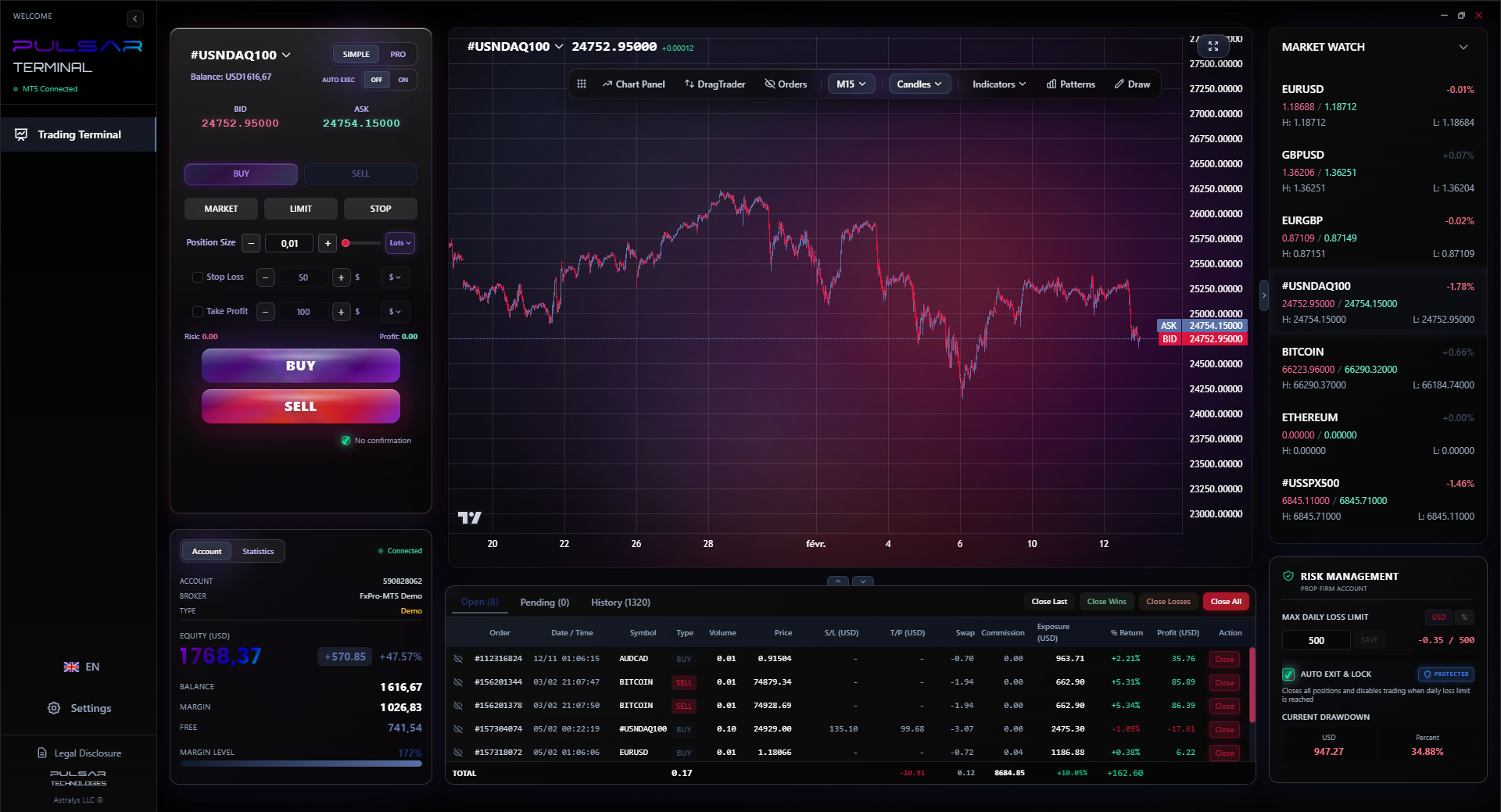
Managing multiple trades and orders around key levels is complex, but tools like Pulsar Terminal automate advanced order types like multi-TP/SL and trailing stops directly on your MT5 chart.
Pulsar Terminal
The all-in-one MT5 companion: drag-and-drop orders, multi-TP/SL, trailing stop, grid trading, Volume Profile, and prop firm protection. Used by 1,000+ traders daily.
You don't need fancy tools, but you need the right ones.
The Platform
Most of us use MetaTrader 4 or 5. It's the industry standard for a reason. The drawing tools are fine for plotting key levels. The real advantage of MT5 is the Depth of Market feature, which can give you clues about buy/sell walls near your levels. Brokers like XM and Pepperstone offer strong MT4/5 support.
Essential Indicators (Less is More)
I keep my chart clean. My only additions are:
- A Simple Moving Average (like the 200-period): To gauge the overall trend. Trading bounces at a key level in the direction of the trend is higher probability.
- Volume: Built into MT5. I watch for spikes.
- Optional: The MACD indicator or RSI. I might use these for divergence near a key level. If price makes a new high at resistance but the RSI makes a lower high, that's a strong reversal signal.
The Game Changer: Order Flow Tools
This is where retail traders bridge the gap with the pros. Seeing where large orders are clustered (order book) or identifying high-volume price zones (Volume Profile) tells you why a level might hold. It moves you from guessing to seeing actual supply and demand.
Pro Tip: Before you go live, test your key level strategy on a demo account for at least a month. Track every trade in a journal. Note the level's characteristics, your entry/exit, and the outcome. This data is gold.
“Finding the level is only half the job. What you do there is everything.”
Let's wrap up by steering clear of the classic errors I see (and have made).
- Overcomplicating the Chart: Too many lines, too many indicators. You can't see the price action. Start with major daily/weekly levels and only add significant intraday ones.
- Ignoring the Spread on ZAR Pairs: Planning a 20-pip profit on GBP/ZAR is unrealistic when the spread is 15 pips. Your edge is gone before you start.
- Trading Against the Trend: Yes, key levels can cause reversals. But it's easier to swim with the current. A bounce at support is more likely to succeed in an uptrend.
- Fading a Strong Breakout: If price slices through a key level with high volume and momentum, don't immediately bet on it failing. It's telling you something has fundamentally changed. Wait for the retest.
- Not Accounting for News: A key level means nothing against a major SARB interest rate announcement or a US Non-Farm Payroll release. Know the economic calendar. I've seen perfect technical levels vaporize in seconds because of news.
The core of trading key levels forex is patience and discipline. It's about waiting for the market to come to your predefined, high-probability zones. It's not about being busy; it's about being right. Focus on the quality of your levels, manage your risk ruthlessly, and the pips will look after themselves.
FAQ
Q1What is the best time frame for finding key levels in forex?
Start with the higher time frames. The daily and 4-hour charts provide the most significant and reliable key levels. Once you've identified those major zones, you can then drop down to the 1-hour or 15-minute chart to fine-tune your entry. A level that aligns across multiple time frames (e.g., a previous daily high that also acts as resistance on the 4-hour) is extremely powerful.
Q2How do I handle false breakouts of key levels?
False breakouts are a fact of life. The best defense is to not trade the initial break. Wait for a pullback and a retest of the level. If the level was broken and then price fails to move further and comes back to it, that's your signal. Also, use a wider stop loss to account for this volatility, especially on ZAR pairs. A false breakout that takes you out before a reversal is the most frustrating loss.
Q3Are round numbers (like 1.1000 in EUR/USD) considered real key levels?
Absolutely. Round numbers are psychological key levels and often act as magnets for price. Large institutional orders (take-profit and stop-loss orders) are frequently placed around these numbers. You'll often see price stall, reverse, or accelerate around them. Always pay attention to price action near major round figures.
Q4How many key levels should I have on my chart at once?
Less is more. A cluttered chart is confusing. Focus on 2-3 major support and resistance levels that are currently relevant. These are usually the most recent swing highs/lows and any levels that have been tested multiple times. As price moves and creates new swings, you can remove older, less relevant levels.
Q5Do key levels work on exotic pairs like USD/ZAR?
They do, but differently. Key levels on exotic and emerging market pairs like USD/ZAR are often wider zones due to higher volatility and lower liquidity. A 50-100 pip zone is more realistic than a precise line. Also, be extra mindful of local South African political and economic news, which can override any technical level in the ZAR.
Q6How does use from South African brokers affect trading key levels?
The FSCA limits use to 30:1 for retail traders. This is a good thing for trading key levels, as it forces you to use proper position sizing. High use (like 1:500 from some offshore brokers) tempts you to overtrade and makes it harder to survive the natural volatility around these levels. Stick to regulated use and focus on your strategy, not magnification.
Q7Should I use Fibonacci retracement levels with key levels?
Yes, they can be a powerful combo. A key horizontal support level that coincides with a 61.8% or 50% Fibonacci retracement level from a prior move creates a high-probability confluence zone. It's like getting two separate reasons for the market to pay attention to that price area. Never use Fib levels alone, but as a confirming tool with traditional key levels.
Prof. Winston's Lesson
Key Takeaways:
- ✓Trade key levels as zones, not precise lines.
- ✓Align levels across multiple time frames for higher probability.
- ✓Never risk more than 1-2% of capital on any single trade.
- ✓Always account for the wider spread on ZAR currency pairs.
How useful was this article?
Click a star to rate
Weekly Trading Insights
Free weekly analysis & strategies. No spam.
About the Author
David van der Merwe
Emerging Markets Trader
Johannesburg-based trader with 11 years in emerging market currencies. Specializes in ZAR pairs, FSCA-regulated trading, and South African market analysis.
Comments
Risk Disclaimer
Trading financial instruments carries significant risk and may not be suitable for all investors. Past performance does not guarantee future results. This content is for educational purposes only and should not be considered investment advice. Always conduct your own research before trading.
You Might Also Like

Cara Trading Forex Sukses: 7 Prinsip dari Trader Profesional
Cara trading forex sukses dengan 7 prinsip trader pro: manajemen modal, disiplin, journal trading, backtest. Data nyata, bukan janji profit palsu.
Jam Trading Forex Terbaik untuk Trader Indonesia: Panduan Lengkap dengan Tabel Waktu
Panduan jam trading forex untuk trader Indonesia. Tabel 4 sesi dunia, jam emas 20:00-00:00, sesi mana yang harus dihindari. Data akurat + tips dari trader berpengalaman.
Top 5 Sàn Forex Uy Tín Nhất 2026: Review Jujur dari Trader Indonesia
Top 5 sàn forex uy tín 2026 untuk trader Indonesia. Review jujur: spread, deposit, withdraw, dukungan lokal. Exness, XM, IC Markets & lebih.
Get Pulsar Terminal
All these calculators are built into Pulsar Terminal with real-time data from your MT5 account. One-click position sizing, automatic risk management, and instant calculations.
Get Pulsar Terminal