


Let's cut through the hype.

James Mitchell
Senior Trading Analyst ·  Canada
☕ 11 min read
What you'll learn:
Let's cut through the hype. The promise of trading a prop firm's capital for a huge profit split is a trap for about 95% of people who try it. I'm not talking about skill; I'm talking about structure. The evaluation rules for firms like Lucid Prop Firm are designed to make you fail, not to find good traders. I've blown two challenges myself and passed three others. In this guide, I'll show you the exact numbers, the psychological games, and the one realistic path to actually getting funded as a Canadian trader. Forget the sales page. This is what it's really like.
First, a crucial distinction. When we talk about 'Lucid Prop Firm' in Canada, we're usually referring to 'Lucid Trading,' a futures-focused proprietary trading firm accessible to traders here. It's not a Canadian-regulated broker. It's an entity that provides a capital allocation model after you pass its evaluation.
Here's the core of the model: you pay a one-time fee for a 'challenge' or evaluation account. This isn't a live account with real money. It's a simulated environment where you must hit a specific profit target without violating strict loss limits. If you pass, you 'graduate' to a funded account where you trade the firm's capital and keep a large slice of the profits (often 80% or more).

Warning: This is not an investment. Your fee buys you the opportunity to be evaluated. It is a sunk cost. I made the mistake of viewing my first $250 challenge fee as an 'investment.' It was a tuition fee for a harsh lesson. You can lose it all and have nothing to show for it but a screen full of broken trades.
The appeal is obvious: access to significant capital ($25k, $50k, $100k+) without risking your own life savings. The reality is a gauntlet of rules engineered to be psychologically brutal. Most firms, including Lucid, operate in a regulatory gray area. They aren't brokers holding client funds, so they don't fall under the same CIRO oversight as your Exness review or IC Markets review. This means your recourse is limited if you have a dispute. Your protection is the firm's reputation and terms of service, period.
This is where dreams go to die. You must understand the rules not as guidelines, but as the primary obstacle. Let's break down a typical Lucid-style challenge for a $50,000 account.
The Visible Targets:
- Profit Target: Let's say 8% ($4,000).
- Maximum Daily Loss: 5% ($2,500).
- Maximum Overall Drawdown: 10% ($5,000 from the starting equity high).
Sounds manageable, right? A few good trades and you're there. This is the illusion. The math works against you in a way most don't calculate.
The Psychology of the Daily Loss Limit
That 5% daily loss is a killer. It forces you to stop trading the moment you have a bad morning. Human nature says, "I'm down $1,500, I need to get it back." The rule says, "Stop now or you're disqualified." I violated this on my second challenge. I was down $1,800 on a $30k account. I took one more 'sure thing' scalping strategy on EUR/USD. It went another 12 pips against me. I hit the daily loss limit and was shut down before I even realized the position had closed. The account was dead. $199 fee, gone.
The Overall Drawdown Trap
The 10% overall drawdown is measured from your peak equity. This is critical. If you start at $50,000, make $3,000 (peak of $53,000), and then lose $4,000, you're at $49,000. You're still up from your start, right? Wrong. Your drawdown from the peak ($53,000) is $4,000, which is 7.5%. You have only 2.5% of breathing room left before you breach the overall limit, even though you're technically profitable. This rule actively punishes you for taking profits early. It encourages paranoid, defensive trading.

Example: Start: $50,000. You profit to $53,000. Your new safety net is 10% of $53,000 = $5,300. Your absolute floor is now $53,000 - $5,300 = $47,700. If you drop to $47,699, you fail. You can be in profit overall and still fail. This breaks people.
The only way to navigate this is with robotic discipline and a position size calculator you use for every single trade. Your risk per trade must be tiny, often 0.5% or less of the account, to survive the inevitable strings of losses.

💡 Winston's Tip
The challenge fee is the cost of admission to a casino where the house has rewritten the rules of blackjack. Only sit down if you've counted the deck a thousand times in practice.
“You can be in profit overall and still fail the challenge. This breaks people.”
Let's talk real numbers, in CAD. As a Canadian, you're dealing with FX fees on top of everything.
Evaluation Fees: These vary by account size. For a Lucid-style firm, expect a range.
- $10,000 Account:
$89 USD ($120 CAD) - $50,000 Account:
$250 USD ($340 CAD) - $100,000 Account:
$400 USD ($540 CAD)
You're paying this in USD. Your credit card or bank will add a 2.5% FX fee. That's an extra $8.50 on a $340 purchase. It's small, but it's part of the real cost. Some firms offer 'free retries' or discounts on a second attempt, which is just a clever way to get more fee revenue from struggling traders.
Profit Splits: The big sell. 'Keep up to 90% of profits!' The split usually scales. You might start at 80% for the first few payouts, then move to 90% after proving consistency. This is the real deal if you get funded. I know a trader who consistently pulls $3-5k USD a month from a $100k account. After the 80% split and converting to CAD, that's a very solid income. But that's the 5% who made it through.
The Payout Process: This is a headache. Most firms pay via USD wire or ACH to a US account. As a Canadian, you need a USD account with your bank (like RBC US Savings). The wire will cost you $15-30 on the receiving end. ACH is cheaper but not all firms offer it. Factor this in. It's not just 'click withdraw.' It's a multi-day, fee-laden process.
The profit target during the funded stage is usually lower (like 5% quarterly). But the real goal is consistency, not hitting a single grand slam. You need a swing trading or systematic approach that grinds out small, steady gains.
Based on my failures and eventual success, here's the only approach that has a statistically decent chance. It's boring. It's slow. It's the opposite of the 'get rich quick' vibe the prop firm ads sell.
1. Treat It Like a Job, Not a Lottery Ticket. You have 30 days (or whatever the period is) to hit 8%. That's 2% per week. Your goal is not 8%. Your goal is 0.4% per day. You achieve that by risking 0.25% of your account per trade and aiming for a 2:1 reward-to-risk ratio. One good trade nets you 0.5%. Two of those and you're done for the day. Stop. Close the platform. This is the single hardest thing to do.
2. Instrument Selection is Key. Don't trade volatile, news-driven pairs or gold (XAU/USD guide) unless you are a true expert. The spread definition on exotic pairs will eat you alive. Stick to major forex pairs like EUR/USD or stock indices like the S&P 500 E-mini (if trading futures with Lucid). The liquidity is high, spreads are tight, and the price action is cleaner.
3. Use Simple, Rule-Based Entries. Forget complex systems. Use one or two indicators at most. A basic MACD indicator crossover on a 1-hour chart, confirmed by price hitting a clear support or resistance level, is infinitely better than a messy 9-indicator setup. I passed my third challenge using basically a 20-period moving average and horizontal lines. I took maybe 25 trades total over 3 weeks.
4. The Mental Game of Losses. You will have losing days. When you do, you must stop immediately at your predefined daily loss (I used 2%, half the allowed limit). Do not 'just look for one setup.' Do not 'revenge trade.' The challenge is a test of loss tolerance, not genius. The firms know that traders who can't handle small losses will blow the funded account. They filter for robots.

Pro Tip: Before you pay for a challenge, practice this exact strategy on a demo account for a full month. Give yourself the same profit target and the same strict daily loss limit. If you can't do it with fake money, you have zero chance with the psychological pressure of a real fee on the line.
💡 Winston's Tip
Your first goal in a challenge isn't profit. It's survival. A 0% day where you didn't trigger the loss limit is a strategic victory. String enough of those together, and profit becomes inevitable.
“Your edge isn't in the markets at first. Your edge is in understanding and outlasting the rulebook.”
Lucid (Trading) is futures-focused. That's its niche. Let's compare it to the broader landscape accessible to Canadians.
| Feature | Lucid Trading (Futures) | Typical Forex Prop Firm (e.g., FTMO style) | Broker-Integrated (e.g., ThinkCapital) |
|---|---|---|---|
| Markets | CME Futures (ES, NQ, etc.) | Forex, Indices, Commodities, Crypto | Forex, CFDs on many assets |
| use | Lower (e.g., 10:1 on ES) | Higher (often up to 100:1) | Can be extremely high (e.g., 500:1+) |
| Platform | NinjaTrader, Sierra Chart | MT4/MT5, own platform | MT4/MT5, broker's platform |
| Challenge Rules | Standard (Profit Target, Daily Loss) | Standard (Profit Target, Daily Loss) | Often simpler, but with lower profit splits initially |
| Best For | Traders who understand futures margins & order flow | Forex & scalping strategy specialists | Traders who want a direct path from a live broker account |
The use Illusion: High use is a double-edged sword. A firm offering 100:1 might seem better, but it makes it exponentially easier to hit that 5% daily loss. A 10-pip move against you with oversized use can end your day. The lower use in futures forces more sensible position sizing.
The Platform Factor: If you live and breathe MT5, a futures prop firm will have a learning curve. NinjaTrader is powerful but different. Factor in the time to learn a new platform before you commit a challenge fee.
My take? If you are a dedicated futures trader, Lucid's model is legitimate within the space. If you're a forex trader, you're better off with a forex-focused firm. But the core challenge rules - the profit target, the daily loss, the overall drawdown - are almost universal. The pain is the same. The firm just provides the arena.
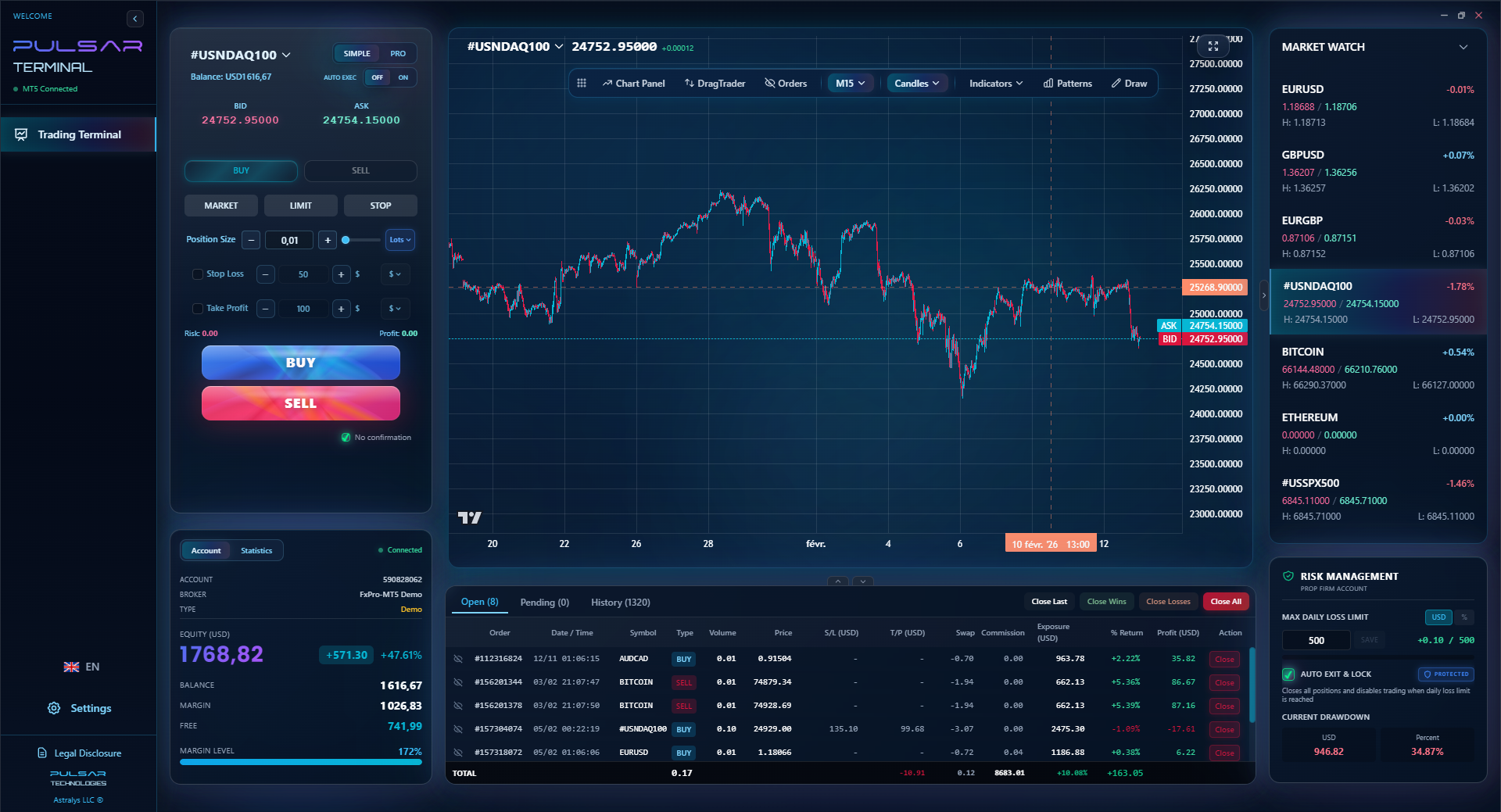
Managing the complex risk rules of a prop firm challenge is exhausting. Pulsar Terminal automates this on MT5, letting you set hard daily loss limits and trailing stops so you can't self-sabotage.
Pulsar Terminal
The all-in-one MT5 companion: drag-and-drop orders, multi-TP/SL, trailing stop, grid trading, Volume Profile, and prop firm protection. Used by 1,000+ traders daily.
Here's my blunt assessment.
Who it's NOT for:
- New traders (you will 100% lose your fee).
- Traders without a proven, written, and demo-tested strategy.
- People needing money quickly.
- Traders who can't control their emotions after a loss.
Who it MIGHT be for:
- A disciplined futures trader with a 6+ month track record of consistent, small gains on a sim account.
- Someone with $300-500 they can afford to lose on evaluation fees, treating it as a business cost.
- A trader who understands that the goal is to pass the challenge by being boring, not brilliant.
The biggest risk isn't losing the fee. It's the psychological damage. Failing a challenge can destroy your confidence and lead to reckless trading in your personal account. I've seen it happen. The second risk is the firm's stability. While Lucid has a presence, the prop firm world has seen firms like My Forex Funds get shut down by regulators. Your funded account is not a bank account. It's a simulation with a promise to pay. Always research the firm's payout history and reputation on trader forums.
If you proceed, start with the smallest, cheapest challenge. Prove you can beat the system with minimal capital at risk. The path to a $100k account is through a $10k challenge, not by gambling on the big one first. Your edge isn't in the markets at first. Your edge is in understanding and outlasting the rulebook. Most don't. That's why the model is so profitable for the firms. Don't be most people. Be the robot that passes, then let your skill work on the funded side.
Remember, the margin call in a prop firm challenge is silent. It's just a notification that your account is closed. Manage your risk every single trade, or that notification will come sooner than you think.
FAQ
Q1Is Lucid Prop Firm legal and regulated in Canada?
Proprietary trading firms like Lucid Trading operate in a regulatory gray area in Canada. They are not brokers, so they aren't regulated by CIRO like Pepperstone review or XM review. They are legal, but they are not overseeing client investments. Your protection is their terms of service and business reputation, not a government-backed guarantee.
Q2What's the biggest mistake traders make in prop firm challenges?
Oversizing. They see a $50,000 account and think in dollar terms, not percentage terms. They risk 2-3% per trade trying to hit the profit target fast. One string of two or three losses triggers the daily or overall drawdown limit, and they're out. The correct risk is 0.5% or less. It feels too small, but it's the only way to survive the variance.
Q3How are payouts taxed for Canadian prop traders?
This is critical. Payouts are typically considered business income or professional trading income in Canada, not capital gains. You must report the full CAD-equivalent value on your tax return. Keep careful records of all payouts, fees, and related expenses (like platform data fees). Consult a Canadian accountant familiar with trading income.
Q4Can I use my own trading strategy, like the RSI indicator?
Absolutely, you can use any strategy you want, including the RSI indicator. The rules don't care how you make money, only that you don't lose too much too quickly. The key is that your strategy must have clearly defined entry/exit rules and risk parameters that align with the challenge's strict loss limits. A strategy that has large drawdowns will fail.
Q5What happens if I pass the challenge but then have a losing month on the funded account?
Most firms have a 'relative drawdown' rule on the funded account, similar to the challenge. If you hit the maximum drawdown (e.g., 10% from your peak equity), your funded account will be closed. You typically keep any profits you've made up to that point (if any), but you lose access to the capital. Some firms offer a 'reset' for a fee, putting you back to the starting balance.
Q6Is it better to try a prop firm or just trade my own small account?
Start with your own account. If you can't grow a $1,000 account to $1,100 over a few months with disciplined risk management, you have no chance in a prop challenge. The prop firm is for scaling a proven, small-edge strategy. It's not a substitute for developing skill. Trade your own capital first, master the psychology, then consider using a firm's capital to amplify your results.
Prof. Winston's Lesson
Key Takeaways:
- ✓Risk 0.5% or less per trade in a challenge.
- ✓A 0% day is a win. Protect capital first.
- ✓The daily loss limit is your main enemy, not the profit target.
- ✓Practice the exact rules on demo for a month first.
How useful was this article?
Click a star to rate
Weekly Trading Insights
Free weekly analysis & strategies. No spam.
About the Author
James Mitchell
Senior Trading Analyst
Based in New York with over 9 years of trading experience. Focuses on major USD pairs, prop firm challenges, and the US regulatory landscape.
Comments
Risk Disclaimer
Trading financial instruments carries significant risk and may not be suitable for all investors. Past performance does not guarantee future results. This content is for educational purposes only and should not be considered investment advice. Always conduct your own research before trading.
You Might Also Like

Cara Trading Forex Sukses: 7 Prinsip dari Trader Profesional
Cara trading forex sukses dengan 7 prinsip trader pro: manajemen modal, disiplin, journal trading, backtest. Data nyata, bukan janji profit palsu.
Jam Trading Forex Terbaik untuk Trader Indonesia: Panduan Lengkap dengan Tabel Waktu
Panduan jam trading forex untuk trader Indonesia. Tabel 4 sesi dunia, jam emas 20:00-00:00, sesi mana yang harus dihindari. Data akurat + tips dari trader berpengalaman.
Top 5 Sàn Forex Uy Tín Nhất 2026: Review Jujur dari Trader Indonesia
Top 5 sàn forex uy tín 2026 untuk trader Indonesia. Review jujur: spread, deposit, withdraw, dukungan lokal. Exness, XM, IC Markets & lebih.
Get Pulsar Terminal
All these calculators are built into Pulsar Terminal with real-time data from your MT5 account. One-click position sizing, automatic risk management, and instant calculations.
Get Pulsar Terminal