


It was 3:17 PM on a Thursday in March 2024.

David van der Merwe
Emerging Markets Trader ·  South Africa
☕ 14 min read
What you'll learn:
- 1What Exactly Is a Margin Call in Forex?
- 2The FSCA Rules: Your Safety Net (and use Limit)
- 3How to Calculate Your Margin and Avoid the Call
- 4Broker Stop-Out Levels: The Guillotine's Blade
- 5The 3 Mistakes That Guarantee a Margin Call
- 6Practical Risk Management Rules That Work
- 7What to Do If You Get The Margin Call Alert
- 8Choosing a Broker in South Africa: The Margin Call Checklist
It was 3:17 PM on a Thursday in March 2024. The USD/ZAR had been grinding higher all week, and I was short from R18.85, convinced the SARB would talk it down. Then the US CPI print hit the wires. Not just hot, but scorching. The pair spiked 150 pips in 90 seconds. My screen flashed red, then a pop-up I hadn't seen in years appeared: 'MARGIN CALL: DEPOSIT FUNDS OR REDUCE EXPOSURE.' I didn't have seconds to decide. The broker's system did it for me. A R12,000 account, gone in under two minutes. That's the reality of a margin call forex event. It's not a gentle nudge. It's a siren blaring that your risk management has already failed.
Let's strip away the jargon. When you trade with use, you're putting down a deposit (your margin) to control a much larger position. Your broker loans you the rest. That margin is your skin in the game, your collateral.
A margin call forex alert is your broker's automated system telling you that your collateral is almost gone. Specifically, it's triggered when your account's Equity (your balance plus your floating profit/loss) falls to 100% of your Used Margin (the total collateral tied up in all your open trades).
Think of it like this: You put down R1,000 as margin to control a R30,000 position (using 30:1 use, the FSCA retail cap for majors). If your trades go against you and your equity drops to R1,000, you get the call. You have no buffer left. The next tick against you means you're technically trading with the broker's money, and they won't stand for that.

Warning: A margin call is not the same as a stop out. The call is the last warning. The stop out is the liquidation. If you don't act on the margin call by adding funds or closing positions, the broker will automatically close your trades, starting with the biggest losers, until your equity is back above the required level. This is the point of no return.
Most South African brokers, like those under the FSCA, are very clear about their levels. You'll find them in the account specifications. The call comes at 100%. The stop out? That's usually between 20% and 50%. At 50%, if your equity is half your used margin, they start closing you out. I learned this the hard way with my USD/ZAR trade. My broker's stop-out was 50%. By the time the price spiked, my equity raced past the 100% margin call level and hit 50% almost instantly. The system didn't ask twice.

💡 Winston's Tip
Professor Winston always said, 'The market can remain irrational longer than you can remain solvent.' Your margin is your solvency. Protect it like your life depends on it, because your trading life does.
South Africa's Financial Sector Conduct Authority (FSCA) isn't trying to stop you from trading. They're trying to stop you from losing your shirt in one go. Their use caps, introduced in 2021, are the single biggest factor affecting your margin call forex risk locally.
Here’s the breakdown for retail traders like you and me:
| Instrument | Maximum use (Retail) | What It Means for Margin |
|---|---|---|
| Major Forex Pairs (EUR/USD, GBP/USD) | 30:1 | You need ~3.33% of the position value as margin. |
| Minor Forex Pairs, Gold, Major Indices | 20:1 | You need 5% margin. |
| Other Commodities, Minor Indices | 10:1 | You need 10% margin. |
| Individual Shares (CFDs) | 5:1 | You need 20% margin. |
| Cryptocurrencies | 2:1 | You need 50% margin. |
Before these rules, I saw brokers offering 1:400 to anyone with an email address. It was carnage. A 25-pip move could wipe you out. Now, with 30:1 on majors, a 25-pip move on a standard lot is about $250 – still painful, but not an instant account killer if you've sized correctly.
The Professional Client Loophole (And Its Dangers)
You'll see brokers like IC Markets or Pepperstone offer "professional" accounts with use up to 1:500. To qualify, you typically need to prove you have a large portfolio (over R8 million in assets) or significant trading experience and volume. It's tempting to try and tick the boxes, but be honest with yourself. Higher use isn't a reward for skill; it's a sharper knife. If you're reading this to understand margin calls, you're not ready for 1:500. Stick to the retail caps. They exist for a reason.
The FSCA also mandates client money segregation, so your funds are separate from the broker's. If the broker goes under, your money should be safe. This is a crucial reason to only use FSCA-regulated brokers or reputable international ones with strong oversight. That offshore "bucket shop" offering 1:1000 use won't offer this protection.
“Higher use isn't a reward for skill; it's a sharper knife.”
This is where most traders mess up. They think, "I have R10,000, I'll open two lots." They don't do the math. Let's fix that.
The Basic Formula: Required Margin = (Trade Size in Lots × Contract Size) / use Ratio
For forex, the standard contract size is 100,000 units of the base currency.
Let's use a real South African example. You want to buy 1 standard lot of USD/ZAR at R19.00 with 30:1 use.
- Trade Size: 1 lot
- Contract Size: 100,000 USD
- Notional Value: 100,000 USD × R19.00 = R1,900,000
- Required Margin: R1,900,000 / 30 = R63,333.33
That's right. To control nearly R2 million of currency, you need to lock up over R63k as margin. If your entire account is R70,000, this one trade uses 90% of your margin. One bad move and you're getting that call.

Example: A more sensible trade for a R70k account might be 0.2 lots on USD/ZAR. Notional Value: 20,000 USD × R19.00 = R380,000 Required Margin: R380,000 / 30 = R12,666.67 This uses only about 18% of your account margin, leaving you room to breathe and manage the trade.
I strongly recommend using a position size calculator before every single trade. Don't guess. In 2019, I guessed on a XAU/USD trade. Gold was volatile, and I used my entire margin on one position. A $15 overnight swing triggered a margin call and a forced liquidation. I lost R8,500 because I was too lazy to calculate the margin for a 20:1 leveraged instrument.
The Free Margin Safety Buffer
Your trading platform shows "Free Margin." This is your equity minus your used margin. It's your breathing room. If Free Margin hits zero, you're at the margin call level. I make it a rule to never let my used margin exceed 30% of my account equity. Ever. This isn't just about avoiding a call; it's about having the mental space to make decisions without panic.
The margin call is the shout. The stop out is the blade falling. Every broker has a pre-defined stop-out level, usually expressed as a percentage. When your Equity ÷ Used Margin × 100 hits this percentage, the auto-liquidation begins.
Here’s a quick look at some brokers popular in South Africa:
- IG: Stop-out at 50%. They start closing positions when your equity is half your used margin.
- XM: Stop-out at 50% for most accounts.
- Exness: Can be as low as 20% for some account types. At 20%, you're in deep trouble.
- IC Markets: Typically 50%.
This is critical information. A 20% stop out is far more dangerous than a 50% stop out. At 50%, you might get a chance for a recovery if the market snaps back. At 20%, the system is closing trades into what is likely a panic move, guaranteeing the worst possible price.
How does it work? The broker's system usually closes your largest losing position first to free up margin the fastest. This can create a cascade. If that big loser was your hedge or part of a strategy, its closure can expose your other positions to even more risk, leading to more liquidations. It's a death spiral.
The only way to avoid the guillotine is to never get your head near the block. Manage your risk so your equity never gets close to the stop-out level. If you get a margin call, the best action is often to manually close a portion of your losing position yourself, immediately. This gives you control. Letting the broker do it is like handing your car keys to a stranger in a storm.
💡 Winston's Tip
If you find yourself calculating 'how much can I make,' you're a gambler. If you're calculating 'how much can I afford to lose,' you're a trader. Always start with the second question.
“Your first job as a trader is not to make money. It's to protect your capital.”
After 12 years and coaching hundreds of traders, I see the same patterns every time. These aren't trading mistakes; they are pre-trade planning failures.
1. Overleveraging on a "Sure Thing." This is the king of all killers. You get a hot tip, see a "can't lose" setup on EUR/USD, and go all in. You use 90% of your margin on one trade. The market doesn't care about your certainty. A 1% move against you at 30:1 use is a 30% loss on your margin. At 90% margin used, you're now at the call. I did this with Bitcoin in 2017. I was so sure it would break $20,000. I leveraged up. It reversed, and I was liquidated 48 hours later. The "sure thing" is a myth.
2. Adding to a Losing Position (Averaging Down) Without a Plan. This is a sophisticated way to blow up. Your USD/ZAR trade goes 50 pips against you. "It's just a retracement," you think. You add another lot to lower your average entry. You've now doubled your position size and your margin requirement. If it goes another 50 pips against you, your loss isn't linear; it's exponential. You've effectively doubled your use on a losing bet. This is not a strategy; it's a gamble. A real strategy, like swing trading, has defined entry, stop-loss, and take-profit points before the trade is ever placed.
3. Ignoring Correlated Pairs. You think you're diversified: you're long EUR/USD and short GBP/USD. They're different pairs, right? Wrong. They are highly correlated. If the US dollar strengthens broadly, both trades will likely go against you. Your margin requirement was for two separate trades, but your risk was for one big dollar bet. Your platform's margin calculator won't save you from this. You need to understand the underlying drivers. A loss on one becomes a amplified loss on both, draining your equity twice as fast toward that margin call forex threshold.
Theory is useless without rules you can apply today. Here are mine, forged from years of mistakes.
The 2% Rule (It's Not What You Think): Everyone hears "risk 2% per trade." They think it means "if I have R100,000, I can lose R2,000." That's the end point. The start point is your stop-loss distance. Let's say you're buying EUR/USD at 1.0850 with a stop at 1.0820. That's a 30-pip risk. The value per pip for a standard lot is $10. So, 30 pips = $300 risk per lot.
If your account is $10,000 (roughly R180,000), 2% is $200. Therefore, your position size should be $200 / $300 = 0.66 lots. You round down to 0.6 lots. This calculates your position size backwards from your risk, not forwards from your capital. It automatically manages your margin. I use this for every single trade, whether I'm scalping or swinging.
The Daily Loss Limit: This saved my career. I set a hard daily loss limit of 3% of my account. If I hit it, I shut down the platform. No excuses. On a bad day in 2020, I hit my 3% limit by 11 AM. I was frustrated and wanted to "get it back." But I walked away. The next day, the market gapped massively against what would have been my revenge trades. That discipline saved me from a 15%+ drawdown.
Use a Trailing Stop, But Not How Brokers Offer It: A trailing stop that follows the price is great for locking in profits. Most broker platforms have clunky versions. The key is to move your stop-loss to breakeven once the trade is in profit by a certain amount (e.g., 1.5x your initial risk). This eliminates the risk of a winning trade turning into a loser and protects your capital from an unnecessary margin call. It's a manual process, but it forces you to engage with the trade management.

Pro Tip: Your first job as a trader is not to make money. It's to protect your capital. If you protect your capital, you stay in the game. If you stay in the game, you'll eventually find opportunities to make money. The traders who chase profits first are the ones who get margin calls.
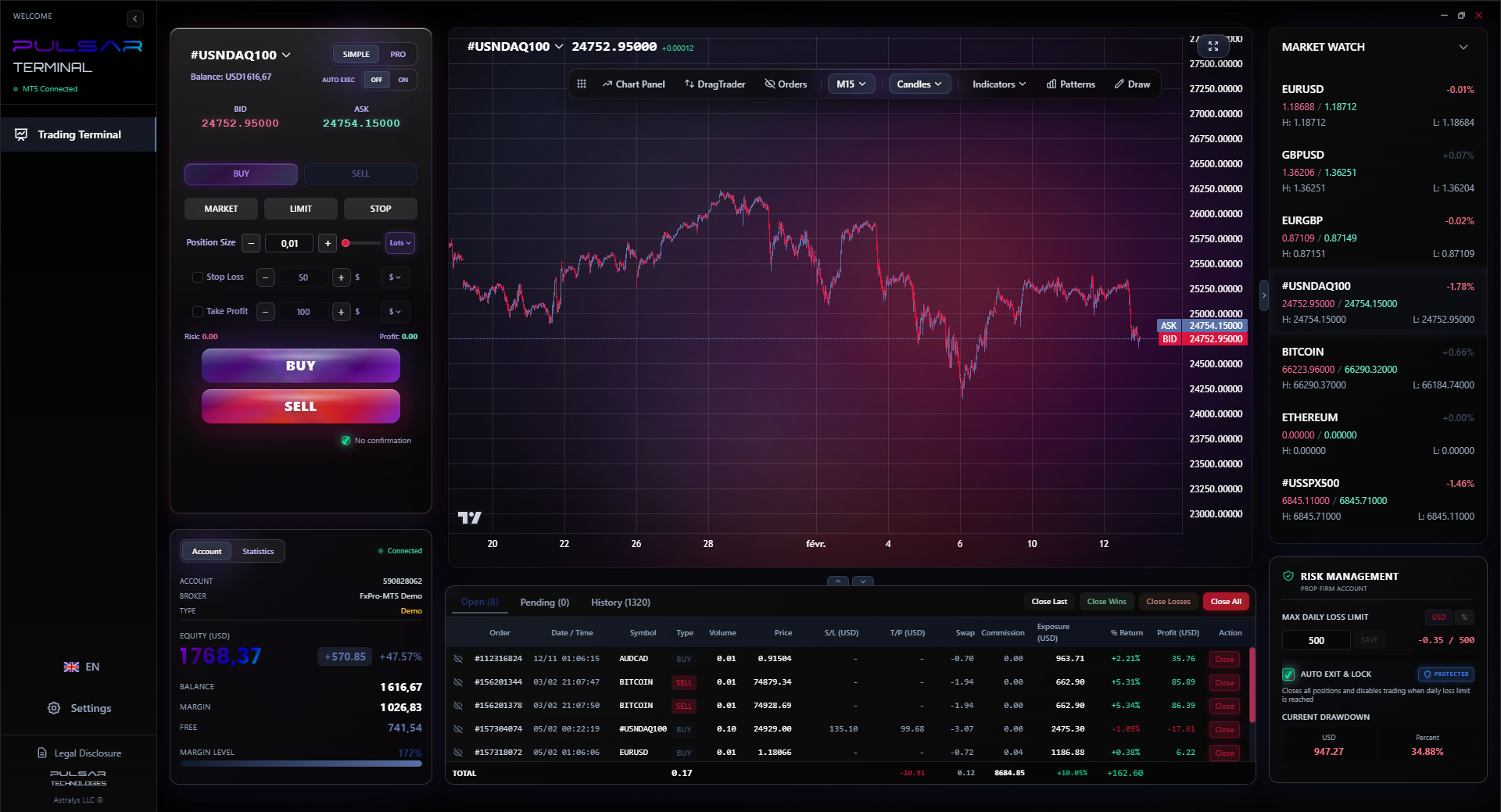
Manually moving stops to breakeven is a key defence against margin calls, and Pulsar Terminal automates this with its 'Breakeven & Trail' tool directly on your MT5 chart.
Pulsar Terminal
The all-in-one MT5 companion: drag-and-drop orders, multi-TP/SL, trailing stop, grid trading, Volume Profile, and prop firm protection. Used by 1,000+ traders daily.
“The 'sure thing' is a myth that has funded more margin calls than any market crash.”
The siren is blaring. The pop-up is on your screen. Panic is the default setting. Don't let it win. Follow this drill.
-
ASSESS, DON'T GUESS: Immediately look at your biggest losing position. Is the reason for the move still valid? Did news just break? If the fundamental picture has changed (like my CPI example), the damage is likely done. Holding is hope, not a strategy.
-
DEPOSIT OR REDUCE? Unless you have spare cash instantly available to wire, depositing is rarely the fast solution. The market moves in seconds. The practical choice is almost always to reduce exposure.
-
REDUCE THE RIGHT WAY: Don't close everything in a panic. Close the position that is causing the most margin pressure - your biggest loser. This frees up the most margin the fastest. Manually close a portion of it. If you're in 2 lots, close 1.5 lots. This is you taking control back from the algorithm.
-
DO NOT RE-ENTER: After you've stabilized the account, shut it down. Your emotional state is wrecked. Your judgment is impaired. The urge to "get back what you lost" is overwhelming and financially suicidal. Walk away for the rest of the day, maybe the week.
-
POST-MORTEM: Later, with a clear head, analyze what happened. Was it position size? use? Ignoring your stop-loss? This analysis is more valuable than the money you lost. I keep a journal of every margin call I've ever had (there are a few). Reviewing them is the best vaccination against future ones.
Remember, a margin call is a system notification. A stop out is a financial event. Your goal is to only ever see the former as a theoretical warning, not a lived experience.
💡 Winston's Tip
A margin call isn't bad luck. It's an audit. It's the market's way of telling you, with perfect clarity, that your pre-trade math was wrong. Listen to it.
Your broker is your partner in this. Choosing the wrong one makes avoiding a margin call harder. Here’s your checklist:
- FSCA Regulation: Non-negotiable. This ensures client money segregation, use caps, and a formal complaints process. Check the FSCA's website for their license status.
- Clear Stop-Out Policy: Before you deposit a cent, find and read their policy on margin calls and stop-out levels. Is it 50%? 30%? 20%? Prefer 50%.
- Transparent Margin Calculations: Their website should have a clear margin calculator or formula. Test it. If you can't easily figure out how much margin a trade will need, that's a red flag.
- Realistic Spreads: A super tight spread on EUR/USD is good, but check the spreads on ZAR pairs, which you'll likely trade. Wide spreads increase your cost and can trigger a stop loss (or margin call) sooner. Compare brokers like Exness, IC Markets, and XM on USD/ZAR and EUR/ZAR.
- Negative Balance Protection: This is crucial. It means you can't lose more than your account balance. If your account goes to zero and the market gaps, you won't owe the broker money. Most reputable FSCA-regulated brokers offer this for retail clients.
Don't be seduced by the highest use offer. The broker offering 1:500 to retail clients (likely through an offshore entity) is not doing you a favour. They are increasing the probability that you'll hit a margin call and lose your money faster. Choose the broker that provides the tools and stability to help you manage risk, not the one that encourages you to take the most of it.
FAQ
Q1At what percentage do you get a margin call in South Africa?
Almost universally, South African brokers regulated by the FSCA will trigger a margin call when your account equity falls to 100% of your used margin. This means you have no free margin left. It's a warning, not a liquidation.
Q2What is the difference between a margin call and a stop out?
A margin call is an alert that your equity is at the required margin level. You need to act. A stop out is the automatic liquidation of your positions by the broker. This happens at a lower level (e.g., 50% equity) if you don't respond to the margin call. The call is the last warning; the stop out is the account blow-up.
Q3Can I trade forex with R500 in South Africa?
Technically, yes. Some brokers have minimum deposits as low as $10. But practically, it's extremely risky. With R500 and even 30:1 use, your margin is tiny. A few pips of spread and a small move will trigger a margin call. You have no room for error. It's better to save until you have at least R5,000-R10,000 to trade with sensible, small position sizes.
Q4Do I have to pay money if I get a margin call?
Not directly. The margin call is a demand to either deposit more funds or reduce your exposure. If you don't act, the broker will close your positions (stop out). You only lose the equity in your account. With Negative Balance Protection (standard for FSCA retail clients), you should never owe the broker additional money.
Q5How is use regulated for ZAR pairs in South Africa?
USD/ZAR is classified as a "non-major" currency pair by the FSCA. Therefore, for retail clients, the maximum use is capped at 20:1, not 30:1. This means you need 5% of the position value as margin, making it slightly more capital-intensive and a bit safer than if it were at 30:1.
Q6What happens if my broker's stop-out level is 20%?
It means your positions will be automatically liquidated when your equity drops to just 20% of your used margin. This is a very aggressive stop out. It gives you less chance for a recovery and increases the likelihood of being closed out at the worst possible prices during a volatile spike. I recommend avoiding brokers with stop-out levels below 40%.
Prof. Winston's Lesson
Key Takeaways:
- ✓Calculate position size from your stop-loss, not your capital.
- ✓Never let used margin exceed 30% of account equity.
- ✓A 2% max risk per trade keeps you in the game.
- ✓Know your broker's exact stop-out level before you trade.
- ✓If you get a margin call, manually close part of your biggest loser.
How useful was this article?
Click a star to rate
Weekly Trading Insights
Free weekly analysis & strategies. No spam.
About the Author
David van der Merwe
Emerging Markets Trader
Johannesburg-based trader with 11 years in emerging market currencies. Specializes in ZAR pairs, FSCA-regulated trading, and South African market analysis.
Comments
Risk Disclaimer
Trading financial instruments carries significant risk and may not be suitable for all investors. Past performance does not guarantee future results. This content is for educational purposes only and should not be considered investment advice. Always conduct your own research before trading.
You Might Also Like

Cara Trading Forex Sukses: 7 Prinsip dari Trader Profesional
Cara trading forex sukses dengan 7 prinsip trader pro: manajemen modal, disiplin, journal trading, backtest. Data nyata, bukan janji profit palsu.
Jam Trading Forex Terbaik untuk Trader Indonesia: Panduan Lengkap dengan Tabel Waktu
Panduan jam trading forex untuk trader Indonesia. Tabel 4 sesi dunia, jam emas 20:00-00:00, sesi mana yang harus dihindari. Data akurat + tips dari trader berpengalaman.
Top 5 Sàn Forex Uy Tín Nhất 2026: Review Jujur dari Trader Indonesia
Top 5 sàn forex uy tín 2026 untuk trader Indonesia. Review jujur: spread, deposit, withdraw, dukungan lokal. Exness, XM, IC Markets & lebih.
Get Pulsar Terminal
All these calculators are built into Pulsar Terminal with real-time data from your MT5 account. One-click position sizing, automatic risk management, and instant calculations.
Get Pulsar Terminal