


I remember staring at my screen in late 2024, watching the USD/NGN chart.

Olumide Adeyemi
West African Trading Pioneer ·  Nigeria
☕ 11 min read
What you'll learn:
- 1Is Forex Trading Legal in Nigeria? The Real Story
- 2Choosing a Forex Broker in Nigeria: Beyond the Ads
- 3How to Start Trading: A Realistic 5-Step Plan
- 4Understanding the Naira in Your Forex Trading
- 5Pitfalls Every Nigerian Trader Faces (And How to Avoid Them)
- 6Developing a Profitable Trading Mindset
- 7Essential Tools and Resources
- 8Your Path Forward in Online Forex Trading
I remember staring at my screen in late 2024, watching the USD/NGN chart. The Naira had just broken through 1,500, a level I thought would hold for months. My short position was getting crushed. That moment, more than any win, taught me what online forex trading in Nigeria is really about: it's not just about charts and pips, it's about understanding a unique, volatile market where global forces and local realities collide. If you're thinking of starting, you need a guide that cuts through the hype. Let's talk.
This is the first question everyone asks, and the answer is yes, but with critical caveats. For you as an individual trader, placing trades online is perfectly legal. The regulatory scene is a bit of a patchwork, though. The Central Bank of Nigeria (CBN) oversees the official foreign exchange market and banks. The Securities and Exchange Commission (SEC) has a broader mandate over capital markets.
The key thing you must understand is this: the CBN prohibits using official bank channels to fund your forex trading account. You cannot walk into your bank, request dollars at the official rate, and wire them to Exness or IC Markets. That's a hard rule. Funding happens through other means, which we'll get to.
Most Nigerian traders use international brokers regulated abroad (think ASIC, FSCA, CySEC). These brokers aren't "regulated" by the CBN for offering CFDs to retail clients like you and me, but using them isn't illegal. The local brokers you might see advertising are typically CBN-authorized as Bureau De Change operators, which is a different ballgame.

Warning: Never use a "funding agent" who promises to get you dollars through the official CBN window for trading. This is a direct violation and can lead to your bank account being frozen. It's not worth the risk.
On profits, the Federal Inland Revenue Service (FIRS) expects its share. A 10% capital gains tax applies to your net trading profits. You're responsible for declaring this yourself when you file your annual returns.
You'll be bombarded with ads promising insane bonuses and "risk-free" trading. Ignore them. Your broker is your gateway to the market, and a bad choice can sink you before you even place a trade.
Regulation is Your Safety Net
Since local CFD regulation is still evolving, your best protection is a broker regulated by a reputable foreign authority. I personally look for brokers with licenses from the Australian Securities and Investments Commission (ASIC) or the South African Financial Sector Conduct Authority (FSCA). These regulators have strict client money protection rules. A broker like Pepperstone, for instance, holds an ASIC license, which gives me peace of mind.
The Nigerian Reality: Deposits and Withdrawals
This is where your research matters most. You need a broker that accepts deposit methods that actually work here. The big ones are:
- Cryptocurrency (USDT): By far the most common and efficient method now. Fast, and bypasses traditional banking hurdles.
- Bank Card (Visa/Mastercard): Works often, but sometimes fails due to local banking restrictions on international forex transactions.
- Bank Transfer: Can be slow and expensive, and faces the same potential blocks as cards.
Check the broker's website specifically for Nigerian Naira (NGN) accounts or local payment partners. It makes life much easier.
Costs You Can't Ignore
Look at the spread (the difference between buy and sell price) and any commissions. For a common pair like EUR/USD, a good raw spread on a commission account can be under 0.2 pips. On a standard no-commission account, expect 0.6 to 1.2 pips. Here's a quick comparison based on recent data:
| Broker Type | Example EUR/USD Spread | Typical Minimum Deposit |
|---|---|---|
| Raw/ECN Account | 0.1 pips + $3.5 per lot commission | $200 (e.g., IC Markets) |
| Standard Account | 0.9 pips, no commission | $100 (e.g., XM) |
| Micro Account | 1.5+ pips, no commission | As low as $1 |
The "micro account" with a $1 minimum is tempting for beginners, but the wider spreads eat into your profits fast. I started with one and lost my first $50 purely to transaction costs before I even understood what a pip was.

Pro Tip: Don't get dazzled by high use offers like 1:1000. It's a trap for new traders. Start with 1:10 or 1:20 max. It forces you to learn proper position sizing without blowing up your account on one bad trade.

💡 Winston's Tip
Your first 100 trades are for data collection, not profit. Journal every single one, especially the losers. The pattern of your mistakes is your greatest teacher.
“Funding your trading account through official CBN windows is prohibited. That's not a grey area, it's a hard rule.”
Here's the process, stripped of all the fluff you see on YouTube.
- Educate Yourself First, Not Later. Don't deposit a single Naira yet. Spend two weeks learning the absolute basics: what a currency pair is (like USD/NGN), what moves prices, what a stop-loss is. I know it's boring, but it's non-negotiable.
- Open a Demo Account. Every legit broker offers this. Practice for at least a month. Try to double a $10,000 virtual account. I guarantee you'll blow it up a few times. That's the point. Learn the platform, test a simple scalping strategy, get comfortable with losing.
- Fund Your Live Account with Money You Can Lose. This is the hardest rule. Start small. Your first deposit should be an amount that, if you lost 100% of it tomorrow, would not affect your ability to pay rent or feed your family. For me, that was 50,000 NGN back in the day. That's your tuition fee.
- Develop a Simple, Written Plan. Your plan must answer: What pairs will I trade? What's my daily loss limit? What's my profit target for the week? What strategy am I using? Write it down. Stick to it. My early failure was trading USD/NGN on emotion during CBN announcements instead of following my plan for EUR/USD.
- Analyze, Execute, Review. Look at the charts, make your analysis, place the trade with a stop-loss. At the end of the day, review every trade. Why did it win? Why did it lose? This journal is what turns a gambler into a trader.
Trading from Nigeria gives you a front-row seat to one of the most interesting currencies in forex: the Nigerian Naira (NGN). You'll mainly see it paired with the US Dollar (USD/NGN).
Trading USD/NGN is a different beast from trading EUR/USD. The volatility can be extreme, often driven by local liquidity, CBN policy announcements, and oil prices. In 2024 alone, the Naira lost about 54% of its value against the dollar. A move like that can create life-changing profits or wipeouts in minutes.
Because of this volatility and potential liquidity issues, many international brokers don't offer USD/NGN as a CFD. You might find it with some brokers specializing in emerging markets, but be prepared for very wide spreads.
Here's my honest take: as a beginner, avoid trading the Naira. Your emotional connection to the currency will cloud your judgment. You'll be tempted to "bet" on it strengthening or weakening based on news headlines, not technical analysis. I learned this the hard way trying to "defend" the Naira with my trades. It's a sure path to losses.
Focus on the major pairs like EUR/USD or XAU/USD (Gold) first. They have more predictable liquidity and tighter spreads. You can apply classic strategies to them without the local noise.
“A 2% return per month, compounded, is a 27% annual return. That's a realistic target for a disciplined trader.”
I've fallen into most of these. Learn from my mistakes.
Pitfall 1: Chasing Bonuses. A broker offers a 100% deposit bonus. Sounds great, right? These bonuses almost always come with impossible withdrawal conditions (like trading a huge volume). They're designed to make you trade more aggressively to "unlock" your money, which usually leads to losing it all. Ignore bonuses.
Pitfall 2: Overtrading with High use. You see use of 1:500 and think, "With 20,000 NGN, I can control 10,000,000 NGN!" Yes, and a 0.2% move against you will wipe out your entire account. use amplifies losses faster than gains. I once lost 120,000 NGN in under an hour on GBP/JPY using 1:200 use. It was a brutal lesson.
Pitfall 3: No Risk Management. This is the killer. You must use a stop-loss on EVERY trade. You must know your maximum risk per trade (I risk no more than 1% of my account). Without this, you are not a trader, you are a gambler. Use a position size calculator for every single entry.
Pitfall 4: Signal Services and "Mentors." If someone is truly a profitable trader, they are making money from the market, not from selling you a 50,000 NGN WhatsApp signal subscription. 99% of these are scams. The knowledge is free online. The discipline you have to build yourself.
Pitfall 5: Ignoring Taxes. That 10% capital gains tax is real. Keep clear records of your deposits, withdrawals, and trades. When you start making consistent profits, set aside the tax portion immediately. The FIRS is getting more sophisticated at tracking financial flows.
💡 Winston's Tip
If you feel a strong urge to 'revenge trade' after a loss, close the platform. Go for a walk. The market will be there tomorrow, but your capital won't be if you act on that emotion.
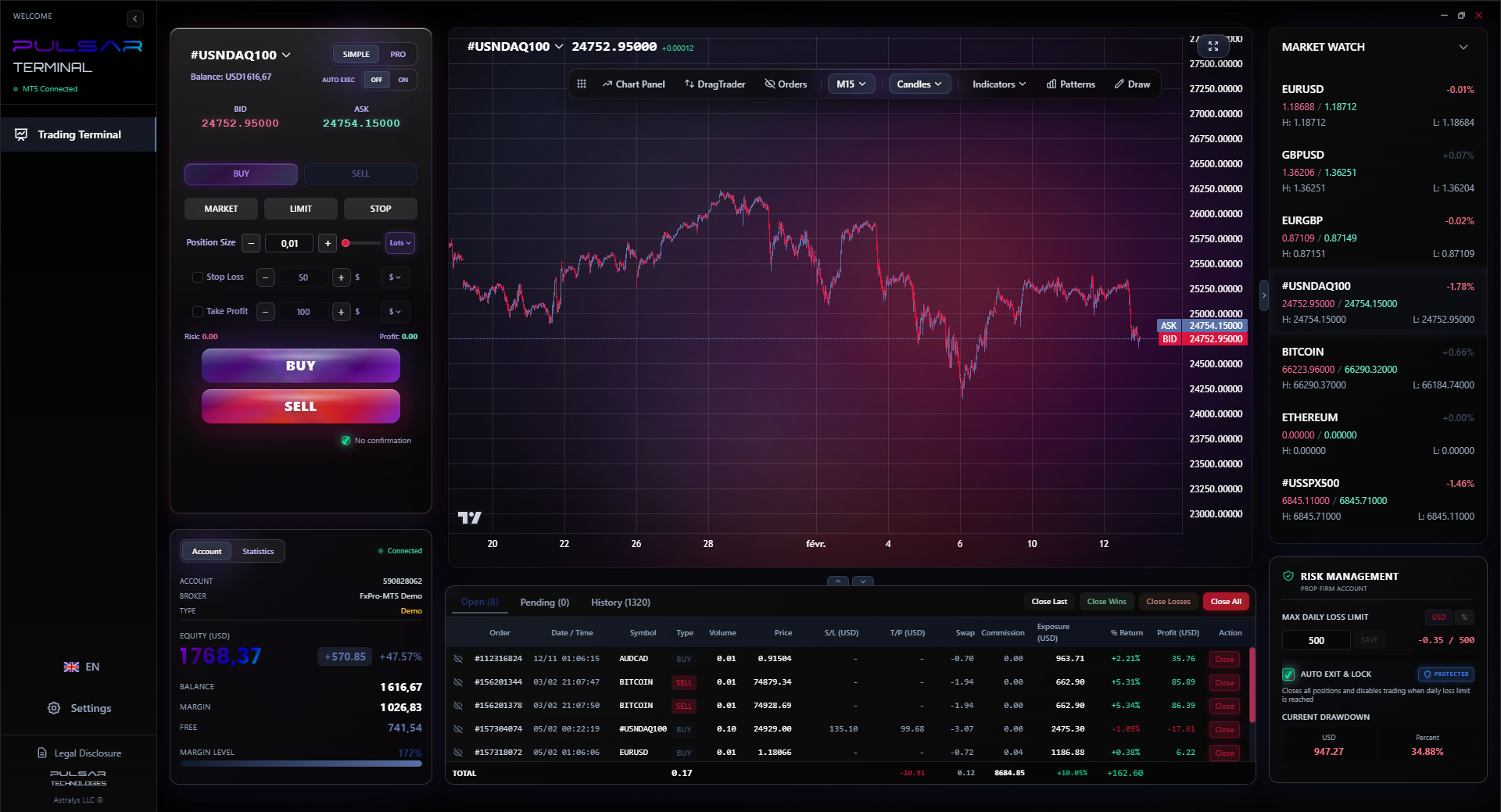
Sticking to a daily loss limit is a core rule for survival, and tools like Pulsar Terminal can automate this protection directly within your MT5 platform.
Pulsar Terminal
The all-in-one MT5 companion: drag-and-drop orders, multi-TP/SL, trailing stop, grid trading, Volume Profile, and prop firm protection. Used by 1,000+ traders daily.
The technical stuff is maybe 30% of trading. The other 70% is your psychology. Here’s what works.
Embrace Being Wrong. Your goal isn't to be right on every trade. It's to be profitable over 100 trades. A good trader might be right only 40% of the time but still be profitable because their winning trades are much bigger than their losing ones. Cut losses quickly. Let profits run.
Treat It Like a Business. You are the CEO, risk manager, and analyst of a one-person firm. Would a business operate without a budget or plan? No. Have a trading plan and a daily routine. Mine is: review the economic calendar at 7 AM, analyze charts for 30 minutes, place any planned swing trades, then check in periodically. No staring at screens all day.
Manage Your Environment. Trading from your phone while in a noisy bus or at work is a recipe for impulsive decisions. Create a quiet space, even if it's just a corner of your room, for your trading hours.

Example: Let's say your account is 200,000 NGN. Your rule is to risk 1% per trade. That's 2,000 NGN risk. If you're buying EUR/USD and your stop-loss is 20 pips away, you must calculate your position size so that a 20-pip loss equals 2,000 NGN. This discipline stops one bad trade from wrecking you.
The biggest shift happened for me when I stopped trying to "get rich tomorrow" and started focusing on consistent, small gains. A 2% return per month, compounded, is a 27% annual return. That destroys any bank savings account. That's a realistic target for a disciplined trader.
“Trading the Naira as a beginner is a sure path to losses. Your emotional connection to the currency will cloud your judgment.”
You don't need expensive software to start. Here's a lean toolkit.
Charting & Analysis: Most broker platforms (like MT4 or MT5) have decent built-in charts and indicators like the RSI and MACD. Learn these well before paying for anything else. For more advanced order management and analysis, some traders use companion apps that plug into MT5.
Economic Calendar: Use free sites like ForexFactory or Investing.com. Know when major data (US Non-Farm Payrolls, CPI) is released. These events cause massive volatility. As a beginner, consider staying out of the market 15 minutes before and after a major release.
News & Analysis: Be careful here. Don't trade the headline. Read Reuters or Bloomberg for the raw news, not the interpretation. Avoid Nigerian blogs that sensationalize every CBN whisper.
Community (Use Sparingly): Find a serious trading community focused on education, not signals. It helps with the isolation. But remember, everyone is biased towards their own trades. Never follow someone else's call blindly.
Your most important resource is your own trading journal. Note your entry, exit, reason for the trade, and most importantly, your emotional state. You'll start to see patterns: "I lose most when I trade after a bad night's sleep." That's gold.
Online forex trading in Nigeria is a legitimate skill you can learn, but it's a marathon, not a sprint. Your first year will likely be about survival and education, not Lamborghinis.
Start with the absolute basics on a demo account. Choose a reputable international broker that accepts crypto or local transfers. Fund a small live account - think of it as paying for a professional course. Develop and stick to a simple plan with strict risk management.
Remember, the market will always be there. The goal is to make sure you are always there too, with your capital intact and your mind clear. Avoid the noise, focus on your process, and the profits will follow as your skill grows. I've been doing this for over a decade, and I still learn something new every week. That's the beauty and the challenge of it. Now, go set up that demo account and get your hands dirty.
FAQ
Q1What is the minimum amount I need to start forex trading in Nigeria?
Technically, you can start with as little as $1 (about 1,500 NGN) on some micro accounts. But realistically, I advise starting with a demo account for a month, then funding a live account with at least 50,000 - 100,000 NGN. This allows for proper position sizing and risk management without being wiped out by a single small loss or high spreads. A tiny account often leads to taking excessive risk just to see meaningful gains.
Q2How do I withdraw my forex trading profits in Nigeria?
Withdrawals are typically processed back to the method you used to deposit. If you deposited using USDT (crypto), your profit will be withdrawn back to your crypto wallet. If you used a card, it may go back to the card (though this can sometimes fail). This is why it's crucial to use a deposit method that is reliable for both funding and withdrawing. Always check the broker's specific withdrawal policy for Nigerian clients before you deposit.
Q3Can I trade forex with my Nigerian bank account?
Not directly on international forex broker platforms. Nigerian banks do not help direct transfers to forex brokers for CFD trading due to CBN restrictions. You will need to use an intermediary method like cryptocurrency (e.g., buying and sending USDT) or sometimes a debit/credit card (though these transactions are frequently blocked). Some brokers have local payment partners that allow Naira deposits, which are then converted.
Q4Is forex trading taxable in Nigeria?
Yes. Profits from forex trading are subject to a 10% Capital Gains Tax under Nigerian law. It is your responsibility to declare this income and pay the tax to the Federal Inland Revenue Service (FIRS) when you file your annual tax returns. Keep detailed records of all your trades, deposits, and withdrawals to make this process easier.
Q5Which forex pairs are best for beginners in Nigeria?
Stick to the major pairs with high liquidity and lower spreads, such as EUR/USD, GBP/USD, and USD/JPY. These pairs have plenty of free educational material available and move in more predictable patterns compared to exotic pairs. I strongly advise beginners to avoid trading the USD/NGN pair initially, as the emotional connection and extreme volatility can lead to poor, emotionally-driven decisions.
Q6How much time do I need to dedicate to forex trading daily?
It depends on your style. If you're a swing trader holding trades for days, you might only need 30-60 minutes a day for analysis and trade management. If you're a day trader or scalper, you might be in front of the screen for 2-4 hours during active market sessions (like the London or New York overlap). As a beginner, start with swing trading or longer timeframes; it's less stressful and gives you more time to think.
Prof. Winston's Lesson
Key Takeaways:
- ✓Start with a demo account for a minimum of one month.
- ✓Risk a maximum of 1% of your account on any single trade.
- ✓Use stop-loss orders on every position, no exceptions.
- ✓Avoid trading USD/NGN until you have consistent profitability.
How useful was this article?
Click a star to rate
Weekly Trading Insights
Free weekly analysis & strategies. No spam.
About the Author
Olumide Adeyemi
West African Trading Pioneer
One of Nigeria's most active forex trading educators. 8 years of experience trading from Lagos. Specializes in low-capital strategies and prop firm challenges for African traders.
Comments
Risk Disclaimer
Trading financial instruments carries significant risk and may not be suitable for all investors. Past performance does not guarantee future results. This content is for educational purposes only and should not be considered investment advice. Always conduct your own research before trading.
You Might Also Like

Cara Trading Forex Sukses: 7 Prinsip dari Trader Profesional
Cara trading forex sukses dengan 7 prinsip trader pro: manajemen modal, disiplin, journal trading, backtest. Data nyata, bukan janji profit palsu.
Jam Trading Forex Terbaik untuk Trader Indonesia: Panduan Lengkap dengan Tabel Waktu
Panduan jam trading forex untuk trader Indonesia. Tabel 4 sesi dunia, jam emas 20:00-00:00, sesi mana yang harus dihindari. Data akurat + tips dari trader berpengalaman.
Top 5 Sàn Forex Uy Tín Nhất 2026: Review Jujur dari Trader Indonesia
Top 5 sàn forex uy tín 2026 untuk trader Indonesia. Review jujur: spread, deposit, withdraw, dukungan lokal. Exness, XM, IC Markets & lebih.
Get Pulsar Terminal
All these calculators are built into Pulsar Terminal with real-time data from your MT5 account. One-click position sizing, automatic risk management, and instant calculations.
Get Pulsar Terminal