


Here's a number that should make you pause: roughly 70% of South African retail traders lose money on their first real account.

David van der Merwe
Emerging Markets Trader ·  South Africa
☕ 11 min read
What you'll learn:
- 1Why a Real Account Feels Nothing Like a Demo
- 2The FSCA Rulebook: Your First Layer of Protection
- 3Picking Your Broker: Local Heroes vs. Global Giants
- 4The Real Costs: It's More Than Just the Spread
- 5The Paperwork: A Step-by-Step Walkthrough
- 6Getting Money In & Out: The ZAR Reality
- 7Your First Trades: The Make-or-Break Mindset
- 8Pitfalls I Fell Into (So You Don't Have To)
Here's a number that should make you pause: roughly 70% of South African retail traders lose money on their first real account. It's not because the market's rigged against you. It's because most people rush in, pick the wrong broker, ignore the FSCA's rules, and treat their first deposit like lottery tickets. I've been there. I blew my first R5,000 account in 2012 by over-leveraging on USD/ZAR. This guide isn't about getting rich quick. It's about opening a real account the right way, so you have a fighting chance.
You've nailed your demo account strategy. You're up 30% in a month, feeling like a genius. Then you open a real account, and suddenly your hands shake clicking the buy button. Welcome to reality.
The psychological shift is brutal. That virtual R100,000 on demo feels like play money. Your own hard-earned R2,000? That's groceries, petrol, a night out. Every pip movement hits differently. I remember my first real trade on EUR/USD. I set a 20-pip stop loss, watched it tick down 19 pips, and panicked-closed for a loss. The price then reversed and hit my original take profit. That R150 lesson cost me R750 in potential profit.
A demo account teaches you platform mechanics. A real account teaches you about yourself: your greed, fear, and discipline (or lack thereof). The FSCA's 1:30 use limit for retail clients exists for a reason. On a demo, you might have played with 1:500. On a real account with real consequences, 1:30 will feel like plenty, trust me.

Warning: Never, ever fund a real account with money you can't afford to lose completely. This isn't a savings plan. It's speculative capital. If losing it would impact your rent or bills, you're not ready.

💡 Winston's Tip
Your first deposit isn't for making money. It's for buying experience. Consider the entire amount the cost of your most valuable trading education.
Trading in South Africa isn't the wild west. The Financial Sector Conduct Authority (FSCA) is the sheriff, and you need to understand their rules before you open a forex real account. Ignoring this is like driving without a license.
First, only use an FSCA-licensed broker. This isn't a suggestion. It's your main defense against scams and broker insolvency. An FSCA license means the broker must segregate client funds. Your money goes into a separate bank account, not into their general business fund. If the broker goes belly-up (it happens), your capital has a better chance of being returned.
The big one is the use cap. Since 2021, the maximum use for retail traders is 1:30 on major forex pairs. For minors like USD/ZAR, it's often lower, like 1:20. This is a good thing. I used to chase 1:400 use from offshore brokers. It magnified my wins for a week, then obliterated my account in one bad trade. The FSCA forced me to trade with smaller position sizes, which ironically made me a more consistent, profitable trader. You can calculate a safe size with our position size calculator.
Brokers must also be transparent about all fees. No hidden charges. If you see an "FSP number" on their website (like FSP 46632), that's your green light. No FSCA regulation? Walk away. It's not worth the risk.
“The FSCA's 1:30 use limit forced me to trade with smaller sizes, which ironically made me a more consistent, profitable trader.”
This is your most critical decision after deciding to open a forex real account. You've got two main paths: a local South African broker or a global broker with an FSCA license.
Local Brokers (Like Khwezi Trade, IFX Brokers)
Pros: They get it. Deposits/withdrawals in ZAR via instant EFT? Standard. Local customer support that answers the phone during SA business hours. They understand the nuances of trading USD/ZAR, which is a beast of its own. Their spreads on ZAR pairs can be tighter. For example, I've seen Khwezi offer spreads from 0.4 pips on USD/ZAR, which is excellent. Cons: Platform choice might be limited (often just MT4/MT5). The range of international instruments (like exotic CFDs) might be smaller.
Global Brokers with FSCA Licenses (Like AvaTrade, HFM, IG)
Pros: Massive product range. Often more advanced research and tools. They might offer proprietary platforms alongside MT4/5. XM and IC Markets, for instance, have huge global liquidity. Cons: Deposits might involve currency conversion fees (around 1.2% if your bank does it). Support might be in a different time zone.
My advice? Start local if you're new. The simplicity of funding in Rands and talking to someone in Johannesburg is priceless. Here’s a quick comparison from my own testing:
| Broker | Min. Deposit (ZAR) | Typical EUR/USD Spread | Key Feature for S.A. Traders |
|---|---|---|---|
| Khwezi Trade | R500 | 0.7 pips | True local broker, ZAR accounts, MT5 only |
| IFX Brokers | ~R180 ($10) | 0.4 pips | Very low spreads, FSCA ODP license |
| HFM | R0 (if via ZAR wallet) | 0.7 pips | Zero fees on deposits/withdrawals in ZAR |
| IG | ~R900 ($50) | 0.8 pips | Best for education, tier-1 global regulator |
Check our deep-dive reviews for Exness and Pepperstone to see how other global players stack up.
When you open a forex real account, you're not just paying the spread. Missing the hidden fees is how beginners bleed their accounts dry without even trading.
- The Spread: This is the main cost. On a major pair like EUR/USD, a 0.6 pip spread is decent. On a ZAR pair like USD/ZAR, expect 4-8 pips normally. That's R40-R80 per standard lot before you're even in profit. That's why scalping strategy on ZAR pairs is so tough.
- Commission: ECN/RAW accounts have tiny spreads but charge a commission. E.g., $4 per 100k lot round turn. Do the math: if you're trading 5 micro lots (0.05), that commission is negligible. If you're trading 5 standard lots, it adds up fast.
- Swap/Overnight Financing: Hold a position past 10 PM SA time? You pay or earn interest. Going long USD/ZAR (buying USD, selling ZAR) usually costs you a negative swap because SA interest rates are high. I once held a USD/ZAR long for a week for a 50-pip gain, and the swap fees ate 30 pips of it. A painful lesson.
- Inactivity Fees: This one's a killer. Leave your account dormant for 3 months? AvaTrade charges $50. Alfa Financials can hit you with 1500 ZAR per month. Read the fine print.
- Currency Conversion: Funding a USD account with ZAR? Your bank might slap on a 1.5% fee. Use a broker with a ZAR wallet to avoid this.

Example: Let's say you trade 1 standard lot of EUR/USD on a commission-free account with a 0.8 pip spread. Cost to open: $8 (0.8 pips * $10 per pip). On an ECN account with 0.1 pips + $5 commission, cost is $1 (spread) + $5 = $6. The ECN is cheaper, but only if you're trading decent volume.
💡 Winston's Tip
When comparing brokers, don't just look at the EUR/USD spread. Test the spread on USD/ZAR at 10 PM on a Sunday. That's the real stress test.
“The goal of your first 10 trades isn't profit. It's to execute your plan under real pressure and manage the psychology.”
Alright, you've picked your FSCA broker. Now, let's open the account. It's not instant. Expect 1-3 business days for full verification.
Step 1: Registration. Click 'Open Real Account' on their site. You'll give basic info: name, SA ID number, physical address, email, phone. Use your real details. They will cross-check them with Home Affairs.
Step 2: Choose Account Type. You'll see options: Standard, ECN, Micro, Islamic. For your first real account, I recommend a Standard or Micro account. Avoid ECN until you understand commissions. Select ZAR as your account currency if available to dodge conversion fees.
Step 3: The Verification Marathon (FICA). This is non-negotiable. You must prove who you are and where you live.
- ID: A clear photo/scan of your South African ID book or smart ID card.
- Proof of Residence: A utility bill (electricity, water) or bank statement from the last 3 months with your name and address. A cellphone bill often isn't accepted.
Step 4: Financial Assessment. The FSCA requires brokers to check if you know what you're doing. You'll answer questions about your trading experience, annual income, net worth, and risk tolerance. Be honest. If you overstate your experience, they might give you higher use, which you don't need.
Step 5: Fund It. Once approved, deposit. Local brokers offer Instant EFT, SID (Secure Instant Deposit), or bank transfer. Global brokers might offer credit/debit card, Skrill, or Neteller. Start small. My rule? Your first deposit should be an amount you are 100% comfortable losing. For most, that's between R1,000 and R5,000.
Step 6: Download Platform & Trade. Get MT4/MT5. Log in with the credentials the broker emails you. Before you hit buy, set up your risk parameters. Decide your risk per trade (e.g., 1% of account) and stick to it. A margin call is a phone call you never want to get.
This is where local brokers shine. Funding an international broker can be a headache with exchange controls.
Funding via a Local (FSCA) Broker: Usually seamless. You log into your broker's client portal, select 'Deposit', choose 'Instant EFT', pick your bank, and authorize the payment. The money is in your trading account in minutes. No SARB approval needed for this, as the broker is locally regulated and the funds are held in a South African bank.
Funding an International Broker: This is trickier. If you deposit ZAR to a broker's South African bank account (many have them), it's usually fine. If you need to send USD overseas, you're subject to the SARB's single discretionary allowance (R1 million per calendar year, but you must declare it). Your bank might ask questions. Most traders use credit/debit cards or e-wallets like Skrill to avoid this.
Withdrawals: The golden rule: withdraw the same way you deposited. If you used Instant EFT, your withdrawal will go back to that bank account. It usually takes 1-2 business days. Local brokers are fast. International ones can take 3-5 days. HFM and XM are known for zero withdrawal fees, which is a big plus.
I made a mistake early on. I funded with a credit card for a bonus, then tried to withdraw to my bank account. The broker refused and sent it back to the card, which took weeks. Stick to one method.
“Funding an international broker can be a headache with exchange controls. This is where local brokers shine.”
The account is open. It's funded. The market is moving. Here's what you do before your first trade: nothing.
Seriously. Wait a day. Get used to seeing your real balance. Then, trade tiny. I mean, 0.01 lots (a micro lot). On a R10,000 account, that's about R7 per pip on EUR/USD. The goal of your first 10 trades isn't profit. It's to execute your plan under real pressure and manage the psychology.
Use the tools you learned on demo. Set your stop loss immediately after entering. Don't move it unless to trail it for breakeven. Speaking of trailing stops, managing them manually is a pain. This is where tech can save you from yourself.
Plan your exits. One profit target? Consider multiple. Taking partial profits at different levels locks in gains and lets a runner go. I once turned a 40-pip win on XAU/USD into a 120-pip win by closing half at the first resistance and letting the rest ride with a trailing stop.
Finally, journal everything. Entry price, exit price, why you took the trade, your emotional state. After a month, review it. You'll see patterns - probably that you cut winners short and let losers run. We all do it. Fixing that is how you graduate from beginner to consistent trader.
💡 Winston's Tip
Print your first ten real trade tickets and stick them next to your screen. They will tell you more about yourself than any trading book ever could.
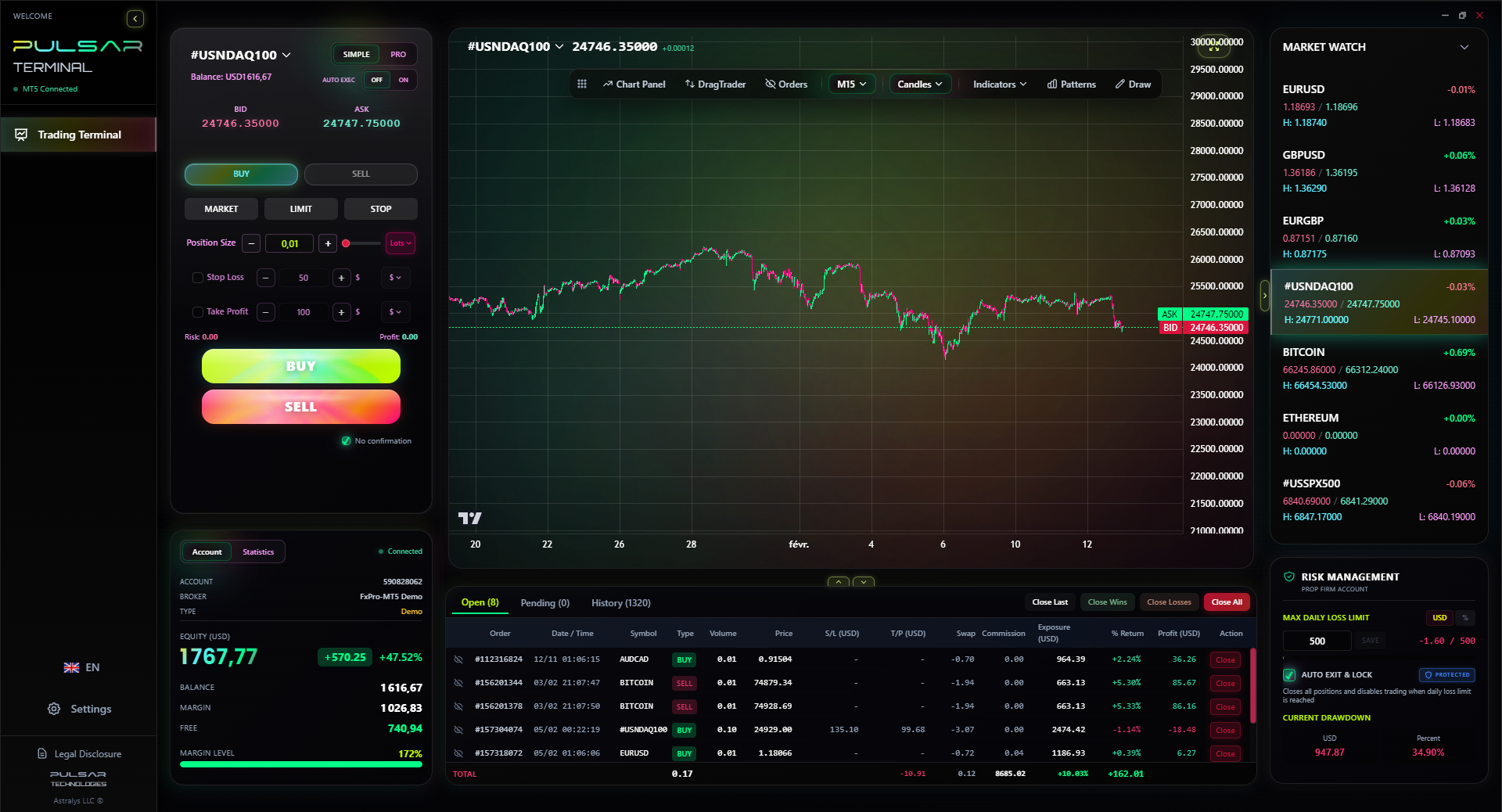
Manually moving stop losses and managing partial exits is where most emotional mistakes happen; Pulsar Terminal automates trailing stops, breakeven moves, and multi-level take profits directly on your MT5 chart.
Pulsar Terminal
The all-in-one MT5 companion: drag-and-drop orders, multi-TP/SL, trailing stop, grid trading, Volume Profile, and prop firm protection. Used by 1,000+ traders daily.
Let me save you some money and heartache. Here are the classic mistakes everyone makes with their first real account.
Chasing Bonuses: A 100% deposit bonus sounds great. The fine print usually says you need to trade a massive volume (like 2 million USD) before you can withdraw any money, including your deposit. It's a trap. Ignore bonuses.
Over-trading: You're bored, the market is flat, so you take a low-probability trade just to 'be in the game'. That's how you lose. No trade is better than a bad trade. This is crucial for swing trading patience.
Revenge Trading: You lose R200 on a trade. You immediately jump back in with double the size to 'make it back fast'. This is the fastest route to a blown account. After a loss, walk away. Close the platform.
Ignoring Fundamentals on ZAR Pairs: Trading USD/ZAR on pure technicals is risky. SARB interest rate decisions, political headlines, load-shedding news - they cause massive spikes. Check the economic calendar.
Not Understanding the Spread: Entering and exiting a trade immediately costs you the spread twice (on entry and exit). If the spread is 5 pips on USD/ZAR, you're down R50 on a micro lot before the market moves. That adds up.
My biggest pitfall? Not using a trading journal. I repeated the same mistake for months because I didn't track it. Don't be me.
FAQ
Q1What is the minimum amount to open a forex real account in South Africa?
It varies by broker. Local brokers like Khwezi Trade allow a minimum of R500. Some global brokers with FSCA licenses, like HFM, have a $0 minimum if you use certain methods, but practically, you should start with at least R1,000-R2,000 to allow for proper risk management on small position sizes.
Q2Can I open a real account if I have no trading experience?
Legally, yes. But should you? Absolutely not. The FSCA-mandated financial assessment will likely label you as a beginner, which is fine. However, you must spend significant time on a demo account first. Understand how a pip works, practice with the RSI indicator and MACD indicator, and develop a basic strategy. Trading with real money is not the place to learn the basics.
Q3Is my money safe with an FSCA-regulated broker?
Safer than with an unregulated one, yes. FSCA regulation requires client fund segregation, which protects your money from being used for the broker's business expenses. However, it is not a guarantee like a bank deposit. Forex trading is inherently risky, and you can lose your capital through trading losses. The FSCA protects against broker fraud, not your own bad trades.
Q4What's better for a beginner: MT4 or MT5?
For pure forex, MT4 is simpler and has more custom indicators available. MT5 is more powerful for stocks and futures, but its forex order handling is slightly different. Most South African brokers offer both. I'd start with MT4 for its simplicity and vast community support. You can always switch later.
Q5How long does verification (FICA) take?
Typically 24 to 72 business hours. If you submit clear, correct documents (SA ID and a valid proof of address), it can be same-day. Weekends and public holidays will delay the process. If it's taking longer, contact their support - don't just wait.
Q6Can I trade cryptocurrencies on a forex real account in SA?
Yes, many FSCA-regulated brokers offer CFDs on Bitcoin, Ethereum, etc. However, be aware that crypto CFDs are incredibly volatile and may have even higher spreads and wider margin requirements than forex. The FSCA has issued warnings about the risks of crypto trading. Tread very carefully.
Q7What happens if I exceed the 1:30 use limit?
You can't on an FSCA-regulated retail account. The broker's platform will cap your available use at the legal maximum. If you see a broker offering you 1:500 and they claim to be FSCA-regulated, double-check their license status - they might be offering an offshore entity, which carries higher risk.
Prof. Winston's Lesson
Key Takeaways:
- ✓Only use an FSCA-licensed broker. It's non-negotiable.
- ✓Start with a local broker for ZAR funding simplicity.
- ✓Your first deposit should be money you're 100% okay losing.
- ✓Trade 0.01 lots for your first 10 real trades.
- ✓The spread on USD/ZAR is your real cost benchmark.
How useful was this article?
Click a star to rate
Weekly Trading Insights
Free weekly analysis & strategies. No spam.
About the Author
David van der Merwe
Emerging Markets Trader
Johannesburg-based trader with 11 years in emerging market currencies. Specializes in ZAR pairs, FSCA-regulated trading, and South African market analysis.
Comments
Risk Disclaimer
Trading financial instruments carries significant risk and may not be suitable for all investors. Past performance does not guarantee future results. This content is for educational purposes only and should not be considered investment advice. Always conduct your own research before trading.
You Might Also Like

Cara Trading Forex Sukses: 7 Prinsip dari Trader Profesional
Cara trading forex sukses dengan 7 prinsip trader pro: manajemen modal, disiplin, journal trading, backtest. Data nyata, bukan janji profit palsu.
Jam Trading Forex Terbaik untuk Trader Indonesia: Panduan Lengkap dengan Tabel Waktu
Panduan jam trading forex untuk trader Indonesia. Tabel 4 sesi dunia, jam emas 20:00-00:00, sesi mana yang harus dihindari. Data akurat + tips dari trader berpengalaman.
Top 5 Sàn Forex Uy Tín Nhất 2026: Review Jujur dari Trader Indonesia
Top 5 sàn forex uy tín 2026 untuk trader Indonesia. Review jujur: spread, deposit, withdraw, dukungan lokal. Exness, XM, IC Markets & lebih.
Get Pulsar Terminal
All these calculators are built into Pulsar Terminal with real-time data from your MT5 account. One-click position sizing, automatic risk management, and instant calculations.
Get Pulsar Terminal