


Here's the biggest lie you'll hear about prop firms in South Africa: that they're a 'free' way to trade big capital.

David van der Merwe
Emerging Markets Trader ·  South Africa
☕ 11 min read
What you'll learn:
- 1What Exactly Is a Prop Firm? (It's Not What You Think)
- 2The Real Numbers: Fees, Rules, and What You Actually Keep
- 3Which Prop Firms Actually Work for South Africans?
- 4Taxes, Payments & Getting Your Money Home
- 5The Right Mindset & Strategy to Pass
- 6The Quickest Ways to Fail (I've Done Most of These)
- 7So, Should You Actually Do This?

Here's the biggest lie you'll hear about prop firms in South Africa: that they're a 'free' way to trade big capital. It's nonsense. You're paying for a high-stakes audition, and most of you will fail. I've seen too many traders blow their challenge fee on a single reckless trade, chasing the dream without understanding the game. Let's cut through the hype. I'll show you exactly how prop trading works here, what the real numbers look like, and whether you should even bother.
A prop firm, short for proprietary trading firm, gives you their capital to trade. You pass their test (the 'challenge' or 'evaluation'), and if you're good, you get a funded account. Your risk is limited to the fee you paid for the challenge. Their risk is the capital they've allocated to you. It's a performance-based contract, not a magic money tree.
Here's the critical bit for South Africans: most international prop firms are NOT regulated by our Financial Sector Conduct Authority (FSCA). They don't need to be. You're not depositing money for them to manage; you're paying for a service - a chance to prove yourself. They operate under their own home country's rules (like Cyprus or the UK). This isn't inherently bad, but it means your recourse if something goes wrong is different than with your local FSCA broker.
The appeal is obvious. Instead of scraping together R50,000 of your own hard-earned cash, you can trade a $100,000 account for a $500 challenge fee. The psychology changes completely. Or at least, it should. The problem is, for many, it doesn't.

Warning: Don't confuse a prop firm with a managed account service or a broker. A prop firm's business is finding profitable traders. A broker makes money from your spreads and commissions. Their incentives are different.

💡 Winston's Tip
Your challenge fee is tuition, not capital. The moment you pay it, consider it spent on education. This mental shift removes the desperate need to 'get it back' and lets you trade the plan.
This is where dreams meet a spreadsheet. Let's talk specifics.
The Cost of Entry (Evaluation Fees)
You don't get a free shot. You pay a one-time fee to take the challenge. This isn't an investment; it's a tuition fee for a very hard lesson. Prices vary wildly:
- A small $10,000 account challenge might cost you $49.
- A $200,000 account? That could be $1,000 or more.
Think of this fee as your maximum loss. If you blow the challenge, that money is gone. I once paid €299 for a challenge, got overconfident on a USD/ZAR trade, and hit the daily loss limit in 48 hours. A very expensive reminder to respect the rules.
The Challenge Rules (Your New Bible)
You must follow these exactly. No negotiations.
| Rule | Typical Range | What It Means For You |
|---|---|---|
| Profit Target | 8% - 10% in Phase 1 | You need to make this much without breaking other rules. |
| Maximum Daily Loss | Usually 5% | Hit this, and your challenge is failed. Instantly. |
| Maximum Overall Loss | 6% - 10% | Your total equity cannot fall below this level from the starting balance. |
| Minimum Trading Days | Often 5-10 days | Prevents you from hitting a lucky trade and quitting. |
These rules force discipline, which is good. But they also create a specific type of pressure. That 5% daily loss limit is a killer. It means a single bad trade on a 1-lot position can end your whole challenge. You must master your position size calculator before you even think about entering.
The Payday (Profit Splits)
If you pass, you get a funded account. When you make profit, you split it. The standard split starts at 80% for you, 20% for the firm. Some go to 90/10 or even 100% for top performers. Payouts are usually every two weeks or monthly.

Example: You're on an 80/20 split. You make a net profit of $5,000 in a month. You get $4,000, the firm keeps $1,000. That $4,000 is then subject to South African income tax.
And yes, you absolutely must pay tax on that. SARS sees this as income. Ignore this at your peril. The profit you receive is yours, and it's taxable at your marginal income tax rate (which can go up to 45%). Factor this into your real-world returns.
“Passing a prop firm challenge is a different beast from regular trading. You're not just trying to be profitable; you're trying to be profitable within a very tight, unforgiving rule set.”
Not all firms are created equal. You need one that accepts ZA traders, has reasonable fees, and, crucially, a reliable payout history. Here’s a breakdown of the current landscape.
The Established International Players: These are the big names you see advertised everywhere. Firms like FTMO, The5%ers, and FundedNext. They have solid track records, clear rules, and generally process payouts without drama. They accept South African traders without issue. The downside? Everyone and their uncle is using them, so their challenges are competitive. Their spreads and platforms (like MT4/MT5) are usually good, often through partners like Eightcap or ThinkMarkets.
The Newer, Agile Firms: Firms like The Trading Pit, Goat Funded Trader, and FXIFY have gained popularity by offering better conditions - sometimes raw spreads from 0.0 pips, higher profit splits, or more flexible rules. They’re worth researching, but always, always check independent user reviews about payout reliability from other South Africans.
The 'Local' Entrants (A New Trend): This is a recent development. Major brokers are getting in on the action. OANDA Prop Trader launched here in July 2024 (though it's now transitioning to the FTMO group). This is significant because it brings a well-known brand into the space. We're also seeing new dedicated firms like Propexito pop up. This trend tells you the market is growing fast.
My Personal Experience: I've used both FTMO and a smaller firm called BluFX (which has since changed its model). With FTMO, I passed a $50k challenge. My first payout of $1,800 hit my Skrill account in 3 business days, no questions. It was seamless. With the smaller firm, I once waited 11 days for a payout and had to chase them with emails. The lesson? Liquidity and reputation matter.

Pro Tip: Before you pay a cent, join online forums (like local South African trading groups on Facebook or Telegram) and ask: "Has anyone here actually been paid by [Firm Name] recently?" Real user feedback is worth more than any slick website.
💡 Winston's Tip
In a challenge, a 0.5% risk per trade isn't conservative; it's strategic. It gives you 10 trades before hitting the 5% daily limit. Survival is the primary objective of Phase 1.
This is the boring, essential stuff that gets overlooked.
Paying for the Challenge: Most international firms don't accept Rand. You'll pay in USD or EUR. They almost all take credit/debit cards. Crucially, many now accept cryptocurrencies like USDT, Bitcoin, or Ethereum. This can be a cheaper and faster option than your bank card, which will hit you with foreign currency fees.
Receiving Your Profits: You won't get paid in Rand directly into your FNB or Standard Bank account. Payouts are typically in USD or EUR via:
- Bank Wire (slow, expensive with intermediary bank fees)
- Cryptocurrency (fast, lower fees)
- E-wallets like Skrill, Neteller, or PayPal (check if the firm supports them)
You need a receiving wallet for crypto or an e-wallet account. Plan this before you make a profit.
The Tax Man (SARS): This is non-negotiable. When you withdraw profits to your South African bank account (converted to ZAR), that is taxable income. You must declare it on your annual tax return. Keep careful records:
- All payout statements from the prop firm.
- Records of your challenge fees (these might be deductible as a business expense if you're trading professionally, but consult a tax professional).
- Bank statements showing the incoming foreign currency.
I'm not an accountant, but I work with one. My first prop firm payout year, I didn't set aside enough for tax. It was a painful April. Learn from my mistake: set aside at least 25-30% of every payout for SARS.
“The brutal truth is that most traders fail the challenges. The firms publish the stats: pass rates are often between 10% and 30%. That's the reality.”
Passing a prop firm challenge is a different beast from regular trading. You're not just trying to be profitable; you're trying to be profitable within a very tight, unforgiving rule set. Your usual swing trading setup might not work here if the drawdown is too large.
The Psychology: The fee creates pressure. You feel you need to 'get it back.' This leads to overtrading. The daily loss limit creates fear, which leads to taking profits too early. You have to mentally treat the challenge fee as gone. It's the cost of a ticket. The only goal is to follow the process.
Adapting Your Strategy:
- Risk Per Trade is King: With a 5% daily loss limit, your risk per trade should be tiny. I never risk more than 0.5% of the account balance on a single trade during a challenge. This means I can survive a string of losses without panic.
- Aim for Consistency, Not Home Runs: You need 8-10% total. That's 4-5 good trades of 2% each. Don't try to get it all in one go.
- Use Simple, strong Tools: Complex strategies break under pressure. I rely heavily on price action and one or two indicators like the RSI indicator for confluence. I avoid news trading during challenges because the spreads can widen and trigger your stop loss.
- The Power of Breakeven Stops: Once a trade is in profit by 1.5x your risk, move your stop to breakeven. This neutralizes the trade and protects you from a win turning into a loss that hurts your drawdown. Managing trades like this is half the battle.
A tool that automates moving stops to breakeven or trailing stops can be a game-saver, especially when you're watching multiple pairs. It removes emotion from the equation.
💡 Winston's Tip
Before funding, test your strategy against the *specific* rules of your chosen firm. A 10% drawdown strategy is useless for a firm with a 6% max loss. Backtest for rule compliance, not just profit.
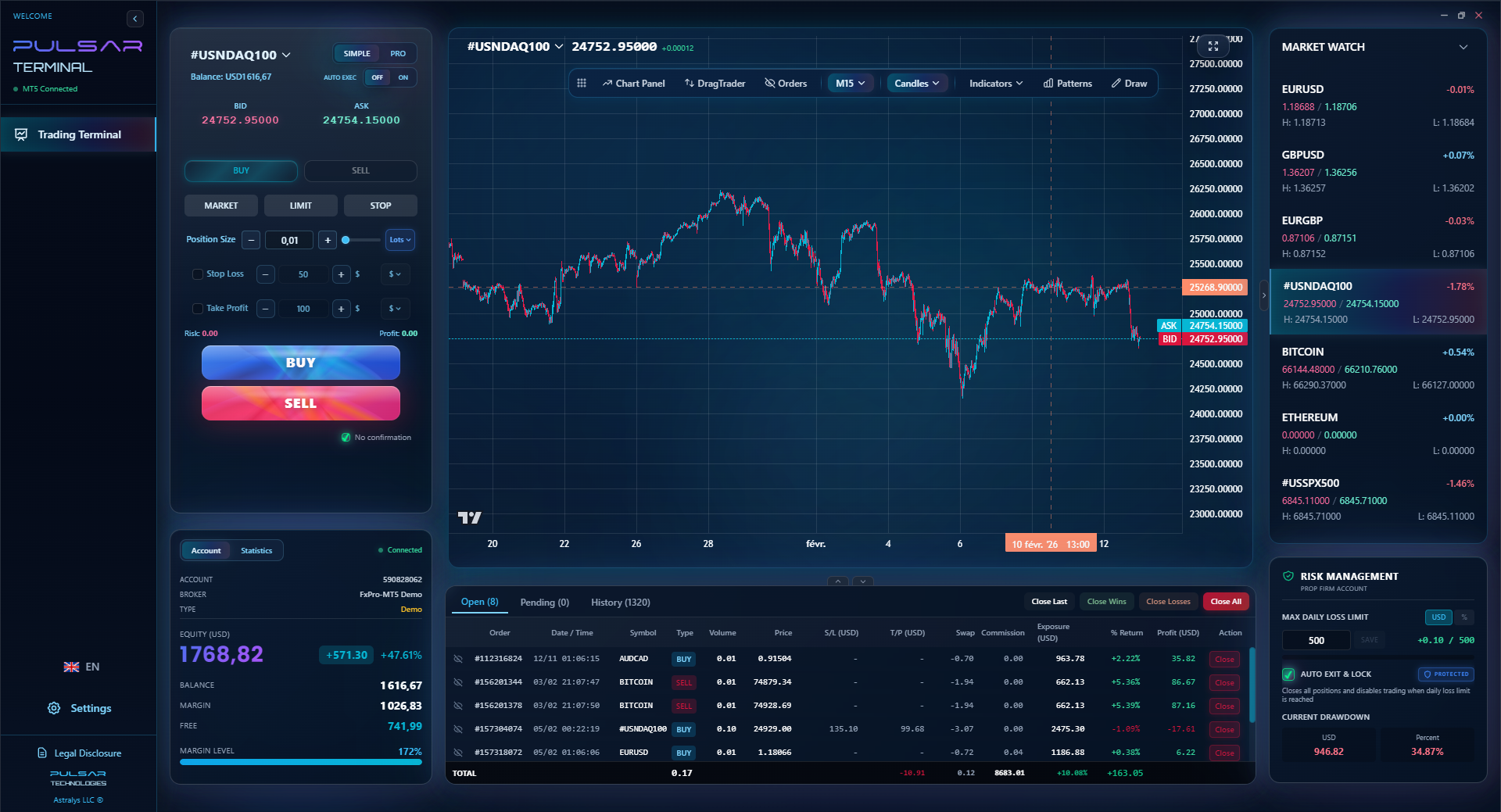
Managing multiple trades and strict prop firm risk limits by hand is a recipe for error; Pulsar Terminal automates breakeven stops, trailing stops, and daily loss protection directly on your MT5 platform.
Pulsar Terminal
The all-in-one MT5 companion: drag-and-drop orders, multi-TP/SL, trailing stop, grid trading, Volume Profile, and prop firm protection. Used by 1,000+ traders daily.
Let me save you some money and heartache by listing my own spectacular failures.
- Trading Too Big, Too Fast: You pass the first 5%. Excitement kicks in. You think, "Let's get this done tomorrow!" You triple your position size. The trade goes 3 pips against you, and suddenly you're down 4% for the day. One more small loss, and you're out. This happened to me. Greed is a faster killer than fear.
- Ignoring the 'Minimum Days' Rule: You're a genius. You make 10% in two days. You stop trading... and fail because you didn't meet the 5 minimum trading days. Read. The. Rules.
- Chasing Losses After a Bad Trade: You hit a 2% loss. The rule is to walk away. Instead, you jump right back in with a 3% risk trade to 'make it back.' This is the number one account destroyer. The daily loss limit turns this into a suicide tactic.
- Not Understanding the 'Overall Drawdown' Rule: It's not just from your starting balance. Some firms calculate it from your equity peak. So if you make 6%, then lose 6%, you're at breakeven, right? Wrong. Your overall drawdown is now measured from that +6% peak. A drop back to start could violate the rule. Know which type your firm uses.
- Picking the Wrong Firm: A firm with terrible spreads will eat your profits. A firm with a history of slow payouts will crush your spirit. Do your homework. Don't just pick the one with the flashiest ads.
Warning: If a firm promises "guaranteed funding" or "no challenge needed," run. That's not a prop firm; it's either a scam or something else entirely. The evaluation is the core mechanism that makes the business model work for them.

“Set aside at least 25-30% of every payout for SARS. My first prop firm payout year, I didn't, and it was a painful April.”
Prop firms in South Africa are a powerful tool, but they're not for everyone. Let's be blunt.
Yes, if:
- You have a proven, written trading strategy with a positive expectancy over at least 3 months of live or detailed demo trading.
- You have rock-solid risk management and the discipline to follow rules robotically.
- You can afford to lose the challenge fee without it affecting your rent or groceries.
- You want to trade sizes far larger than your personal capital allows.
No, absolutely not, if:
- You're a beginner trying to use a prop firm as a learning platform. You'll just burn money.
- You're an emotional trader who can't stick to a plan.
- You see the challenge fee as an 'investment' you must get back.
- Your personal trading account isn't consistently profitable.
The brutal truth is that most traders fail the challenges. The firms publish the stats: pass rates are often between 10% and 30%. That's the reality.
But for the disciplined few, it's a legitimate path. It provides structure, capital, and a clear performance benchmark. It turned my hobby into a business because it forced professionalism I was lacking. Just go in with your eyes wide open. Treat it like a serious business audition, not a lottery ticket.
Start small. Try a $10,000 challenge with a low fee. See if you can operate within the rules. That low-cost experience is more valuable than any course. It'll teach you more about yourself as a trader than a year of demo trading ever could.
FAQ
Q1Are prop firms legal in South Africa?
Yes, participating in prop firm challenges is completely legal. The firms are not regulated by the FSCA because you're not giving them money to manage. You're paying for an evaluation service. It's a contractual agreement, not a regulated financial product.
Q2How much tax will I pay on prop firm profits?
You'll pay standard South African income tax on the profit share you receive. The amount depends on your total annual taxable income. The profits are added to your other income (like your salary) and taxed at your marginal rate, which can range from 18% to 45%. Always consult a tax professional.
Q3What's the best prop firm for beginners in South Africa?
There's no 'best' for beginners, because beginners shouldn't start with prop firms. However, if you have a solid demo track record, start with a firm offering small, cheap challenges (like a $10k account for $50). Look for clear rules, good educational support, and a straightforward platform like MT5. Firms with lower profit targets for the challenge phase (like 8%) can be slightly less pressured.
Q4Can I use my local South African broker as a prop firm?
No, not directly. Your local FSCA-regulated broker (like Exness or XM South Africa) gives you a retail account where you trade your own money. A prop firm gives you their money to trade. However, some international brokers like OANDA now offer separate prop trading programs, which is a new hybrid model.
Q5What happens if I break a rule by accident?
You fail. Immediately and automatically. The rules are enforced by software. There's no 'oops' or appeal if you violate the daily loss or max drawdown. This is why understanding the rules and having a tool that helps you manage risk in real-time is critical to avoid accidental violations.
Q6Is it better to get paid in crypto or bank transfer?
For speed and lower fees, crypto (like USDT) is usually better. A bank wire to South Africa can take days and incur fees from both the sending firm and intermediary banks. Crypto transfers are often near-instant with minimal network fees. Just make sure you have a secure crypto wallet set up.
Prof. Winston's Lesson
Key Takeaways:
- ✓Prop firm fees are tuition, not investments.
- ✓Never risk more than 0.5% per trade during an evaluation.
- ✓SARS taxes your profit share as income. Plan for it.
- ✓Crypto payouts are faster and cheaper than bank wires.
- ✓The 5% daily loss limit is the most common killer.
How useful was this article?
Click a star to rate
Weekly Trading Insights
Free weekly analysis & strategies. No spam.
About the Author
David van der Merwe
Emerging Markets Trader
Johannesburg-based trader with 11 years in emerging market currencies. Specializes in ZAR pairs, FSCA-regulated trading, and South African market analysis.
Comments
Risk Disclaimer
Trading financial instruments carries significant risk and may not be suitable for all investors. Past performance does not guarantee future results. This content is for educational purposes only and should not be considered investment advice. Always conduct your own research before trading.
You Might Also Like

Cara Trading Forex Sukses: 7 Prinsip dari Trader Profesional
Cara trading forex sukses dengan 7 prinsip trader pro: manajemen modal, disiplin, journal trading, backtest. Data nyata, bukan janji profit palsu.
Jam Trading Forex Terbaik untuk Trader Indonesia: Panduan Lengkap dengan Tabel Waktu
Panduan jam trading forex untuk trader Indonesia. Tabel 4 sesi dunia, jam emas 20:00-00:00, sesi mana yang harus dihindari. Data akurat + tips dari trader berpengalaman.
Top 5 Sàn Forex Uy Tín Nhất 2026: Review Jujur dari Trader Indonesia
Top 5 sàn forex uy tín 2026 untuk trader Indonesia. Review jujur: spread, deposit, withdraw, dukungan lokal. Exness, XM, IC Markets & lebih.
Get Pulsar Terminal
All these calculators are built into Pulsar Terminal with real-time data from your MT5 account. One-click position sizing, automatic risk management, and instant calculations.
Get Pulsar Terminal