


Let's cut through the noise.

David van der Merwe
Emerging Markets Trader ·  South Africa
☕ 9 min read
What you'll learn:
- 1What is 'Royal Forex'? A Reality Check
- 2Trading the ZAR: The Real South African Pairs
- 3Choosing a Broker in South Africa: The Practical Guide
- 4Strategies That Work With Rand Volatility
- 5Risk Management: This Isn't a Suggestion, It's Survival
- 6Common Pitfalls (And How I Stepped in Every One)
- 7Building a South African Trading Plan
Let's cut through the noise. You've seen the ads: 'Royal Forex' promising riches with the ZAR/USD. Here's the brutal truth nobody tells you. In 2022, the Financial Sector Conduct Authority (FSCA) issued over 120 warnings against unlicensed forex operators targeting South Africans. The 'royal' treatment often ends with your account at zero. I've traded the rand for over a decade, through Zuma, load-shedding, and everything in between. This isn't about get-rich-quick schemes. It's about understanding the local market, finding an actual edge, and keeping your capital safe from the wolves.
First thing's first. 'Royal Forex' isn't one specific, FSCA-licensed broker you can just sign up with. More often, it's a marketing term used by a bunch of different outfits, some legit, many not. It plays on that desire for a premium, elite trading experience. I fell for this myself back in 2015. Signed up with a platform called 'Royal Markets' or something similarly pompous. Spreads were tight on EUR/USD, but the moment I traded USD/ZAR, the slippage was criminal. I entered a buy at 14.85, and the platform filled me at 14.91. Six pips gone before the trade even started. That's not royal service, that's theft.
Your job is to look past the name. In South Africa, the only title that matters is 'FSCA Authorised Financial Services Provider'. If the broker you're looking at doesn't have that license number plastered everywhere, walk away. It's that simple. These offshore 'royal' entities operate in a grey area, and when things go south (and they will), you have precisely zero recourse. The FSCA can't help you if the broker is registered in St. Vincent or Vanuatu.

Warning: A 'royal' name often masks a bucket shop operation. They profit when you lose. Your first trade isn't against the market, it's against their dealing desk. Verify the FSCA license, every single time.
“The 'royal' treatment often ends with your account at zero.”
If you're trading from SA, you have a natural edge on ZAR pairs. But you have to know what moves them. It's not just global dollar strength.
The Big Three: USD/ZAR, EUR/ZAR, GBP/ZAR
USD/ZAR is the main event. It's liquid, volatile, and reacts to both US data and local SA drama. I've made my biggest wins and most painful losses here. A classic trade: shorting USD/ZAR during a SARB (South African Reserve Bank) rate hike cycle. In late 2021, when the SARB started hiking aggressively to fight inflation, I went short at 15.20, targeting a move back to 14.80. It worked, but the volatility was insane. You need a wide stop. I used a 300-pip stop, which felt huge, but was necessary.
EUR/ZAR and GBP/ZAR are less about SA and more about Eurozone and UK politics. They can trend beautifully. But remember, you're taking on two layers of risk: the Euro and the Rand.
What Actually Moves the Rand?
Forget technicals for a second. Fundamentals rule here.
- SARB Monetary Policy: This is number one. Hawkish = Rand strength (usually). Watch the MPC statements like a hawk.
- Eskom & Load-Shedding Stages: I'm not joking. The market has a direct correlation. Stage 4 load-shedding? The rand sells off. I've seen the USD/ZAR jump 20 pips on a Eskom press conference announcing higher stages.
- Political Risk: ANC policy announcements, cabinet reshuffles, corruption headlines. It creates noise and opportunity.
- Commodity Prices: We're a resource economy. Strong platinum, gold, and coal prices support the ZAR. Use the XAU/USD guide to understand gold's movements, as it's a key driver.

Example: Let's say SARB hikes by 50bps, but Eskom announces Stage 6. The hike is bullish ZAR, but Stage 6 is massively bearish. The market might chop violently. This is where you stand aside. Don't trade confused markets.

💡 Winston's Tip
The rand doesn't care about your opinion on the ANC. Trade the chart in front of you, not the headline on News24.
“Trading your home currency is emotional. You hear bad news on the radio and want to sell the rand. That's not trading, that's reacting.”
This is where you separate the kings from the clowns. You need a broker that gives you clean access to ZAR pairs with fair pricing.
Must-Haves:
- FSCA Regulation: Non-negotiable. Protects your funds up to a certain amount.
- Local ZAR Account: You want to deposit and withdraw in Rands without getting murdered on bank conversion fees.
- Reasonable Spreads on ZAR Pairs: Check USD/ZAR during SA market hours. If the spread is consistently above 8-10 pips on a standard account, they're taking you for a ride.
- MT4/MT5: The standard. Don't get locked into some proprietary 'royal' platform you can't escape.
My Experience with Local and International Brokers: I've used them all. The big international names like IC Markets and Pepperstone offer raw spreads and great execution via their global entities. But, your account is often in USD, so you face currency risk on your deposits. Their ZAR pair liquidity can also be slightly worse than a local specialist.
Local FSCA-licensed brokers have the advantage of seamless ZAR banking. But sometimes their platforms or range of other instruments (like CFDs on JSE stocks) can be limited. You need to decide what's more important: perfect ZAR access or a wider global offering.
Do not, under any circumstances, use an unregulated broker just because they offer a 500:1 use or a massive deposit bonus. That bonus is a leash, not a gift. I learned this the hard way early on; the bonus terms made it impossible to withdraw until I turned over my deposit 50 times. It's a trap.
“Trading your home currency is emotional. You hear bad news on the radio and want to sell the rand. That's not trading, that's reacting.”
Trading the ZAR like you trade the EUR/USD is a recipe for a margin call. You need to adapt.
Swing Trading is Your Friend: Trying to scalp USD/ZAR during a data release is like trying to sip water from a firehose. The spreads widen, slippage is guaranteed, and you'll get stopped out by noise. I focus on 4-hour and daily charts for ZAR pairs. Look for setups around key technical levels that align with the fundamental picture. For example, if USD/ZAR is approaching a major resistance level (say, 19.00) and the US Fed is looking dovish, that's a high-probability short setup. Use a wide stop (200-400 pips) and a target of 300-600 pips. This requires patience and a solid position size calculator to ensure the wide stop doesn't blow up your account.
Use Volatility to Your Advantage: Instead of fearing the big swings, plan for them. When you know SARB is announcing a rate decision, don't have open trades. Wait for the announcement, let the initial spike (and spread widening) happen, then assess the price action. Often, the market will overreact and then retrace. That retracement is a cleaner, lower-risk entry.
A Failed Experiment: I once tried a grid trading bot on EUR/ZAR during a quiet period. It made small profits for weeks. Then, one unexpected political headline caused a 500-pip directional move. The bot kept placing orders against the trend, and I ended up with a massive, unmanageable loss. Automated strategies on volatile exotic pairs are extremely dangerous unless you have deep pockets and even deeper risk controls.
💡 Winston's Tip
Your first calculation before any ZAR trade should be the pip value. If you don't know what a 50-pip loss costs in Rands, you're not ready to click 'buy'.
“use is a test, not a feature.”
This is the most important section. I don't care how good your strategy is. If you mess this up, you're done.
Position Sizing is Everything: With ZAR pairs, a 100-pip move is common. A 1% risk rule is not a gentle guideline. If your account is R50,000, you're risking R500 per trade. On USD/ZAR, where a pip is worth roughly R6.70 per standard lot (R670,000 contract), you need to do the math. To risk R500 on a 100-pip stop, your position size should be tiny - around 0.07 lots. Most new traders size at 1 lot and are wiped out in two bad trades. Use a calculator. Every. Single. Time.
use is a Double-Edged Sword: Local brokers often offer high use (like 100:1 or 200:1) on forex. This is a test, not a feature. Just because you can use 100:1 doesn't mean you should. On volatile pairs, high use will amplify losses to the point of account destruction. I never use more than 10:1 effective use on ZAR pairs. It keeps me in the game.
The Emotional Toll: Trading your home currency is emotional. You hear bad news on the radio and want to sell the rand. That's not trading, that's reacting. You need a system and you need to stick to it. One of my rules: no trading for 30 minutes after major SA news. Let the algorithms fight it out first.
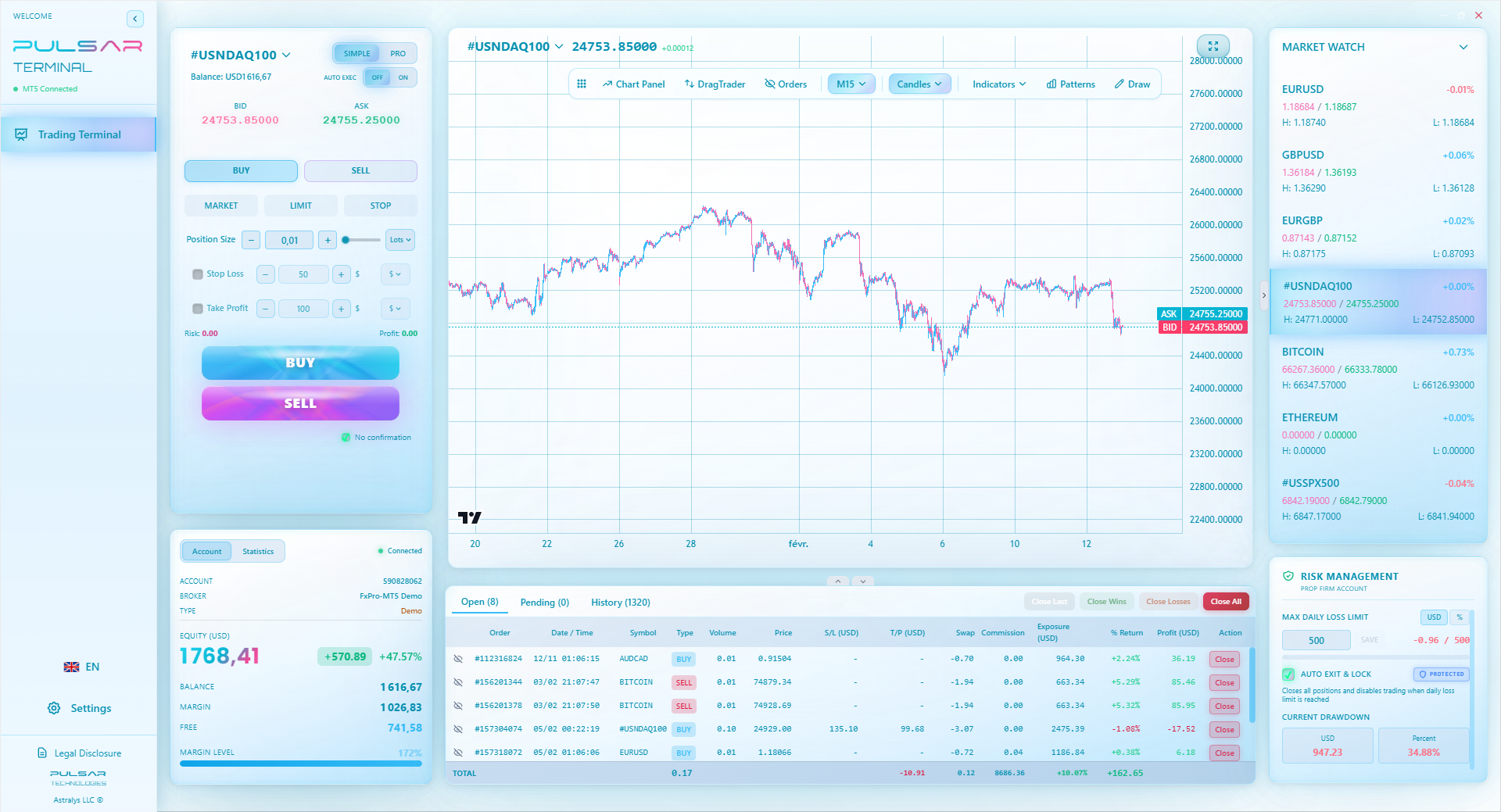
Managing multiple trades on volatile pairs like USD/ZAR is a headache; Pulsar Terminal's drag-and-drop order management and multi-TP/SL features let you adjust your entire plan in seconds directly on your MT5 chart.
Pulsar Terminal
The all-in-one MT5 companion: drag-and-drop orders, multi-TP/SL, trailing stop, grid trading, Volume Profile, and prop firm protection. Used by 1,000+ traders daily.
“use is a test, not a feature.”
Let me save you some money and heartache.
Pitfall 1: Chasing 'Royal' Bonuses. As mentioned, they're a lock-in mechanism. The broker doesn't give you free money. They give you terms that ensure you trade aggressively until you lose.
Pitfall 2: Over-trading During Load-Shedding. Your internet goes down. Your generator kicks in. You're stressed. The market is moving. This is when you make the worst decisions. Have a plan: if load-shedding hits, close all positions or ensure stops are in place. Don't open new ones. The stress cloud is real.
Pitfall 3: Ignoring the 'Spread' on Exotics. You see EUR/ZAR sitting still and think it's a good time to enter. Check the spread. On exotics, it can be 15-20 pips normally. You're down 20 pips the second you click buy. Your trade needs to overcome that just to break even. Factor it into your entry and stop calculations.
**Pitfall 4: Going All-In on a 'Sure Thing'.**nEvery few years, there's a story: 'The Rand is doomed, USD/ZAR to 20!' Or 'New leadership will send the ZAR to 14!' I've gone heavy on these thematic trades. Sometimes I win. Often, the market takes much longer to get there than I can financially withstand. Trade the price action, not the prophecy.
💡 Winston's Tip
The most 'royal' tool you have is your journal. A trader who doesn't review their mistakes is doomed to fund someone else's Bentley.
“The 'royal' path isn't about fancy platforms. It's about disciplined, intelligent execution in a tough market.”
Your plan is your constitution. Write it down.
- Market Selection: I will primarily trade USD/ZAR and EUR/ZAR. I may occasionally trade GBP/ZAR or EUR/USD for diversification, but ZAR pairs are my specialty.
- Timeframes: My analysis will be on the 4H and Daily charts. My entries will be on the 1H or 4H.
- Strategy: I will use a combination of support/resistance and fundamental catalysts (SARB, major US data). I will confirm momentum with the MACD indicator on the 4H chart and overbought/oversold conditions with the RSI indicator.
- Risk Rules: I will never risk more than 1.5% of my account on any single trade. I will calculate position size before every entry. My stop-loss will be placed at a logical technical level, not an arbitrary number.
- Session Rules: I will avoid trading the first 30 minutes after major SA or US data releases. I will not trade if I am affected by load-shedding without a stable UPS/internet solution.
- Review: I will journal every trade - why I took it, the outcome, the emotional state. I will review this journal weekly.
This isn't sexy. But it's what turns a gambler into a trader. The 'royal' path isn't about fancy platforms or empty titles. It's about disciplined, intelligent execution in a tough market. That's how you keep your crown.
FAQ
Q1Is Royal Forex a legitimate, FSCA-regulated broker?
No, 'Royal Forex' as a single, specific broker with that exact name is not a well-known, FSCA-licensed entity. The term is often used in marketing by various firms. The critical step is to ignore the name and verify the FSCA license number of any broker you consider. If they don't have one, they are not operating legally in South Africa.
Q2What is the best pair to trade for a beginner in South Africa?
Start with USD/ZAR. It's the most liquid ZAR pair, and you'll naturally understand the local news that moves it. However, begin with a demo account to get a feel for its volatility. Never start live trading on exotic pairs without experiencing how fast 100-pip moves can happen.
Q3Why is the spread so high on ZAR pairs like EUR/ZAR?
ZAR is an exotic currency with lower liquidity than majors like EUR or USD. Fewer banks and institutions trade it, so the market is thinner. Brokers widen the spread to protect themselves from the higher risk of slippage and to make a profit. It's a cost of doing business you must always factor in.
Q4Can I use international brokers like IC Markets from South Africa?
Yes, you can. Many South Africans use global brokers like IC Markets or Pepperstone for their tight spreads on major pairs. However, your account will likely be in USD, adding a currency exchange layer to your deposits/withdrawals. Also, ensure you are comfortable that you are dealing with their offshore entity, as your recourse will be under a different jurisdiction than the FSCA.
Q5How much money do I need to start trading forex in South Africa?
Technically, some brokers let you start with a few hundred Rand. Practically, I wouldn't recommend starting with less than R10,000. Why? With proper risk management (risking 1% per trade), a R1,000 account means you're only risking R10 per trade. After accounting for spreads and commissions, it's nearly impossible to grow meaningfully. A R10k account allows for more sensible position sizing and room to breathe.
Q6What's the biggest mistake South African traders make?
Using excessive use on volatile ZAR pairs. They see a 200:1 offer and think it's a shortcut. It's a shortcut to a margin call. Combine high use with the natural 100-pip swings of USD/ZAR, and a small move against you can wipe out your entire deposit. Always, always trade with low effective use.
Prof. Winston's Lesson
Key Takeaways:
- ✓Verify FSCA license, ignore fancy names.
- ✓Size for 100-pip ZAR swings (use 1% risk max).
- ✓Trade ZAR on 4H/D charts, not for scalps.
- ✓Load-shedding = no new trades.
How useful was this article?
Click a star to rate
Weekly Trading Insights
Free weekly analysis & strategies. No spam.
About the Author
David van der Merwe
Emerging Markets Trader
Johannesburg-based trader with 11 years in emerging market currencies. Specializes in ZAR pairs, FSCA-regulated trading, and South African market analysis.
Comments
Risk Disclaimer
Trading financial instruments carries significant risk and may not be suitable for all investors. Past performance does not guarantee future results. This content is for educational purposes only and should not be considered investment advice. Always conduct your own research before trading.
You Might Also Like

Cara Trading Forex Sukses: 7 Prinsip dari Trader Profesional
Cara trading forex sukses dengan 7 prinsip trader pro: manajemen modal, disiplin, journal trading, backtest. Data nyata, bukan janji profit palsu.
Jam Trading Forex Terbaik untuk Trader Indonesia: Panduan Lengkap dengan Tabel Waktu
Panduan jam trading forex untuk trader Indonesia. Tabel 4 sesi dunia, jam emas 20:00-00:00, sesi mana yang harus dihindari. Data akurat + tips dari trader berpengalaman.
Top 5 Sàn Forex Uy Tín Nhất 2026: Review Jujur dari Trader Indonesia
Top 5 sàn forex uy tín 2026 untuk trader Indonesia. Review jujur: spread, deposit, withdraw, dukungan lokal. Exness, XM, IC Markets & lebih.
Get Pulsar Terminal
All these calculators are built into Pulsar Terminal with real-time data from your MT5 account. One-click position sizing, automatic risk management, and instant calculations.
Get Pulsar Terminal