


Let's cut through the marketing fluff right now.

David van der Merwe
Emerging Markets Trader ·  South Africa
☕ 12 min read
What you'll learn:
- 1Indices Aren't Forex (And That's Your First Lesson)
- 2The Indices South Africans Actually Trade (And Why)
- 3The Real Costs Your Broker Won't Shout About
- 4Trading Strategies That Actually Work for Indices
- 5Choosing a Broker in South Africa: The FSCA is Non-Negotiable
- 6The Top 3 Mistakes I See (And Made Myself)
- 7How to Place Your First Index Trade (A Step-by-Step Walkthrough)

Let's cut through the marketing fluff right now. Most new traders think 'indices in forex' means they're buying a piece of the JSE. They're wrong, and that misunderstanding will cost them money. You're not buying shares. You're placing a bet on a number's direction using a contract that's more complex than your broker lets on. I've seen too many South Africans get burned on the S&P 500 or DAX because they didn't grasp the instrument. This guide will set the record straight on what you're actually trading, the real costs involved, and how to approach it without blowing up your account.
This is the core misconception. When you hear 'indices in forex,' you're really talking about index CFDs offered by forex brokers. You're not trading on the Johannesburg Stock Exchange itself. You're trading a derivative contract with a broker whose main business is currencies.
The instrument is a Contract for Difference (CFD). When you 'buy' the US30 (Dow Jones), you're entering an agreement with your broker to exchange the difference in the index's price from when you open the trade to when you close it. The broker is your counterparty. This has huge implications for things like overnight financing costs, which we'll get to.
Why does this matter? Because the behaviour, liquidity, and even the quoted price can differ from the actual underlying index. During volatile news events, the CFD spread can widen to ridiculous levels, while the real index trades normally. I learned this the hard way in 2020. I was long on the GER40 (DAX) CFD, and when the ECB made a surprise announcement, my broker's price feed froze for 10 seconds while the spread blew out to 50 points. By the time my order filled, I was already down R1,200 on a trade that should have been near breakeven. The real DAX didn't have that hiccup.

Warning: Your broker's index price is a derived price, not a direct feed from the exchange. Slippage and requotes are more common than with major forex pairs, especially around market opens.
Forget the textbook list. South African traders focus on a handful of indices because of their liquidity and trading hours that fit our timezone. Here’s the real breakdown.
The Global Heavyweights
These are your bread and butter. They're liquid, well-understood, and move on global sentiment.
- US30 (Dow Jones Industrial Average): 30 big US companies. It's a sentiment bellwether. Trades from 3:30 PM to 10:00 PM SAST during our summer, which is perfect for after-work trading.
- SPX500 (S&P 500): The 500 largest US companies. More diversified than the Dow. This is where the big institutional money flows. If you're going to trade one US index, make it this one.
- NAS100 (NASDAQ 100): Tech-heavy. Think Apple, Microsoft, Amazon. It's more volatile, more rewarding, and more punishing. It's fantastic for a swing trading approach if you have the stomach for the swings.
- GER40 (DAX): The German blue-chip index. Its main trading session overlaps with our late morning to afternoon. It's highly reactive to European Central Bank news and German economic data.
The Local Favorite
- JSE40 (FTSE/JSE Top 40): This is the one you think you know. It's the 40 largest companies on the JSE. But here's the kicker: the CFD often has a much wider spread than the global indices - sometimes 8-10 points versus 1-2 on the SPX500. The liquidity isn't as deep either. I trade it less than you'd think.
Trading Sessions Are Key
This is the secret sauce. You don't trade the DAX when the US market is open unless you're specifically playing off US news. Each index has a 'personality' during its own market hours. The NAS100, for example, often has its biggest moves in the last hour of the US session (our late night). I used to try and day-trade it during our evening. I stopped after a string of losses. Now, if I'm not in a swing trade, I only take NAS100 setups after 9 PM SAST.

Example: Let's say the SPX500 CFD is quoted at 5220.5 / 5221.5. That's a 1-point spread. If you buy at 5221.5 and it moves to 5225.5, you're up 4 points. But remember, a 'point' value depends on your contract size. On a standard lot (R100 per point), that's R400. On a mini lot (R10 per point), it's R40. Always, always use a position size calculator before you click buy.

💡 Winston's Tip
The market's job is to take your money. Your job is to not give it to them. On indices, that means respecting session opens and never, ever adding to a losing position because 'it has to bounce.'
“You're not buying shares. You're placing a bet on a number's direction using a contract that's more complex than your broker lets on.”
The spread is just the entry fee. The hidden costs are where they make their money, especially from retail traders who hold positions for days or weeks.
1. The Swap Rate (Overnight Financing): This is the big one. Since you're trading a CFD on use, you're being loaned money to hold the position overnight. You pay (or occasionally receive) interest. For indices, this is usually a daily charge.
Let me give you a real example from my own trading log. In January 2024, I was long on the US30. The buy swap rate was -$4.50 per lot per night. I held 2 mini lots (R20 per point) for 5 nights. That cost me roughly R90 in financing fees ($4.50 * 2 * 5 nights * ~2 ZAR/$ at the time). The trade made a profit, but that R90 came straight off the top. On a losing trade, it's a double whammy.
2. Weekend Swap: Hold a position over the weekend? You'll get charged for THREE nights of financing (Friday, Saturday, Sunday) on Wednesday night. It's not a mistake. It's in the fine print.
3. The Spread Widens at the Worst Times: Market opens, major news events (like US Non-Farm Payrolls), and low-liquidity periods (like late Friday SAST). Your broker's 1-point spread on the SPX500 can easily become 5 or 10 points. If you're using tight stop-losses, you'll get taken out by the spread, not the market move.
4. Inactivity Fees: Some brokers still have them. If you don't trade for a few months, they'll start nibbling at your balance.
My advice? Factor in at least 0.5% to 1% of your intended profit target to cover these costs. If your plan is to make 2% on a trade, the market needs to move 2.5-3% in your favour just for you to break even after costs. This is why so many scalping strategies fail on indices - the costs eat the tiny profits.
Trading the JSE40 like you trade the EUR/USD is a recipe for frustration. Indices have their own rhythms.
Follow the Session Leader
Indices trend beautifully during their own market hours. The best trend signals often come at the open. I watch for a strong move in the first 30-60 minutes of the US cash session (3:30 PM SAST) and then look for pullbacks to join the trend. Trying to guess the direction before the open is gambling.
Use Index-Specific Correlations
- US Indices & USD: A strong US dollar can hurt multinational earnings, potentially weighing on the SPX500. It's not a perfect inverse correlation, but it's a context you must be aware of.
- Tech & Bond Yields: The NAS100 is hypersensitive to US Treasury yields. Rising yields (especially real yields) hurt tech stock valuations. I have the US 10-year yield chart open next to my NAS100 chart at all times.
- DAX & EUR/USD: The DAX often has a positive correlation with EUR/USD. A weaker Euro helps German exporters.
Support & Resistance is King
Because indices are made of many stocks, they respect big, round numbers and previous swing highs/lows with an almost eerie precision. A simple strategy I've used for years: Identify the previous day's high and low. If price breaks and closes above the previous day's high, I look for a long entry on a retest. My stop goes just below that breakout level. This works because you're trading the confirmation of a new intra-day trend.
Indicators? Keep it simple. A 20-period and 50-period Exponential Moving Average (EMA) on the 1-hour or 4-hour chart to define the trend. The RSI indicator for spotting overbought/oversold conditions within that trend. I wasted years overlaying 5 different oscillators. Price action and volume (via the futures market, if your platform shows it) tell you more.

Pro Tip: Don't trade index CFDs in the first 15 minutes after your broker's 'daily cash adjustment.' This is when they roll the contract forward. The spread is insane and the price can jump erratically. Go make a cup of rooibos instead.
💡 Winston's Tip
If you can't articulate the fundamental reason (e.g., central bank policy, earnings season, bond yield move) behind your technical index trade, you're just guessing. Context is your armour.

“I lost more money on 'good setups' in the wrong session than on bad setups in the right one.”
This is the most important decision you'll make. Your broker is your business partner. A bad one will fail you when you need them most.
Regulation is Everything: Only use a broker regulated by the Financial Sector Conduct Authority (FSCA). This isn't a suggestion; it's a survival rule. The FSCA ensures client money segregation, fair pricing practices, and gives you a recourse if things go south. An offshore broker might offer 1000:1 use. It also might disappear with your deposit. I've had clients come to me after that happened. Don't be that person.
What to Look For:
| Feature | What to Ask For | Why It Matters for Indices |
|---|---|---|
| Regulation | A valid FSP number from the FSCA. Check it on the FSCA website. | Legal protection and fund safety. |
| Spreads | The average spread on the SPX500 and JSE40 during market hours. Not the advertised 'from' spread. | Your biggest direct trading cost. |
| Swap Rates | The detailed swap sheet. How much will it cost to hold a long/short position on the US30 overnight? | Your biggest hidden cost. |
| Platform | MT4, MT5, or cTrader. These are industry standards with proper charting tools. | You need reliable execution and good charts. |
| Funding | Local EFT (FNB, Absa, etc.) with no or low fees. Withdrawals in ZAR within 1-3 business days. | Getting your profits out should be easy. |
Brokers like IC Markets and Pepperstone have strong international reputations and FSCA-regulated entities for South African clients. Exness is another popular choice, but always, always verify the specific entity you're signing up with is FSCA-regulated.
use: The FSCA has guidelines limiting use for retail clients. Expect maximum use around 30:1 or 50:1 for major indices. This is a good thing. Anyone offering you 500:1 on indices is selling you a margin call waiting to happen. I use a maximum of 10:1 on index trades. Survival first, get rich second.
1. Trading Without a Session Map: This was my mistake for two years. I'd see a nice setup on the DAX at 8 PM SAST. The problem? The European session had been closed for hours. I was trading a dead, illiquid market prone to random spikes. The setup was technically perfect, but the context was all wrong. I lost more money on 'good setups' in the wrong session than on bad setups in the right one.
2. Ignoring Earnings Season: The US indices are driven by their component stocks. When Apple, Microsoft, Amazon, etc., report earnings, the index can gap at the open. Holding a position through a major component's earnings report is pure gambling. I learned this by being short the NAS100 ahead of a big tech earnings week. Four companies beat expectations, the index gapped up 2% at the open, and I was stopped out for a 1.5% account loss before I'd even finished my morning coffee.
3. Using Forex Money Management on Indices: A 20-pip stop loss on EUR/USD is normal. A 20-point stop loss on the SPX500 is microscopic noise. Indices have larger daily ranges. You need wider stops, which means you must trade smaller position sizes to keep your risk (in Rands) the same. If you risk 1% of your account per trade, that 1% must be defined by your stop distance. A R10,000 account risking 1% (R100) with a 50-point stop on the SPX500 means you can only trade R2 per point. Don't let your ego make you trade bigger.
Managing these trades manually, especially setting multiple take-profit levels or moving your stop to breakeven, is a hassle. That's where tools built for MT5 come in handy.
💡 Winston's Tip
Your first profit target should always be to get to breakeven. Move your stop-loss to your entry price as soon as the trade gives you enough room. A breakeven trade is a lesson paid for, not a loss.

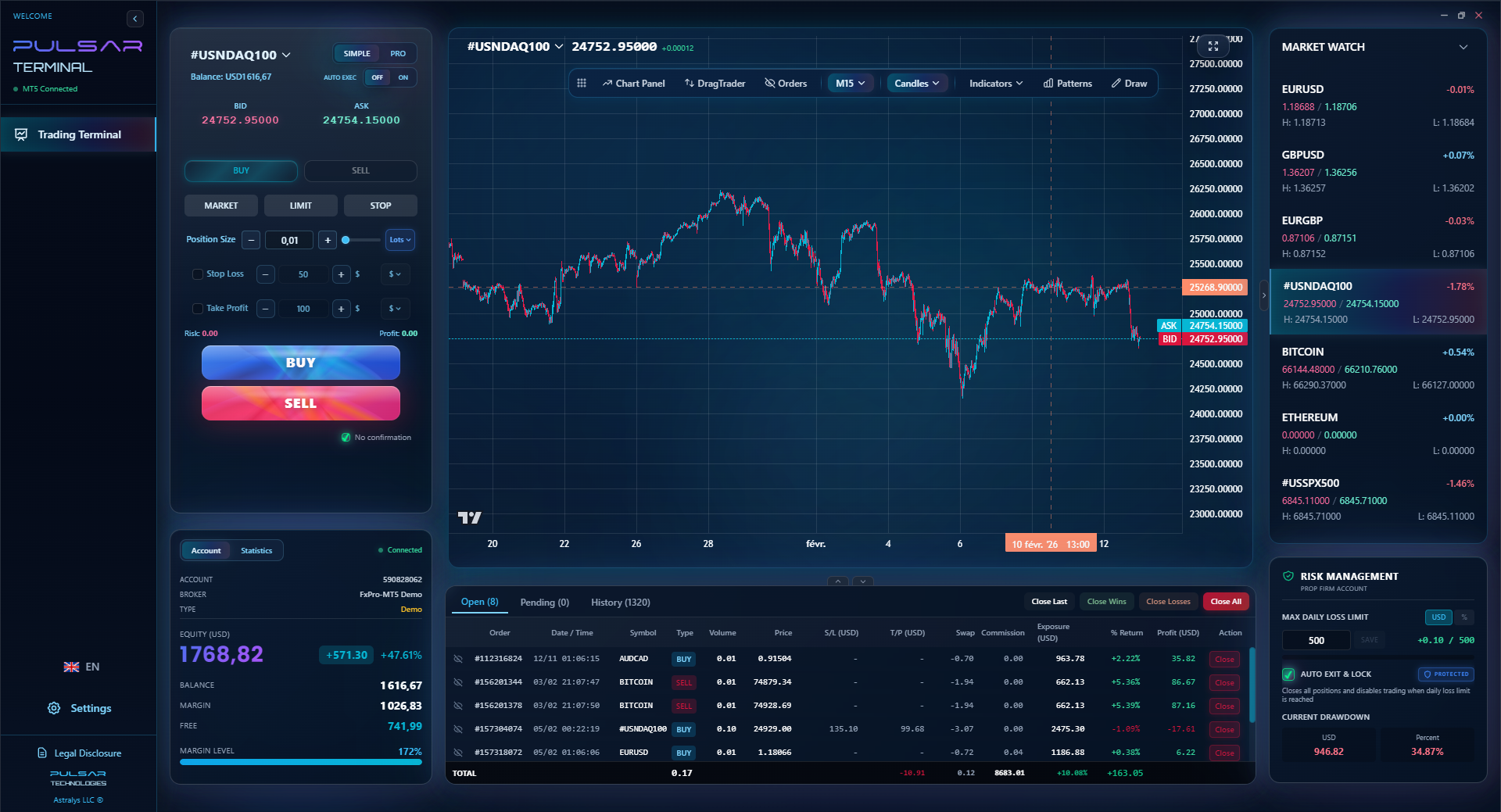
Managing multiple take-profit levels and moving stops to breakeven on index trades is a manual headache, but tools like Pulsar Terminal automate this directly on your MT5 platform.
Pulsar Terminal
The all-in-one MT5 companion: drag-and-drop orders, multi-TP/SL, trailing stop, grid trading, Volume Profile, and prop firm protection. Used by 1,000+ traders daily.
“Survival first, get rich second. Anyone offering you 500:1 on indices is selling you a margin call waiting to happen.”
Let's make this concrete. You've done your research, chosen an FSCA-regulated broker like XM or IC Markets, and funded your account with R5,000. You're using a demo account first (you are, right?). Here's how the process looks.
Step 1: The Analysis (Monday Afternoon SAST) You're looking at the SPX500. The US session opens at 3:30 PM SAST. At 3:00 PM, you check the 4-hour chart. Price is above the 50 EMA, and the MACD indicator is above its signal line on the 1-hour chart. The overall trend is up. You decide to look for a long trade after the US open.
Step 2: The Setup (3:45 PM SAST) The market opens and pushes higher, then pulls back to a small support level that was resistance last week. This is your potential entry zone.
Step 3: The Trade Plan
- Instrument: SPX500 CFD
- Direction: Buy (Long)
- Entry Price: 5230.0 (if price holds at support)
- Stop-Loss: 5215.0 (15 points below entry). This is placed below the recent swing low.
- Take-Profit 1: 5245.0 (15 points, 1:1 risk-reward)
- Take-Profit 2: 5260.0 (30 points, 2:1 risk-reward)
- Position Size: Your risk is 1% of R5,000 = R50. Your stop is 15 points. R50 / 15 points = R3.33 per point. You round down to R3 per point (a mini lot size on many platforms).
Step 4: Execution & Management You place the buy limit order at 5230.0 with your stop and take-profits attached. The order fills. Now you manage. If price hits TP1 at 5245, you could close half the position and move your stop-loss on the remainder to your entry price (breakeven). This locks in some profit and removes risk from the trade.
Step 5: The Review Win or lose, you journal it. Why did you take the trade? Did the session context help? How were the spreads at the time of entry? This feedback loop is what turns a gambler into a trader. Your first ten trades should be on a demo account, following this exact process until it's muscle memory.
FAQ
Q1Is trading indices in forex legal in South Africa?
Yes, it is completely legal, provided you use a financial services provider that is licensed and regulated by the Financial Sector Conduct Authority (FSCA). Trading with unregulated offshore brokers is not illegal for you as a client, but it offers zero protection if the broker fails or engages in malpractice.
Q2What's the minimum amount I need to start trading indices?
Technically, some brokers allow you to start with a few hundred Rand. Practically, I wouldn't recommend starting with less than R5,000. With less, your position sizing becomes so small that costs (as a percentage) eat you alive, and you can't properly implement risk management. It's not about getting rich quick; it's about having enough capital to trade professionally.
Q3What is the best time of day to trade indices from South Africa?
The sweet spot is between 3:30 PM and 7:00 PM SAST. This covers the first few hours of the US market open (when volatility is high) and the overlap with the end of the European session. The DAX (GER40) is best traded between 10:00 AM and 5:00 PM SAST during its main market hours.
Q4Do I pay tax on profits from trading index CFDs in South Africa?
Yes. Profits from CFD trading are generally considered capital gains for tax purposes in South Africa. You have an annual exclusion (around R40,000). Gains above that are included in your taxable income and taxed at your marginal rate. Keep detailed records of all your trades. I'm a trader, not an accountant - consult a tax professional for advice specific to your situation.
Q5What's the difference between the JSE40 index and the JSE40 CFD?
The JSE40 index is the actual benchmark calculated by the JSE. The JSE40 CFD is a derivative contract offered by your broker that tracks that index's price. You don't own the index or any dividends. You are subject to the broker's spreads, swap fees, and execution on the CFD. The CFD price will mostly follow the index, but not perfectly, especially in fast markets.
Q6Why does my index CFD price sometimes differ from the price on the news?
The news typically quotes the futures price (e.g., E-mini S&P 500 futures), which is the primary trading vehicle for institutions. Your broker's CFD price is often derived from these futures prices but may have a slight markup/down adjustment for dividends and financing costs. During high volatility or after hours, the difference can be more pronounced.
Prof. Winston's Lesson
Key Takeaways:
- ✓Indices in forex are CFDs, not direct assets. Know your instrument.
- ✓Session timing is more important than indicator signals.
- ✓Swap fees are a silent killer for swing traders.
- ✓FSCA regulation is non-negotiable for South Africans.
- ✓Use wider stops and smaller sizes than you do with forex.
How useful was this article?
Click a star to rate
Weekly Trading Insights
Free weekly analysis & strategies. No spam.
About the Author
David van der Merwe
Emerging Markets Trader
Johannesburg-based trader with 11 years in emerging market currencies. Specializes in ZAR pairs, FSCA-regulated trading, and South African market analysis.
Comments
Risk Disclaimer
Trading financial instruments carries significant risk and may not be suitable for all investors. Past performance does not guarantee future results. This content is for educational purposes only and should not be considered investment advice. Always conduct your own research before trading.
You Might Also Like

Cara Trading Forex Sukses: 7 Prinsip dari Trader Profesional
Cara trading forex sukses dengan 7 prinsip trader pro: manajemen modal, disiplin, journal trading, backtest. Data nyata, bukan janji profit palsu.
Jam Trading Forex Terbaik untuk Trader Indonesia: Panduan Lengkap dengan Tabel Waktu
Panduan jam trading forex untuk trader Indonesia. Tabel 4 sesi dunia, jam emas 20:00-00:00, sesi mana yang harus dihindari. Data akurat + tips dari trader berpengalaman.
Top 5 Sàn Forex Uy Tín Nhất 2026: Review Jujur dari Trader Indonesia
Top 5 sàn forex uy tín 2026 untuk trader Indonesia. Review jujur: spread, deposit, withdraw, dukungan lokal. Exness, XM, IC Markets & lebih.
Get Pulsar Terminal
All these calculators are built into Pulsar Terminal with real-time data from your MT5 account. One-click position sizing, automatic risk management, and instant calculations.
Get Pulsar Terminal