


Here's a statistic that should keep you up at night: over 70% of retail forex traders lose money.

Olumide Adeyemi
West African Trading Pioneer ·  Nigeria
☕ 9 min read
What you'll learn:
Here's a statistic that should keep you up at night: over 70% of retail forex traders lose money. In Nigeria, I'd argue that number is higher, and use is the main reason why. Everyone talks about the potential for 100:1 use turning N50,000 into N5,000,000. No one wants to admit it works just as fast in reverse. So, what does use mean in forex? It's a bank loan from your broker that lets you control a massive position with a tiny deposit. It's the ultimate double-edged sword, and most people cut their own hands off with it.
Forget the textbook definitions. Let's make this real. Imagine you want to buy a Bungalow in Lekki worth N50 million, but you only have N500,000. A bank says, 'Here, use this N49.5 million loan.' That's 100:1 use. You control the whole asset with just 1% of its value.
In forex, it's the same. Your broker lends you money to trade bigger lots. The 'margin' is your own cash deposit. If you have N100,000 and use 50:1 use, you can control a position worth N5,000,000. Your profit or loss is calculated on that full N5m, not your initial N100k.

Warning: This is where new traders get wrecked. They see N100k controlling N5m and think 'easy money.' They forget that a 2% move against them wipes out their entire capital. That's not a rare event in forex; it happens all the time.
I learned this the hard way in 2015. I put N200,000 on a USD/NGN trade with 100:1 use at a broker like Exness. The CBN made an unexpected announcement, the pair spiked 1.5%, and I got a margin call. My account went to zero in under an hour. I was trading a size my capital couldn't stomach.
“use is a bank loan from your broker that lets you control a massive position with a tiny deposit.”
Let's break down a real trade with numbers you can feel.
The Setup:
- Account Balance: N500,000
- use Chosen: 30:1
- Instrument: EUR/USD
- Trade: Buy 1 standard lot (100,000 units)
The Math Behind the Trade
Without use, to control 100,000 EUR, you'd need about $120,000 (or over N150 million at current rates). Impossible with N500k.
With 30:1 use, your required margin is just 1/30th of the trade size. For a 1-lot EUR/USD trade (roughly $120,000), the margin is about $4,000, which is roughly N5 million? Wait, that doesn't add up. Let's correct this with the actual forex margin calculation.
For a 1-lot (100k units) EUR/USD trade where EUR/USD = 1.0800:
- Trade Value = 100,000 EUR * 1.0800 = $108,000
- Required Margin (30:1) = $108,000 / 30 = $3,600
At an exchange rate of ~N1,500/$, that's about N5.4 million in margin. Your N500,000 isn't enough! This is the critical point. You're not trading the full N500k. You're using it as a deposit to borrow much more. For a 1-lot trade with 30:1, you'd need a broker that allows 'margin in units of base currency' or you'd trade a smaller size, like a 0.1 lot (mini lot).

Example: Let's use a mini lot (0.1 lot).
- Trade Value = 10,000 EUR * 1.0800 = $10,800
- Required Margin (30:1) = $10,800 / 30 = $360 (~N540,000)
- Your N500,000 can cover this.
- Now, if EUR/USD moves 1% (108 pips) in your favor:
- Profit = 10,000 EUR * 0.0108 = $108
- In Naira: $108 * 1,500 = N162,000 profit.
- On your N500k capital, that's a 32.4% return from a 1% market move.
- If it moves 1% against you? You lose N162,000 instantly.
This is the power and the peril. A small market move creates a huge swing in your equity. This is why a solid scalping strategy needs tight stops, and why swing trading requires careful position sizing.

💡 Winston's Tip
If you can't explain your trade's risk in Naira before you enter, you have no business entering it. use makes this calculation non-optional.
“If you're asking 'what does use mean in forex,' you have no business above 30:1.”
Brokers offer different levels. Here’s what you’ll typically find and what it really means for your risk.
| use Ratio | What It Means | Required Margin | Good For... | The Reality in Nigeria |
|---|---|---|---|---|
| 10:1 | For every N1 you have, control N10 | 10% | Conservative traders, beginners | Actually smart, but feels 'slow' to most. |
| 30:1 | Control N30 with N1 | ~3.33% | Balanced risk/reward | A sensible middle ground if you have discipline. |
| 50:1 | Control N50 with N1 | 2% | Common retail offering | Where most people start (and often blow up). |
| 100:1 to 500:1 | Control N100-N500 with N1 | 1% - 0.2% | Highly experienced, short-term trading | The danger zone. A 0.5% move can wipe 50% of your margin. |
International brokers like IC Markets or Pepperstone might offer up to 500:1 on certain accounts. Nigerian-focused brokers might cap it lower due to regulatory nuances. My blunt advice? If you're asking 'what does use mean in forex,' you have no business above 30:1. Start at 10:1. Prove you can be consistently profitable for six months, then maybe consider moving up. High use is a privilege, not a right.

Pro Tip: Your broker's use setting is a MAXIMUM, not a mandate. You can use less. If your account is set to 100:1, you can still trade as if it's 10:1 by simply using a smaller position size. Always use a position size calculator before every trade.
“If you're asking 'what does use mean in forex,' you have no business above 30:1.”
use doesn't just amplify losses; it introduces specific, account-killing mechanics.
1. Margin Call: This is your broker's warning siren. When your losses eat up most of your margin, your equity falls below a required level (e.g., 50% of used margin). The broker alerts you to add funds or close positions. In my experience, by the time you get the email or SMS, it's often too late. The market moves too fast.
2. Stop Out: This is the execution. If your equity falls to a critical level (e.g., 20% of used margin), the broker's system automatically starts closing your losing positions, starting with the biggest loser. You have zero control. It happens at the worst possible price, often during high volatility.
Here's a personal story with a 'successful' trade that nearly went bad. I shorted Gold (XAU/USD) with 50:1 use. I entered at $1845, stop loss at $1855. My position was too large. Gold spiked to $1854.50. I was seconds from a stop-out, sweating bullets. It reversed and I took profit at $1820 for a nice gain. But that feeling of helplessness? That's use risk. I got lucky. I was right on the trade but wrong on the position size. I celebrated the profit but knew I'd broken my own rules.
The psychological pressure of a leveraged trade with a tight stop is immense. It makes you jump at shadows, close winners early, and let losers run. It corrupts your entire process.
💡 Winston's Tip
The market doesn't care about your use ratio. It only cares about your position size. Focus on controlling the latter, and the former becomes irrelevant.
“High use is a privilege, earned through consistency, not a right given with a sign-up bonus.”
You can use this tool without self-destructing. It requires a system, not just hope.
Rule 1: use is a Function of Your Stop Loss. This is the golden rule. Your position size should be determined by how much you're willing to lose (e.g., 1-2% of account), and the distance to your stop loss. A tight stop allows for a larger position size (higher effective use). A wide stop demands a smaller size (lower effective use). Never decide your lot size first.
Rule 2: The 1% Rule is Non-Negotiable. Risk a maximum of 1% of your account balance on any single trade. If you have a N1,000,000 account, that's N10,000. If your stop loss is 50 pips away on EUR/USD, you work backwards to find the position size that loses N10,000 if hit. This automatically caps your effective use.
Rule 3: Lower use for High-Volatility Pairs. Pairs like GBP/JPY or during major news events are wild. Use half your normal use or avoid trading them altogether. Stick to more stable majors like EUR/USD when you're learning.
Rule 4: Build a Buffer. If your broker stops you out at 20% margin level, never let your account equity get near 50%. Act as if your own personal stop-out level is 70%. This gives you a huge psychological and financial cushion.
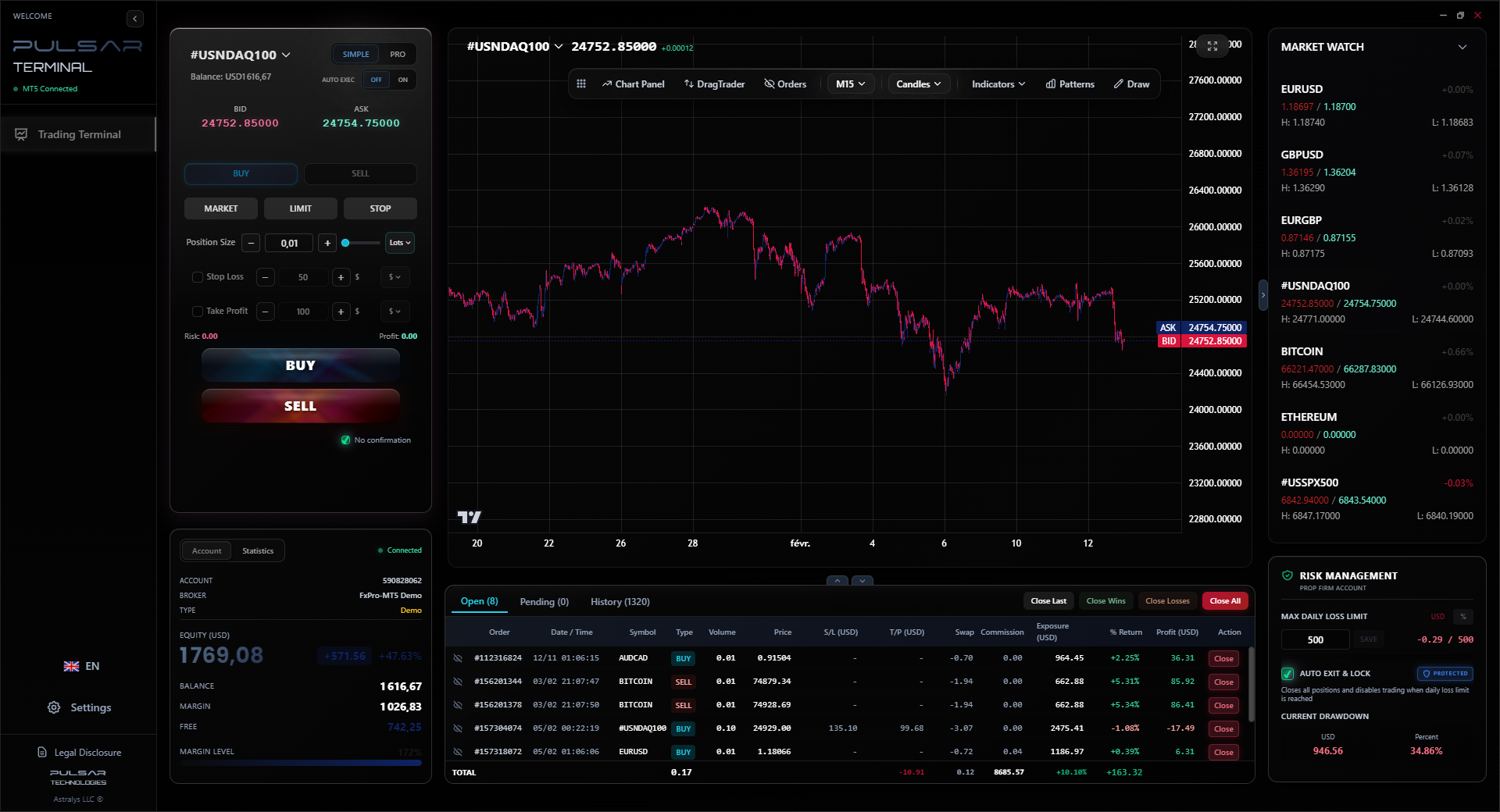
Rule 5: Use Technology to Enforce Discipline. This is where tools become your risk manager. Setting a trailing stop or a breakeven order manually is stressful and easy to forget.
Manually moving stops to breakeven or trailing a winner is prone to error and emotion, which is why automating these actions with a tool like Pulsar Terminal directly on your MT5 platform is a game-saver for leveraged trading.
Pulsar Terminal
The all-in-one MT5 companion: drag-and-drop orders, multi-TP/SL, trailing stop, grid trading, Volume Profile, and prop firm protection. Used by 1,000+ traders daily.
“High use is a privilege, earned through consistency, not a right given with a sign-up bonus.”
This is a huge topic here. Prop firms promise you a funded account if you pass a challenge with strict rules: a profit target (e.g., 10%) and a maximum daily loss (e.g., 5%).
Here's the trap: The challenges often allow high use (like 100:1). Traders see this and think, 'Great! I'll use high use to hit the 10% target fast!' This is the fastest way to fail. That 5% daily loss limit is incredibly tight with high use. Two bad trades in a row can end your challenge.
The smart approach? Use very low effective use during the challenge. Aim for consistent 0.5-1% gains per day, not home runs. The goal is to pass, not to impress anyone. The use is there for flexibility, not for maximum aggression.
Also, consider the Nigerian reality: internet stability. There's nothing worse than being in a highly leveraged trade during a 'light issue' or data network drop. You can't manage your trade. This alone is a compelling reason to use lower use and wider stops, giving you time to react when the lights come back on.
💡 Winston's Tip
A demo account is useless if you trade it with N10 million fantasy money and 500:1 use. Use realistic capital and use to simulate real psychological pressure.
“The greatest traders aren't defined by how much use they use, but by how long they survive.”
Understanding what use means in forex is a technical first step. Mastering it is a psychological battle.
You have to fight the ego that says, 'My N200,000 should be making N50,000 a day.' That ego will kill your account. Respect the market. It is infinitely larger and more powerful than you, use or not.
Start a demo account. Not for a week, but for 3-6 months. Trade with a virtual N1,000,000. Use 10:1 use. Impose the 1% risk rule. Try to grow it consistently without a single blow-up month. Only then consider real money.
Remember, the greatest traders in the world aren't defined by how much use they use, but by how long they survive. Survival comes from risk management, and use is the first variable you must control. Don't let the dream of quick riches in Naira blind you to the mathematical certainty of ruin if you're careless. Trade small, trade smart, and stay in the game.
FAQ
Q1What is a good use for a beginner forex trader in Nigeria?
10:1. Full stop. It forces you to focus on making good trades rather than hoping for a lottery ticket. It limits your losses while you learn. Anyone telling you to start higher is ignoring the 70%+ failure rate.
Q2Can I lose more money than I deposit with use?
With most reputable retail brokers, no. Your loss is limited to the funds in your trading account due to 'negative balance protection.' However, during extreme market gaps (like the SNB event in 2015), some brokers did pass on losses. Always read your broker's terms. The real risk isn't owing extra money; it's losing your entire deposit, which happens very easily.
Q3How is use different from margin?
use is the ratio (e.g., 50:1). Margin is the actual amount of your own money (the deposit) required to open and hold that leveraged position. If use is the loan agreement, margin is the collateral you put down.
Q4Do professional traders use high use?
Rarely in the way retail traders think. Institutional traders might use use, but their position sizes are relative to massive capital pools, and their risk is carefully calculated down to the basis point. A prop trader might use higher use for short-term plays, but their risk per trade is still a tiny fraction of their overall capital. They use use for efficiency, not for magnification.
Q5Should I use maximum use on a winning streak?
Absolutely not. This is a classic mistake. A winning streak is often followed by overconfidence. Increasing use at this point sets you up for a single, catastrophic loss that wipes out all your previous gains. Stick to your risk percentage. If your account has grown, your 1% risk in Naira terms is larger, allowing you to naturally trade slightly bigger positions safely.
Q6How do I calculate my position size with use?
Don't start with use. Start with risk. 1) Decide the % of your account you'll risk (e.g., 1%). 2) Convert that to Naira (e.g., 1% of N500k = N5,000). 3) Determine your stop loss in pips for your trade. 4) Use a position size calculator to input your risk amount, stop loss, and pair. It will tell you the correct lot size. The use is just a byproduct of this calculation.
Prof. Winston's Lesson
Key Takeaways:
- ✓Start with 10:1 use maximum.
- ✓Never risk more than 1% of capital per trade.
- ✓Position size is determined by stop loss, not use.
- ✓Prop firm challenges demand lower use, not higher.
- ✓A 2% market move can wipe out a 50:1 leveraged account.
How useful was this article?
Click a star to rate
Weekly Trading Insights
Free weekly analysis & strategies. No spam.
About the Author
Olumide Adeyemi
West African Trading Pioneer
One of Nigeria's most active forex trading educators. 8 years of experience trading from Lagos. Specializes in low-capital strategies and prop firm challenges for African traders.
Comments
Risk Disclaimer
Trading financial instruments carries significant risk and may not be suitable for all investors. Past performance does not guarantee future results. This content is for educational purposes only and should not be considered investment advice. Always conduct your own research before trading.
You Might Also Like

Cara Trading Forex Sukses: 7 Prinsip dari Trader Profesional
Cara trading forex sukses dengan 7 prinsip trader pro: manajemen modal, disiplin, journal trading, backtest. Data nyata, bukan janji profit palsu.
Jam Trading Forex Terbaik untuk Trader Indonesia: Panduan Lengkap dengan Tabel Waktu
Panduan jam trading forex untuk trader Indonesia. Tabel 4 sesi dunia, jam emas 20:00-00:00, sesi mana yang harus dihindari. Data akurat + tips dari trader berpengalaman.
Top 5 Sàn Forex Uy Tín Nhất 2026: Review Jujur dari Trader Indonesia
Top 5 sàn forex uy tín 2026 untuk trader Indonesia. Review jujur: spread, deposit, withdraw, dukungan lokal. Exness, XM, IC Markets & lebih.
Get Pulsar Terminal
All these calculators are built into Pulsar Terminal with real-time data from your MT5 account. One-click position sizing, automatic risk management, and instant calculations.
Get Pulsar Terminal