


If you're trading forex in Nigeria and you don't know what your margin level is, you're driving a car with a blindfold on.

Olumide Adeyemi
West African Trading Pioneer ·  Nigeria
☕ 13 min read
What you'll learn:
- 1Margin Level 101: Your Account's Vital Sign
- 2A Real Example with Naira
- 3Margin Call vs. Stop-Out: The Moment It All Goes Wrong
- 4The Deadly Link: use and Margin Level
- 5How to Actively Manage Your Margin Level
- 6Why This Matters Even More for Nigerian Traders
- 7The 3 Biggest Margin Level Mistakes I've Made (So You Don't Have To)
- 8Your Action Plan: From Theory to Practice
If you're trading forex in Nigeria and you don't know what your margin level is, you're driving a car with a blindfold on. It's that simple. I've seen more accounts blown up from ignoring this one number than from any bad trade idea. Everyone gets obsessed with entries and exits, but the real killer is in the account window, not the chart. In this guide, I'll break down exactly what margin level means in forex, why it's your most important risk metric, and how to use it to survive the volatile markets we face here.
Let's cut through the jargon. Your margin level is a single percentage that tells you how much breathing room you have left before your broker starts closing your trades. It's calculated like this:
Margin Level = (Equity / Used Margin) x 100
Think of it this way. Your Used Margin is the cash your broker has locked up as a security deposit for all your open trades. Your Equity is your account's real-time value (Balance + Floating P/L). The margin level shows the relationship between the two.
A high margin level (like 500%) means you have plenty of equity compared to your margin used. You're not overextended. A low margin level (creeping toward 100%) is a flashing red siren. It means your open trades are losing money, your equity is shrinking, and you're running out of buffer.

Warning: Don't confuse margin level with free margin. Free margin is just Equity minus Used Margin (the cash available to open new trades). Margin level is the ratio. It's the ratio that triggers the catastrophic events - the margin call and the stop-out.
For Nigerian traders using high use - and let's be honest, offers of 1:500 or 1:1000 from brokers like Exness or HFM are common - this number becomes hyper-sensitive. High use lets you control a large position with little capital, but it also means your used margin is a tiny fraction of your position's real value. A small move against you can crush your equity and send your margin level plummeting.

💡 Winston's Tip
Your broker's margin call is their emergency brake. Your personal margin call - set at 200% or 300% - is your steering wheel. Drive with the steering wheel, not the brake.
Let's make this concrete with numbers you can feel. Say you deposit ₦500,000 into your trading account.
You see a setup on USD/NGN (or more commonly, you trade a major like EUR/USD). You decide to use your broker's 1:500 use.
- You open a position that requires ₦100,000 as Used Margin.
- Your starting Equity is ₦500,000 (your balance).
- Your starting Margin Level = (500,000 / 100,000) x 100 = 500%. Safe.
Now, the trade goes against you. Your floating loss hits ₦80,000.
- Your Equity is now Balance + Floating P/L = 500,000 + (-80,000) = ₦420,000.
- Your Used Margin is still ₦100,000 (locked up).
- Your new Margin Level = (420,000 / 100,000) x 100 = 420%.
Still okay, but you can see how a loss eats directly into that percentage. Let's say you get stubborn (we've all been there). The loss deepens to ₦380,000.
- Equity = 500,000 + (-380,000) = ₦120,000.
- Margin Level = (120,000 / 100,000) x 100 = 120%.
This is the danger zone. You've almost no equity left above your margin deposit. Your broker's systems are now watching you like a hawk. This is where understanding your broker's specific rules is non-negotiable. You must know their Margin Call Level and Stop-Out Level. These are the thresholds that trigger automatic actions.

Example: If your broker's Margin Call Level is 100%, hitting 120% means you'll likely get a notification (an email, a pop-up in MT4) warning you to deposit more funds or close positions. If you don't act and the level falls to their Stop-Out Level (say, 50%), they will automatically start closing your losing positions, strongest loser first, until your margin level is back above the threshold. You go from being a trader to a spectator in seconds.
“The real skill isn't in picking winners; it's in sizing your bets so a string of losers can't tank your margin level.”
This is the heart of the matter. Most traders use these terms interchangeably, but they're different stages of the same disaster.
The Margin Call (The Warning Siren)
This is a notification, not an action. When your margin level falls to a pre-set percentage (often 100%, but it varies by broker), your broker alerts you. The message is simple: "Deposit more money or reduce your risk immediately." Your trades are still open. You still have a chance to salvage the situation by adding funds or strategically closing some positions. Ignoring this is a cardinal sin.
The Stop-Out (The Guillotine)
If your margin level continues to fall to an even lower level (commonly 20%, 50%, or 70%), the broker stops asking and starts acting. This is the stop-out. Their system will automatically begin closing your positions, starting with the one with the largest loss, until your margin level climbs back above the stop-out threshold.
You have zero control here. The closes happen at market price, which can be terrible during high volatility. I learned this the hard way years ago. I was short on gold (XAU/USD) during a news event. My margin level dipped to 101%, I got the call, and I froze, hoping for a reversal. It didn't come. At 50%, the platform closed my entire position at a price 15 pips worse than my last seen quote. I went from a manageable drawdown to a blown account. The loss wasn't just from the trade direction, it was from the execution during the stop-out chaos.
Broker Policy is Everything
| Broker | Typical Margin Call Level | Typical Stop-Out Level |
|---|---|---|
| Most Standard Brokers | 100% | 50% |
| Some Aggressive Brokers | 50% | 20% |
| IC Markets | 100% | 50% |
| XM | 50% | 20% |
You must check your broker's specific policy in their terms. It's not boring paperwork, it's your survival manual. A broker with a 20% stop-out gives you more rope, but also more chance to hang yourself completely.
Here's the uncomfortable truth for the Nigerian market: the high use that attracts us is the very thing that makes margin level so dangerous.
Brokers advertise 1:1000 use like it's a superpower. And it is - it's the superpower to destroy your account incredibly fast. With 1:1000 use, a mere 0.1% move against your position (10 pips on most pairs) wipes out 100% of your margin. Your margin level can go from 1000% to 100% in the blink of an eye.
Let's say you have ₦200,000 and use 1:1000 use on a standard lot (100,000 units). The margin required might be as low as ₦20,000. You think, "Great, I have ₦180,000 free!" But a 200-pip move, which happens regularly in pairs like GBP/JPY, would be a ₦200,000 loss on that lot size. You'd not only blow your account but owe the broker money (though most now have negative balance protection).

Pro Tip: Use a position size calculator for every single trade. Input your account balance, your risk percentage (I never risk more than 1% per trade), your stop-loss distance, and it will tell you the correct lot size. This controls your used margin automatically. High use should be a tool for efficiency (using less margin per trade), not for taking massive, reckless positions.
The real skill isn't in picking winners; it's in sizing your bets so that a string of losers can't tank your margin level. This is the core of risk management that separates gamblers from traders. When you're scalping or swing trading, your strategy should dictate your position size based on this math, not on how much 'free margin' you see.
💡 Winston's Tip
If you can't instantly state your current margin level without looking, you're not managing risk. You're hoping.
“Free margin is not a challenge to be used up.”
You don't just watch this number, you manage it. It's your primary risk dashboard.
1. Set a Personal Minimum Threshold. Your broker's margin call is the last line of defense. Yours should be much higher. I never let my margin level fall below 300% during active trading. If it hits 350%, I'm reviewing all open trades and not opening new ones. This self-imposed rule has saved me countless times.
2. Use Stop-Losses Religiously. This is the biggest one. Every open trade without a stop-loss is a landmine on your margin level. A runaway trade can drain equity faster than anything. A stop-loss defines the maximum loss for that trade, which lets you calculate and control its impact on your used margin and equity upfront.
3. Monitor Correlated Positions. If you're long USD/JPY and short EUR/USD, you're double-long the US dollar. A strong dollar move helps one but hurts the other? Not exactly. Correlations can break, and you can get squeezed on both sides. Multiple correlated positions increase your real risk and can drain equity from multiple angles, collapsing your margin level unexpectedly.
4. Factor in Swaps and Commissions. Overnight financing charges (swaps) and commissions slowly eat into your equity. On a large position held for weeks, this can be a meaningful drip-feed lowering your margin level. It's a slow burn, but it matters.
5. Have a Bailout Plan. Know before you enter a trade what you will do if your overall margin level drops. Will you close the newest trade first? The smallest one? The one with the smallest loss? Having a pre-defined plan stops you from panicking and making it worse when the warning lights come on.
Automation is your friend here. While MT4/MT5 show your margin level, managing multiple trades and partial closures manually is a headache. This is where tools that integrate with your platform can enforce discipline.
Example: Let's go back to our ₦500,000 account. If you set a personal minimum margin level of 200%, you know your Equity must never fall below (Used Margin x 2). If you have ₦100,000 used, you will not let your equity drop below ₦200,000. That means your total floating loss across all trades must stay above -₦300,000. This frames your entire risk management in one clear number.
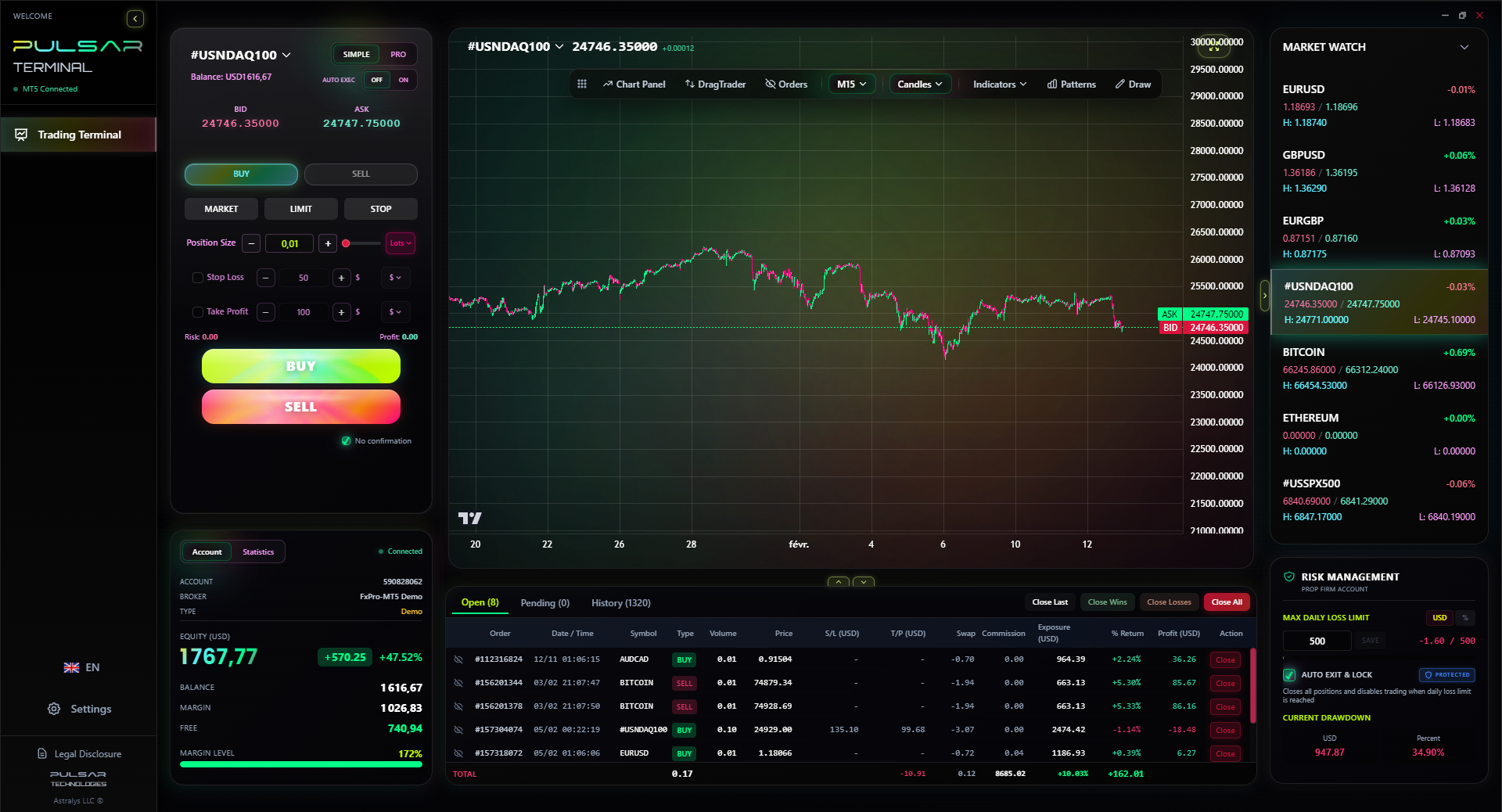
Manually monitoring and acting on margin levels across multiple trades is stressful; Pulsar Terminal's advanced trade management features let you set rules for partial closures and breakeven stops, helping you automatically defend your margin level before a crisis hits.
Pulsar Terminal
The all-in-one MT5 companion: drag-and-drop orders, multi-TP/SL, trailing stop, grid trading, Volume Profile, and prop firm protection. Used by 1,000+ traders daily.
Our trading environment has unique pressures that make margin level management critical.
Volatility in USD/NGN and Our Economy: The Naira's volatility is legendary. While you might not be trading the local pair directly, economic news from Nigeria can trigger risk-off sentiment that moves major pairs. Sudden CBN announcements can cause ripple effects. During these spikes, spreads can widen dramatically. A wider spread means your trade starts with a bigger immediate loss, which hits your equity and margin level the second you open it.
Payment Delays and Deposits: If you get a margin call and need to fund your account, how fast can you get Naira to your broker? Bank transfers can take days. Even with local payment processors, there can be delays. That margin call won't wait. Relying on a fast deposit to save you is a flawed strategy. Your first line of defense must be closing positions.
High use Culture: The marketing is relentless. Brokers know the appeal of high use in a market where starting capital can be hard to come by. But using 1:2000 use because it's there is like using a sports car's top speed in Lagos traffic - a disaster waiting to happen. Discipline means self-limiting your use use per trade, regardless of what's offered.
Platform Reliance: Most of us use MT4/MT5. You need to know exactly where to find your margin level on your platform (usually prominently displayed in the 'Trade' or 'Terminal' tab). Make it a habit to check it as often as you check your charts. It's more important.
“At 100% margin level, your only action should be to close positions, not open new ones.”
I've blown up accounts. Let's not pretend otherwise. Here's how it happened, tied directly to margin level ignorance.
Mistake 1: The 'Averaging Down' Trap. I went long on EUR/USD at 1.1200. It fell to 1.1150. My analysis was "still good," so I doubled my position size at 1.1150 to lower my average entry. My used margin doubled. The pair then fell to 1.1100. My equity was getting hammered by a now-massive position, but my used margin was also huge. My margin level sank like a stone. I wasn't just wrong on direction; I'd magnified the error on my balance sheet. The stop-out cleaned me out. Averaging down is not a strategy; it's a gamble that directly attacks your margin level.
Mistake 2: Ignoring Overnight Gaps. I held a swing trade over the weekend. Friday's margin level was a healthy 400%. A major geopolitical event happened Sunday night. The market opened Monday with a 150-pip gap against my position. My equity was down 30% before I could even log in. My margin level was already below 100%, and the broker's system issued a margin call and began closing before the market had even finished its first minute of trading. I learned to either close before major risk events or reduce position size dramatically to withstand a gap.
Mistake 3: Confusing Free Margin for Safety. I had a ₦1,000,000 account with ₦150,000 in used margin. My free margin was ₦850,000. I felt rich, invincible. So I opened another large position. This new trade went south quickly, losing ₦300,000. My equity dropped to ₦700,000, but my used margin was now ₦300,000. My margin level went from 667% to 233% in one trade. That 'safe' free margin evaporated because I used it to take on disproportionate risk. Free margin is not a challenge to be used up.
💡 Winston's Tip
Averaging down is the most effective method ever invented for turning a small losing trade into a margin call.
Knowing what does margin level mean in forex is useless if you don't act on it. Here's your checklist.
- Find Your Broker's Exact Numbers. Log in to your client portal or read the terms. Write down: Margin Call Level: __%. Stop-Out Level: __%. Put it on a sticky note on your monitor.
- Set Platform Alerts. Most platforms let you set an audio or visual alert when your margin level falls to a certain point. Set one for 200% as your personal early warning.
- Make it Part of Your Pre-Trade Checklist. Before hitting 'buy' or 'sell':
- Calculate position size based on your 1% risk rule.
- Check your potential new used margin.
- Mentally calculate: "If this trade hits its stop-loss, what will my new margin level be?" If it takes you below your personal threshold (e.g., 300%), the trade is too big.
- Regularly Review. Once a day, or once per trading session, take a screenshot of your account summary showing your margin level. Track it. This builds awareness.
- Respect the Levels. If you get a margin call notification, treat it with the seriousness of a fire alarm. Do not 'wait and see.' Have the discipline to close at least one position immediately to raise the level. Pride has no place here.
, margin level is the scoreboard for your risk management. A consistently high margin level means you're trading within your means. A yo-yoing margin level that constantly flirts with 100% means you're one bad trade from a reset. In Nigeria's exciting but tough market, preserving your capital isn't just the first rule, it's the only rule that guarantees you get to play tomorrow. Keep that level high, and you'll be in the minority of traders who last long enough to figure the rest out.
FAQ
Q1What is a good margin level in forex?
There's no universal 'good' number, but a safe practice is to keep it above 300% during active trading. This provides a substantial buffer against normal market volatility. Letting it fall below 200% means you're cutting it too close. Your broker's margin call (often 100%) is a danger zone, not a target.
Q2Can I trade if my margin level is at 100%?
Technically, you might still be able to open a tiny new position if you have a small amount of free margin left. But you absolutely should not. At 100%, your equity equals your used margin. You have zero buffer. Any further loss will immediately trigger a margin call. Your only action at 100% should be to close positions to raise the level, not open new ones.
Q3What happens if my margin level reaches zero?
Your margin level won't actually hit 0% before your broker intervenes. Once it hits the Stop-Out Level (e.g., 20% or 50%), the broker automatically closes your positions. If, through some extreme gap or slippage, your equity falls below your used margin (meaning margin level <100%), you could have a negative balance. Most reputable brokers now offer negative balance protection, meaning they absorb that loss and reset your account to zero. Always check if your broker provides this.
Q4How is margin level different from free margin?
Free margin is simple subtraction: Equity - Used Margin. It's the cash amount available to open new trades. Margin level is a ratio: (Equity / Used Margin) x 100. It's a percentage that indicates your account's health and proximity to a margin call. You can have a large free margin but a falling margin level if your existing trades are losing money.
Q5Do all forex brokers have the same margin call and stop-out levels?
No, they vary significantly. This is why you must check your broker's specific terms. Common margin call levels are 100% or 50%. Common stop-out levels are 50% or 20%. Some brokers, like XM, have a 50% call and 20% stop-out. Others stick to 100% and 50%. This policy dramatically affects your risk.
Q6How does use affect my margin level?
use has a direct and inverse relationship. Higher use allows you to control a larger position with less used margin. This can make your starting margin level look very high (e.g., 1000%). However, because the position size is large relative to your equity, any price movement has a magnified effect on your equity. This means your margin level can fall much faster and more violently than if you used lower use.
Q7As a Nigerian trader, should I avoid high use offers?
You shouldn't avoid them entirely, but you must use them with extreme discipline. Having access to 1:1000 use doesn't mean you should use 1:1000 on a trade. Use a position size calculator to determine your lot size based on your risk percentage and stop-loss. The high use will then simply mean less of your capital is locked up as used margin per trade, which is actually a good thing - it keeps your margin level higher. The problem is using high use to justify taking massive positions.
Prof. Winston's Lesson
Key Takeaways:
- ✓Margin Level = (Equity / Used Margin) x 100. Memorize it.
- ✓Know your broker's exact Margin Call and Stop-Out percentages.
- ✓Set a personal safety threshold (e.g., 300%) far above your broker's call.
- ✓Use a position size calculator for every trade to control used margin.
- ✓High use magnifies margin level volatility. Discipline is non-negotiable.
How useful was this article?
Click a star to rate
Weekly Trading Insights
Free weekly analysis & strategies. No spam.
About the Author
Olumide Adeyemi
West African Trading Pioneer
One of Nigeria's most active forex trading educators. 8 years of experience trading from Lagos. Specializes in low-capital strategies and prop firm challenges for African traders.
Comments
Risk Disclaimer
Trading financial instruments carries significant risk and may not be suitable for all investors. Past performance does not guarantee future results. This content is for educational purposes only and should not be considered investment advice. Always conduct your own research before trading.
You Might Also Like

Cara Trading Forex Sukses: 7 Prinsip dari Trader Profesional
Cara trading forex sukses dengan 7 prinsip trader pro: manajemen modal, disiplin, journal trading, backtest. Data nyata, bukan janji profit palsu.
Jam Trading Forex Terbaik untuk Trader Indonesia: Panduan Lengkap dengan Tabel Waktu
Panduan jam trading forex untuk trader Indonesia. Tabel 4 sesi dunia, jam emas 20:00-00:00, sesi mana yang harus dihindari. Data akurat + tips dari trader berpengalaman.
Top 5 Sàn Forex Uy Tín Nhất 2026: Review Jujur dari Trader Indonesia
Top 5 sàn forex uy tín 2026 untuk trader Indonesia. Review jujur: spread, deposit, withdraw, dukungan lokal. Exness, XM, IC Markets & lebih.
Get Pulsar Terminal
All these calculators are built into Pulsar Terminal with real-time data from your MT5 account. One-click position sizing, automatic risk management, and instant calculations.
Get Pulsar Terminal