


Here's a stat that might surprise you: most automated trading systems that blow up retail accounts aren't complex AI models.

David van der Merwe
Emerging Markets Trader ·  South Africa
☕ 12 min read
What you'll learn:
- 1The Core Idea: Trading the Range, Not the Trend
- 2The Nuts and Bolts: Building Your Grid
- 3The Local Landscape: FSCA Rules & Real-World Pitfalls
- 4A Smarter Approach: Building a Defensive Grid
- 5The Bottom Line: Costs, Brokers & Starting Capital
- 6Should You Use a Bot? Manual vs. Automated Grids
- 7Final Verdict: Is This Strategy for You?
Here's a stat that might surprise you: most automated trading systems that blow up retail accounts aren't complex AI models. They're often simple grid trading bots that traders set and forget. I learned this the hard way, watching a bot I'd coded turn a R5,000 test account into R7,200, then wipe it down to R800 in a single volatile session. So, what is grid trading in forex, really? It's not a magic money machine, but a specific, range-bound strategy that can work if you understand its mechanics and, crucially, its fatal flaws. Let's break it down for the local market.
At its heart, grid trading in forex is about giving up on predicting direction. You're not trying to catch the big move from A to B. Instead, you're betting that price will bounce around within a channel, and you place orders at regular intervals to scoop up profits from those smaller swings.
Think of it like setting a fishing net in a river. You don't care which way the current is flowing overall; you're placing multiple lines (orders) at different depths (prices). Every time the price fish swims into one of your lines, you catch a small profit. The 'grid' is simply that series of buy and sell orders placed above and below a starting price.

Example: Let's say EUR/USD is at 1.0850. You might set a grid with orders every 10 pips. So you'd have buy orders at 1.0840, 1.0830, 1.0820... and sell orders at 1.0860, 1.0870, 1.0880. Each time price hits one of those levels, an order executes.
The big appeal for us in South Africa? It can be fully automated. You can code an Expert Advisor (EA) in MT4/MT5 or use a pre-built bot to manage the entire grid. This lets you 'trade' 24/5 without staring at screens, which is tempting when you've got a day job. But automation is a double-edged sword, as we'll see.
A key part of making this work is knowing your costs to the cent. Every time one of those grid orders fills, you pay a spread or commission. On a high-frequency grid, those tiny costs add up fast. Always run your strategy through a position size calculator first, factoring in our local broker fees.

💡 Winston's Tip
A grid without a hard stop is a financial suicide note. Define your maximum loss before you place the first order, and let the software enforce it.
Let's get practical. Setting up a grid involves a few key decisions. Get these wrong, and you're setting up a loss machine.
The Three Main Settings
- Grid Spacing: This is the distance between your orders, measured in pips. Too tight (like 5 pips) and you'll get whipsawed by noise, with commissions eating you alive. Too wide (like 50 pips) and you might not get enough trades to make it worthwhile. For a pair like EUR/USD, I've found 15-25 pips to be a reasonable starting point, but it depends entirely on volatility.
- Grid Levels: How many orders do you place on each side? A 10-level grid means 10 buy orders below price and 10 sell orders above. More levels mean more potential trades, but also more capital tied up and greater risk if the market runs away.
- Order Size: Do you trade 0.01 lots on every order? Or do you use a martingale-style increase (doubling down after a loss)? I strongly advise against martingale in grid trading. It's the fastest route to a margin call. I stick to fixed, small lot sizes.
The Profit Mechanism
A grid makes money in two ways. First, from the simple take-profit on each individual order. If your buy at 1.0830 hits and price bounces back up 10 pips, you bank that profit. Second, and more critically for the system's logic, from the difference between opposite orders. If you have a buy order at 1.0820 and a sell order at 1.0840 that both fill, the system profits from the 20-pip difference, regardless of where price ends up.
This is where the illusion of safety comes in. It looks like you're always hedging yourself. But it's a false hedge. If a strong trend develops, all your orders on one side of the market will fill, leaving you with a massive, unhedged losing position. I got caught in this trap trading XAU/USD (gold). I had a beautiful grid on a swing trading range, but when a major US inflation report dropped, gold shot up in a straight line. My grid sold all the way up, leaving me with a pile of losing short positions and no offsetting buys. The loss was many times the small profits I'd collected.
“Grid trading taught me more about risk management and the importance of hard stops than any other strategy.”
Trading in South Africa isn't the wild west. The Financial Sector Conduct Authority (FSCA) has rules that directly impact how you can grid trade, especially regarding use.
The big one: retail use is capped at 30:1. This is a godsend for grid traders, though it might not feel like it. When I started, some offshore brokers offered 500:1. That kind of use with a grid strategy is like playing with a live grenade. The 30:1 limit forces you to use more sensible position sizes, which might just save your account from a blow-up during a black swan event.
You must use an FSCA-licensed broker. This ensures client money segregation and gives you recourse if something goes wrong. I've had good execution experiences with brokers like IC Markets and Pepperstone for this kind of automated trading. Their ECN models offer tight spreads, which is non-negotiable for grid trading.

Warning: The biggest risk isn't regulation; it's the strategy itself. Grid trading has a fatal flaw: it assumes markets will always mean-revert. But currencies can trend for months. Imagine setting a grid on USD/ZAR during a period of sustained rand weakness. Your grid would sell rands all the way down, accumulating a catastrophic loss. The small profits from the bounces won't save you.
Another hidden killer is the swap fee, or overnight financing charge. If your grid holds positions open for days or weeks, these fees can completely erase your profits. You need to check the swap rates for your currency pair and factor them into your backtesting.
Also, watch those bank fees! Funding your broker account from your SA bank account often incurs international transfer fees. That R250 fee from Capitec to send $500 eats directly into your starting capital.
After my gold trade disaster, I went back to the drawing board. A pure, infinite grid is suicidal. You need to build in defenses. Here’s how I structure mine now.
First, always define a hard stop-loss zone. My grid is not allowed to operate beyond a certain price boundary. For example, if I start my EUR/USD grid at 1.0850, I might set a stop-loss buy zone at 1.0750 (100 pips down) and a stop-loss sell zone at 1.0950 (100 pips up). If price reaches those zones, the entire grid closes at a loss. This limits your downside. Yes, it means you can lose, but you lose a defined amount, not your entire account.
Second, use a volatility-based grid spacing. Don't just use 15 pips because it sounds good. Use the Average True Range (ATR) indicator. If the ATR(14) is 60 pips, a 15-pip grid is way too tight. I set my grid spacing to be a fraction of the ATR, so it adapts to changing market conditions.
Third, be incredibly selective about market conditions. I only run grids on pairs that are clearly in a strong, wide horizontal range. I use tools like Volume Profile to identify high-volume nodes where price is likely to oscillate. I avoid grids around major news events like SARB interest rate decisions or US Non-Farm Payrolls.
Finally, manual oversight is mandatory. Automation doesn't mean abdication. I check my running grids at least twice a day. If a trend is starting to develop, I manually intervene to close the grid early for a small loss or reduced profit. This discipline turned grid trading from a loser into a modestly profitable side strategy for me.

Pro Tip: Test your grid logic in a demo account for at least two months, across different market phases (ranging, trending, volatile). Note the maximum drawdown. If the drawdown is more than 20% of the grid's allocated capital, your settings are too aggressive.
💡 Winston's Tip
The profits from a grid are like sand. They look solid until the tide of a trend comes in. Always know which way the macroeconomic tide is flowing before you lay your net.
“Automation doesn't mean abdication. A brainless bot with a grid strategy is a ticking time bomb.”
Let's talk numbers, because grid trading lives or dies on its cost structure.
Costs You Can't Ignore:
- Spreads: This is your biggest enemy. If your grid profit target is 10 pips and the spread is 2 pips, you've already given up 20% of your potential profit. You need a broker with razor-sharp spreads. On majors, look for average spreads under 0.5 pips. For example, the raw EUR/USD spread on an ECN account can often be 0.0 pips, with a small commission.
- Commissions: ECN brokers charge a commission per lot. This is often better than a wide spread. A typical rate is $7 per standard lot (round turn). If your grid trades 100 micro lots (1 standard lot) in a day, that's $7 gone. Your strategy must overcome this.
- Swap Fees: Check these! Holding a grid sell position on a currency with a high-interest rate differential can cost you nightly.
Broker Choice is Critical: You need a broker that allows automated trading (most MT4/MT5 brokers do) and has reliable, fast execution. Slippage on grid orders can ruin your precise spacing. I've found Exness and XM to be very accessible for South Africans with low minimum deposits, which is good for testing. But for serious grid capital, I prefer the institutional-grade execution of the brokers mentioned earlier.
How Much to Start? Forget the R150 minimum deposit. That's for opening an account, not for running a viable grid. A grid ties up capital as margin for all those open orders. Starting too small means your position size is tiny, and costs will devour you.
My honest advice? Don't even think about live grid trading with less than R5,000 in dedicated risk capital. And even then, that R5,000 should only be a portion of your total trading capital. A realistic starting point for a micro-lot grid (0.01 lots per order) on a single major pair is R10,000 to R15,000. This gives you the buffer to withstand drawdowns and pay costs without being wiped out by a single bad run.
This is the million-rand question. The allure of a 'set and forget' bot is strong. I've used them, and I've written my own EAs. Here's the raw truth.
Automated Grids (Bots/EAs):
- Pros: They remove emotion. They execute 24/7, catching moves while you sleep. They manage the complex web of orders flawlessly.
- Cons: They are brainless. They will happily sell into a crashing market or buy into a parabolic spike until your margin runs out. They cannot assess changing market context. Most cheap 'grid trader' EAs you buy online have no hard stop-loss logic. They are ticking time bombs.
Manual Grids:
- Pros: You retain control. You can pause the strategy if news is due. You can adjust the grid spacing or close it early if a trend emerges. You use your discretion.
- Cons: It's time-consuming. You need to monitor and manage orders constantly. It's easy to let emotion override your plan ('just one more level and it'll reverse...').
My hybrid approach? I use automation for the tedious order placement and management, but I build in manual override triggers. My EA will send me a Telegram alert if price moves outside a volatility band or approaches my pre-defined stop-loss zone. Then I manually decide whether to close the grid. This combines machine efficiency with human judgment.
If you go the automated route, the tool you use matters. A basic MT4 EA can open the grid, but managing it - like moving stops to breakeven on partial profits or trailing the entire grid - requires more sophisticated logic. This is where a dedicated trading terminal can make a huge difference.
💡 Winston's Tip
If you wouldn't manually scalp the 15-pip bounce you're trying to automate, don't build a grid to do it. Automation amplifies strategy, not intelligence.
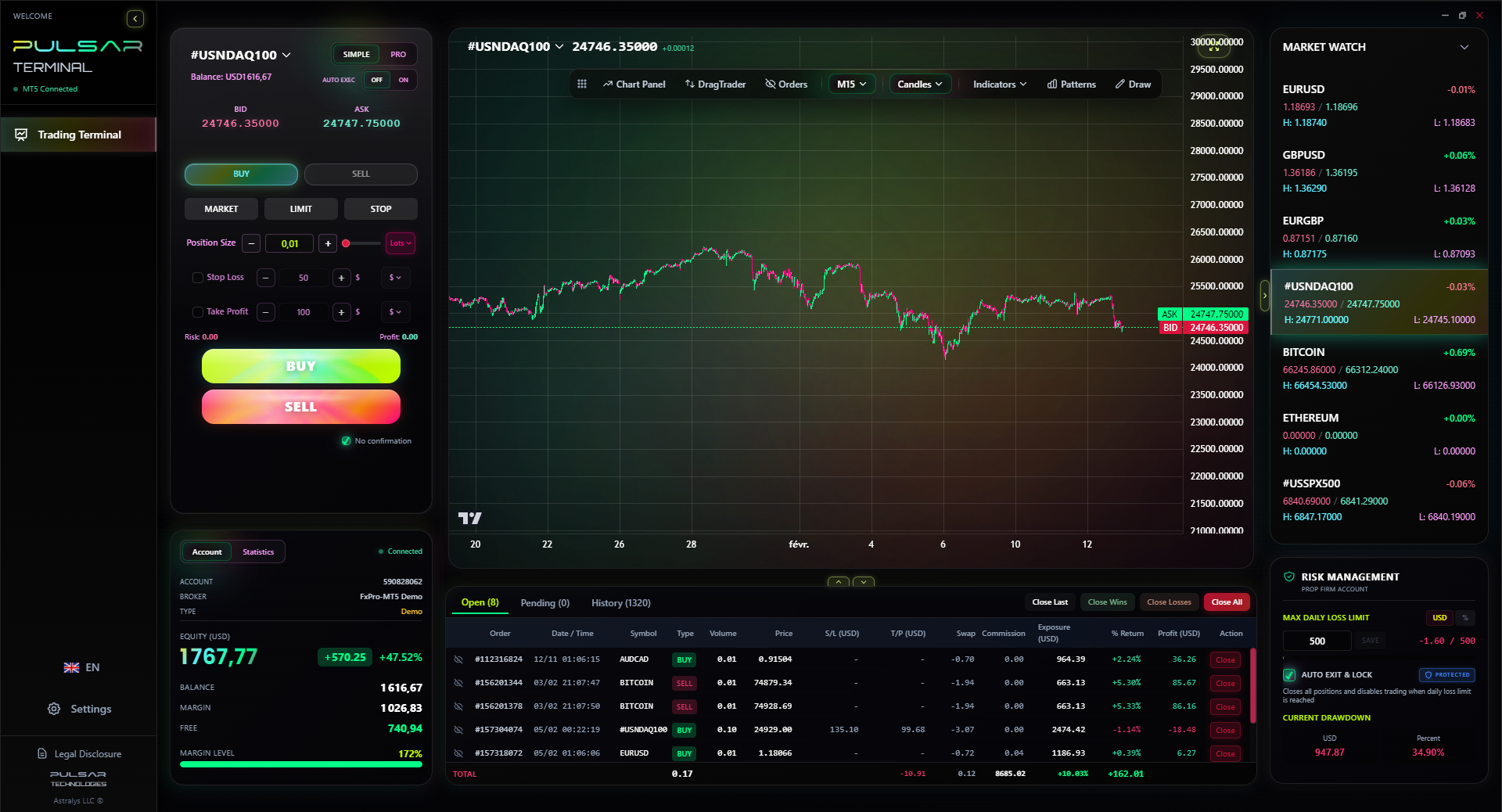
Managing a complex grid with multiple take-profit and stop-loss levels is tedious in standard MT5, but tools like Pulsar Terminal allow you to visualize and control the entire grid with drag-and-drop ease.
Pulsar Terminal
The all-in-one MT5 companion: drag-and-drop orders, multi-TP/SL, trailing stop, grid trading, Volume Profile, and prop firm protection. Used by 1,000+ traders daily.
“The 30:1 use cap is a godsend for grid traders; it might just save your account from a blow-up.”
So, after all this, what is grid trading in forex? It's a high-frequency, range-trading strategy that profits from volatility but is dangerously vulnerable to trends.
It is NOT for:
- Beginners looking for a passive income 'hack'.
- Traders with small accounts (under R10,000).
- Anyone who can't stomach double-digit drawdowns.
- People who want to 'set and forget' without deep understanding.
It MIGHT be for:
- Experienced traders who understand mean reversion and can identify strong ranging markets.
- Systematic traders comfortable with coding or using advanced trading tools.
- Those with sufficient capital to absorb the costs and inevitable losing grids.
- Traders who can commit to active oversight, even of an automated system.
My personal take? Grid trading taught me more about risk management and the importance of hard stops than any other strategy. It forced me to respect the market's ability to trend. I still use a modified, defensive grid occasionally in specific conditions, but it's a small part of my overall portfolio. It's a tool, not a strategy. And like any powerful tool, used carelessly, it will blow up in your face.
If you're intrigued, start in a demo. Build a simple grid. Watch it make money for a week. Then wait for the trend that takes it all back and more. That lesson is worth more than any profit the grid will ever make you.
FAQ
Q1Is grid trading profitable in forex?
It can be, but not consistently or reliably. Grid trading profits in ranging markets but suffers heavy losses in trending markets. Most retail traders underestimate the severity of these losses, which can wipe out months of small profits. It's a high-risk strategy, not a steady income generator.
Q2What is the best forex pair for grid trading?
Major pairs with lower volatility and a tendency to range are often cited, like EUR/USD or USD/CHF. However, 'best' is misleading. The right pair is the one that is currently in a clear, wide horizontal range. You must analyze the market context each time. Avoid exotic pairs or pairs like GBP/JPY that are known for sharp, trending moves.
Q3How much money do I need to start grid trading in South Africa?
Realistically, a minimum of R10,000 dedicated to the grid strategy. With the FSCA's 30:1 use cap, you need sufficient margin to hold multiple open orders. Starting with less (like R1,000-R2,000) means your position sizes will be so small that trading costs (spreads, commissions) will consume most, if not all, of your potential profits.
Q4What's the difference between grid trading and martingale?
Grid trading places orders at fixed price intervals. Martingale is a money management technique that doubles the trade size after a loss to recover previous losses. They are often combined (a 'martingale grid'), which is extremely dangerous. A pure grid uses a fixed lot size. Combining them accelerates your risk of a margin call exponentially.
Q5Do I need a bot for grid trading?
Technically, no, but practically, yes. Managing dozens of orders manually is nearly impossible. An Expert Advisor (EA) automates the placement and management. However, you should never let the bot run unsupervised. You must monitor it and be ready to intervene to close the grid if a strong trend develops.
Q6How do I protect my grid from a strong trend?
You must implement a global, hard stop-loss. Define a price level (e.g., 100 pips away from your start price) where the ENTIRE grid will close at a loss. This is non-negotiable. Without it, you have unlimited downside risk. Also, avoid grid trading during major economic news releases that can cause sustained directional moves.
Q7Are grid trading bots legal in South Africa?
Yes, using automated trading software (bots or EAs) is legal. The key is that you must be using an FSCA-licensed broker for your live trading. The software itself is just a tool. You are responsible for the trades it executes and for ensuring your overall trading activity complies with local tax laws.
Prof. Winston's Lesson
Key Takeaways:
- ✓Always define a hard stop-loss zone for your entire grid.
- ✓Grid spacing must adapt to market volatility (use ATR).
- ✓Trading costs (spread/commission) will make or break the strategy.
- ✓Start with at least R10,000 dedicated grid capital.
- ✓Never combine grid logic with martingale money management.
How useful was this article?
Click a star to rate
Weekly Trading Insights
Free weekly analysis & strategies. No spam.
About the Author
David van der Merwe
Emerging Markets Trader
Johannesburg-based trader with 11 years in emerging market currencies. Specializes in ZAR pairs, FSCA-regulated trading, and South African market analysis.
Comments
Risk Disclaimer
Trading financial instruments carries significant risk and may not be suitable for all investors. Past performance does not guarantee future results. This content is for educational purposes only and should not be considered investment advice. Always conduct your own research before trading.
You Might Also Like

Cara Trading Forex Sukses: 7 Prinsip dari Trader Profesional
Cara trading forex sukses dengan 7 prinsip trader pro: manajemen modal, disiplin, journal trading, backtest. Data nyata, bukan janji profit palsu.
Jam Trading Forex Terbaik untuk Trader Indonesia: Panduan Lengkap dengan Tabel Waktu
Panduan jam trading forex untuk trader Indonesia. Tabel 4 sesi dunia, jam emas 20:00-00:00, sesi mana yang harus dihindari. Data akurat + tips dari trader berpengalaman.
Top 5 Sàn Forex Uy Tín Nhất 2026: Review Jujur dari Trader Indonesia
Top 5 sàn forex uy tín 2026 untuk trader Indonesia. Review jujur: spread, deposit, withdraw, dukungan lokal. Exness, XM, IC Markets & lebih.
Get Pulsar Terminal
All these calculators are built into Pulsar Terminal with real-time data from your MT5 account. One-click position sizing, automatic risk management, and instant calculations.
Get Pulsar Terminal