


Here's a number that got my attention early on: the GBP/USD pair, known as 'GU' on your trading terminal, sees over $730 billion traded every single day.

David van der Merwe
Emerging Markets Trader ·  South Africa
☕ 11 min read
What you'll learn:
- 1GU Meaning and the 'Cable' Nickname
- 2Why Trade GBP/USD from South Africa?
- 3What Moves the Price? Key Drivers for GU
- 4Trading GU from SA: FSCA Rules & Practical Realities
- 5The Real Cost of Trading GU: Spreads, Commissions & Broker Data
- 6A Simple GU Trading Strategy (And a Trade I Got Wrong)
- 7Common Mistakes South African Traders Make with GU
Here's a number that got my attention early on: the GBP/USD pair, known as 'GU' on your trading terminal, sees over $730 billion traded every single day. That's more than the entire annual GDP of South Africa changing hands in 24 hours. For us trading from SA, understanding what is gu in forex isn't just jargon, it's about tapping into one of the deepest, most liquid, and frankly, most dramatic markets in the world. I've made some of my best trades on Cable, and I've also taken my most painful losses on it. This guide is the manual I wish I'd had.
So, what is gu in forex? It's simply the ticker symbol for the GBP/USD currency pair. GU stands for Great Britain Pound versus US Dollar. Every other pair you see works the same way: EUR/USD, USD/JPY. The first currency (GBP) is the base, the second (USD) is the quote. The price tells you how many US dollars it costs to buy one British pound.
Now, the nickname 'Cable' is where it gets interesting. It dates back to the 1800s when the exchange rate was transmitted across the Atlantic via a submarine telegraph cable. Traders would literally say "the cable says..." That history matters because it tells you this pair has weight. It's been around through empires, world wars, and financial crises. That pedigree creates a certain personality in the market, one that respects news and economic data with a vengeance.
Trading from Johannesburg, I used to think this was just another pair. Then I held a position through a Bank of England announcement. The volatility wasn't just numbers on a screen, it felt like a physical force. That's when I understood Cable isn't just a pair, it's a character in the market story.

Example: If GBP/USD is quoted at 1.2500, it means 1 British Pound costs 1.25 US Dollars. A move to 1.2510 is a 10-pip gain for the Pound. Understanding the pip definition is your first step in measuring these moves.

💡 Winston's Tip
Cable respects its history. A price level that was important six months ago will often be important again. Mark those old swing points on your chart; they're magnets for future price action.
“Understanding what is gu in forex isn't just jargon, it's about tapping into one of the deepest, most liquid, and most dramatic markets in the world.”
You might wonder why a South African trader should care about the British Pound and the US Dollar. The reasons are practical, and they've shaped my entire approach to swing trading this instrument.
First, liquidity. That $731 billion daily turnover means you can get in and out of positions easily, even with larger sizes. The spreads are usually tight, especially with a good ECN broker. During the London-New York overlap (2 PM to 6 PM SAST), the market is at its most active. That's your prime time.
Second, volatility. The Pound has a reputation for being politically sensitive. Brexit taught me that lesson the hard way. I was long Cable in 2016, thinking the 'Remain' vote was a sure thing. The 8% intraday crash that followed was a brutal, but useful, education in event risk. This pair moves, and it moves with conviction, offering clear opportunities if you have the stomach for it.
Finally, relevance. The UK and US are two of SA's major trading partners. Their economic health, interest rates set by the Bank of England and the Federal Reserve, and their inflation data all ripple through to our own economy and the ZAR. Trading GU gives you a front-row seat to global macro trends that eventually affect everything here at home.

Warning: That famous volatility is a double-edged sword. I've seen GU rip through 150 pips in an hour on a surprise headline. Never trade it without a stop-loss. A sharp move can trigger a margin call faster than you can say 'Bank of England'.
“I was long Cable in 2016, thinking the 'Remain' vote was a sure thing. The 8% intraday crash was a brutal, but useful, education.”
Trading GU successfully means becoming a part-time economist for two countries. The price is a constant tug-of-war between London and Washington. Here’s what I watch, in order of importance.
Central Bank Policy (BoE vs. Fed)
This is the big one. It’s all about interest rate differentials. If the Bank of England is hiking rates while the Fed is on hold, the Pound typically strengthens against the Dollar (GU goes up). You need to follow every Monetary Policy Committee (MPC) statement and Fed FOMC meeting. I keep a calendar solely for these events. A mistake I made was only listening to the headline rate decision. Now I scrutinize the voting split and the meeting minutes for clues on future moves.
Economic Data Releases
High-impact UK data: CPI inflation, employment reports (especially wage growth), GDP, and PMI surveys. High-impact US data: Non-Farm Payrolls (NFP), CPI, Retail Sales, and ISM Manufacturing PMI. I got burned once ignoring UK wage data. The BoE is obsessed with it as an inflation signal, and a hot print sent GU soaring against my short position.
Political and Geopolitical Events
The Pound is a political currency. Elections, leadership changes, budget announcements, and, as we all remember, Brexit negotiations, can cause massive swings. The Dollar, meanwhile, acts as a global safe haven. During times of broad market stress or risk-off sentiment, money flows into USD, often pushing GU lower regardless of UK-specific news.
“I was long Cable in 2016, thinking the 'Remain' vote was a sure thing. The 8% intraday crash was a brutal, but useful, education.”
Trading in South Africa means operating under the Financial Sector Conduct Authority (FSCA). This isn't red tape, it's your first layer of protection. Here’s what you need to know as it applies to trading a pair like GU.
Your broker must be licensed. A legitimate FSCA-regulated broker, like those we've reviewed such as XM or Pepperstone, is required to segregate client funds. This means your money for trading GU is held separately from the broker's company accounts. It's not foolproof, but it's critical. I only deposit with brokers who can clearly show their FSCA authorization number.
The Conduct of Financial Institutions (COFI) Bill is coming, likely in 2026. It will tighten rules further. For you, this means more transparency on costs, which is crucial when you're calculating if a trade on GU's tight spreads is actually profitable after all fees.
The ZAR Consideration
This is a uniquely South African point. Your trading account might be in USD, but your bank account is in Rands. When you deposit or withdraw, you're exposed to the USD/ZAR rate. I learned this the expensive way. I made a $500 profit on a GU trade, but between the bank's forex conversion fee and a slight weakening of the Rand that day, I netted noticeably less in my pocket. Always factor in a 1-2% haircut for currency conversion.

Pro Tip: Consider a broker that offers ZAR-denominated accounts to avoid conversion fees on your deposit. Some local brokers offer this. Then, use a position size calculator to work out your lot size based on your ZAR capital, not USD, to keep your risk management grounded in reality.
💡 Winston's Tip
The most expensive lesson on GU is trying to outguess a central bank. Trade the reaction after the news, not your prediction before it. Let the market show you its hand first.
“Even the best technical setup is worthless against a scheduled, high-impact fundamental event.”
Let's talk numbers, because this is where many South African traders get tripped up. The 'cost' of a trade isn't just the loss if you're wrong, it's the friction you pay just to enter.
For GBP/USD, you'll typically encounter two models:
- Spread-Only: The broker's profit is built into the difference between bid and ask. For GU, expect average spreads between 0.8 and 1.5 pips on a standard account.
- Commission + Raw Spread: You pay a tiny spread (often 0.0 to 0.2 pips) plus a commission per lot. This is usually cheaper for active traders.
Here’s a snapshot of what I've seen recently from brokers accessible in SA:
| Broker | Account Type | Avg. GBP/USD Spread | Commission (per standard lot) | Min. Deposit |
|---|---|---|---|---|
| IC Markets (Int'l) | Raw Spread | 0.1 pips | $7.00 round turn | $200 |
| Tickmill (FSCA) | Raw Account | 0.11 pips | $6.00 round turn | $100 |
| FP Markets (FSCA) | Raw Account | 0.1 pips | $6.00 round turn | $100 |
| XM (Int'l) | Standard | 1.7 pips | $0 | $5 |
| Khwezi Trade (FSCA) | USD One | 0.4 pips | $0 | $50 |
My Experience: I started on a standard spread-only account. On a typical GU scalping strategy where I'd aim for 10-15 pips, a 1.5 pip spread meant I was giving up 10-15% of my target profit before the trade even started. Switching to a raw spread account with a commission changed my game. My cost per trade dropped significantly, making those small, quick moves on GU actually viable.
Don't forget overnight financing (swap fees). Holding a GU position overnight means you pay or receive interest based on the BoE and Fed rate differential. If you're a long-term trader, this can add up or eat into profits. Most platforms show the swap rate before you place the trade.
“Even the best technical setup is worthless against a scheduled, high-impact fundamental event.”
I'm not a fan of overcomplicating things. Here’s a basic, price-action focused approach I use for GU on the 4-hour and daily charts. It combines trend with key support/resistance.
- Identify the Trend: Use the daily chart. Are the price highs and lows generally moving up (bullish) or down (bearish)? For GU, I also watch the 50 and 200-period Exponential Moving Averages (EMAs). Price above both suggests a bullish bias.
- Find a Key Level: Look for previous swing highs or lows, areas where price has reacted multiple times. These are your potential support (for buys) or resistance (for sells) zones.
- Wait for a Reaction: In an uptrend, wait for price to pull back to a support level. Look for a bullish rejection candle (like a hammer or bullish engulfing) forming on that level.
- Enter and Manage Risk: Enter on a break of the high of that rejection candle. Place your stop-loss below the recent swing low (or the low of the rejection candle). Aim for a take-profit at the next resistance level, ideally with a risk-reward ratio of at least 1:2.
A Trade That Went Against Me: In early 2025, GU was in a clear daily downtrend. It pulled back to a former support-turned-resistance zone at 1.2350. A perfect bearish pin bar formed. I went short at 1.2345, SL at 1.2405 (60 pips), TP at 1.2250 (95 pips). Risking 0.5% of my account.
The problem? I ignored the scheduled speech by a Fed official that afternoon. He struck a unexpectedly dovish tone, the Dollar sold off across the board, and GU ripped higher. It took out my stop and kept going. I lost my 60 pips. The lesson was brutal: even the best technical setup is worthless against a scheduled, high-impact fundamental event. Now, I always, always check the economic calendar.
Indicators like the RSI indicator can help confirm if the pullback is overstretched, and the MACD indicator on the 4-hour can help gauge momentum. But price and levels come first.
💡 Winston's Tip
Your stop-loss on GU isn't a suggestion, it's a life raft. Place it at a level that, if hit, objectively invalidates your trade idea. Emotional hope has no place in Cable's deep waters.
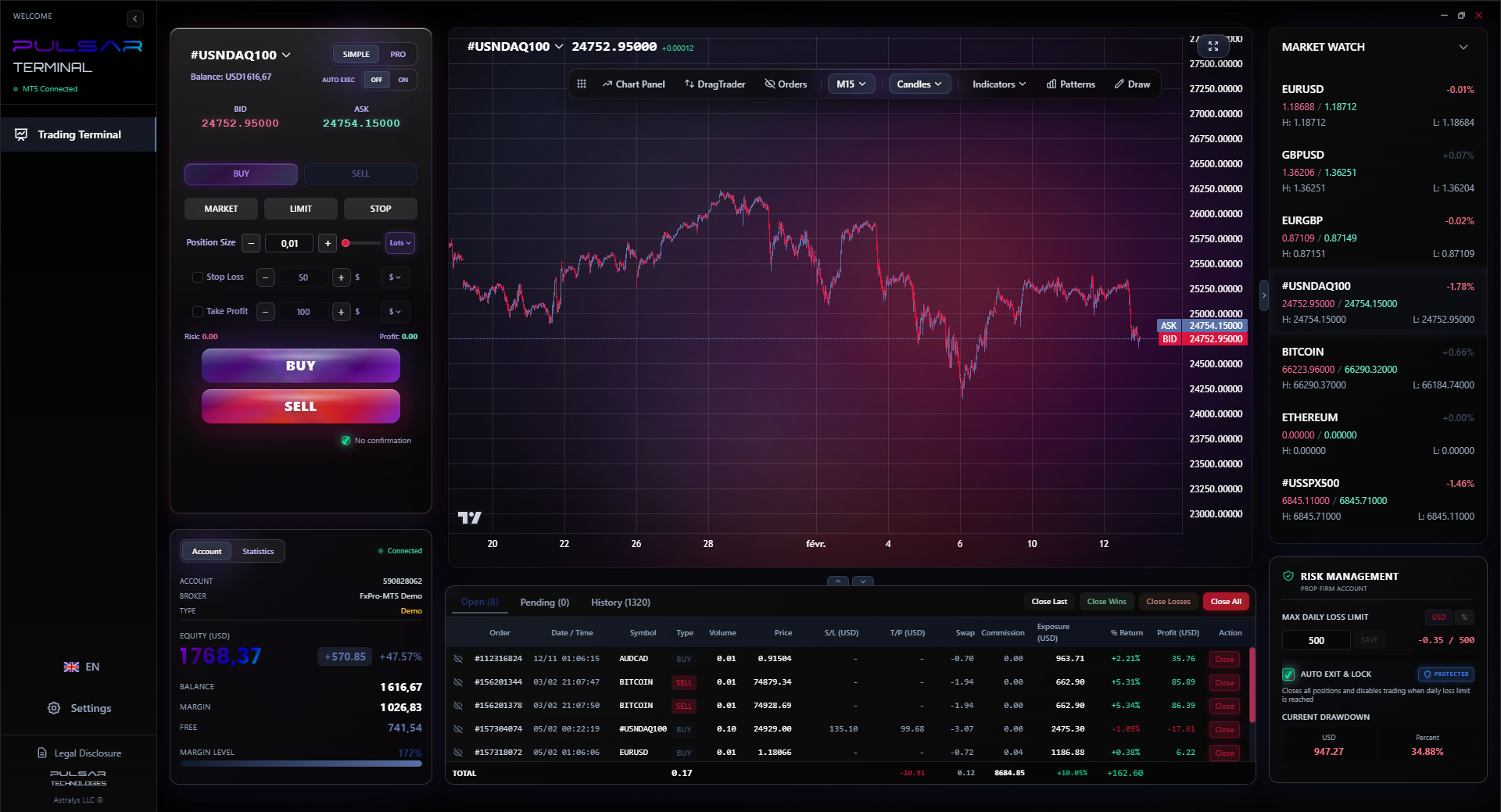
Managing multiple take-profit levels and a trailing stop on a volatile pair like GU is complex, but Pulsar Terminal lets you set it all up with a single drag-and-drop order directly on your MT5 chart.
Pulsar Terminal
The all-in-one MT5 companion: drag-and-drop orders, multi-TP/SL, trailing stop, grid trading, Volume Profile, and prop firm protection. Used by 1,000+ traders daily.
“GU doesn't just 'react' to news, it often gaps. If you have a position open during a major data release, you're gambling.”
Let me save you some money and frustration by sharing the errors I've made (and seen others make) trading Cable.
Trading During Low Liquidity: The worst time to trade GU is during the Asian session (late SA evening to early morning). Spreads widen, and price can slide on minimal volume, only to reverse violently when London opens. I've been 'stopped out' in a quiet market only to watch the trade go my way 30 minutes later. Patience is key.
Ignoring UK and US Session Overlap: Your most reliable moves will happen between 2 PM and 6 PM SAST. That's when both London and New York are open. The volume is huge, spreads are tightest, and trends are most likely to develop. Structure your day around this window if you can.
Underestimating News Volatility: GU doesn't just 'react' to news, it often gaps. If you have a position open during a major data release or BoE decision, you're gambling. Either close before the event or use a guaranteed stop-loss (if your broker offers it, for a fee).
Forgetting About the 'Third Currency' (ZAR): As mentioned, your profit in USD can be eroded when you convert back to Rands. It also affects your psychology. A R10,000 loss feels different than a $500 loss, even if they're technically the same. Always think in your home currency when assessing real P&L.
Finally, overtrading. Because GU moves so much, it's tempting to jump in on every little swing. That's a fast track to burnout and blown accounts. Wait for your setup, the one you've defined in your plan. GU will still be there tomorrow.
FAQ
Q1What does GU stand for in forex trading?
GU is the ticker symbol for the GBP/USD currency pair. It represents the exchange rate between the British Pound (GBP) and the United States Dollar (USD), showing how many US dollars are needed to buy one British pound.
Q2Why is GBP/USD called 'Cable'?
The nickname 'Cable' comes from the 19th century when the exchange rate was transmitted between London and New York via a transatlantic submarine telegraph cable. Traders would refer to the rate as 'the cable,' and the name stuck.
Q3What is the best time to trade GBP/USD from South Africa?
The best time is during the overlap of the London and New York sessions, from approximately 2:00 PM to 6:00 PM South African Standard Time (SAST). This is when liquidity is highest and spreads are tightest, offering the most favourable trading conditions.
Q4Is forex trading legal in South Africa?
Yes, forex trading is legal and regulated in South Africa. The Financial Sector Conduct Authority (FSCA) oversees the market, licenses brokers, and sets rules to protect consumers. It's crucial to use an FSCA-regulated broker for security.
Q5What are the typical spreads for trading GBP/USD?
Spreads vary by broker and account type. On standard accounts, expect 0.8 to 2.0 pips. On professional or raw spread accounts, you can find spreads as low as 0.0 to 0.2 pips, but you'll usually pay a separate commission per trade (e.g., $3-$7 per standard lot).
Q6What moves the price of GBP/USD the most?
The biggest drivers are: 1) Interest rate decisions and policy statements from the Bank of England and the US Federal Reserve, 2) High-impact economic data (UK inflation, wages, US jobs reports), and 3) Major political events in the UK (e.g., elections, budgets) and global risk sentiment.
Q7Can I trade GU with a small account in South Africa?
Yes, many brokers catering to South Africans offer low minimum deposits, some as low as $5 or R500. However, with a small account, you must be extremely careful with position sizing. The high volatility of GU can wipe out a small account quickly if you risk too much per trade.
Prof. Winston's Lesson
Key Takeaways:
- ✓GU's $731bn daily volume means liquidity, but also violent, news-driven moves.
- ✓The 2-6 PM SAST London-NY overlap is your prime trading window.
- ✓Always check the economic calendar before entering a GU position.
- ✓Factor in a 1-2% ZAR conversion cost on your real profit/loss.
How useful was this article?
Click a star to rate
Weekly Trading Insights
Free weekly analysis & strategies. No spam.
About the Author
David van der Merwe
Emerging Markets Trader
Johannesburg-based trader with 11 years in emerging market currencies. Specializes in ZAR pairs, FSCA-regulated trading, and South African market analysis.
Comments
Risk Disclaimer
Trading financial instruments carries significant risk and may not be suitable for all investors. Past performance does not guarantee future results. This content is for educational purposes only and should not be considered investment advice. Always conduct your own research before trading.
You Might Also Like

Cara Trading Forex Sukses: 7 Prinsip dari Trader Profesional
Cara trading forex sukses dengan 7 prinsip trader pro: manajemen modal, disiplin, journal trading, backtest. Data nyata, bukan janji profit palsu.
Jam Trading Forex Terbaik untuk Trader Indonesia: Panduan Lengkap dengan Tabel Waktu
Panduan jam trading forex untuk trader Indonesia. Tabel 4 sesi dunia, jam emas 20:00-00:00, sesi mana yang harus dihindari. Data akurat + tips dari trader berpengalaman.
Top 5 Sàn Forex Uy Tín Nhất 2026: Review Jujur dari Trader Indonesia
Top 5 sàn forex uy tín 2026 untuk trader Indonesia. Review jujur: spread, deposit, withdraw, dukungan lokal. Exness, XM, IC Markets & lebih.
Get Pulsar Terminal
All these calculators are built into Pulsar Terminal with real-time data from your MT5 account. One-click position sizing, automatic risk management, and instant calculations.
Get Pulsar Terminal