


Most new traders in Nigeria think forex is just about buying dollars and selling pounds.

Olumide Adeyemi
West African Trading Pioneer ·  Nigeria
☕ 11 min read
What you'll learn:
- 1Forex is Not Just Currencies (And That's Your First Lesson)
- 2Currency Pairs: The Core Market Explained
- 3CFDs: Trading the World from Your Phone in Lagos
- 4The Nigerian Context: Real Costs & The New Regulatory Reality
- 5use & Margin: The Double-Edged Sword
- 6Choosing What to Trade: A Practical Guide for Nigerian Traders
- 7Common Pitfalls & Mistakes I Made (So You Don't Have To)
Most new traders in Nigeria think forex is just about buying dollars and selling pounds. I did too. I blew up my first $200 account trying to 'predict' the Naira, completely misunderstanding what the market actually offers. The truth is, the question of what is traded on forex opens a door to a world far beyond simple currency exchange. It's about contracts, commodities, indices, and a regulatory landscape that's finally getting some teeth. Let's set the record straight on what you're really trading, the costs you'll face in Naira, and how to navigate this market without the common pitfalls that catch so many of us.
When you log into your broker's platform, you're not accessing a single market. You're entering a global financial supermarket. The core product is, of course, currency pairs. But the instrument you trade is almost always a Contract for Difference (CFD). This is a critical distinction. You're not taking delivery of 100,000 Euros; you're entering a contract to profit from the price difference between when you open and close the trade.
This CFD model is what allows brokers to offer use. It's also what lets you trade on the price movement of gold, US stocks, and global stock indices without owning the underlying asset. My early mistake was treating a GBP/USD trade like I was physically exchanging money at a bureau de change. The psychology is different. With a CFD, you're betting on a price tick, not acquiring an asset. This realization changed my entire approach to position size calculator and risk.

Warning: Trading CFDs means you're exposed to the broker's solvency. Always verify they are regulated by a reputable authority like the FCA or ASIC, and that client funds are segregated. This is non-negotiable, especially with the new SEC rules in Nigeria.
The main categories you'll see are:
- Currency Pairs (Majors, Minors, Exotics): Like EUR/USD, GBP/JPY, or USD/NGN? (if offered).
- Precious Metals: Primarily Gold (XAU/USD) and Silver.
- Indices: CFDs on baskets of stocks like the US30 (Dow Jones), SPX500 (S&P 500), and GER40 (DAX).
- Commodities: Oil (Brent, WTI), Natural Gas, Coffee, etc.
- Cryptocurrencies: Bitcoin, Ethereum, etc., often as CFD pairs like BTC/USD.
- Stocks & ETFs: Single-share CFDs for companies like Apple or Tesla.
Understanding this was my first step towards treating forex as a professional speculation business, not a currency guessing game.

💡 Winston's Tip
The spread isn't just a cost, it's a signal. A suddenly widening spread on your usual pair often means liquidity is drying up - step away. It's the market telling you it's unstable.
This is the heart of what is traded on forex. Every trade involves two currencies: the base and the quote. If you buy EUR/USD, you're buying Euros and selling US Dollars, expecting the Euro to strengthen against the Dollar.
The Majors (The Liquid Highway)
These pairs involve the US Dollar and the world's other most traded currencies: EUR/USD, USD/JPY, GBP/USD, USD/CHF, AUD/USD, USD/CAD, NZD/USD. They have the tightest spreads (the difference between buy and sell price) and highest liquidity. When I started scalping strategy, I stuck almost exclusively to EUR/USD and GBP/USD because the low spreads meant my profit wasn't immediately eaten by costs. On a good ECN account with a broker like IC Markets review, you can see spreads as low as 0.0 pips on majors during peak hours.
The Minors (Crosses)
These are major currencies paired against each other, excluding the USD. Think EUR/GBP, AUD/JPY, or GBP/CAD. Spreads are wider, and moves can be more volatile. I learned this the hard way trading AUD/JPY. The spread was 3 pips, and my short-term strategy needed a 5-pip move just to break even. It taught me to always check the spread before entering, not just the chart.
The Exotics (The Wild Frontier)
This is where you find pairs like USD/TRY (US Dollar/Turkish Lira) or EUR/TRY. They often involve a major currency and one from a developing or smaller economy. Spreads can be enormous - I've seen 50 pips or more. The volatility is extreme. While the potential for big moves is there, the cost of entry is prohibitively high for most strategies. For Nigerian traders, a pair like USD/NGN would be exotic, but it's rarely offered by international brokers due to local capital controls. You're better off understanding the Naira's fundamentals to gauge broader market risk, not trading it directly.

Example: A 1-pip move on a standard lot (100,000 units) of EUR/USD is worth $10. If the spread is 1 pip, your trade starts $10 in the red. On an exotic pair with a 30-pip spread, you start $300 in the red. That's a mountain to climb before you see profit.
“Trading from Nigeria isn't the same as trading from London or New York. Our local realities shape everything.”
This is where the modern forex broker's offering gets interesting. Through CFDs, your trading account becomes a gateway to global markets.
Gold (XAU/USD): This is the most popular non-currency asset. Traded in ounces, it's a hedge against inflation and market chaos. I remember during a major geopolitical scare in 2023, while currencies were whipsawing, gold had a clean, sustained rally. I took a long position at $1812 and rode it to $1875. That trade alone saved my quarterly P&L. Understanding the XAU/USD guide dynamics - its inverse relationship with the US Dollar and real yields - is crucial.
Indices: You can trade the entire mood of a stock market. Don't have time to analyze individual companies? The US30 (Dow Jones) gives you exposure to 30 major US blue-chips. The spreads are wider than majors, but the trends can be beautiful for swing trading. I use the 4-hour and daily charts for these, not the 5-minute.
Oil: The lifeblood of the global economy. News-driven, volatile, and fantastic for traders who understand supply/demand headlines. As a Nigerian, you're acutely aware of oil price shocks. I used to let that bias my trading. I'd be perpetually bullish on oil because 'Nigeria needs the price high.' That's not trading; that's hoping. The market doesn't care. I had to learn to read the inventory data and technicals objectively.
Stocks: Want to trade Tesla or Apple earnings? You can, via CFDs. No need for a US brokerage account. But remember, you don't get dividends or voting rights. You're purely trading the price movement.
The convenience is incredible, but it's a double-edged sword. Easy access leads to overtrading. I had weeks where I'd jump from the London open (currencies) to the US open (indices) to after-hours (crypto), ending up exhausted and net negative. Discipline means choosing your battlefield, not fighting on every front.
Trading from Nigeria isn't the same as trading from London or New York. Our local realities shape everything.
Taxes: Let's be clear. If you're making consistent profits, especially if trading is your main gig, you have a 10% Capital Gains Tax obligation to the FIRS. I set aside 10% of every profitable withdrawal into a separate account. It's not a 'maybe,' it's a cost of business. Ignoring this is an operational risk.
Deposits & Withdrawals: Funding your account is your first hurdle. Most international brokers don't accept direct Naira deposits. You'll use:
- Domiciliary Account Transfer: The classic method. Slow, with bank charges.
- Credit/Debit Cards (USD): Faster, but your Nigerian bank will convert Naira to USD at their rate, plus a fee.
- E-Wallets: Skrill, Neteller, PayPal. Often the fastest. I use Skrill. The conversion from Naira to USD happens on their platform, and I can fund my Exness review account in minutes.
- Crypto: USDT is becoming a popular workaround. Fast and avoids traditional banking bottlenecks. But be aware of crypto price volatility between the time you buy USDT and fund your account.
Every conversion and transfer has a cost. That $500 you want to deposit might cost you ₦25,000 in fees and spread by the time it hits your trading account. Factor this in.
The New Regulations (2024-2026): This is the biggest change. For years, we operated in a grey area. The SEC now has teeth. The Investments and Securities Act (ISA) 2025 requires online forex platforms to register with the SEC. This is good for us. It means more consumer protection, clearer rules, and a push against outright scam brokers. The CBN's new FX code and unified market also aim for more transparency in the wholesale market, which trickles down to liquidity we eventually access.
What does this mean for you? Choose brokers that are not only internationally regulated (FCA, ASIC) but are also likely to comply with emerging Nigerian regulations. Your broker's legitimacy is your first line of defense.
💡 Winston's Tip
Your first profitable strategy will likely come from mastering a single instrument's 'personality' on one timeframe. Don't collect pairs like stamps. Master one, then expand.
“use amplifies everything: gains AND losses. It directly affects your margin - the collateral needed to open and hold a position.”
Brokers in Nigeria are often offered insane use - up to 1:2000. That's a trap dressed as an opportunity. Let me tell you a story.
Early on, with a $100 account and 1:500 use, I could control a $50,000 position. I thought I was smart. I entered a USD/JPY trade with a 5-lot micro position. The market moved 20 pips against me. At 1:500 use, that small move resulted in a 100% loss of my account. Poof. Gone in under an hour. I didn't even get a margin call; it was a straight liquidation.
use amplifies everything: gains AND losses. It directly affects your margin - the collateral needed to open and hold a position. Higher use means less margin per trade, which tempts you to size up dangerously.
My rule now? I never use more than 1:30 use on my core account, regardless of what the broker offers. On a prop firm account with stricter rules, I follow their guidelines to the letter. This self-imposed cap forces me to be more selective with trades and use proper position sizing. A 50-pip stop-loss on a sensibly sized trade is manageable. On an over-leveraged trade, it's an account killer.

Pro Tip: Calculate your position size based on the amount of capital you're willing to risk (e.g., 1% of your account), your stop-loss in pips, and the pip value. Use a calculator. Don't let the available use dictate your trade size. Your risk tolerance should.
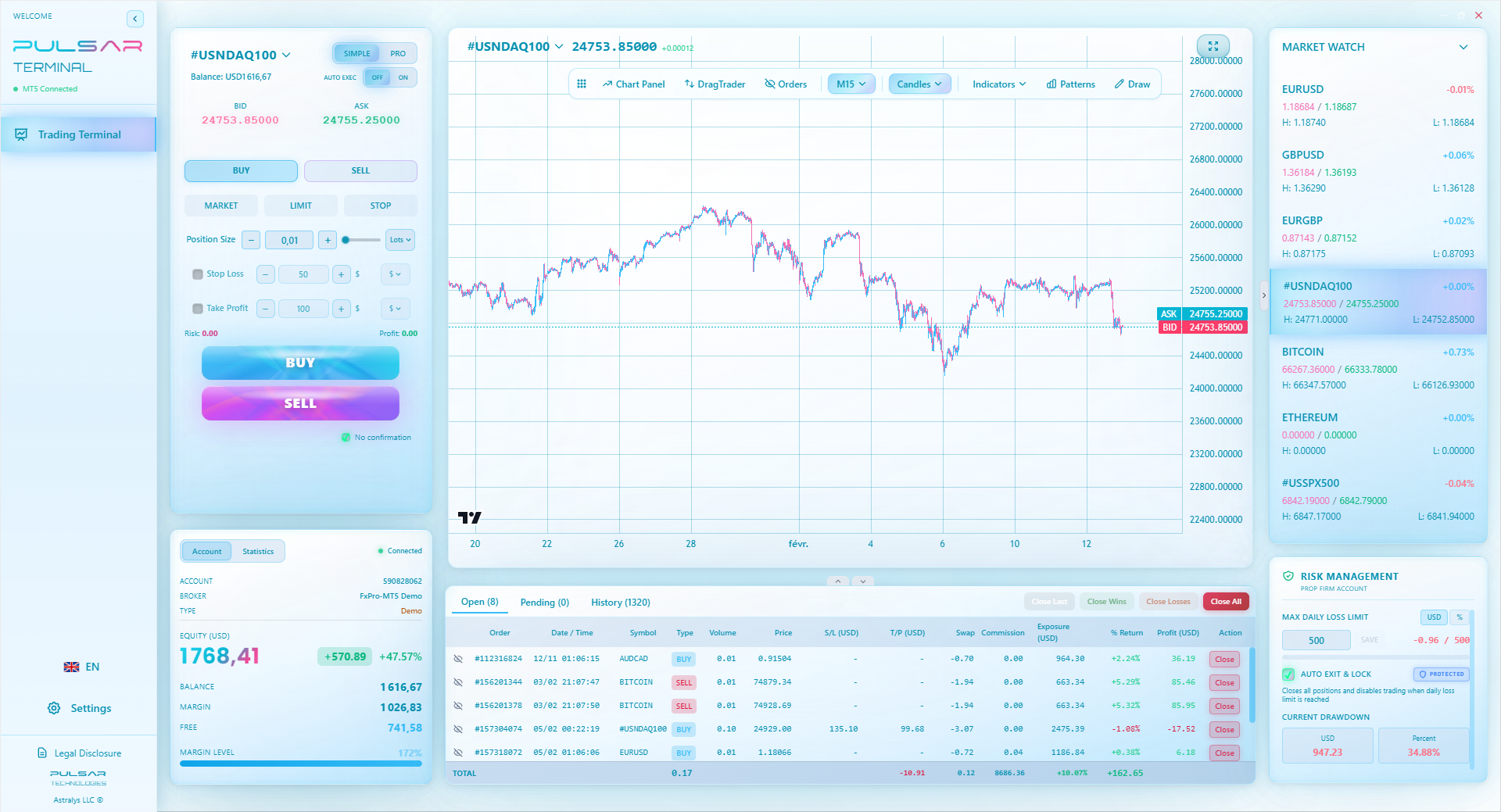
Managing multiple trades and complex risk parameters like trailing stops is where a tool like Pulsar Terminal, which integrates directly with MT5, turns a stressful juggling act into a streamlined, automated process.
Pulsar Terminal
The all-in-one MT5 companion: drag-and-drop orders, multi-TP/SL, trailing stop, grid trading, Volume Profile, and prop firm protection. Used by 1,000+ traders daily.
With so many options, how do you pick? You don't have to trade everything. Specialization is a strength.
For Beginners: Start with one major currency pair. EUR/USD is the textbook choice. Why? The most information available, the tightest spreads (look for brokers like Pepperstone review or IC Markets for raw spreads), and clear sessions (London and New York overlap). Spend your first six months learning its personality. Use the MACD indicator and RSI indicator on it. Learn how it reacts to US Non-Farm Payroll data. Master one instrument.
For Intermediate Traders: Add one non-correlated asset. If you're trading EUR/USD, add Gold (XAU/USD). They often move independently. When currencies are flat, commodities might be trending. This diversifies your opportunities. I also added the US30 index for swing trading on higher timeframes.
What to Avoid at the Start:
- Exotic Pairs: The spreads will eat you alive.
- Cryptocurrencies: Extreme 24/7 volatility is a recipe for emotional trading and sleepless nights in our timezone.
- Trying to Trade Every Session: You're in WAT. The Asian session is slow. The London session (8 AM - 5 PM our time) is active. The New York session (2 PM - 11 PM our time) is most volatile. Don't burn yourself out trying to catch the Tokyo session at 1 AM.
Build a watchlist of 3-5 instruments you understand deeply. Your trading platform isn't a menu; it's a toolbox. You don't use every tool for every job.
“Your trading platform isn't a menu; it's a toolbox. You don't use every tool for every job.”
Let's get honest about the mistakes that cost real money.
1. Chasing Naira Sentiment: I used to take USD/JPY trades based on how 'strong' I felt the Naira was. That's irrelevant. The market doesn't price in Naira sentiment. You must think in the currency pair you're trading.
2. Ignoring the True Cost: I'd see a "0.0 pip spread" advertisement and get excited. What they don't tell you is the commission. A "zero spread" account might charge $7 per round turn lot. On a 1-lot EUR/USD trade, that's 0.7 pips of cost anyway. Always calculate the total cost: Spread + Commission. Compare brokers like XM review (low spreads, sometimes higher commissions) with others to find your best fit.
3. Overtrading Exotics for 'Action': The USD/ZAR or USD/TRY pair would be moving 100 pips a day while EUR/USD moved 50. I thought that meant more opportunity. It meant more spread cost and unpredictable, gap-prone price action. The action was all noise.
4. Not Accounting for Slippage: During high-impact news (like CBN rate decisions or US CPI), your market order might not fill at the price you see. I once had a stop-loss on GBP/USD during Brexit news that filled 15 pips worse than my set price. That's slippage. Use limit orders where possible, and avoid trading the initial spike of major news unless you have a specific strategy for it.
5. Underestimating Psychological Toll: Trading USD/NGN might be emotionally charged for you. Avoid it. Trade instruments you have no emotional baggage with. Your judgment needs to be clinical, not patriotic or hopeful.
FAQ
Q1Is forex trading legal in Nigeria?
Yes, forex trading for individuals is legal. The regulatory environment is evolving. The Securities and Exchange Commission (SEC) of Nigeria now requires online forex trading platforms to register under the Investments and Securities Act (ISA) 2025, aiming to provide more investor protection. Always use internationally regulated brokers as a primary safety measure.
Q2What is the minimum amount to start forex trading in Nigeria?
While some brokers allow deposits as low as $1, I strongly advise against starting with that. After factoring in transfer costs and realistic risk management, a minimum of $500 is a more practical starting point. This allows you to trade sensible position sizes and absorb a few losses while learning without immediately blowing your account.
Q3Can I trade the Nigerian Naira (NGN) on forex?
Directly trading Naira pairs (like USD/NGN) is rare on major international forex platforms due to local capital controls and liquidity issues. You are primarily trading major global currencies (EUR, USD, GBP, JPY) and other CFDs. Your profits and losses are in USD or another major currency, which you then convert to Naira.
Q4How are my forex trading profits taxed in Nigeria?
If trading is considered a business or you generate significant profits, you are liable for a 10% Capital Gains Tax on your gross profits, payable to the Federal Inland Revenue Service (FIRS). It's wise to keep detailed records of all trades and withdrawals for tax purposes.
Q5What is the most traded forex pair, and why should I care?
EUR/USD is the most traded pair globally. It has the highest liquidity and typically the lowest spreads. For Nigerian traders, this means lower trading costs and more predictable, smoother price action, making it an ideal pair for beginners to learn on compared to volatile exotics with wide spreads.
Q6What's the difference between trading currencies and trading CFDs on gold?
When you trade a currency pair, you're trading the value of one currency against another. When you trade a Gold (XAU/USD) CFD, you're trading a contract based on the US Dollar price of an ounce of gold. You never own the physical gold. The key difference is in the asset's drivers: gold is a commodity/hedge asset influenced by different factors (real yields, safe-haven demand) than pure currency pairs.
Q7Is the high use offered by brokers good for me?
In most cases, no. use above 1:100 is extremely dangerous for retail traders. It magnifies losses and can lead to rapid account liquidation. I recommend using no more than 1:10 to 1:30 use, focusing instead on proper position sizing. High use is a marketing tool, not a trading tool.
Prof. Winston's Lesson
Key Takeaways:
- ✓Forex trading is primarily CFD speculation, not currency exchange.
- ✓Start with EUR/USD; its low spread and high liquidity are beginner-friendly.
- ✓Factor in ALL costs: spread, commission, currency conversion, and 10% CGT.
- ✓Use use under 1:30 to survive; let position sizing dictate profit.
- ✓Specialize in 3-5 instruments you understand deeply.
How useful was this article?
Click a star to rate
Weekly Trading Insights
Free weekly analysis & strategies. No spam.
About the Author
Olumide Adeyemi
West African Trading Pioneer
One of Nigeria's most active forex trading educators. 8 years of experience trading from Lagos. Specializes in low-capital strategies and prop firm challenges for African traders.
Comments
Risk Disclaimer
Trading financial instruments carries significant risk and may not be suitable for all investors. Past performance does not guarantee future results. This content is for educational purposes only and should not be considered investment advice. Always conduct your own research before trading.
You Might Also Like

Cara Trading Forex Sukses: 7 Prinsip dari Trader Profesional
Cara trading forex sukses dengan 7 prinsip trader pro: manajemen modal, disiplin, journal trading, backtest. Data nyata, bukan janji profit palsu.
Jam Trading Forex Terbaik untuk Trader Indonesia: Panduan Lengkap dengan Tabel Waktu
Panduan jam trading forex untuk trader Indonesia. Tabel 4 sesi dunia, jam emas 20:00-00:00, sesi mana yang harus dihindari. Data akurat + tips dari trader berpengalaman.
Top 5 Sàn Forex Uy Tín Nhất 2026: Review Jujur dari Trader Indonesia
Top 5 sàn forex uy tín 2026 untuk trader Indonesia. Review jujur: spread, deposit, withdraw, dukungan lokal. Exness, XM, IC Markets & lebih.
Get Pulsar Terminal
All these calculators are built into Pulsar Terminal with real-time data from your MT5 account. One-click position sizing, automatic risk management, and instant calculations.
Get Pulsar Terminal