
Margin

MAR-jinsince Early 1990s interbank forex eraMargin — your 'good faith' deposit that lets you control massive trading positions with just a fraction of the actual value — think of it as a security deposit for borrowed market power.
§1So, what IS margin anyway?
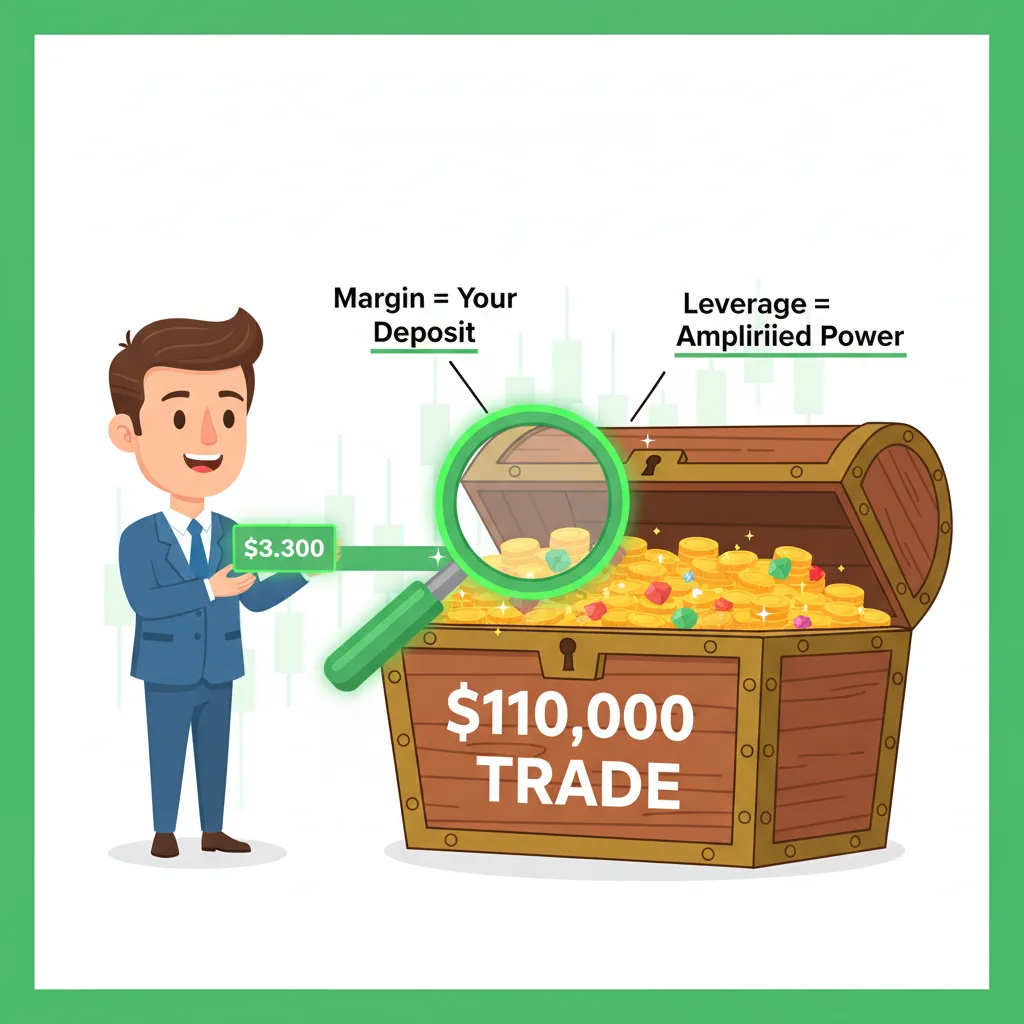
Okay, picture this: you want to rent a fancy apartment, but instead of paying the full year's rent upfront, you just put down a security deposit. That's margin in trading! It's not a fee you lose — it's your own money that gets 'locked up' as collateral so you can control positions way bigger than your actual account balance. Think of it as your 'good faith' deposit to the broker, saying 'trust me, I've got skin in this game.' I've seen traders get this wrong and think margin is a cost — nope! It's just your funds temporarily parked while your trade runs. The real magic? That 3% margin on EUR/USD means you're controlling $110,000 with just $3,300 of your own cash. Sounds powerful, right? Well, it is — and that's why you need to understand it inside out before you start playing with this financial amplifier.
§2The math (don't worry, it's friendlier than it looks)
Let's break down that intimidating formula into something you can actually use. Required Margin = (Lot Size / Leverage) × Current Price. See? Not so scary! Here's what's happening: your lot size is how many units you're trading (like 100,000 for a standard lot), leverage is your broker's multiplier (say 30:1), and current price is, well, the current price. Divide the lot by leverage to get your 'effective' position size, then multiply by price to convert to your account currency. Or think of it this way: if your broker requires 3% margin, that's just 3% of your total trade value. So for that $110,000 EUR/USD trade, 3% × $110,000 = $3,300. Simple division! The other formulas? Margin Level = (Equity / Used Margin) × 100 tells you how 'healthy' your account is, and Free Margin = Equity - Used Margin shows what you've got left to play with. See? Math can be your friend.
§3Here's how margin actually works in your trading platform
Let's walk through what happens when you click 'buy' on EUR/USD. You decide to buy 1 standard lot (that's 100,000 units) at 1.1000. Your platform calculates the total value: 100,000 × 1.1000 = $110,000. Now, your broker says 'we need 3% as collateral' — that's their margin requirement. So 3% of $110,000 = $3,300. That $3,300 gets moved from your 'available balance' to 'used margin' — it's still yours, just locked up. Now you're controlling $110,000 with only $3,300! If the price moves to 1.1100 (up 100 pips), you gain $1,000. If it drops to 1.0900 (down 100 pips), you lose $1,000. See how those moves feel bigger? That's leverage working through margin. Your platform constantly monitors your Margin Level — if it drops too low (often to 50%), you'll get that dreaded margin call. It's all happening automatically, but understanding the mechanics means you're in control.
§4The weird exceptions nobody warns you about (until it's too late)
Alright, time for the fine print that can trip you up! First, weekend margin — some brokers increase requirements before markets close Friday. Why? They're covering their risk if prices gap wildly over the weekend. Suddenly your comfortable 3% becomes 5% and boom, margin call! Then there's volatile markets: during big news events, brokers might temporarily hike margin requirements. I've seen traders get caught here thinking 'but my math was right!' — well, the rules changed mid-game. Offshore brokers? That's a whole different ballgame. While regulated brokers in Europe cap leverage at 30:1 (3.33% margin), some offshore jurisdictions offer 500:1 or more. Sounds tempting, but trust me, that's playing with financial dynamite. And JPY pairs? They quote to two decimals instead of four, so a pip is 0.01 instead of 0.0001 — just know your numbers look different. These exceptions matter because they're where accounts get blown.

§5Three real examples that'll make margin click
Let's get concrete with some scenarios you might actually face:
| Scenario | Pair | Position Size | Entry Price | Margin Required | What Happens |
|---|---|---|---|---|---|
| Standard Forex | EUR/USD | 1 lot (100,000) | 1.1000 | $3,300 (3%) | Control $110,000 with just $3,300 of your cash |
| Smaller Trade | EUR/USD | €20,000 | 1.13015 | $754.94 (3.34%) | Even smaller positions need collateral — every trade uses margin |
| Commodity CFD | Gold (XAU/USD) | 1 lot | $2,000/oz | $1,000 (5%) | Higher margin for volatile assets protects you (and your broker) |
See how that works? In the first example, you're putting up $3,300 to control $110,000 — that's the power (and risk) of leverage through margin. The second shows even a modest €20,000 trade needs nearly $755 locked up. The gold example? That 5% margin requirement (20:1 leverage) is typical for commodities — regulators know they're jumpy! Each scenario has different margin because different assets have different risk profiles. The key takeaway? Margin isn't one-size-fits-all.
§6Where this 'margin' thing even came from
Margin trading isn't new — it's been around since people started borrowing to buy stocks. But in retail forex? That really took off in the 1990s as online trading platforms emerged. Brokers offered crazy leverage like 100:1 or even 400:1, and let's just say... some traders learned painful lessons. Then came 2008 — the financial crisis didn't create margin trading, but it sure made regulators nervous about excessive leverage everywhere. Fast forward to 2018: European regulators (ESMA) said 'enough!' and capped retail leverage at 30:1 for major pairs. The UK's FCA followed in 2019. Why? To protect everyday traders from wiping out accounts with one bad move. These caps mean 3.33% margin minimum for EUR/USD instead of the 0.25% (400:1) some offshore brokers still offer. The history of margin is basically a pendulum swinging between 'access for all' and 'protection from ourselves' — and right now, protection's winning.
§7Key takeaways
- Margin is collateral, not a cost — your money gets locked but not lost when you trade.
- With just 3.33% margin (30:1 leverage), you control positions 30 times your deposit — powerful but risky!
- Watch your margin level like a hawk: below 100% means trouble, at 50% positions get auto-closed.
- Different assets need different margin: 3.33% for EUR/USD, 5% for gold, 20% for stocks — know before you trade.
- Free margin = available cash for new trades. Run out of free margin? That's a margin call waiting to happen.
§8Frequently asked questions
QWhat's a margin call and should I be scared?
QIs margin a cost or fee I pay?
QWhat's free margin and why do I care?
QHow can I avoid a margin call?
QWhat's margin level and what number should I watch?
§See also
§References
- ESMA Product Intervention Measures on CFDs — European Securities and Markets Authority
- FCA Permanent Restrictions on CFDs for Retail Consumers — Financial Conduct Authority