
Take Profit

/teɪk ˈprɒfɪt/ (TAYK PROF-it)since Early 2000s with electronic trading platformsTake Profit — Your automated 'cash out' button that closes a winning trade at a predetermined price so you don't get greedy and watch profits vanish.
§1So, what IS a Take Profit order?
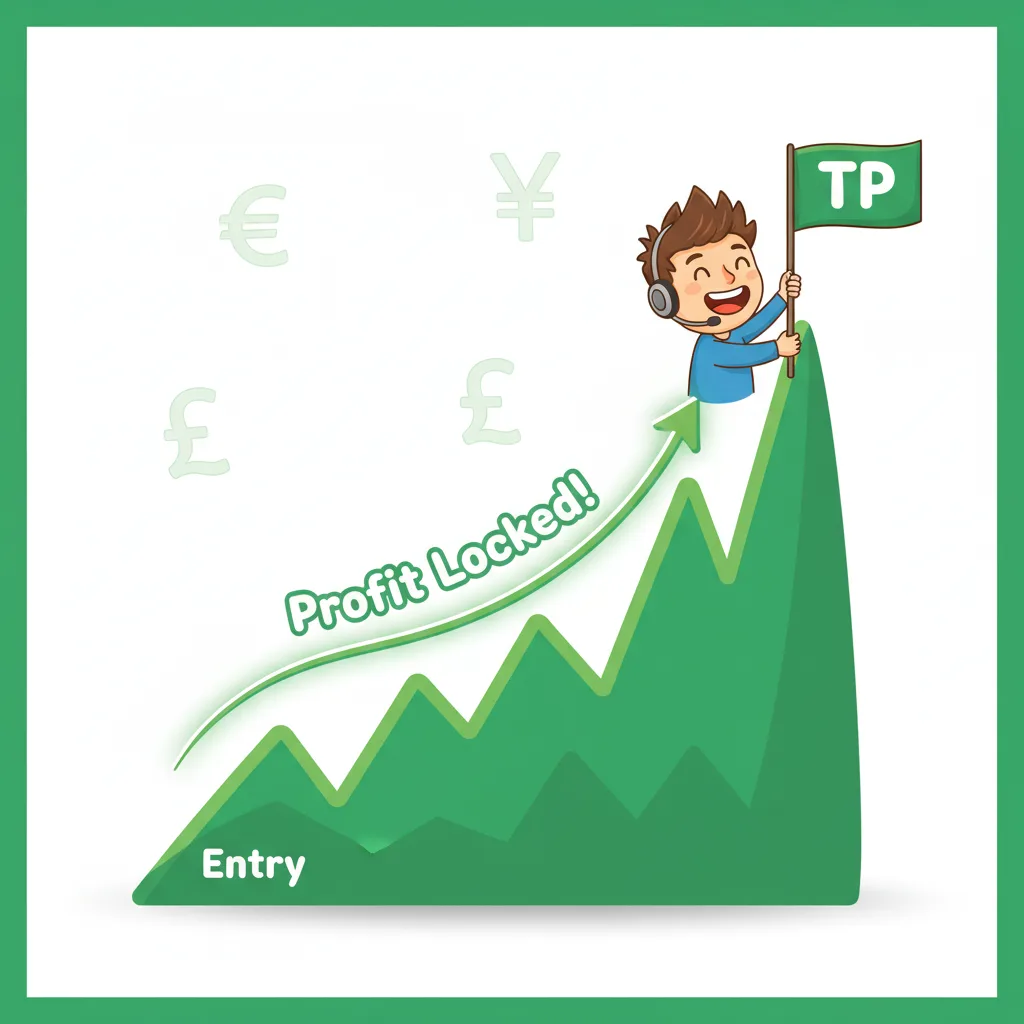
Imagine you're at a buffet with your favorite dessert. You could keep eating until you're sick, or you could decide ahead of time: 'Three slices, then I'm done.' A Take Profit order is that decision for your trades. It's an automated instruction you give your broker that says, 'Hey, when this trade reaches this specific profitable price, close it and give me my money!' Why bother? Because markets have this nasty habit of reversing right after you think, 'Just a little more profit...' I've seen traders watch 100-pip gains turn into losses because they got greedy. A TP order removes that emotion. It's like having a responsible friend who takes your keys when you've had enough. You set it once when you're thinking clearly, and it executes automatically. No monitoring charts all night, no panic decisions. Just pure, disciplined profit-taking.
§2The math (don't run away — it's simpler than it looks!)
Okay, I know formulas can make eyes glaze over, but stick with me. The basic idea is just addition or subtraction from your entry price. Buying EUR/USD at 1.0801 and want 50 pips profit? Your Take Profit is 1.0801 + 0.0050 = 1.0851. Selling USD/JPY at 155.20 and want 70 pips? That's 155.20 - 0.70 = 154.50. See? Not rocket science. The 'pip value' part just tells you how much each pip is worth in your account currency. For a standard lot (100,000 units) on EUR/USD, it's about $10 per pip. So those 50 pips would be $500 profit. Mini lots are $1 per pip, micro lots $0.10. The actual formula? Pip Value = (0.0001 / Exchange Rate) × Trade Size for most pairs. But honestly, your trading platform calculates this automatically. You just need to know where to place your TP!
§3Here's how it plays out in real life
Let's walk through a real scenario. You're bullish on GBP/USD, and you enter a long position at 1.2500 with 0.5 lots. Your platform tells you that's about $5 per pip (half of the standard $10). You decide you want a 50-pip profit because that's what your analysis suggests is reasonable. So you set your Take Profit at 1.2550 (1.2500 + 0.0050). Then you go make coffee. If the price rises to 1.2550, boom — your trade closes automatically. Profit = 50 pips × $5 = $250. No need to stare at the screen. No second-guessing. The market does the work, and you get paid. It's like setting a thermostat: you pick the temperature (profit level), and the system maintains it. Without a TP, you're manually adjusting the heat every minute — exhausting and prone to error.
§4The weird exceptions nobody warns you about
Now for the fun part — exceptions! First, JPY pairs. They're the quirky cousin in the forex family. For USD/JPY, a pip is 0.01, not 0.0001. So if you sell at 155.20 and want 70 pips, you subtract 0.70, not 0.0070. Mess this up and your TP will be in another galaxy. Second, slippage. In crazy volatile markets (think news events), your TP might not fill at exactly 1.2550. It could be 1.2549 or 1.2551. Usually it's minor, but it happens. Third, leverage differences. EU/UK brokers cap leverage at 30:1 for majors, but some offshore shops offer 500:1. Higher leverage means bigger profits with a TP... and bigger losses if you're wrong. Trust me, I've seen accounts evaporate with over-leveraged trades that reversed before hitting TP.

§5Three examples that'll make it click
Let's look at three concrete setups. First, EUR/USD buy at 1.0801, TP at 1.0851 for 50 pips. Second, GBP/USD long at 1.2500 with 0.5 lots, TP at 1.2550 for $250 profit. Third, USD/JPY sell at 155.20, TP at 154.50 for 70 pips. Here's a quick comparison table:
| Scenario | Pair | Entry | TP Exit | P&L |
|---|---|---|---|---|
| Day Trade | EUR/USD | 1.0801 | 1.0851 | 50 pips |
| Swing Trade | GBP/USD | 1.2500 | 1.2550 | $250 |
| JPY Trade | USD/JPY | 155.20 | 154.50 | 70 pips |
Notice how each has a clear exit. That's the power of a TP — you know exactly when you're taking money off the table.
§6Where this thing even came from
The idea of taking profits is ancient — traders have been selling assets after price rises since markets existed. But the automated Take Profit order? That's a modern luxury. Back in the pit-trading days, you had to scream 'Sell!' and hope someone heard you. With the rise of electronic platforms in the early 2000s, brokers let you place orders in advance. Suddenly, you could set a profit target and walk away. No more glued to the screen. It became a cornerstone of risk management alongside the stop-loss. There wasn't a big 'Eureka!' moment — just technology catching up with common sense. Now, it's standard practice. My first year trading, I didn't use TPs consistently... and I lost more profits to reversals than I care to admit. Learn from my mistakes!
§7Key takeaways
- Always set a Take Profit — it's your 'cash out' button that prevents greed from turning wins into losses.
- Aim for risk-reward ratios like 1:2 or 1:3; this means your profit target should be 2-3 times further from entry than your stop loss.
- For JPY pairs, remember pips are 0.01 moves, not 0.0001 — get this wrong and your TP will be wildly off.
- Use real numbers: 50 pips on EUR/USD with a standard lot equals about $500 profit. Know what you're playing for.
§8Frequently asked questions
QWhat is a Take Profit order and why is it important?
QHow do you set a Take Profit level?
QWhat's the difference between Take Profit and Stop Loss?
QCan a Take Profit order guarantee execution at the exact price?
QShould I always use a Take Profit order?
§See also
§References
- ESMA Leverage Regulations — European Securities and Markets Authority
- Forex Trading Glossary — The Trading Mentor