


You've probably seen the ads, right? 'Download this 100% accurate MT5 indicator for free and start printing money!' It sounds too good to be true, and as a trader in South Africa, you need to know the hard truth.

David van der Merwe
Nhà giao dịch Thị trường Mới nổi ·  South Africa
☕ 11 phút đọc
Bạn sẽ học được:
You've probably seen the ads, right? 'Download this 100% accurate MT5 indicator for free and start printing money!' It sounds too good to be true, and as a trader in South Africa, you need to know the hard truth. I've been down that rabbit hole myself, wasting months and real money chasing that perfect signal. Let's talk honestly about why that magical indicator doesn't exist, what the FSCA-regulated landscape really looks like, and how you can build a realistic edge using MT5.
Let's get this out of the way first. Any website promising a '100% accurate forex indicator' is selling you a dream, not a tool. I learned this the expensive way back in 2018. I paid $97 for an 'AI-powered, never-fail' indicator for MT5. The seller's backtests looked flawless. My real account? I blew through R15,000 in three weeks. The market doesn't work on perfect signals; it works on probabilities and human psychology.
Think about it. If someone had a truly 100% accurate system, why would they sell it for R100 or even R10,000? They'd quietly use it to become the richest person on the planet. The forex market has a daily turnover of over $6 trillion. A perfect edge would be worth billions, not the price of a cheap ebook.
These 'free download' offers are almost always lead magnets. You give your email, you get a broken or repackaged version of a common indicator like a moving average, and then you're bombarded with upsells for the 'pro version' that 'really works'. It's a marketing funnel, not a trading education.

Warning: Downloading random .ex5 or .mq5 files from unverified sources is a major security risk. You could be installing malware or a 'sniffer' that steals your MT5 login credentials and gives a hacker access to your trading account. Only use indicators from trusted, reputable sources or learn to code your own.
The reality is that all indicators are lagging. They're mathematical formulas applied to past price data. They can't predict the future; they can only suggest what might happen based on what has happened. Your job as a trader is to interpret that suggestion within the context of market structure, news, and volume.

💡 Mẹo của Winston
A trader once asked me for the perfect indicator. I gave him a ruler and said, 'Measure every loss. The pattern you need to find is in your own discipline, not on the chart.'
So, if 100% accuracy is a fantasy, what should you be doing? You should be building a strong trading plan around indicators that help you assess probability. Forget perfection; aim for consistency. A good strategy might only be right 55-60% of the time, but with proper risk management, that's more than enough to be profitable over the long run.
Combining Price Action with Momentum
I don't use any single indicator in isolation. My core setup on MT5 is simple: I look at pure price action (support/resistance, trend lines) and then use one or two indicators for confirmation. My favourite combo is the MACD indicator alongside the RSI indicator. The MACD helps me see trend direction and momentum shifts, while the RSI helps identify potential overbought or oversold conditions within that trend.
For example, if USD/ZAR is in a clear uptrend and pulls back to a key support level, I'll wait for the MACD histogram to start turning back up from the zero line and the RSI to bounce from a level like 40 (not necessarily the extreme 30). That's a confluence of three factors: price level, trend momentum, and short-term exhaustion. It's not a guarantee, but it stacks the odds in my favour.
Volume is Your Secret Weapon
One of MT5's advantages over MT4 is better volume data (tick volume). Most retail traders ignore volume, which is a huge mistake. An indicator like the Volume Profile, which you can find in advanced tools like Pulsar Terminal or certain custom MT5 scripts, shows you where the market has traded the most volume. These high-volume nodes often act as massive support or resistance. A price break with high volume is far more significant than a break on low volume. Incorporating this kind of analysis moves you away from chasing lagging signals and towards understanding market mechanics.
“The market doesn't work on perfect signals; it works on probabilities and human psychology.”
Trading in South Africa isn't just about charts; it's about operating within a specific regulatory and economic environment. The Financial Sector Conduct Authority (FSCA) is our watchdog. Always, and I mean always, check that your broker is FSCA-regulated. You can verify their license number on the FSCA's website. This is your first line of defence against scams promising those '100% accurate' systems.
Our currency, the ZAR, is a wild animal. It's an emerging market currency, and pairs like USD/ZAR can move 200-300 pips in a day without breaking a sweat. On April 7, 2026, it hit 16.9236, and it's been as high as 19.93. This volatility is a double-edged sword: huge opportunity for profit, and huge risk for loss. An indicator that seems calm on EUR/USD might go completely haywire on USD/ZAR.

Pro Tip: When testing any new indicator or strategy, test it specifically on ZAR pairs like USD/ZAR or EUR/ZAR. The spreads are wider and the moves are more erratic. If your strategy can handle that, it's more strong. Many international 'gurus' don't account for our local market's character.
Costs matter too. Trading USD/ZAR on a standard account might have a spread of 40-50 pips. That means the price needs to move 50 pips just for you to break even on a round trip. This makes scalping strategy very difficult on these pairs. You need a strategy that aims for larger moves, like swing trading, to overcome that transaction cost. Always factor the spread into your risk/reward calculation. A good FSCA-regulated broker like Khwezi Trade or Exness will offer ZAR-denominated accounts, saving you conversion fees.
💡 Mẹo của Winston
In Johannesburg or Cape Town, the spread on USD/ZAR is your real first opponent. If your strategy can't overcome a 40-pip gatekeeper, it's not a strategy, it's a wish.
Okay, so where do you actually find decent indicators for MT5? The first and best place is the MetaTrader Market built right into your MT5 platform. Click on 'Market' in the toolbox. Here you'll find both free and paid indicators that have been vetted by MetaQuotes. The ratings and reviews are from real users.
The MQL5 Community website is another hub. You can find thousands of scripts, indicators, and Expert Advisors (EAs). The key is to look for tools with open-source code (so you can see there's no malicious software) or those with a long history and positive forum feedback. Avoid anything that promises 'no loss' or '100% win rate' in its description.
Once you download an indicator, the real work begins: testing. Don't you dare use it on a live account first.
- Visual Backtest: Apply it to your MT5 chart and scroll back in time. See how it behaved. Did it give good signals at major swing points? How many false signals did it produce? Be brutally honest with yourself.
- Demo Account: Trade the signal on a demo account for at least a month, or 50-100 trades. Keep a detailed journal. Note the win rate, the average win vs. average loss.
- Strategy Tester: MT5 has a fantastic built-in Strategy Tester. You can code your indicator logic into an Expert Advisor (EA) or find an EA that uses it, and run historical data tests. This gives you hard data on profitability, drawdown, and the strategy's stability over time.
I tested a popular 'supply and demand zone' indicator this way last year. On visual backtest, it looked amazing. The Strategy Tester over 5 years of EUR/USD data revealed it had a 42% win rate and a max drawdown of 35% of the account. That's a fast track to a margin call. I scrapped it. Let the data make your decisions, not hope.
“Your edge comes from your entire process, not from a single flashing arrow on your screen.”
The indicator is just one piece of the puzzle, and honestly, it's not even the most important piece. Your edge comes from your entire process. Here’s what truly matters:
Risk Management: This is non-negotiable. I never risk more than 1% of my account on a single trade. Use a position size calculator every single time. If you're trading volatile USD/ZAR, you might need to risk even less, like 0.5%, because the stops are wider. Surviving the losing streaks is what keeps you in the game.
Psychology: This is the hardest part. You will have losing trades. A lot of them. The '100% accurate' fantasy preys on your desire to avoid this pain. Accepting that losses are part of the cost of doing business is liberating. It stops you from moving your stop loss, revenge trading, or abandoning your plan after two bad trades.
Broker Choice: Your broker is your business partner. I've had good experiences with the execution and ZAR support from IC Markets and Pepperstone, both of which have FSCA regulation. Low, transparent costs (spreads + commission) directly increase your profitability. Compare the effective spread - the spread plus any commission - across brokers for the pairs you trade most.
Continuous Learning: Don't just be an indicator user. Understand what the indicator is calculating. Learn to read raw price action. Study market fundamentals - why is the ZAR moving? Is it the SARB interest rate decision, commodity prices (like platinum or gold), or global risk sentiment? This context will help you filter out bad indicator signals. For instance, if the XAU/USD guide shows gold crashing, it's likely to pressure the ZAR, giving you a bias for your USD/ZAR trades.
💡 Mẹo của Winston
Your trading journal is the only 'indicator' that's 100% accurate about one thing: you. It never lies about your habits, your fears, or your greed.
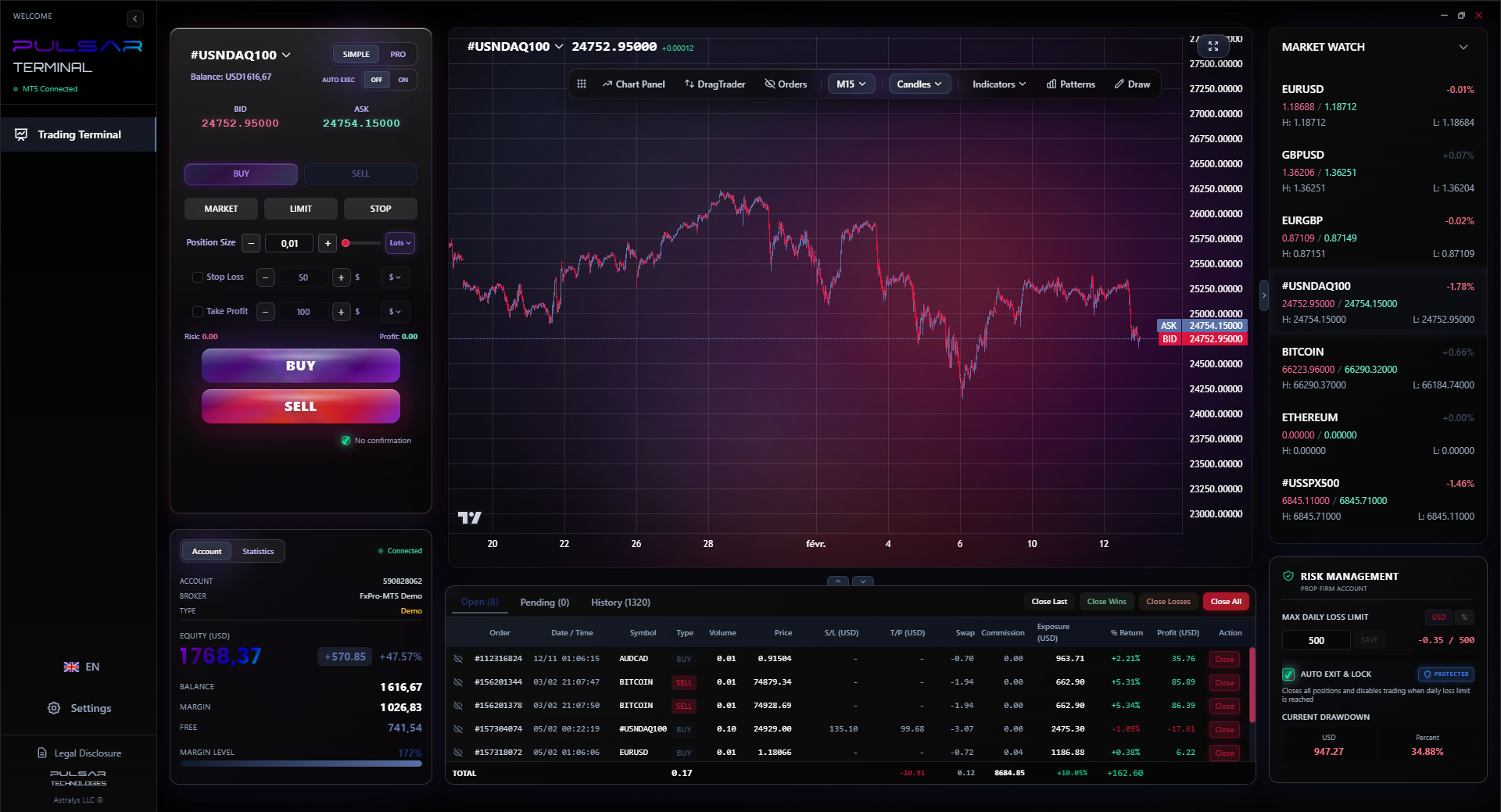
Managing multiple take-profit levels and moving stops to breakeven on volatile pairs like USD/ZAR is stressful; Pulsar Terminal automates this directly on your MT5 chart with drag-and-drop ease.
Pulsar Terminal
Công cụ MT5 tất-cả-trong-một: đặt lệnh kéo-thả, multi-TP/SL, trailing stop, grid trading, Volume Profile và bảo vệ prop firm. Hơn 1.000 trader sử dụng mỗi ngày.
Let's make this concrete with some real trade examples from my own book. No cherry-picking, just reality.
Trade 1 (Winner): EUR/USD
- Setup: Price bounced off a clear 4-hour support level. Daily trend was up. My custom momentum oscillator (a modified RSI) showed a bullish divergence.
- Action: Entered long at 1.0725.
- Risk: Stop loss at 1.0695 (30 pips risk). Used my 1% rule, so position size was calculated accordingly.
- Result: Took half profit at +30 pips (1.0755), moved stop to breakeven. Price ran further, closed final half at 1.0780. Total gain: 45 pips on average.
- Cost: Spread was 0.8 pips, commission $7 per lot. Net profit still healthy.
Trade 2 (Loser): USD/ZAR
- Setup: Similar indicator setup on the hourly chart, looking for a continuation long after a pullback. Entered at 16.8500.
- The Problem: I ignored a major resistance zone just 50 pips above, visible on the daily chart. I was too focused on my short-term indicator.
- Action: Stop loss hit at 16.8200 (300 pips risk - yes, ZAR stops are big!).
- Result: Loss of 1% of the account. The lesson? The indicator gave a signal, but higher timeframe structure overruled it. I now always check the daily chart before any ZAR trade.
These two trades show the rhythm: a disciplined win followed by a disciplined loss. The system works because the wins are generally larger than the losses (a positive risk-to-reward ratio), not because every trade is a winner. My journal shows a 58% win rate over the last 200 trades. That's a realistic, achievable target, not 100%.
“A 58% win rate with disciplined risk management is a realistic, achievable target. 100% is a fantasy that will cost you real money.”
Forget the download. Here's what to do instead:
- Unsubscribe & Ignore: Unsubscribe from any YouTube channel or email list selling the 'holy grail'. It's mental pollution.
- Audit Your MT5: Go through your MT5 'Indicators' folder. Delete anything with a name like 'MillionairePips' or 'GodModeSignal'. Clean slate.
- Learn One Setup: Pick ONE major pair (start with EUR/USD guide as it's most liquid) and ONE simple indicator combo (like Moving Average + RSI). Learn everything about it. What does it look like in a ranging market? In a trend? On the 1-hour vs. the 4-hour chart?
- Open a Demo Account: If you don't have one, open a demo with an FSCA broker like XM or AvaTrade. Practice your one setup for 100 trades. Journal every single one.
- Master the Basics: Truly understand a pip definition, how the spread definition affects you, and how margin works. These are the bricks your trading house is built on.
The path to becoming a proficient trader in South Africa is through education, discipline, and realistic expectations, not through a magical download. The market is tough enough without you believing in fairy tales. Put in the real work, and you'll build something that lasts.
FAQ
Q1Is it illegal to use forex indicators or trading bots in South Africa?
No, it's perfectly legal. The Financial Sector Conduct Authority (FSCA) regulates the conduct of brokers and financial service providers, not the specific tools you use on your platform. The key is that your broker must be FSCA-licensed. Using bots or indicators on an unregulated offshore platform is where you run into legal and safety risks.
Q2What is the most accurate forex indicator for MT5?
There isn't one. Accuracy depends on market conditions and how you use the tool. Many professional traders consider price action (support/resistance, candlestick patterns) combined with volume analysis to be the most reliable 'indicator.' For confirming tools, moving averages, the MACD, and the RSI are timeless precisely because they don't pretend to be perfect - they just show what the data says.
Q3Where can I safely download free MT5 indicators in South Africa?
The safest sources are the official MetaTrader Market within your MT5 platform and the MQL5.com community website. Look for indicators with high ratings, many downloads, and positive user reviews. Be wary of third-party 'free download' blogs, as the files can be tampered with. Always run a virus scan on any downloaded .ex5 or .mq5 file.
Q4Why do ZAR pairs like USD/ZAR need a different approach?
The South African Rand is an emerging market currency, which means it's significantly more volatile than majors like the Euro or US Dollar. Spreads are wider (often 30-50 pips vs. 0.8 for EUR/USD), and price moves can be more explosive and news-driven. Indicators can give frequent false signals due to this volatility. You need wider stop losses, smaller position sizes, and must pay extra attention to local economic news and commodity prices.
Q5Can I make a living trading forex with indicators in South Africa?
It's possible, but it's exceptionally difficult and should not be your initial goal. The FSCA itself highlights that most retail traders lose money. To even consider it, you need a substantial, risk-proofed trading capital (not your rent or savings), a proven, documented strategy with years of demo and live testing, and iron-clad discipline. Treat it as a serious business venture, not a get-rich-quick scheme. Most successful traders take years to reach consistency.
Q6What's the difference between an MT5 indicator and an Expert Advisor (EA)?
An indicator is a tool for analysis. It displays information on your chart (like lines, histograms, or arrows) to help you make a decision. An Expert Advisor (EA) is an automated trading robot. It's a program that can execute trades, manage orders, and apply a full strategy automatically based on its programming. You can use indicators as part of an EA's logic. Many '100% accurate' scams are sold as EAs.
Bài học của Prof. Winston
Điểm chính:
- ✓No indicator predicts the future; they only interpret the past.
- ✓Always verify your broker's FSCA license number.
- ✓Risk a maximum of 1% per trade on volatile ZAR pairs.
- ✓Test any strategy for 100 trades before going live.
Bài viết này hữu ích thế nào?
Nhấp vào ngôi sao để đánh giá
Nhận định giao dịch hàng tuần
Phân tích & chiến lược miễn phí hàng tuần. Không spam.
Về tác giả
David van der Merwe
Nhà giao dịch Thị trường Mới nổi
Trader tại Johannesburg với 11 năm kinh nghiệm về tiền tệ thị trường mới nổi. Chuyên về cặp ZAR, giao dịch theo quy định FSCA và phân tích thị trường Nam Phi.
Bình luận
Cảnh báo rủi ro
Giao dịch các công cụ tài chính tiềm ẩn rủi ro đáng kể và có thể không phù hợp với tất cả nhà đầu tư. Hiệu suất trong quá khứ không đảm bảo kết quả trong tương lai. Nội dung này chỉ mang tính chất giáo dục và không nên được coi là lời khuyên đầu tư. Hãy luôn tự nghiên cứu trước khi giao dịch.
Bạn cũng có thể thích

Cara Trading Forex Sukses: 7 Prinsip dari Trader Profesional
Cara trading forex sukses dengan 7 prinsip trader pro: manajemen modal, disiplin, journal trading, backtest. Data nyata, bukan janji profit palsu.
Jam Trading Forex Terbaik untuk Trader Indonesia: Panduan Lengkap dengan Tabel Waktu
Panduan jam trading forex untuk trader Indonesia. Tabel 4 sesi dunia, jam emas 20:00-00:00, sesi mana yang harus dihindari. Data akurat + tips dari trader berpengalaman.
Top 5 Sàn Forex Uy Tín Nhất 2026: Review Jujur dari Trader Indonesia
Top 5 sàn forex uy tín 2026 untuk trader Indonesia. Review jujur: spread, deposit, withdraw, dukungan lokal. Exness, XM, IC Markets & lebih.
Tải Pulsar Terminal
Tất cả các công cụ tính này được tích hợp trong Pulsar Terminal với dữ liệu thời gian thực từ tài khoản MT5 của bạn.
Tải Pulsar Terminal