


I lost R4,200 in a single USD/ZAR trade back in 2015 because I didn't understand how local liquidity dried up during load-shedding hours.

David van der Merwe
Nhà giao dịch Thị trường Mới nổi ·  South Africa
☕ 10 phút đọc
Bạn sẽ học được:
- 1Why Reading Matters (Especially for South African Traders)
- 2Absolute Beginner Books (Start Here)
- 3Mastering the Charts: Technical Analysis Essentials
- 4The Winning Mindset: Trading Psychology Books
- 5Leveling Up: Advanced Strategies & Market Mechanics
- 6Building Your South African Trading Library
- 7From Books to Charts: Applying the Knowledge
- 8Common Pitfalls & What to Avoid
I lost R4,200 in a single USD/ZAR trade back in 2015 because I didn't understand how local liquidity dried up during load-shedding hours. I'd read all the generic American trading books, but none prepared me for our market's quirks. That's when I realized the best forex books to read aren't necessarily the most popular ones, they're the ones that teach you how to think. This guide mixes global classics with what you need to know about trading ZAR pairs, FSCA rules, and our unique market hours.
Let's be honest, most guys jump straight into a demo account, watch a few YouTube videos, and think they're ready. I did the same thing. The problem? You're learning someone else's system without understanding the foundation. It's like trying to build a house starting with the roof.
Our market has specific challenges you won't find in most generic material. When you're trading USD/ZAR, which makes up about 95% of rand volume, you're dealing with a different beast than EUR/USD. The spreads are wider, the moves can be more volatile around local data releases (like SARB interest rate decisions), and our trading day overlaps with both Asia and Europe in a unique way.
Reading the right books gives you context. It helps you understand why a strategy works, not just how to execute it. When load-shedding hits and your internet drops, knowing the underlying market structure from a good book might stop you from panicking and closing a good trade. I learned this the hard way after that R4,200 loss. A proper book on market psychology would have saved me from revenge trading the next day (which cost me another R1,800, but that's a story for another time).

Pro Tip: Don't just read passively. When a book mentions a concept like 'support and resistance,' open your USD/ZAR chart and find real examples from the past week. Apply it directly to the pairs you actually trade.
If you're brand new, start here. These books assume you know nothing, and that's perfect.
'Currency Trading for Dummies' by Brian Dolan & Kathleen Brooks This was my first real trading book. It sounds basic, but it covers everything from what a pip definition is to how central banks work. The reason it's great for South Africans is that it explains fundamental concepts without assuming you're trading from London or New York. It gives you the vocabulary you need to not sound like a chop when you're asking questions in forums.
'Forex Trading: The Basics Explained in Simple Terms' by Jim Brown This one is shorter and more direct. Brown cuts through a lot of the fluff and gets to practical points about choosing a broker, understanding use, and basic order types. It's a quick weekend read that will prevent you from making the most obvious (and expensive) mistakes.
What These Books Won't Tell You
They're global. They won't mention that funding your account with a local EFT to a broker like Exness or XM can sometimes take 24-48 hours, or that you should always check if the broker's FSCA license is current. That's your homework. But they give you the foundation to ask the right questions.
My beginner mistake? I read one book, thought I had it all figured out, and immediately moved to complex strategies. Bad move. Master the basics in these books first. Practice with a position size calculator using Rands, not Dollars, to make the risk feel real.

💡 Mẹo của Winston
A library of three books you've mastered is worth more than a shelf of fifty you've skimmed. Depth beats breadth every time in this game.
“The best forex books to read aren't necessarily the most popular ones, they're the ones that teach you how to think.”
This is where you learn to read the story the price is telling. For our volatile pairs like USD/ZAR or even GBP/ZAR, technical analysis is your best friend because it helps filter out the noise.
'Japanese Candlestick Charting Techniques' by Steve Nison The bible. It's not a light read, but you don't need to finish it all at once. Learn the top 10-15 major patterns (like Doji, Engulfing, Hammer) and you'll start seeing opportunities on your ZAR charts you missed before. I remember spotting a clear bullish engulfing pattern on USD/ZAR at R18.40 back in 2022. The book gave me the confidence to take the trade, and it ran to R18.90. That was a R3,500 win from a single concept.
'Technical Analysis of the Financial Markets' by John J. Murphy This is the complete textbook. If Nison's book teaches you the words, Murphy's teaches you the grammar of the markets. It covers everything from trends and chart patterns to indicators like the RSI indicator and MACD indicator. The key for us is the section on intermarket analysis. Understanding how gold (XAU/USD) often moves inversely to the USD can give you clues about USD/ZAR direction. You can learn more about trading gold in our XAU/USD guide.

Warning: Don't become an indicator junkie. I made this mistake early on. I had 12 different indicators on my chart, all giving conflicting signals. Start with pure price action and support/resistance from these books, then add one or two indicators later. Clean charts lead to clear decisions.
You can have the best strategy in the world, but if your head isn't right, you'll lose. This is the most important section for long-term survival, especially when trading our emotionally charged market.
'Trading in the Zone' by Mark Douglas This book changed my career. Douglas argues that trading is a pure probability game. You need to think in terms of probabilities, not certainties. This is crucial when a surprise political announcement sends USD/ZAR swinging 200 pips in minutes. The book teaches you to accept losses as a cost of doing business, not a personal failure. After reading this, I stopped chasing losses on EUR/USD trades that were clearly going against me, saving my account multiple times.
'Market Wizards' by Jack D. Schwager This isn't a how-to manual, it's a collection of interviews with the most successful traders of the 80s and 90s. You hear their stories, their failures, and their philosophies. The big takeaway? There is no single 'right' way to trade. Some are fundamentalists, some are technicians, some are quants. It gives you permission to find your own style that fits your personality and the time you can dedicate - whether that's scalping strategy or swing trading.
Your biggest enemy is the voice in your head after a losing trade. These books give you the tools to silence it.
“You can have the best strategy in the world, but if your head isn't right, you'll lose.”
Once you have the basics and the mindset, you can explore more sophisticated concepts. These books pull back the curtain on how the market really works.
'Day Trading and Swing Trading the Currency Market' by Kathy Lien Lien is a respected fundamental analyst. This book is fantastic because it bridges technical and fundamental analysis specifically for currencies. She explains how interest rate decisions, employment data, and geopolitical events move markets. For a South African trader, understanding how US Non-Farm Payrolls data impacts global USD strength (and thus USD/ZAR) is priceless. She provides concrete strategies for trading around these events.
'The Art of Currency Trading' by Brent Donnelly This is a modern classic from a former bank trader. It's dense, but it explains the real mechanics: who the players are (banks, hedge funds, corporates), how liquidity works, and why the spread definition widens at certain times. This knowledge helps you understand why your stop-loss might get hunted during thin liquidity at 10 PM South African time, and how to place orders more strategically.
Applying Advanced Concepts Locally
Donnelly talks about 'market structure.' In South Africa, our structure includes major local banks being big players in the ZAR market. Sometimes, you can see their influence on the charts. Reading this book helped me identify a false breakout on USD/ZAR that was likely caused by a large local corporate hedge, allowing me to avoid a bad trade.
💡 Mẹo của Winston
The market doesn't care what you've read. It only cares about your next decision. Use books to inform your process, not predict the price.
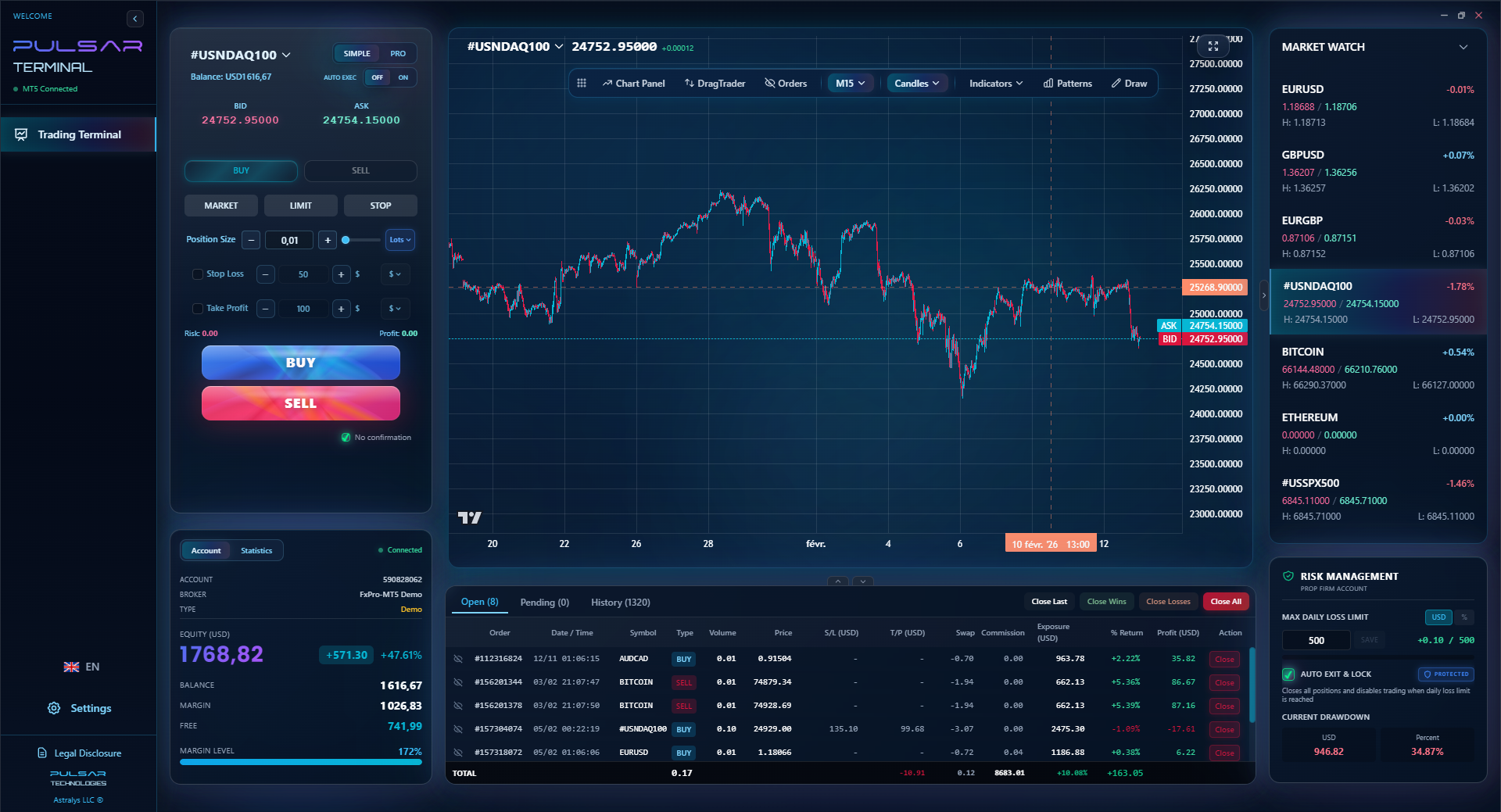
When you're ready to apply advanced order management from books like Donnelly's, a tool like Pulsar Terminal lets you execute complex multi-TP/SL and trailing stop strategies directly on your MT5 platform with precision.
Pulsar Terminal
Công cụ MT5 tất-cả-trong-một: đặt lệnh kéo-thả, multi-TP/SL, trailing stop, grid trading, Volume Profile và bảo vệ prop firm. Hơn 1.000 trader sử dụng mỗi ngày.
You don't need to buy 50 books. Start with a curated shelf. Here’s my recommended progression for a South African trader:
| Stage | First Book | Second Book | Focus |
|---|---|---|---|
| Beginner | Currency Trading for Dummies | Trading in the Zone | Foundation & Mindset |
| Intermediate | Japanese Candlestick Charting | Market Wizards | Technical Skills & Inspiration |
| Advanced | Kathy Lien's Day Trading Book | The Art of Currency Trading | Strategy & Market Mechanics |
Where to buy them? I use Takealot for physical copies (delivery is quick) and Amazon Kindle for instant digital access. Some can be found as PDFs online, but I prefer to support the authors if I can.
Budget about R1,500-R2,000 to get started with 3-4 core books. It's the cheapest education you'll ever get compared to the cost of learning from market losses. I still revisit 'Trading in the Zone' every 6 months as a refresher. The concepts sink in deeper each time.

Example: Cost of not reading vs. reading. A single bad trade due to poor risk management could cost you R1,000. A library of 5 great books costs roughly the same. It's an investment with a guaranteed ROI if you apply the lessons.
“Reading is useless without application. The gap between theory and practice is where most traders fail.”
Reading is useless without application. Here’s how I translate book knowledge into trades on my platform (I use IC Markets for their tight spreads on majors).
- Take Notes in Your Own Words: When you read about a 'head and shoulders' pattern, don't just highlight it. Write in the margin: 'Look for this on USD/ZAR 4H chart after a strong trend.'
- Backtest with a Purpose: Don't just randomly test. After reading Kathy Lien's section on trading interest rate decisions, go back on your trading platform's history and see how USD/ZAR reacted to the last 5 SARB meetings. Was there a consistent pattern?
- Paper Trade New Concepts: If a book introduces a new indicator or money management rule, test it on a demo account for at least a month before risking real Rands. I paper-traded a complex strategy from an advanced book for 3 months. It lost consistently. I saved my live account by not deploying it.
- Create a Cheat Sheet: I have a one-page summary from each major book taped next to my monitor. Douglas's '5 Fundamental Truths' from Trading in the Zone is right there to remind me not to get emotional.
The gap between theory and practice is where most traders fail. Bridge it with deliberate, focused practice. Start by applying one single concept from your current book to your next week of trading. Master it before adding another.
💡 Mẹo của Winston
If a concept from a book doesn't make sense on your USD/ZAR chart, it's not the market that's wrong. Reread the chapter, then find a real example. Theory must survive contact with reality.
Let me save you some time and money by telling you what didn't work for me.
Avoid the 'Holy Grail' Trap. Any book that promises a secret, 100% winning system is lying. The best forex books to read teach you principles and frameworks, not magic formulas. I wasted R800 on a book that promised 'risk-free arbitrage.' It was mathematically flawed for a retail trader.
Don't Confuse Inspiration with Strategy. 'Market Wizards' is inspiring, but you are not Paul Tudor Jones. You can't replicate his billion-dollar macro trades with a R10,000 account. Take the psychology lessons, not necessarily the specific trades.
Beware of Outdated Information. Some older books might not account for today's algorithmic trading or specific post-2008 regulations. Always cross-reference concepts with current market conditions. Check if the broker examples still exist and are still FSCA regulated, like Pepperstone.
The Biggest Mistake: Reading without trading. You need skin in the game (even small amounts) to truly internalize the lessons about fear and greed. Open a small live account alongside your reading. The emotional lessons are part of the curriculum.
Finally, remember that books teach you how to fish. They don't give you the fish. Your job is to take those lessons, adapt them to the South African market's tides, and cast your own line.
FAQ
Q1Are there any forex trading books written specifically for South Africans?
Honestly, no major internationally recognized ones. The core principles of forex are global. The smart move is to read the global classics (like the ones listed here) and then supplement that knowledge with local resources - follow local market analysts on reputable financial sites, understand SARB policy, and learn how ZAR reacts to local political events. The books give you the engine; you need to learn how to drive it on South African roads.
Q2I'm on a tight budget. What is the ONE book I should buy first?
Start with 'Trading in the Zone' by Mark Douglas. It's more important to learn how to manage your mind and risk than to learn a specific pattern. A good mindset will protect your capital while you learn the technical stuff for free from online sources. A bad mindset will blow up your account no matter how many patterns you know.
Q3How do I apply risk management from these books to my ZAR account?
The principles are the same, but the numbers are in Rands. If a book says 'risk 1% per trade,' calculate 1% of your ZAR account balance. Use a position size calculator to find out how many lots that equates to for USD/ZAR, factoring in the distance to your stop-loss. Always know your maximum loss in Rands before you enter. This simple habit is the number one thing that will keep you in the game.
Q4Do these books cover trading with prop firms?
Most of the older classics don't, as prop firm challenges are a more recent phenomenon. However, the core disciplines they teach - strict risk management, consistency, psychology - are EXACTLY what you need to pass a challenge. Books like Douglas's are essential for handling the pressure of a challenge's drawdown limits. Managing a daily loss is a psychological game first.
Q5Should I read books about stocks or crypto as a forex trader?
Yes, selectively. Books on general market psychology (like 'Reminiscences of a Stock Operator') are timeless. Also, understanding other markets can help with intermarket analysis. For example, a book on commodity trading might give you deeper insight into how the AUD/USD (linked to iron ore) or USD/ZAR (sensitive to gold) moves. It broadens your perspective.
Q6How long should I study before I start trading live?
There's no set time. The benchmark is competence, not hours. You should be able to: 1) Explain your strategy in one sentence, 2) Calculate your exact risk in Rands for any trade using a position size calculator, and 3) Define the specific conditions that would make your trade idea wrong (your exit point). If you can do those three things confidently on paper, you're ready to start very small with live funds.
Bài học của Prof. Winston
Điểm chính:
- ✓Start with psychology ('Trading in the Zone') before advanced strategies.
- ✓Always calculate risk in Rands, not just percentages.
- ✓Apply every concept directly to your USD/ZAR chart.
- ✓A R2,000 library can save you from a R10,000 mistake.
Bài viết này hữu ích thế nào?
Nhấp vào ngôi sao để đánh giá
Nhận định giao dịch hàng tuần
Phân tích & chiến lược miễn phí hàng tuần. Không spam.
Về tác giả
David van der Merwe
Nhà giao dịch Thị trường Mới nổi
Trader tại Johannesburg với 11 năm kinh nghiệm về tiền tệ thị trường mới nổi. Chuyên về cặp ZAR, giao dịch theo quy định FSCA và phân tích thị trường Nam Phi.
Bình luận
Cảnh báo rủi ro
Giao dịch các công cụ tài chính tiềm ẩn rủi ro đáng kể và có thể không phù hợp với tất cả nhà đầu tư. Hiệu suất trong quá khứ không đảm bảo kết quả trong tương lai. Nội dung này chỉ mang tính chất giáo dục và không nên được coi là lời khuyên đầu tư. Hãy luôn tự nghiên cứu trước khi giao dịch.
Bạn cũng có thể thích

Cara Trading Forex Sukses: 7 Prinsip dari Trader Profesional
Cara trading forex sukses dengan 7 prinsip trader pro: manajemen modal, disiplin, journal trading, backtest. Data nyata, bukan janji profit palsu.
Jam Trading Forex Terbaik untuk Trader Indonesia: Panduan Lengkap dengan Tabel Waktu
Panduan jam trading forex untuk trader Indonesia. Tabel 4 sesi dunia, jam emas 20:00-00:00, sesi mana yang harus dihindari. Data akurat + tips dari trader berpengalaman.
Top 5 Sàn Forex Uy Tín Nhất 2026: Review Jujur dari Trader Indonesia
Top 5 sàn forex uy tín 2026 untuk trader Indonesia. Review jujur: spread, deposit, withdraw, dukungan lokal. Exness, XM, IC Markets & lebih.
Tải Pulsar Terminal
Tất cả các công cụ tính này được tích hợp trong Pulsar Terminal với dữ liệu thời gian thực từ tài khoản MT5 của bạn.
Tải Pulsar Terminal