


I lost ₹47,000 in a single week back in 2018.

Rajesh Sharma
Chuyên gia Phân tích Forex Cao cấp ·  India
India
☕ 10 phút đọc
Bạn sẽ học được:
- 1The Legal Minefield You Have to Understand First
- 2My 5 Non-Negotiable Criteria for an Indian Trader
- 3Broker Breakdown: The Real Pros and Cons for India
- 4The Hidden Costs That Eat Your Profits
- 5My Personal Setup & A Costly Mistake
- 6Prop Firms & Indian Traders: A Complicated Affair
- 7The Final Step: Your Action Plan

I lost ₹47,000 in a single week back in 2018. It wasn't just bad analysis. The real culprit was my broker - a slick international brand that offered zero support for Indian payment methods. My withdrawal got stuck for 18 days while the market moved against me, turning a manageable drawdown into a full-blown margin call. That experience taught me that for an Indian trader, the 'best' broker isn't just about low spreads. It's about navigating a regulatory grey area, finding a partner that accepts your INR deposits without insane fees, and getting your money back when you need it. Let's break down what actually works here.
Before you even look at a trading platform, you need to get this straight. The Reserve Bank of India (RBI) does not allow Indian residents to remit money abroad for margin trading in forex, except for a few major currencies like EUR/USD/GBP/JPY under the Liberalised Remittance Scheme (LRS).
However, and this is the big 'however', trading forex pairs (like EUR/INR) on Indian exchanges like the NSE or MCX-SX is perfectly legal and regulated by SEBI. The confusion - and the entire grey market - exists because most Indian traders want to trade the international forex market, with its 24/5 liquidity and use.
So, what do we do? Practically, Indian traders open accounts with international brokers who are regulated offshore (like by CySEC, ASIC, or FCA). You fund these accounts using your LRS limit (up to $250,000 per financial year). This is the common workaround, but it's not without its risks. You're relying on the foreign regulator's investor protection, not India's.

Warning: Any broker claiming to be 'SEBI-regulated for international forex' is lying. SEBI only regulates domestic currency derivatives on Indian exchanges. If a 'broker' based in India offers you direct trading on GBP/JPY with 500:1 use, run. It's almost certainly a bucket shop scam.
The first filter for the best forex broker in India is this: they must openly state they accept clients from India and have a clear, reliable process for INR deposits and withdrawals. If that information is hard to find, move on.

💡 Mẹo của Winston
Your first ₹10,000 profit is meaningless if you can't withdraw it. Test the exit before you commit the capital.

Forget the generic 'best broker' lists. Here’s what actually matters when you're sitting in Mumbai or Delhi trying to place a trade.
1. INR Deposit & Withdrawal Smoothness
This is the king of all criteria. You need a broker with a dedicated local payment processor or partnership with an Indian payment gateway. Look for options like:
- Local Bank Transfer (NEFT/IMPS/RTGS)
- UPI (this is becoming a game-changer for speed)
- Popular Indian E-Wallets
The processing time should be under 24 hours for deposits, and 1-3 working days for withdrawals. Any longer, and you're dealing with a middleman who doesn't have its act together. I once waited 11 days for a withdrawal from a broker; never again.
2. Realistic use (Not the Max They Offer)
Offshore brokers will advertise 500:1 or 1000:1 use. That's a trap for new capital. For major pairs, I never use more than 30:1. For anything exotic, 10:1 is my max. A good broker makes it easy to adjust your use per account and doesn't push you towards the dangerous limits. Responsible trading starts with your broker's settings.
3. MT4/MT5 as a Standard
You might love TradingView, but MetaTrader 4 and 5 are the universal language of forex. They're stable, support countless Expert Advisors (EAs), and every serious broker offers them. If a broker only has a proprietary platform, you're locking yourself into their environment. Avoid that. You want the freedom to move your strategies or use advanced tools like a position size calculator that integrates seamlessly.
4. Raw Spreads on Major Pairs
For EUR/USD, anything under 1.0 pip on a standard account is decent. Under 0.5 pips on a raw spread/ECN account is good. But you must check this during both Asian and London sessions. Some brokers widen spreads to 2+ pips when liquidity is low, which can murder a scalping strategy.
5. Customer Support That Knows 'INR'
Test their support before you deposit. Ask a specific question like, "What are the processing fees for an INR withdrawal via IMPS?" If they take more than an hour to respond or give a generic copy-paste answer, it's a red flag. You need support that understands the nuances of Indian banking.

“For an Indian trader, the 'best' broker isn't just about low spreads. It's about getting your money back when you need it.”
Based on my experience and constant monitoring of trader forums, here’s a no-BS look at popular options. Remember, conditions change, so always verify the deposit details on their site today.
| Broker (Global Entity) | The Good for India | The Not-So-Good | My Take |
|---|---|---|---|
| Exness | the smoothest INR deposit/withdrawal system. UPI, Paytm, local bank transfers. Very fast processing. | Can be seen as too retail-focused. High use is easily accessible (a risk for the undisciplined). | For pure ease of funding, they're hard to beat. A solid starting point. Read our full Exness review for deeper details. |
| IC Markets | True ECN pricing, some of the tightest raw spreads. Accepts INR deposits via third-party processors. | Withdrawals can sometimes take the full 3-5 business days. More geared towards experienced traders. | My go-to for raw spreads when trading majors. Their execution is top-notch. Check the IC Markets review. |
| Pepperstone | Strong regulation (ASIC, FCA). Excellent Razor account with tight spreads. Good educational content. | INR deposit options can be less direct than Exness, sometimes involving currency conversion fees. | A premium, trustworthy broker. You pay for the quality in slightly less flexible local payments. See the Pepperstone review. |
| XM | No fees on deposits/withdrawals (in most cases). A wide range of account types. | Spreads are generally higher than the ECN-focused brokers above. | Good for beginners due to their cent accounts, which allow tiny position sizes to learn. Here's our XM review. |

Pro Tip: Open a demo account with your top 2 choices. Then, try a small real deposit (like ₹2000) just to test the entire cycle: deposit, place one trade, withdraw. The cost of this test is the best insurance you can buy.

You think you're paying 0.6 pips on EUR/USD? Think again. Here’s where your money really goes.
1. Payment Processing Fees: This is the big one for India. Some brokers absorb the fee, some charge a flat ₹50-₹100, and some charge a percentage (1-2.5%). A 2.5% fee on a ₹50,000 deposit is ₹1,250 gone before you even trade. Always check the 'Payment Methods' page.
2. Currency Conversion (Forex Fee): If your broker converts your INR to USD at their own rate, the spread can be 1-3%. That's a massive hidden cost. Ideally, the broker should accept and hold INR, only converting it when you trade a non-INR pair.
3. Inactivity Fees: If you don't trade for 6-12 months, many brokers will start charging a monthly fee (like $5-$15). If you're a seasonal swing trading type, be aware.
4. Overnight Financing (Swap Rates): Holding a position overnight costs or earns you interest. For some pairs like AUD/JPY, the negative swap can be huge. I once held a small AUD/JPY position for a week, and the swap charges were more than the spread definition costs. Calculate this into your long-term holds.

Example: You deposit ₹1,00,000 via a method with a 2% fee. You're down ₹2,000 instantly. To just break even on that fee alone, you need to make a 2% return on your capital purely from trading. That's not nothing.
💡 Mẹo của Winston
A 'zero spread' account always has a commission. Calculate the total cost per round turn (spread + commission) before you get excited.

“That 2% deposit fee means you need a 2% return just to break even before you've even traded.”
I split my capital. 70% is with IC Markets for my core ECN trading. The execution on news events is reliable, which is critical for my style. The other 30% is with Exness for quick experimental trades and because funding is instant when I need it.
Here's the mistake I made that cost me: I didn't understand the 'lot size' difference between brokers. On my IC Markets account (MT5), a standard lot on XAU/USD (gold) is 100 ounces. On another broker I used briefly, it was 1 ounce for a 'standard lot'. I placed what I thought was a 0.1 lot trade on gold, expecting a $1 move to be worth about $10. Instead, because of the lot size confusion, I had 10 ounces on. When gold moved $5 against me, I lost $500 in minutes instead of $50. It was a brutal, stupid lesson in broker-specific contract specifications.
Always, always check the contract specs for each instrument. Don't assume a 'lot' is the same everywhere. This is especially true for indices and commodities. Your position size calculator must be calibrated to your specific broker's settings.
This is also where a unified trading terminal shines. Having a tool that manages trades across platforms or provides consistent order sizing logic can prevent these catastrophic slips.
Prop trading firms are all the rage. You pass a challenge, get a funded account, and keep a share of the profits. For an Indian trader, the appeal is obvious: trade large capital without risking your own savings.
But there are major hurdles.
1. The Payout Problem: Most prop firms are based overseas and pay profits via wire transfer, PayPal, or crypto. Getting a large dollar wire into your Indian bank account will attract scrutiny from your bank and potentially the tax department. Crypto payouts are an option, but you then face the volatility and regulatory uncertainty of converting crypto to INR.
2. The 'No Hedging' Rule: Many prop firm challenges have a rule against hedging (holding buy and sell positions on the same pair). This directly conflicts with a common risk-management strategy used by many experienced traders.
3. Daily Loss Limits: These are strict. A tool that can automatically enforce a daily stop-loss or prevent you from trading after a certain loss is useful here. Without automation, one emotional trade can blow your challenge. Managing this risk is key to not getting a margin call on your challenge account.
If you go the prop firm route, choose one that is transparent about payouts to India and has a clear track record of paying Indian traders. And get your trade management locked down tight before you start the evaluation.
💡 Mẹo của Winston
If your broker's support can't explain their fees in simple INR terms during a demo, imagine the headache during a real withdrawal issue.

Passing a prop firm challenge requires iron-clad discipline on daily loss limits, which is exactly what Pulsar Terminal's auto-risk manager enforces directly on your MT5 platform.
Pulsar Terminal
Công cụ MT5 tất-cả-trong-một: đặt lệnh kéo-thả, multi-TP/SL, trailing stop, grid trading, Volume Profile và bảo vệ prop firm. Hơn 1.000 trader sử dụng mỗi ngày.
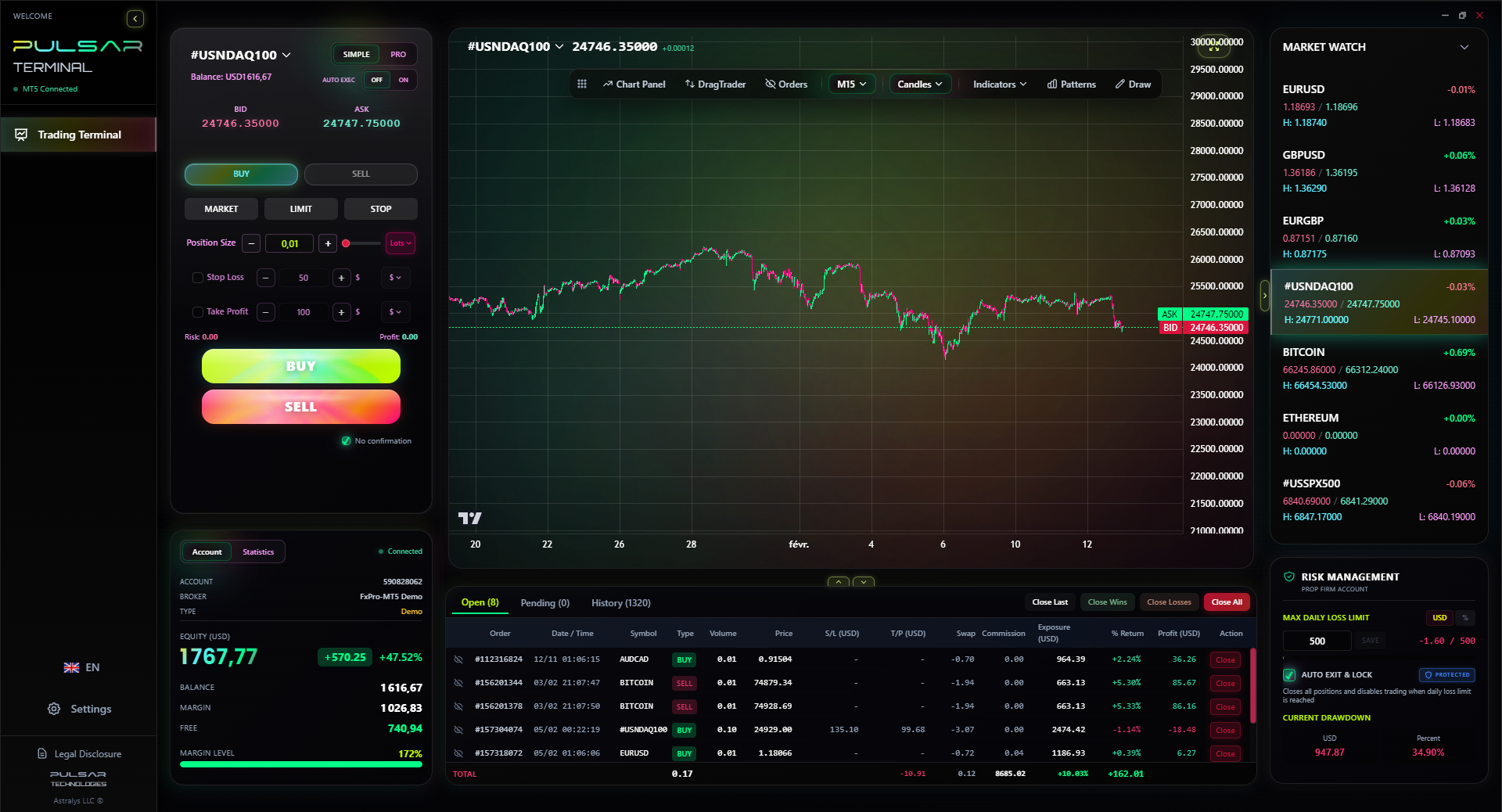
“One emotional trade can blow your prop firm challenge. Automation is your insurance policy against yourself.”
Reading is useless without action. Here's your homework.
- Shortlist: Pick 2 brokers from the table above that fit your style (e.g., Exness for easy funding, IC Markets for low spreads).
- Demo: Open a demo account with each. Test the platform, see the spreads during your preferred trading hours (e.g., 9 AM - 12 PM IST). Try placing and managing orders.
- Contact Support: Send them an email asking for their document checklist for Indian clients and their current INR withdrawal timeline. Gauge their response.
- Micro Test: Fund the winner with the minimum deposit (maybe ₹2000). Place one or two small trades. Then, immediately request a withdrawal of your remaining balance. This tests the most critical path: getting your money back.
- Scale Up: Only after the withdrawal lands in your bank account should you consider funding with your real trading capital.
Finding the best forex broker in India is less about a global trophy and more about a reliable local partner. It's the boring stuff - deposits, withdrawals, support - that will save you from disaster, not the flashy trading signals or promised use. Do the groundwork. Your future self, who isn't staring at a stuck withdrawal request, will thank you.
FAQ
Q1Is forex trading legal in India?
It's a grey area. Trading forex pairs (like EUR/INR) on Indian exchanges like NSE is legal and regulated by SEBI. However, trading the international forex market (like GBP/JPY) is not directly regulated by Indian authorities. Indian residents commonly use the Liberalised Remittance Scheme (LRS) to fund accounts with international brokers regulated abroad (like by CySEC or ASIC).
Q2What is the minimum deposit for forex trading in India?
It varies wildly by broker. Some international brokers accept as little as $10 (approx. ₹800), while others have minimums of $100-$200 (₹8,000-₹16,000). However, I strongly advise against starting with the absolute minimum. You need enough capital to trade sensible position sizes and withstand normal market fluctuations without being wiped out by a single bad trade.
Q3Which broker has the fastest INR withdrawal for Indian traders?
As of now, brokers with integrated UPI or direct local bank processing (like Exness) often process withdrawals within 24 hours. Brokers using third-party payment processors can take 1-3 business days. Always check the broker's website for their current processing times, as this can change.
Q4Do I have to pay tax on forex trading profits in India?
Yes. Profits from trading are classified as 'Business Income' or 'Capital Gains' depending on the frequency and nature of your trading. You are required to declare this income and pay tax according to your applicable income tax slab. Consult a qualified Indian CA (Chartered Accountant) for advice specific to your situation.
Q5Can I use TradingView with my forex broker in India?
Many international brokers (like IC Markets, Pepperstone) offer direct brokerage integration with TradingView. This means you can analyze on TradingView and place trades directly from its interface to your broker account. This is a fantastic option if you prefer TradingView's charts.
Q6What use should an Indian beginner use?
As little as possible. Start with 10:1 or even 5:1. High use (like 100:1 or 500:1) amplifies losses just as fast as profits. Most blow up because of excessive use, not bad analysis. Get consistently profitable with low use first.
Bài học của Prof. Winston
Điểm chính:
- ✓Test withdrawals before large deposits.
- ✓Calculate total cost: spread + commission + fees.
- ✓Maximum use is a trap, not a tool.
- ✓Prop firm payouts to India require planning.
Bài viết này hữu ích thế nào?
Nhấp vào ngôi sao để đánh giá
Nhận định giao dịch hàng tuần
Phân tích & chiến lược miễn phí hàng tuần. Không spam.
Về tác giả
Rajesh Sharma
Chuyên gia Phân tích Forex Cao cấp
Hơn 10 năm giao dịch tại thị trường Ấn Độ và Nam Á. Bắt đầu với phái sinh tiền tệ trên NSE trước khi chuyển sang forex quốc tế. Chuyên về cặp USD/INR và các cặp tiền thị trường mới nổi.
Bình luận
Cảnh báo rủi ro
Giao dịch các công cụ tài chính tiềm ẩn rủi ro đáng kể và có thể không phù hợp với tất cả nhà đầu tư. Hiệu suất trong quá khứ không đảm bảo kết quả trong tương lai. Nội dung này chỉ mang tính chất giáo dục và không nên được coi là lời khuyên đầu tư. Hãy luôn tự nghiên cứu trước khi giao dịch.
Bạn cũng có thể thích

Cara Trading Forex Sukses: 7 Prinsip dari Trader Profesional
Cara trading forex sukses dengan 7 prinsip trader pro: manajemen modal, disiplin, journal trading, backtest. Data nyata, bukan janji profit palsu.
Jam Trading Forex Terbaik untuk Trader Indonesia: Panduan Lengkap dengan Tabel Waktu
Panduan jam trading forex untuk trader Indonesia. Tabel 4 sesi dunia, jam emas 20:00-00:00, sesi mana yang harus dihindari. Data akurat + tips dari trader berpengalaman.
Top 5 Sàn Forex Uy Tín Nhất 2026: Review Jujur dari Trader Indonesia
Top 5 sàn forex uy tín 2026 untuk trader Indonesia. Review jujur: spread, deposit, withdraw, dukungan lokal. Exness, XM, IC Markets & lebih.
Tải Pulsar Terminal
Tất cả các công cụ tính này được tích hợp trong Pulsar Terminal với dữ liệu thời gian thực từ tài khoản MT5 của bạn.
Tải Pulsar Terminal