


It was 7:30 AM on a Tuesday in London, and the GBP/USD was about to eat my lunch.

Sarah Collins
Chiến lược gia Giao dịch ·  United Kingdom
☕ 11 phút đọc
Bạn sẽ học được:
It was 7:30 AM on a Tuesday in London, and the GBP/USD was about to eat my lunch. I'd entered long at 1.2850, convinced the morning data would push it higher. The spread on my so-called 'ECN' account suddenly widened to 3 pips right as the news hit, and the price instantly dropped 25 pips against me. I was down over £500 before my second coffee. That moment, more than any profitable trade, taught me the brutal truth: the best forex trading strategy isn't about predicting the market. It's about surviving it, especially here in the UK where the rules of the game are written by the FCA and played on London's turf. Let's cut through the nonsense.
You can't build a winning strategy if you don't know the rulebook. In the UK, that rulebook is written by the Financial Conduct Authority (FCA), and it's non-negotiable. Forget those offshore brokers promising 1:500 use. Here, you're playing with a capped bat for your own protection.
The FCA's use limits are your first strategic constraint. For major pairs like EUR/USD or our beloved GBP/USD, you get 1:30. That's it. For a £10,000 account, that's a maximum position size of £300,000. This forces a level of discipline that many traders abroad lack. You can't just YOLO your entire account on one trade with insane use. This single rule eliminates about 80% of the blow-up stories you hear.
Then there's negative balance protection. This is a psychological game-changer. You cannot lose more than you deposit. I've had trades go spectacularly wrong (we all have), but knowing my liability was capped let me think clearly about the exit, not just panic. It's a safety net that lets you trade with a clearer head.
Finally, the £85,000 FSCS coverage. It means your broker's insolvency isn't your problem. This allows you to focus purely on your trading performance and broker execution, not on whether they'll disappear with your cash. Always, and I mean always, verify your broker on the FCA Register. It's the first step in any serious strategy.

Warning: If a 'broker' approaches you offering FCA-like protections but is based in Cyprus or the Seychelles, run. You are not getting the full UK regulatory shield. Stick with the genuine article.

💡 Mẹo của Winston
Your first £10,000 in the market is for paying tuition fees. Don't expect to withdraw it. Focus on learning to preserve it.
“The FCA's use limit is a ceiling, not a target. Using less is often the mark of a mature trader.”
Everyone wants the magic system. The one indicator that flashes 'BUY' and 'SELL' with perfect accuracy. It doesn't exist. I've bought those systems, coded those robots, and blown up accounts chasing them. The 'best' strategy is the one that fits your personality, your schedule, and the London market's rhythm.
The London Session Scalper
Are you glued to the screens from 8 AM to 12 PM? The London open (8 AM GMT) is a volatility factory, especially when it overlaps with the European session. This is for the adrenaline junkie. You're trading the initial momentum, the economic data spikes (like UK CPI or BoE decisions), and the liquidity surge. You need a broker with razor-thin spreads and instant execution. Think Pepperstone's Razor account or a similar ECN model. A strategy here might be simple: trade breakouts of the first 15-minute range after the open. But it's high-frequency, high-stress. Your risk per trade must be tiny - 0.5% of your account or less. One bad news spike can wipe out a day's work. I used to scalp GBP/JPY during this time; made £300 one morning, lost £450 the next. It's a grind.
The Swing Trader
This is where I've found my peace. You're not chasing every pip. You're analysing the broader trends, holding trades for days or weeks. The London session provides your key entry and exit levels, but you're not sweating the intraday noise. This suits someone with a day job. You do your analysis in the evening, set your orders, and manage them with stops and limits. The FCA's 1:30 use is perfect here - enough to make the moves meaningful, not enough to blow you up on a single swing. My most consistent profits have come from swing trading EUR/USD using weekly support and resistance. I held a short from 1.0950 down to 1.0720 over two weeks in 2025, banking a cool 230 pips. The key? Patience, and a position size that let me sleep at night.
The News Trader
This is high-risk, high-reward, and requires military discipline. You trade major economic releases: UK Employment data, US NFP, ECB statements. The goal is to capture the explosive move in the seconds after the news hits. You need a broker with guaranteed no-requotes and a stable platform. You also need to understand that spreads will widen astronomically - I've seen GBP/USD spreads hit 20 pips at major news. Your strategy isn't about direction, it's about volatility capture. Often, it's better to use a scalping strategy with a strict 1:1 risk/reward, get in, get out, and wait for the next event.
“Your strategy isn't just competing with the market; it's competing against the costs of trading.”
This is the engine of your strategy. Everything else is just the paint job. You can have a mediocre entry system with brilliant risk management and survive. A brilliant entry system with poor risk management will destroy you. Here's the UK-specific maths.
First, position sizing. Never risk more than 1-2% of your account on a single trade. With a £10,000 account, that's £100-£200 per trade. Use a position size calculator every single time. Don't eyeball it. Let's say you're buying GBP/USD at 1.2800 with a stop loss at 1.2770. That's a 30-pip risk. If your max loss is £100, and each pip on a standard lot is roughly $10 (about £7.80), your position size should be around £100 / (30 pips * £7.80 per pip) = 0.43 lots. Round down to 0.4 lots. This mechanical process removes emotion.
Second, the stop loss. It is not a suggestion. It is an order. Place it immediately when you enter the trade. The FCA's negative balance protection is your last line of defence; your stop loss should be your first. I learned this the hard way early on, 'riding' a losing EUR/USD trade, hoping it would turn. It didn't. I turned a planned £150 loss into a £900 nightmare. That trade alone set me back three months.
Third, use. Just because you can use 1:30 doesn't mean you should. For swing trading, I rarely use more than 1:10. It automatically keeps my position sizes sane. The FCA limit is a ceiling, not a target.

Example:
- Account: £15,000
- Risk per Trade: 1.5% = £225
- Trade: Short EUR/USD at 1.0850, Stop at 1.0880 (30-pip risk)
- Pip Value (approx.): £7.80 per pip per standard lot
- Calculation: £225 / (30 * £7.80) = 0.96 lots
- Position Size: 0.96 standard lots (or 96,000 units). This precise calculation prevents a 50-pip move from crippling your account.
“Your strategy isn't just competing with the market; it's competing against the costs of trading.”
Your strategy isn't just competing with the market; it's competing against the costs of trading. In the UK, these costs are generally transparent thanks to the FCA, but you must account for them in your profit targets.
Spreads: This is your primary cost. If you're a scalper, a 2-pip spread on EUR/USD is a death sentence. You need sub-1-pip spreads, which you'll find with brokers like IC Markets or Pepperstone on their raw accounts. For swing traders, a slightly wider spread is less critical, but it still eats into your profit. If your average profit per trade is 50 pips, a 2-pip spread costs you 4% of your profit right off the bat.
Commissions: ECN/Raw accounts charge a commission per lot. For example, you might pay $3.50 per lot round turn. On that 0.96 lot trade from our example, that's $3.36 in commission. Factor it in.
Overnight Financing (Swaps): Holding positions past 10 PM UK time incurs a cost or credit. For GBP pairs, these can be significant. If you're swing trading and holding for weeks, these swaps can add up. Sometimes, they can even be a small profit if you're holding the right currency pair. Check your broker's swap rates before entering a longer-term trade.
Here’s a brutal truth: if your strategy doesn't have an average profit target that's at least 3-4 times the typical spread + commission, you're just feeding the broker. A strategy aiming for 5-pip scalps with a 2-pip spread is mathematically doomed.
💡 Mẹo của Winston
If you can't write down your exact entry, stop loss, and take profit rules on a post-it note, your strategy is too complicated. Simplify.
“After a loss, walk away. Close the platform. The market will be there tomorrow.”
Let's get concrete. Here's a simple, strong framework you can adapt. It's based on price action and uses tools available on any platform like MT5.
1. The Filter (Time & Trend):
- Time: Only look for trades during the London session (8 AM - 4 PM GMT). Liquidity is highest, spreads are lowest.
- Trend: Use the daily chart. Is price above or below the 200-period simple moving average (SMA)? That's your broad bias. Don't fight the daily trend for your main positions.
2. The Trigger (Entry):
- Move to the 1-hour or 4-hour chart.
- Wait for price to pull back to a key level: a previous support/resistance zone, or the 50-period EMA.
- Look for a price action signal: a bullish/bearish engulfing candle, or a pin bar rejecting that level.
- That's your entry signal.
3. The Plan (Exit):
- Stop Loss: Place your stop loss 10-20 pips beyond the trigger candle's extreme. No ambiguity.
- Take Profit: Use a risk-to-reward ratio of at least 1:1.5. If your stop is 30 pips, your target is 45 pips away. Even better, use a partial closure method. Take 50% off at 1:1 R:R, and trail the rest.
Tools: Keep it simple. I use the MACD indicator on the 1-hour to gauge momentum convergence/divergence, and the RSI indicator to spot overbought/oversold conditions within the trend. That's it. I don't have 15 indicators cluttering my screen.

Pro Tip: Backtest this on GBP/USD for the last 3 months. Don't guess. Use MT5's strategy tester. See how many pips it would have made or lost, including an estimated 1-pip spread. If it's not profitable in the past, it won't be in the future.
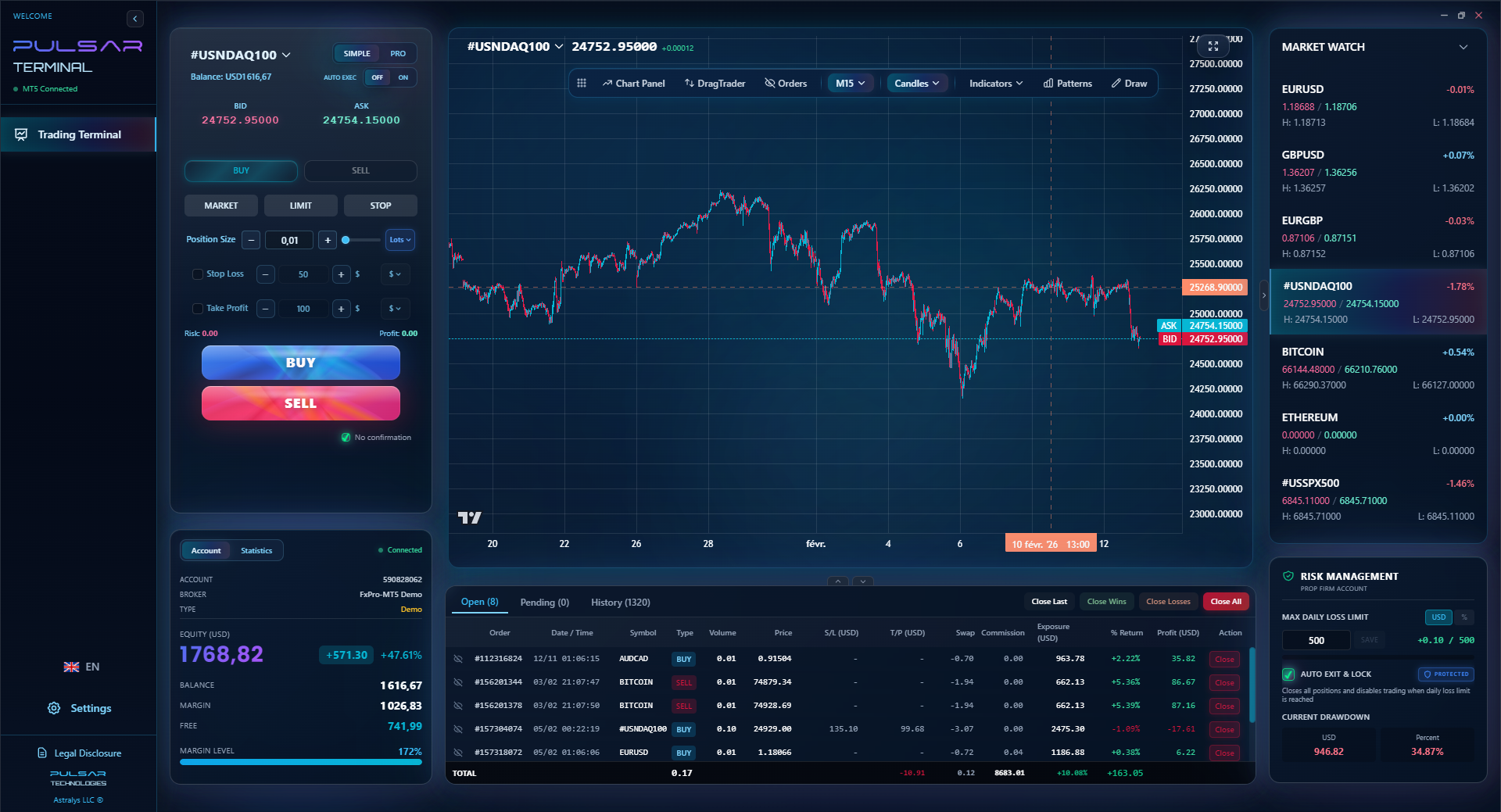
Executing a multi-part exit strategy with partial closures and trailing stops is what separates pros from amateurs, and Pulsar Terminal automates this directly on your MT5 charts.
Pulsar Terminal
Công cụ MT5 tất-cả-trong-một: đặt lệnh kéo-thả, multi-TP/SL, trailing stop, grid trading, Volume Profile và bảo vệ prop firm. Hơn 1.000 trader sử dụng mỗi ngày.
“After a loss, walk away. Close the platform. The market will be there tomorrow.”
All the rules, strategy, and risk management in the world mean nothing if your psychology is weak. The UK market, with its sharp moves at the open and during news, is a psychological gauntlet.
FOMO (Fear Of Missing Out): You see GBP/USD rocket 50 pips at the open. You jump in late, near the top, and it reverses. You've just become liquidity. Your strategy should have clear entry rules that keep you out of these emotional chases.
Revenge Trading: You take a loss. You're angry. You immediately enter another trade twice the size to 'get it back.' This is the fastest path to a margin call. After a loss, walk away. Close the platform. The market will be there tomorrow.
Overconfidence: You have three winning trades in a row. You start thinking you're a genius. You increase your position size beyond your risk rules. The next trade wipes out all your profits and more. Stick to your plan like a robot.
My personal rule: I have a daily loss limit of 3% of my account. If I hit it, my trading terminal closes for the day. No arguments, no 'just one more trade.' This single rule has saved me more money than any indicator ever could.
💡 Mẹo của Winston
The London open isn't for making money. It's for watching. Let the initial volatility settle, then look for the real move. Patience pays.
“The 'best' strategy is the one that fits your personality, your schedule, and the London market's rhythm.”
- Regulation First: Choose an FCA-regulated broker. Read our reviews for Exness (global entity), XM, or IC Markets to see who fits your style (scalper vs. swing trader).
- Open a Demo Account: Practice for at least 2-3 months. Trade your chosen strategy (like the framework above) in real market conditions without real money. Your goal is not to make fake profit, but to execute your plan flawlessly 100 times.
- Start Small: When you go live, fund your account with an amount you can afford to lose completely. Start with a micro or cent account if possible. Your goal for the first six months is to not blow up, not to get rich.
- Focus on One Pair: Master EUR/USD or GBP/USD. Learn its personality, its average daily range (about 70-100 pips for GBP/USD), when it's most active. Don't jump around.
- Keep a Journal: Log every trade. Entry, exit, reason, emotion. Review it weekly. This is how you find your real edge - by analysing your own behaviour.
The best forex trading strategy is the one you can follow consistently, without emotion, within the safe confines of the UK regulatory environment. It's boring, it's disciplined, and it's the only thing that works long-term.
FAQ
Q1What is the most profitable forex trading strategy?
There isn't one universal 'most profitable' strategy. Profitability comes from consistency, not a secret method. A simple swing trading strategy with a 1:1.5 risk/reward ratio, applied diligently to a major pair like EUR/USD during the London session, and coupled with strict 1% risk management, has a far higher chance of long-term success than chasing complex, high-frequency systems. The numbers show that UK traders who are disciplined tend to have a higher share of profitable accounts.
Q2Is 1:30 use from the FCA enough to make money?
Absolutely, and it's more than enough to blow up your account if you're reckless. 1:30 means with a £1,000 account, you can control a £30,000 position. A 1% move against you is a £300 loss (30% of your account). The limit forces sensible position sizing. Successful traders often use much less. The use isn't what makes you money; it's your market direction and risk management.
Q3What's the best time to trade forex in the UK?
The most active and liquid time is the London session, from 8:00 AM to 12:00 PM GMT. This is when UK and European banks are most active, creating high volume and lower spreads. The overlap with the US session (starting from 1:30 PM GMT) also creates volatility. For most retail traders, focusing on the core London morning hours is optimal.
Q4Should I use spread betting or a CFD account for forex in the UK?
For most UK residents, spread betting is the superior choice for one reason: tax efficiency. Profits from spread betting are free from Capital Gains Tax and Stamp Duty. CFDs are not tax-free. The trading mechanics (spreads, execution) are virtually identical with most brokers. Always ensure your spread betting provider is FCA-regulated.
Q5How much money do I need to start forex trading in the UK?
You can start with very little. Many FCA brokers like Pepperstone or XTB have no minimum deposit. However, starting with a realistic amount is key. With a £500 account and a 1% risk rule, you're risking £5 per trade. After spreads, you need sizable moves to see meaningful growth. A more practical starting point for applying proper risk management is £2,000-£5,000. But start on a demo account first, regardless.
Q6Why do most forex traders lose money?
The main reasons are poor risk management (risking too much per trade), overuse of use, emotional trading (FOMO, revenge trading), and a lack of a consistent, tested strategy. Many treat trading like gambling. The FCA's rules (use caps, negative balance protection) help mitigate some of this, but the psychological discipline must come from the trader.
Q7Can I trade forex full-time in the UK?
Yes, but it's exceptionally difficult and should not be the initial goal. You need a substantial capital base (I'd argue at least £50,000) to generate a liveable income while adhering to safe risk parameters (e.g., 1-2% risk). Most successful full-time traders have years of experience and have built their capital gradually while having other income. Aim to be a consistently profitable part-time trader first.
Bài học của Prof. Winston
Điểm chính:
- ✓FCA rules (1:30 use, negative balance) are strategic foundations, not limitations.
- ✓Risk more than 2% per trade and you're gambling, not trading.
- ✓London session (8AM-12PM) offers the cleanest, most liquid price action.
- ✓A 1:1.5 risk/reward ratio is the minimum for a sustainable edge.
- ✓Your trading journal is more important than your charting software.
Bài viết này hữu ích thế nào?
Nhấp vào ngôi sao để đánh giá
Nhận định giao dịch hàng tuần
Phân tích & chiến lược miễn phí hàng tuần. Không spam.
Về tác giả
Sarah Collins
Chiến lược gia Giao dịch
Chuyên gia chiến lược giao dịch tại London với 12 năm kinh nghiệm thị trường tài chính. Cựu chuyên viên phân tích tại một sàn môi giới ở City of London. Phụ trách cặp GBP, thị trường châu Âu và giao dịch theo quy định FCA.
Bình luận
Cảnh báo rủi ro
Giao dịch các công cụ tài chính tiềm ẩn rủi ro đáng kể và có thể không phù hợp với tất cả nhà đầu tư. Hiệu suất trong quá khứ không đảm bảo kết quả trong tương lai. Nội dung này chỉ mang tính chất giáo dục và không nên được coi là lời khuyên đầu tư. Hãy luôn tự nghiên cứu trước khi giao dịch.
Bạn cũng có thể thích

Cara Trading Forex Sukses: 7 Prinsip dari Trader Profesional
Cara trading forex sukses dengan 7 prinsip trader pro: manajemen modal, disiplin, journal trading, backtest. Data nyata, bukan janji profit palsu.
Jam Trading Forex Terbaik untuk Trader Indonesia: Panduan Lengkap dengan Tabel Waktu
Panduan jam trading forex untuk trader Indonesia. Tabel 4 sesi dunia, jam emas 20:00-00:00, sesi mana yang harus dihindari. Data akurat + tips dari trader berpengalaman.
Top 5 Sàn Forex Uy Tín Nhất 2026: Review Jujur dari Trader Indonesia
Top 5 sàn forex uy tín 2026 untuk trader Indonesia. Review jujur: spread, deposit, withdraw, dukungan lokal. Exness, XM, IC Markets & lebih.
Tải Pulsar Terminal
Tất cả các công cụ tính này được tích hợp trong Pulsar Terminal với dữ liệu thời gian thực từ tài khoản MT5 của bạn.
Tải Pulsar Terminal