


Most Nigerian traders get breakeven completely wrong.

Olumide Adeyemi
Nhà tiên phong Giao dịch Tây Phi ·  Nigeria
☕ 10 phút đọc
Bạn sẽ học được:
- 1What Breakeven Actually Means (It's Not What You Think)
- 2The Costs You Absolutely Must Cover
- 3How to Calculate Your Exact Breakeven Price
- 4The Nigerian Reality: Regulations, Funding, and Naira
- 5The Smart Trader's Move: When to Shift Your Stop to Breakeven
- 6Broker Comparison: Who Makes Breakeven Easier in Nigeria?
- 7Mistakes I Made (So You Don't Have To)
Most Nigerian traders get breakeven completely wrong. They think it's just moving a stop loss to their entry price and calling it a day. That's a fast track to getting your account wiped out by hidden costs. The real breakeven in forex isn't about avoiding a loss on your screen; it's about covering every single Naira you spent to open and hold that trade. I'll show you the math, the local broker specifics, and the mistakes I made so you can actually protect your capital.
When you hear 'breakeven,' you probably picture your trade floating at zero pips of profit or loss. That's the broker's display, not reality. Your true breakeven point is the price where your trade profit covers all costs incurred. If you don't hit that price, you're still losing money, even if your platform shows a green zero.
For us in Nigeria, this is critical. Our capital is hard-earned Naira, often converted at a volatile rate. Letting a broker's simplified display trick you is a luxury we can't afford.
Think of it like selling pure water. If you buy a sachet for ₦20 and sell it for ₦25, you didn't make ₦5 profit. You spent ₦10 on transport to get to the market. Your real breakeven selling price was ₦30. Forex costs are your 'transport fee' – they're silent but deadly to your bottom line.

Warning: A trade showing "0.00" on your MT4 screen is almost certainly still a net loss once you account for the spread you paid to enter. Never trust the platform's P&L as your true financial position.
“True breakeven in forex isn't about avoiding a loss on your screen; it's about covering every single Naira you spent to open and hold that trade.”
To find your real breakeven point, you need to know your enemy. These are the fees that eat into your trade before it even moves.
The Spread: Your Entry Toll
This is the difference between the buy (ask) and sell (bid) price. It's the broker's cut for facilitating the trade. On a major pair like EUR/USD, this can range from 0.0 pips on a raw account to 1.5 pips or more on a standard account. If you buy EUR/USD at 1.0850 and the sell price is 1.0849, you're already 1 pip in the hole the moment your order fills. Your trade needs to move 1 pip in your favor just to recover that cost. Brokers like IC Markets and Vantage offer raw spreads from 0.0 pips, but usually charge a commission on top.
The Commission: The Active Trader's Fee
If you're using an ECN or Raw account for tighter spreads, you'll pay a commission. This is typically quoted per lot. A common rate is $7 per round lot (100,000 units) per side. So, a full trade (open and close) costs $14. That's over ₦20,000 at current rates! You need to make that back in pips. My rule? If a broker's commission is above $7 per lot, I look elsewhere. It just makes the breakeven mountain too high to climb.
The Swap Fee: The Overnight Tax
This is the interest paid or received for holding a position past 5 PM New York time. For Nigerian traders, this is a big deal because we often hold trades overnight due to our time zone. If you're trading a pair where you're selling a high-interest currency and buying a low-interest one, you pay a swap. These fees can add up over days and completely erase the profits from a winning trade that took too long. You can check swap rates directly in your MT4 platform under 'Specification' for the symbol.

Example: Let's say you buy 1 standard lot of GBP/JPY. Spread is 2 pips ($20). Commission is $7. Your total entry cost is $27. The price must move 2.7 pips in your favor just to cover your costs and hit true breakeven. That's before any swap charges if you hold overnight.

💡 Mẹo của Winston
Your broker's 'zero balance' is a lie. Your true zero is buried under spreads and commissions. Find that number first, before you dream of profits.
“A trade showing '0.00' on your MT4 is almost certainly still a net loss once you account for the spread.”
Stop guessing. Here's the simple formula I use for every single trade. You need to know your pip value first (a pip definition refresher might help).
For a BUY Trade: Breakeven Price = Entry Price + (Total Costs in $ / Pip Value in $)
For a SELL Trade: Breakeven Price = Entry Price - (Total Costs in $ / Pip Value in $)
Let me give you a real example from my journal. I went long on EUR/USD at 1.0725 with IC Markets. I used a Raw account: spread was 0.1 pips, commission $7 per lot. I traded 0.5 lots.
- Entry Cost (Spread): 0.1 pips. Pip value for 0.5 lots = $5. So, 0.1 pips = $0.50.
- Entry Cost (Commission): $7 * 0.5 lots = $3.50.
- Total Entry Cost = $4.00.
My breakeven price was 1.0725 + ($4.00 / $5 per pip) = 1.0725 + 0.8 pips = 1.07258.
The trade crawled up to 1.0726 and my platform showed a profit. But I wasn't at breakeven yet. I needed it to hit 1.07258. It never did. It reversed and I took a small loss. Knowing my exact number saved me from holding onto hope and turning a small loss into a big one. Always do this math, maybe using a position size calculator that includes cost breakdowns.
“A trade showing '0.00' on your MT4 is almost certainly still a net loss once you account for the spread.”
Our trading environment isn't like Europe or the US. We have to navigate unique hurdles that directly impact our breakeven strategy.
First, regulation. The SEC Nigeria doesn't license forex brokers. We rely on international brokers regulated abroad (like FCA, CySEC, ASIC). This means we must be extra diligent about broker choice. A broker with unstable servers causing slippage, or hidden fees, will make achieving breakeven impossible. I stick with well-reviewed international brokers that have a strong local presence or support, like Exness or HFM, which have offices here and understand our funding challenges.
Second, funding costs. CBN restrictions make depositing and withdrawing a mission. Some payment channels charge fees of 2-5%. If you deposit ₦100,000 and pay a ₦3,000 fee, your trading capital is effectively ₦97,000. You need to make a 3% return just to get back to your starting point! That's a huge, often ignored, breakeven hurdle. I use brokers with free deposit options, or I factor that fee into my overall account profit target.
Finally, the Naira's volatility. Your capital in dollars is constantly being revalued. If the Naira strengthens, your dollar profits buy fewer Naira when you withdraw. This isn't a trading cost per se, but it affects your life breakeven point. You might need a 5% dollar return to achieve a 3% Naira return after conversion. It's a layer of complexity other traders don't face.
💡 Mẹo của Winston
In Nigeria, your first profit target isn't 50 pips. It's covering the wire transfer fee you paid to fund your account. That's your first real trade.
“Your broker choice is the single biggest factor in your breakeven equation.”
Now for the tactical part. Moving your stop loss to your entry price (or better, to your true calculated breakeven) is a powerful risk management tool. But doing it too early is a classic mistake.
I used to move my stop to breakeven as soon as I had a 5-pip profit. I felt clever, 'locking in' a risk-free trade. What happened? I got stopped at breakeven constantly, missing out on dozens of trends that needed a little room to breathe. I was protecting profits that didn't even exist yet.
Here's my rule now: Don't move to breakeven until the trade has moved at least 1.5 times your initial risk. If your stop was 20 pips away, wait for 30 pips of profit before moving your stop. This gives the trade room to fluctuate without knocking you out prematurely. This patience transformed my swing trading results.
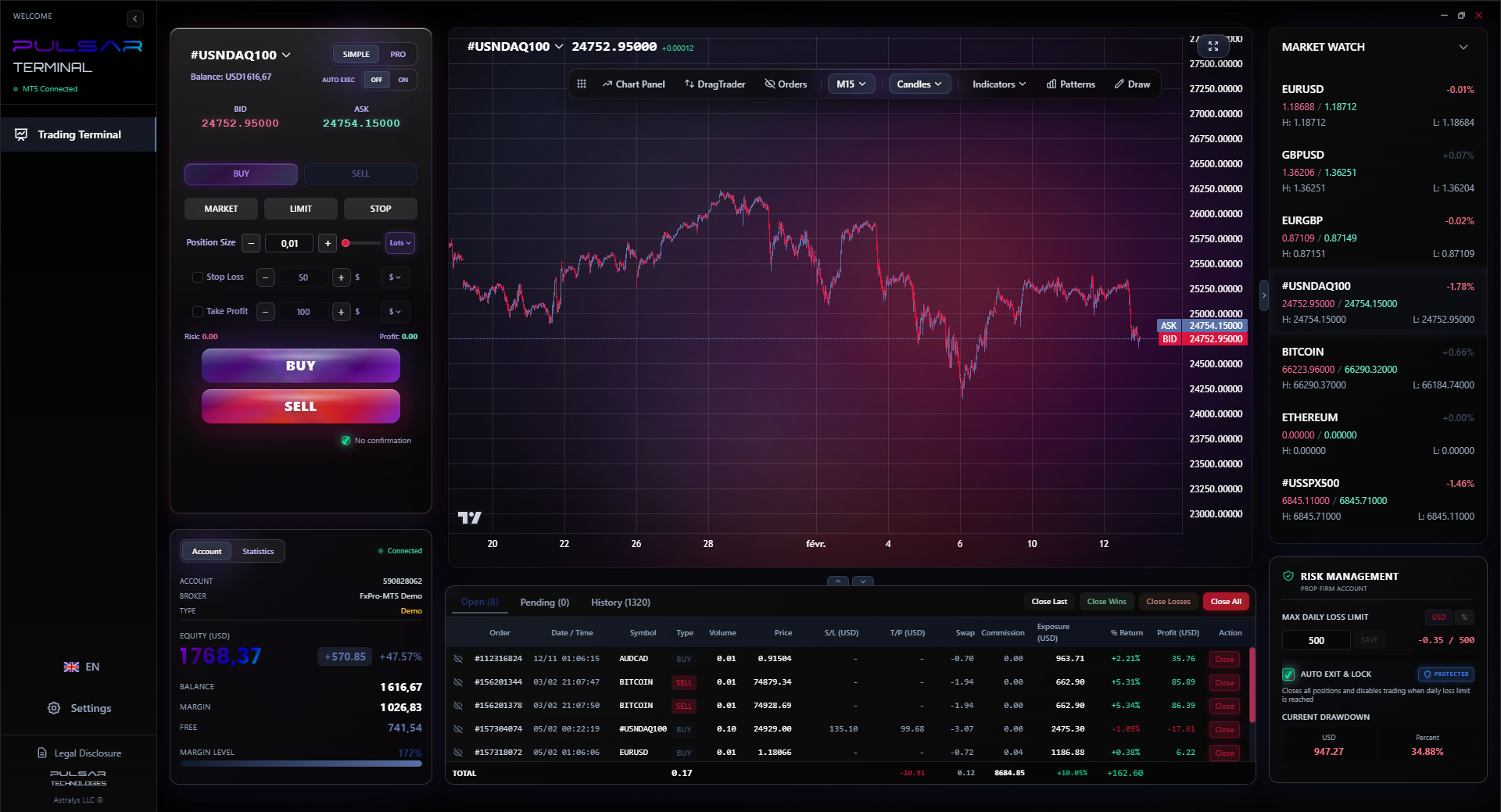
Automation is your friend here. Manually moving stops is emotional and slow. Many advanced trading tools let you set a breakeven order automatically at a specified profit level. For example, tools like Pulsar Terminal can automate this on MT5, moving your stop to your exact cost price once the trade goes X pips in your favor. This removes emotion and ensures you never forget.

Pro Tip: Your 'breakeven stop' should be placed a few pips BEYOND your calculated breakeven price. Why? Because of spread widening at news times. If your true breakeven is 1.0850, set your stop at 1.0848. This guarantees that if the stop is hit, you've definitely covered all costs.
Manually calculating and moving stops to breakeven is prone to error and emotion; Pulsar Terminal automates this directly on your MT5 chart based on your precise cost calculation.
Pulsar Terminal
Công cụ MT5 tất-cả-trong-một: đặt lệnh kéo-thả, multi-TP/SL, trailing stop, grid trading, Volume Profile và bảo vệ prop firm. Hơn 1.000 trader sử dụng mỗi ngày.
“Your broker choice is the single biggest factor in your breakeven equation.”
Your broker choice is the single biggest factor in your breakeven equation. Here’s a quick comparison of popular brokers among Nigerians, focusing on the costs that matter.
| Broker | Typical EUR/USD Spread | Commission (per lot) | Minimum Deposit | Key Note for Nigerians |
|---|---|---|---|---|
| IC Markets | 0.0 - 0.1 pips | ~$7 | $200 | Raw spreads, but commission adds up. Great for scalpers. IC Markets review. |
| Exness | 0.3 - 0.6 pips | $0 (on Std) | $10 | Popular here. Low minimums, but spreads can widen. Exness review. |
| XM | 0.8 - 1.0 pips | $0 (on Std) | $5 | No commissions, but wider spreads. Easier for beginners to calculate cost. XM review. |
| Pepperstone | 0.0 - 0.2 pips | ~$7 | $200 | Razor account offers top-tier pricing. Reliable execution. Pepperstone review. |
| HFM | 1.4 - 1.8 pips | $0 (on Cent) | $0* | Has a Lagos office. Cent accounts good for micro-testing strategies. |
Note: Payment processors may impose a minimum.
My take? If you're a high-volume scalping strategy trader, a raw spread + commission account (IC Markets, Pepperstone) is cheaper overall. If you trade less frequently or with smaller sizes, a commission-free account with slightly wider spreads (XM, Exness) might be simpler. Always test their execution during London open – that's when slippage can turn your breakeven calculation to dust.
“A trade stopped at breakeven is not a win. It's a missed opportunity.”
Let me be brutally honest about where I went wrong. It'll save you money.
Mistake 1: Ignoring Swap on Long-Term Trades. In 2020, I held a USD/JPY sell trade for 3 weeks aiming for a big swing. I made 85 pips ($850). I was celebrating. Then I checked the swap statement: I had paid $28 in overnight fees. My net profit was $822. Then the Naira devalued before withdrawal. My 'big win' felt very small. Now, if I plan to hold for more than a few days, I check the swap and factor it into my target.
Mistake 2: Chasing 'Risk-Free' Trades. I became obsessed with moving every stop to breakeven instantly. My trading journal showed a 90% 'win rate,' but my account was stagnant. I was cutting off all my winners at the knees and letting my losers run. A high win rate with a poor risk/reward ratio is a slow death. A trade stopped at breakeven is not a win. It's a missed opportunity.
Mistake 3: Not Accounting for All Costs in Backtests. I'd build a strategy on TradingView, see a 100-pip profit, and think 'great!' But I wasn't subtracting the 1.5 pip spread and commission I'd actually pay. The strategy was profitable in theory, but unprofitable in reality. Now, I subtract an average of 2 pips from every theoretical trade result to simulate real costs. It changes everything.
The bottom line? Breakeven is a defensive tool, not an offensive one. Its purpose is to protect your capital from a loss, not to secure a profit. Use it wisely, with precise calculation, and you'll have a huge edge over traders who are just guessing.
FAQ
Q1Is moving my stop loss to my entry price the same as breakeven?
No, and this is the most common misconception. Your entry price does not account for the spread you paid to enter the trade. If you bought EUR/USD and move your stop to the exact entry price, you will still lose the amount of the spread if stopped out. True breakeven is your entry price plus (for a buy) or minus (for a sell) the cost of the spread and any commissions.
Q2How do swap fees affect my breakeven as a Nigerian trader?
Swap fees are charged daily for holding positions overnight. If you hold a trade for multiple days, these fees accumulate and increase your total costs. Your original breakeven price is no longer valid; you need the price to move further in your favor to cover the added swap costs. Always check the swap rate for your pair before holding long-term.
Q3Which is better for achieving breakeven: a low-spread account with commission, or a commission-free account?
It depends on your trade size and frequency. For frequent traders or those trading larger lot sizes, a low-spread account with a commission (like an ECN/Raw account) usually results in lower total costs, making breakeven easier to reach. For infrequent traders or those with very small accounts, a commission-free account with a slightly wider spread is simpler and often cheaper overall. You need to do the math for your specific trading style.
Q4Can funding and withdrawal fees affect my overall breakeven?
Absolutely. If you pay a 3% fee to deposit ₦100,000, you start with only ₦97,000 of effective trading capital. You need to make a 3.1% return just to get back to your original deposit amount. This is your 'account breakeven' before you even place a trade. Always use brokers with free deposit/withdrawal options for Naira where possible.
Q5How many pips do I typically need to reach breakeven?
There's no single number. It depends on your broker's spread, any commission, and your lot size. On a major pair like EUR/USD with a 1-pip spread and no commission, you need 1 pip. With a 0.1-pip spread and a $7 commission on 1 lot, you need about 1.7 pips (because the $7 commission is roughly 0.7 pips on a standard lot). Always calculate it per trade using the formula in the article.
Q6Should I always move my stop loss to breakeven?
No. Moving your stop to breakeven too early is a major error. It often results in being stopped out before a trend has room to develop. A good rule is to only move your stop to breakeven after the trade has moved in your favor by at least 1 to 1.5 times your initial risk (the distance to your original stop loss).
Bài học của Prof. Winston
Điểm chính:
- ✓Breakeven Price = Entry Price + (Total Costs / Pip Value). Memorize it.
- ✓Never move stop to breakeven before 1.5x your initial risk.
- ✓Factor Nigerian funding fees into your account profit target.
- ✓Swap fees can turn a winning weekly trade into a loser.
Bài viết này hữu ích thế nào?
Nhấp vào ngôi sao để đánh giá
Nhận định giao dịch hàng tuần
Phân tích & chiến lược miễn phí hàng tuần. Không spam.
Về tác giả
Olumide Adeyemi
Nhà tiên phong Giao dịch Tây Phi
Một trong những nhà đào tạo forex tích cực nhất tại Nigeria. 8 năm kinh nghiệm giao dịch từ Lagos. Chuyên về chiến lược vốn thấp và thử thách prop firm dành cho trader châu Phi.
Bình luận
Cảnh báo rủi ro
Giao dịch các công cụ tài chính tiềm ẩn rủi ro đáng kể và có thể không phù hợp với tất cả nhà đầu tư. Hiệu suất trong quá khứ không đảm bảo kết quả trong tương lai. Nội dung này chỉ mang tính chất giáo dục và không nên được coi là lời khuyên đầu tư. Hãy luôn tự nghiên cứu trước khi giao dịch.
Bạn cũng có thể thích

Cara Trading Forex Sukses: 7 Prinsip dari Trader Profesional
Cara trading forex sukses dengan 7 prinsip trader pro: manajemen modal, disiplin, journal trading, backtest. Data nyata, bukan janji profit palsu.
Jam Trading Forex Terbaik untuk Trader Indonesia: Panduan Lengkap dengan Tabel Waktu
Panduan jam trading forex untuk trader Indonesia. Tabel 4 sesi dunia, jam emas 20:00-00:00, sesi mana yang harus dihindari. Data akurat + tips dari trader berpengalaman.
Top 5 Sàn Forex Uy Tín Nhất 2026: Review Jujur dari Trader Indonesia
Top 5 sàn forex uy tín 2026 untuk trader Indonesia. Review jujur: spread, deposit, withdraw, dukungan lokal. Exness, XM, IC Markets & lebih.
Tải Pulsar Terminal
Tất cả các công cụ tính này được tích hợp trong Pulsar Terminal với dữ liệu thời gian thực từ tài khoản MT5 của bạn.
Tải Pulsar Terminal