


You're probably asking yourself, 'How does forex trading actually work, and can I make real money from it here in South Africa?' The short answer is yes, but the path is littered with blown accounts.

David van der Merwe
Nhà giao dịch Thị trường Mới nổi ·  South Africa
☕ 11 phút đọc
Bạn sẽ học được:
- 1Forex 101: It's Not Buying Money, It's Betting on a Relationship
- 2The South African Reality: ZAR Accounts, FSCA Rules, and Real Costs
- 3From Click to P&L: The Anatomy of a Live Trade
- 4The Real Reasons South African Traders Blow Up Their Accounts
- 5Building a Strategy That Doesn't Self-Destruct
- 6Your First 90 Days: A Realistic Action Plan
You're probably asking yourself, 'How does forex trading actually work, and can I make real money from it here in South Africa?' The short answer is yes, but the path is littered with blown accounts. I've been trading for over 12 years, and I've seen the same story play out a hundred times. Most people focus on fancy indicators and news headlines, completely missing the foundational mechanics that determine their success or failure. This guide won't teach you a 'secret strategy.' Instead, I'll show you how the forex market actually functions for a South African trader - the real costs, the FSCA's rules, and the precise reasons 80% of people lose their capital.
Let's clear up the biggest misconception first. You're not 'buying dollars' when you trade forex. You're speculating on the relationship between two currencies, expressed as a pair. Think of it like a seesaw. When you buy EUR/USD, you're betting the Euro will strengthen relative to the US Dollar. The price you see, like 1.0850, is the exchange rate: 1 Euro equals 1.0850 US Dollars.
Every trade is a simultaneous buy of one currency and sell of another. That's the core of como funciona forex. If you think the Rand will weaken against the Dollar, you buy USD/ZAR. You're long Dollars, short Rands. The profit or loss comes from the change in that exchange rate, measured in pips. One pip is typically a 0.0001 move for pairs like EUR/USD, but for USD/ZAR, it's 0.0010 because of how the pair is quoted.

Example: You buy USD/ZAR at 18.5000. The rate moves to 18.7500. You've made 250 pips (18.7500 - 18.5000 = 0.2500, which is 250 pips). On a standard lot (100,000 units), that's a profit of 250,000 ZAR? No. You calculate profit in the quote currency. Profit = (0.2500) * 100,000 = 25,000 ZAR. That's the real mechanical math.
The market is driven by a global network of banks, institutions, governments, and retail traders like you. There's no central exchange like the JSE. It's an over-the-counter (OTC) market, which means prices can vary slightly between brokers. Liquidity - the ease of buying or selling - is highest during overlapping market hours (London and New York sessions are key). When you understand you're trading a dynamic relationship, not a static asset, you start thinking in terms of relative strength, which is where real analysis begins. For a deep dive on the world's most traded pair, check out our EUR/USD guide.
“You're not 'buying dollars' when you trade forex. You're speculating on the relationship between two currencies.”
Trading from South Africa isn't the same as trading from London or New York. Your local context changes everything, from your costs to your protection.
Regulation: Your First Line of Defence
The Financial Sector Conduct Authority (FSCA) is the sheriff in town. Any broker seriously offering services here must have an FSP license. This isn't just bureaucracy. It means client funds should be segregated. If the broker goes under, your money isn't part of their bankruptcy estate. Always verify the license on the FSCA's website. I learned this the hard way early on with an unregulated 'bucket shop' that mysteriously froze withdrawals during a big winning streak.
The use Cap: A Blessing in Disguise
The FSCA capped use for retail traders at 30:1 on major pairs. Brokers moaned, but this rule has saved more accounts than any trading course ever could. At 30:1, a 3.33% move against you wipes out your margin. That's still risky, but it's a far cry from the 500:1 or 1000:1 offered offshore, where a 0.2% move can trigger a margin call. This cap forces a bit of sanity into your position sizing.
The ZAR Account Advantage
Many brokers, like those in our XM review or Exness review, offer ZAR-denominated accounts. This is a game-saver. It means your profit and loss are in Rands from the get-go. No hidden currency conversion fees eating 1-2% of your balance every time you deposit or withdraw. Your bank transfers are local EFTs, which are faster and cheaper than international wires that can cost R250-R500 a pop.
The Real Cost of Doing Business
You don't just pay when you're wrong. You pay to play. The spread is the broker's cut. On USD/ZAR, it can be 50-80 pips during volatile times. That means the price has to move 50-80 pips in your favor just for you to break even. On majors like EUR/USD, it can be under 1 pip on a good ECN account. Then there's the commission, often $3-$7 per standard lot per side. And the swap rate (overnight financing) - if you hold a position past 5 PM New York time, you'll pay or receive interest based on the rate differential. Holding a ZAR pair overnight can have significant swap costs because of South Africa's interest rate structure. You must factor all this into your strategy, especially if you're swing trading.

💡 Mẹo của Winston
Your first R10,000 is for learning, not earning. If you can preserve it for 6 months while executing a plan, you've passed the most important test.
“The FSCA's 30:1 use cap doesn't limit your profits; it limits your ability to destroy yourself in one trade.”
Let's walk through a real trade I placed last month. This is where como funciona forex moves from theory to practice, and where most mistakes happen.
The Setup: I was watching GBP/ZAR. The Bank of England was hawkish, and the Rand was looking soft on local political noise. The rate was at 23.4000.
The Order: I didn't just click 'buy.' I set a limit order at 23.3500, believing a small dip would come before a rise. I committed 2% of my account risk. Using a position size calculator, with a stop loss at 23.2000 (150 pips away), I calculated my position size to risk exactly R2,000.
The Execution: The price dipped, hit 23.3500, and my order became a live trade. My stop loss was immediately set at 23.2000. My first take-profit target was at 23.6000 (250 pips away).

Warning: This is where psychology kills you. The trade immediately went 20 pips in my favor, then reversed. It ticked down to 23.3100. The urge to move my stop loss 'just a little wider' was intense. I didn't. I let the market breathe.
The Management: The trade rallied, hit my first target at 23.6000. I closed half my position, banking a profit of 250 pips on that portion. I then moved my stop loss on the remaining half to my entry point (23.3500), making it a risk-free trade. This is a critical skill most traders never develop.
The Outcome: The trade continued to 23.8500, where I closed the rest. Total profit: R4,150 on the initial R2,000 risk. The key wasn't a magical entry. It was the pre-defined plan, the strict risk management (that 2% rule), and the active management of the position after entry. Without that structure, I would have likely exited at the first sign of a pullback for a tiny profit, or let a winner turn into a loser. This multi-target approach is something tools are built for, but the discipline has to come from you.
“Survival comes first. Profits come second. A strategy that blows up in a month is no strategy at all.”
After mentoring hundreds of traders, I can tell you the failure has nothing to do with intelligence. It's a series of predictable, mechanical errors.
1. Overleveraging on ZAR Pairs: This is the number one killer. A trader sees USD/ZAR at 18.50 and thinks, 'It's so cheap! I'll buy 5 lots!' With 30:1 use, that's a massive position. A normal 50-pip swing (0.27%) against them can wipe out a huge chunk of their margin. They're using dollar-pair logic on an emerging market currency that moves differently. The volatility is higher, the spreads are wider.
2. Ignoring the Total Cost Structure: They see 'zero spread' advertised and don't factor in the commission. Or they hold GBP/ZAR positions for weeks, not realizing the negative swap charges are slowly draining their account like a leaky tap. They trade 20 times a day, and the costs (spread + commission) completely erase their small profits. This is especially deadly for scalping strategies.
3. No Defined Edge, Just Hope: They trade based on a 'feeling' or a news headline they don't understand. They have no statistical edge - no proven reason why their entry should work more often than not. It's gambling, not trading. I blew my first R15,000 account this way, chasing gold moves based on gut instinct before I learned to use tools like the RSI indicator and MACD indicator within a structured system.
4. Poor Broker Choice: They sign up with an unregulated offshore broker offering 1000:1 use because it sounds exciting. When they have a withdrawal issue, they have zero recourse. No FSCA to call. I've had clients lose five-figure sums this way. Always start with a regulated entity; our IC Markets review and Pepperstone review cover solid, regulated options.
5. Mismanaging Winners: They turn a 50-pip profit into a 10-pip loss because they refuse to take profits, hoping for a home run. Greed is a terrible business model. You need a plan for partial closures and trailing stops before you even enter.
💡 Mẹo của Winston
The spread isn't a fee, it's a toll bridge. You have to cross it to get to your profit. Choose brokers with the lowest, most transparent tolls for your style.
“Survival comes first. Profits come second. A strategy that blows up in a month is no strategy at all.”
Survival comes first. Profits come second. Here’s how to build a framework that lasts.
Start with Risk, Not Reward
Decide what percentage of your account you will risk on any single trade. I never go above 2%. This means I can survive 10 consecutive losses and still have 80% of my capital. Calculate your position size every single time using your stop loss distance. If your stop is 200 pips away on USD/ZAR, your lot size must be small enough that 200 pips lost equals 2% of your account.
Choose Your Timeframe and Pairs Wisely
If you have a day job, don't try to scalp the 1-minute chart. You'll get slaughtered. Swing trading on the 4-hour or daily chart is more realistic. Stick to 1-3 major pairs (EUR/USD, GBP/USD) and maybe one ZAR pair to start. Learn their personality. Gold (XAU/USD) is popular but moves differently than currencies; our XAU/USD guide explains its quirks.
Have a Clear Entry, Exit, and Management Plan
Your trading plan should answer these questions:
- Entry: What specific condition must the chart meet? (e.g., "Price bounces off the 200-day moving average with RSI oversold.")
- Stop Loss: Where is it, and why? It should be placed where your trade idea is invalidated.
- Take Profit: Will you take all at one level? Use multiple targets? My earlier example shows why partial closure is powerful.
- Management: Will you move your stop to breakeven after a certain point? Will you trail it?
Backtest this plan on historical data. If it wouldn't have worked last year, it probably won't work tomorrow. This process of planning and managing multiple exit points is where technology can remove emotion, but the rules must be yours.
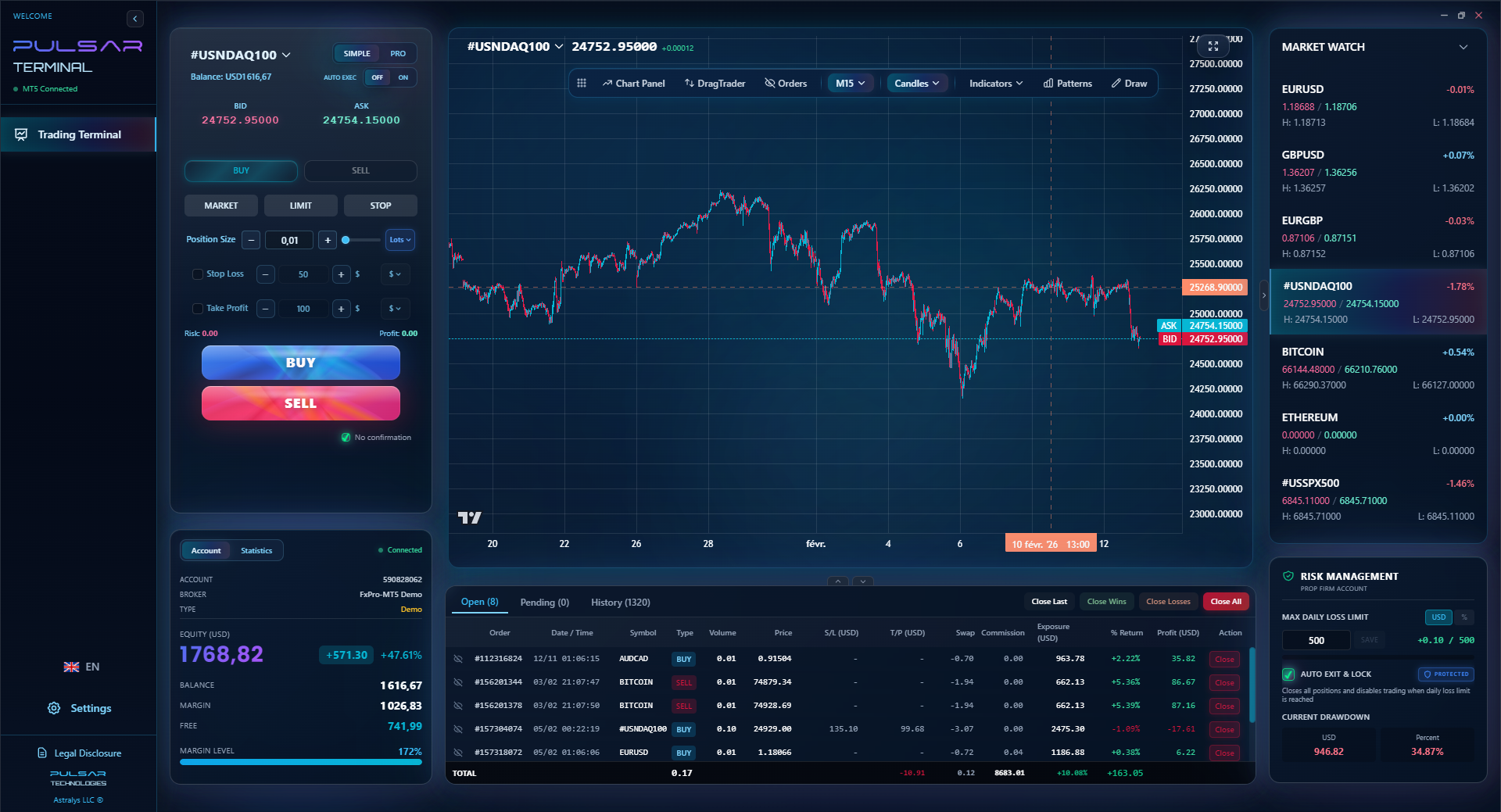
Manually moving stops to breakeven and managing multiple profit targets is where discipline often fails, which is why tools that automate these rules directly on your MT5 chart are critical for consistent execution.
Pulsar Terminal
Công cụ MT5 tất-cả-trong-một: đặt lệnh kéo-thả, multi-TP/SL, trailing stop, grid trading, Volume Profile và bảo vệ prop firm. Hơn 1.000 trader sử dụng mỗi ngày.
“Your goal with your first live account is not to make money. It's to execute your plan under real psychological pressure.”
Here's exactly what to do, in order. Skip a step, and you're increasing your odds of failure.
Weeks 1-4: Education & Paper Trading Don't deposit real money. Open a demo account with a reputable, FSCA-regulated broker. Learn the MT4 or MT5 platform inside out. Practice placing orders, setting stops, and calculating position size. Understand what a pip and spread mean on your screen. Follow the markets for a month without trading. Just watch.
Weeks 5-8: Develop and Test a Single Strategy Pick one simple strategy. Maybe a moving average crossover on the EUR/USD 4-hour chart. Define every rule. Then, trade it on your demo account for a full month. Log every trade in a journal: entry, exit, reason, emotion. At the end, analyze. Are you profitable? Is the spread cost killing you? Be brutally honest.
Weeks 9-12: Live Trading with Micro Risk Now, open a live account with the minimum deposit - maybe $100 with a broker like XM. Trade the smallest possible size (micro lots). Your goal is not to make money. Your goal is to execute your plan under real psychological pressure and to experience real costs and slippage. Can you click the button when your set-up appears? Can you accept a loss without revenge trading? If you can protect that $100 account for a month, you're ready to fund a proper account.
Funding and Taxes When you do fund, use a broker with a local ZAR account to save on fees. And from day one, keep careful records. SARS views trading profits as income. You are responsible for declaring it. Talk to a tax consultant who understands trading; it's a business expense worth paying for.
FAQ
Q1Is forex trading legal and safe in South Africa?
Yes, it's legal, but 'safe' depends entirely on you and your broker. It's safe if you trade with an FSCA-licensed broker (which provides client fund segregation) and you employ strict risk management. It's unsafe if you use unregulated brokers offering insane use or you risk 20% of your account per trade. The activity is legal; your actions determine the safety.
Q2How much money do I need to start forex trading in South Africa?
You can technically start with as little as $5 or $10 with some brokers. But realistically, you need enough so that trading micro lots (1,000 units) makes sense and your risk per trade is a sane percentage. I'd suggest a minimum of R2,000-R5,000 for a live account, with the understanding that the first R1,000 is tuition fee. Most of that should sit in your account as a risk buffer, not be deployed all at once.
Q3What is the best forex trading platform in South Africa?
MetaTrader 4 (MT4) and MetaTrader 5 (MT5) are the industry standards and for good reason. They're stable, have excellent charting, and support automated trading (Expert Advisors). Almost every FSCA-regulated broker offers them. cTrader is also excellent, known for its clean interface and true ECN pricing. Start with MT4 or MT5 - they're the most widely supported and have the largest community for support.
Q4How are my forex trading profits taxed by SARS?
SARS treats profits from speculative forex trading (not for international payments) as revenue in your hands, subject to normal income tax. You must declare it. You can deduct certain expenses like platform fees, data costs, and a portion of home office expenses if you trade professionally. Keep a detailed trade journal and all broker statements. It's non-negotiable. Consult a tax professional.
Q5Why is the use cap of 30:1 a good thing?
It forces discipline. Most new traders see high use as a way to make huge profits from small moves. In reality, it's a way to incur huge losses from small moves. The 30:1 cap limits how much you can borrow, which limits how big a position you can take relative to your capital. This automatically reduces your risk of a total account blow-up from a single, normal market swing. It's a regulatory safety net.
Q6Should I trade ZAR pairs like USD/ZAR or stick to majors?
Start with majors (EUR/USD, GBP/USD). They have much tighter spreads, higher liquidity, and more predictable behavior driven by global macroeconomics. ZAR pairs like USD/ZAR have wider spreads (often 50+ pips), are subject to local political shocks and liquidity crunches, and can gap significantly. Once you're consistently profitable on majors, then you can carefully explore ZAR pairs with a much smaller position size to account for the higher volatility and cost.
Bài học của Prof. Winston
Điểm chính:
- ✓Trade the relationship, not the currency.
- ✓Never risk more than 2% per trade.
- ✓ZAR accounts save you on hidden fees.
- ✓Always verify FSCA license before depositing.
- ✓Wider spreads on ZAR pairs require smaller sizes.
Bài viết này hữu ích thế nào?
Nhấp vào ngôi sao để đánh giá
Nhận định giao dịch hàng tuần
Phân tích & chiến lược miễn phí hàng tuần. Không spam.
Về tác giả
David van der Merwe
Nhà giao dịch Thị trường Mới nổi
Trader tại Johannesburg với 11 năm kinh nghiệm về tiền tệ thị trường mới nổi. Chuyên về cặp ZAR, giao dịch theo quy định FSCA và phân tích thị trường Nam Phi.
Bình luận
Cảnh báo rủi ro
Giao dịch các công cụ tài chính tiềm ẩn rủi ro đáng kể và có thể không phù hợp với tất cả nhà đầu tư. Hiệu suất trong quá khứ không đảm bảo kết quả trong tương lai. Nội dung này chỉ mang tính chất giáo dục và không nên được coi là lời khuyên đầu tư. Hãy luôn tự nghiên cứu trước khi giao dịch.
Bạn cũng có thể thích

Cara Trading Forex Sukses: 7 Prinsip dari Trader Profesional
Cara trading forex sukses dengan 7 prinsip trader pro: manajemen modal, disiplin, journal trading, backtest. Data nyata, bukan janji profit palsu.
Jam Trading Forex Terbaik untuk Trader Indonesia: Panduan Lengkap dengan Tabel Waktu
Panduan jam trading forex untuk trader Indonesia. Tabel 4 sesi dunia, jam emas 20:00-00:00, sesi mana yang harus dihindari. Data akurat + tips dari trader berpengalaman.
Top 5 Sàn Forex Uy Tín Nhất 2026: Review Jujur dari Trader Indonesia
Top 5 sàn forex uy tín 2026 untuk trader Indonesia. Review jujur: spread, deposit, withdraw, dukungan lokal. Exness, XM, IC Markets & lebih.
Tải Pulsar Terminal
Tất cả các công cụ tính này được tích hợp trong Pulsar Terminal với dữ liệu thời gian thực từ tài khoản MT5 của bạn.
Tải Pulsar Terminal