


I remember staring at my screen in late 2024, watching the Naira/USD pair whip back and forth like a live wire.

Olumide Adeyemi
Nhà tiên phong Giao dịch Tây Phi ·  Nigeria
☕ 12 phút đọc
Bạn sẽ học được:
I remember staring at my screen in late 2024, watching the Naira/USD pair whip back and forth like a live wire. I had a small position, and the volatility was eating my lunch. At the same time, my shares in a solid Nigerian bank were just… sitting there, barely moving. That moment crystallized the core difference between stocks and forex for me. One market is a 24-hour global storm; the other is a local marathon. If you're trying to figure out where to put your money, understanding this split is your first real step. Let's break it down, the Nigerian way.
This is the most fundamental difference, and it changes everything about your approach.
When you buy a stock on the Nigerian Exchange (NGX), you're buying a tiny piece of a company. You own a share of Dangote Cement, Zenith Bank, or MTN Nigeria. Your profit comes from the company's success - its earnings, dividends, and growth prospects - and from other investors being willing to pay more for that piece later. You're investing in a business.
Forex is different. You're not buying a company; you're speculating on the value of one currency against another. The most common pair for Nigerians is USD/NGN. You're betting on whether the Naira will strengthen or weaken against the Dollar. You don't own Dollars in a bank; you own a contract for difference (CFD) that mirrors that price movement. Your profit comes purely from being right about the direction of the exchange rate. It's a pure play on macroeconomic forces, central bank policy (hello, CBN!), and global sentiment.

Warning: Because forex trading is often done via CFDs with international brokers, you never actually take delivery of the currency. You're trading a derivative. This is a crucial legal and practical distinction from walking into a bureau de change.
I learned this the hard way early on. I bought GTB stock because I used their app and believed in their management. It was a long-term belief. My USD/NGN trades, however, were based on news headlines about CBN meetings and oil prices. The timeframes, analysis, and emotional attachment were completely different. One felt like planting a tree; the other felt like catching a wave.

💡 Mẹo của Winston
A market is just a crowd of people. Stocks are a crowd judging a business. Forex is a crowd judging a country. Learn to read the crowd's mood, not just the numbers.

Here in Nigeria, the regulatory environment for these two markets is like night and day. This isn't just paperwork; it defines your protection, the brokers you can use, and where your money actually sits.
Stock Market Regulation
The Nigerian stock market is tightly regulated. The main players are the Securities and Exchange Commission (SEC Nigeria) and the Nigerian Exchange Limited (NGX). Every stockbroker you deal with must be licensed by the SEC. Your shares are held in trust for you by the Central Securities Clearing System (CSCS). This system is designed for safety and transparency. Recent updates, like the new rules for Trading License Holders in 2024, aim to strengthen this framework further.
When you use a platform like Stanbic IBTC Stockbrokers, Meristem's Meritrade, or even a digital sub-broker like Cowrywise, you're operating within this protected, Nigerian-regulated system. Your money is in a Nigerian account, and the assets are in your name in the CSCS.
Forex Market Regulation
Forex regulation is murkier for the retail trader. The Central Bank of Nigeria (CBN) regulates the official foreign exchange market, focusing on banks and Bureaux de Change (BDCs). Their 2024 guidelines for BDCs were a big deal for that sector. However, as an individual retail trader speculating on platforms, you are almost certainly not dealing with a CBN-licensed entity.
You'll be using an international broker like Exness, IC Markets, or Pepperstone. These brokers are regulated offshore (e.g., in Cyprus, Australia, the Seychelles). There is no specific Nigerian body that licenses or oversees your activity with these firms. This means your primary recourse in a dispute is with the foreign regulator, not the SEC or CBN. It's a critical point of vulnerability.

Pro Tip: Always, always check the regulatory license of any forex broker you consider. Don't just look at the fancy website; find their license number and verify it on the regulator's official site (like CySEC or ASIC). This is your first line of defense.
The difference in regulation directly impacts your choice of broker. For stocks, you pick a local, SEC-licensed broker. For forex, you're comparing international platforms. This also affects funding: stock accounts are funded in Naira from your local bank, while forex accounts often require funding in USD or via cryptocurrency, adding another layer of complexity and exchange risk.
“Forex with high use is a higher-risk, short-term speculation game. Stocks are a lower-risk, longer-term investment vehicle. Confusing the two is a recipe for disaster.”
Both markets take a cut, but they do it in very different ways. Ignoring these costs is a surefire way to see your profits evaporate before you even make them.
The Cost of Trading Stocks on the NGX
Trading stocks involves multiple, small statutory fees that add up. Here’s a typical breakdown for a trade:
| Fee Type | Typical Rate | Who Gets It |
|---|---|---|
| SEC Fee | 0.3% of trade value (on purchase) | Securities & Exchange Commission |
| NGX Fee | 0.3% of trade value (on sale) | Nigerian Exchange Limited |
| CSCS Fee | ~0.378% on sale, ~0.063% on buy | Central Securities Clearing System |
| Stamp Duty | 0.075% | Government |
| Brokerage Commission | 0.7% - 1.8% (varies) | Your Stockbroker |
Example: If you buy ₦100,000 worth of shares, you might pay ₦300 (SEC) + ₦63 (CSCS) + ₦75 (Stamp Duty) + ₦700 (brokerage at 0.7%) = ₦1,138 in total fees just to enter the trade. Selling incurs another round. This is why stock trading in Nigeria favors a longer-term, swing trading or investment mindset. You need the asset to appreciate enough to overcome these friction costs.
The Cost of Trading Forex
Forex costs are simpler but can be just as impactful, especially if you trade frequently. The primary cost is the spread - the difference between the buy (ask) and sell (bid) price. For example, if USD/NGN is quoted as 1500.00 / 1500.50, the spread is 0.50 Naira. That’s your cost to enter the trade.
Some brokers also charge a commission per lot traded, on top of a tighter spread. The key here is that these costs are incurred on every single trade, and with the high use common in forex, they represent a significant portion of your margin. If you're scalping and making dozens of trades a day, spreads will be your biggest enemy.
A personal lesson: I once tried a scalping strategy on EUR/USD with a broker that had a "low" 1-pip spread. After 20 trades in a day, I was technically profitable on price movement but my account was down. Why? The cumulative spread cost had wiped out all my gains. I wasn't trading the market; I was feeding the broker. Always factor in the cost per pip before you hit buy.
This is where the difference between stocks and forex hits you in your daily schedule. The NGX operates from 10:00 AM to 2:30 PM, Monday through Friday. That's it. The market is closed at night, on weekends, and on public holidays. This creates a predictable rhythm. News that breaks after hours waits until the next opening bell to be priced in.
The forex market is a 24-hour beast, from 5 PM EST Sunday to 5 PM EST Friday. It just rolls across the globe: Sydney opens, then Tokyo, then London, then New York. For a Nigerian trader, this means the London session (which overlaps with our afternoon) and the New York session (our evening) are often the most volatile. Major economic data from the US or Europe drops when our stock market is long closed.
Liquidity - the ease of buying or selling without moving the price - is also vastly different. The forex market is the most liquid in the world, with trillions traded daily. This means you can usually get in and out of major pairs like EUR/USD or USD/NGN (on international platforms) instantly at the quoted price. The Nigerian stock market, while liquid for top-tier banks and consumer goods stocks, can be thin for smaller companies. You might struggle to sell a large block of shares without affecting the price.
This 24/5 nature of forex is a double-edged sword. It offers flexibility but also temptation. I've made some of my worst trades at 11 PM, reacting to some overseas headline when I should have been asleep. The market never closes, but sometimes you should.
“The Nigerian stock market is a tightly regulated local marathon. The forex market is a 24-hour global storm. You need different shoes for each race.”
If there's one area that defines the difference between stocks and forex in terms of raw risk, it's use.
Stock Market use in Nigeria: It's limited and conservative. Some brokers may offer margin facilities, but it's not the norm for most retail investors. You're largely trading with the capital you have. If you buy ₦100,000 of shares, your maximum loss is theoretically ₦100,000 if the company goes bankrupt. This encourages a more measured, research-driven approach.
Forex use: It's a whole different universe. It's common to see use offers of 1:100, 1:500, or even 1:1000 from international brokers. This means with a $100 margin, you can control a $100,000 position. Let's make this real with numbers.

Example: You have ₦150,000 ($100 approx). With 1:500 use, you can open a $50,000 position on USD/NGN. If the rate moves 1% in your favor, you've made $500 (a 500% return on your margin!). But if it moves 1% against you, you've lost $500 - wiping out your entire margin and getting a margin call. That 1% move can happen in minutes.
I learned about use the expensive way. Early on, I funded an account with $200, used 1:500 use on a gold (XAU/USD) trade, and watched a $15 move against me wipe out the entire account in under an hour. I was right on the overall direction a week later, but my account was already gone. use amplifies everything: your gains, your losses, and your emotions. It's the main reason most new forex traders blow up their accounts. Managing this risk is job number one, and using a position size calculator is non-negotiable.
Forex, with its high use, is inherently a higher-risk, shorter-term speculation game. Stocks, with limited use, lean towards being a lower-risk (but not no-risk), longer-term investment vehicle. Confusing the two approaches is a recipe for disaster.
💡 Mẹo của Winston
Your first profit in forex will feel like genius. Your first loss with high use will feel like robbery. Both are wrong. It's just math. Respect the math.

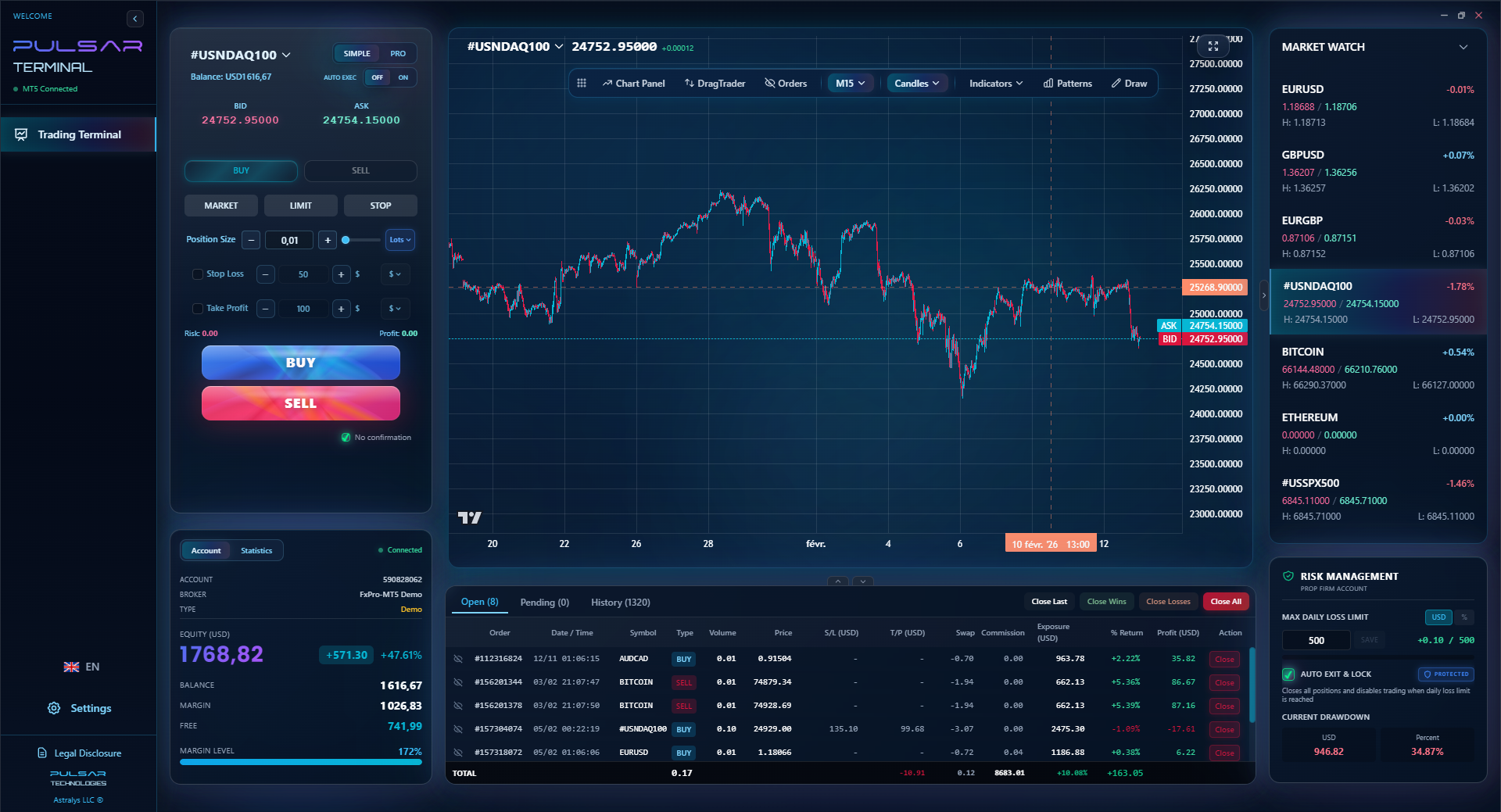
Managing the high-risk, fast-paced nature of forex requires precise order tools, which platforms like Pulsar Terminal provide directly on your MT5.
Pulsar Terminal
Công cụ MT5 tất-cả-trong-một: đặt lệnh kéo-thả, multi-TP/SL, trailing stop, grid trading, Volume Profile và bảo vệ prop firm. Hơn 1.000 trader sử dụng mỗi ngày.
So, which one is for you? It's not about which is "better," but which fits your personality, goals, and risk tolerance.
Consider Stocks If:
- You prefer investing in tangible businesses you understand (like Nigerian banks, telcos, or consumer goods).
- You have a longer time horizon (months to years) and want to earn dividends.
- You want the security of Nigerian regulation and asset custody with the CSCS.
- You're uncomfortable with the idea of 24-hour trading and high use.
- You can start with smaller amounts (₦5,000 - ₦10,000) through platforms like Cowrywise or Meritrade.
Consider Forex If:
- You are fascinated by global economics, central bank policy, and geopolitical events.
- You can dedicate time to analyze charts and economic calendars, often outside NGX hours.
- You have strict risk management discipline and understand that most of your job is preserving capital.
- You're comfortable with the regulatory gray area of using international brokers.
- You're aiming for shorter-term trades (days to weeks) and can handle intense volatility.
My journey? I do both, but I keep them in completely separate mental accounts. My stock portfolio is my "anchor" - built slowly, held for dividends and long-term growth. My forex account is my "trading business" - a much smaller risk capital pool where I actively trade, using tools to manage the complexity. For example, managing multiple trades on EUR/USD or XAU/USD requires precise order management that basic MT4 doesn't handle well.
You don't have to choose one forever. Many successful traders start with one, learn its lessons - especially about risk and psychology - and then cautiously explore the other with a much clearer understanding of the difference between stocks and forex. The worst thing you can do is jump into forex thinking it's just like stocks, but faster. It's a different sport entirely.
“High use is a tool for professionals with institutional-grade risk systems, not a lottery ticket for beginners.”
Let's talk about the mistakes I see all the time, so you can skip a few painful lessons.
Pitfall 1: Using a Stock Mindset for Forex. This is the big one. You buy a currency pair because it's "cheap" or "has fallen a lot," like you might a battered stock. But currencies can trend for years. The Naira can keep weakening far beyond what feels logical. Forex requires technical discipline - using support/resistance, and indicators like the RSI or MACD - to manage entries and exits, not just a "buy and hope" mentality.
Pitfall 2: Ignoring the Cost Structure. As we covered, not factoring in all the statutory fees for stocks or the spread/commission for forex will make your strategy unprofitable. Always calculate your break-even point before you trade.
Pitfall 3: Chasing use in Forex. Just because you can use 1:1000 use doesn't mean you should. I now rarely use more than 1:30, even on my most confident trades. High use is a tool for professionals with institutional-grade risk systems, not a lottery ticket.
Pitfall 4: Underestimating Naira Liquidity in Forex. Be careful with exotic pairs or even USD/NGN on some international platforms. During times of extreme volatility (like a CBN policy announcement), the spread can widen dramatically, triggering your stop-loss at a worse price than you planned (slippage). Stick to major pairs for better liquidity.
Pitfall 5: Not Having a Clear Goal. Are you trading for supplemental income, or building long-term wealth? Your answer should dictate your market choice and strategy. Forex can generate income faster but with higher risk of loss. Stocks build wealth slower but more steadily. Mixing these goals leads to confused, emotional decisions.
The bottom line? Respect the difference between stocks and forex. They reward different skillsets. Start with a demo account in whichever market attracts you, treat it like real money, and see if your personality and patience align with its rhythm before you fund a live account. That's the smartest first trade you'll ever make.
FAQ
Q1Which is more profitable, stocks or forex?
There's no universal answer. Forex offers higher potential returns per trade due to use, but also carries a much higher risk of rapid loss. The Nigerian stock market offers slower, more steady growth and dividends. Profitability depends entirely on your skill, discipline, and risk management. Most beginners lose money in both markets initially.
Q2Can I trade forex legally in Nigeria?
Yes, you can legally trade forex through international brokers. However, it operates in a regulatory gray area. The CBN regulates the official market (banks, BDCs) but not individual retail speculation on offshore platforms. You are subject to the broker's international regulations, not direct Nigerian SEC oversight like with stocks. Always use a reputable, internationally regulated broker.
Q3How much money do I need to start trading stocks in Nigeria?
You can start with very little. Platforms like Cowrywise allow investments from ₦5,000. Some stockbrokers like Meritrade have minimums around ₦10,000. Remember to account for the various fees, so starting with at least ₦20,000-₦50,000 gives you more flexibility and makes the fees a smaller percentage of your capital.
Q4Why is use so high in forex?
Because currency prices move in very small increments (pips). A 1% move is a huge deal. High use allows traders to control large positions with little capital, making these small price movements meaningful in profit terms. However, it's a double-edged sword that magnifies losses just as quickly. It's the primary risk in forex trading.
Q5Should I pay more attention to technical or fundamental analysis?
It depends on the market and your style. For Nigerian stocks, fundamental analysis (company financials, management, sector outlook) is crucial for long-term investing. For forex, technical analysis (chart patterns, indicators) is often more immediately useful for timing entries and exits, though fundamentals (CBN rates, inflation data, oil prices) drive the long-term trends. Most successful traders blend both.
Q6Can I trade both stocks and forex at the same time?
Absolutely, and many experienced traders do. The key is to treat them as separate endeavors with separate accounts, separate risk capital, and separate strategies. Don't use forex use mentality on stocks, and don't apply a "buy-and-hold" stock mindset to an active forex trade. Keep the disciplines distinct.
Bài học của Prof. Winston
Điểm chính:
- ✓Stocks = owning a business. Forex = betting on a price.
- ✓Nigerian stocks: SEC & NGX rules. Forex: International broker rules.
- ✓Stock fees are many & small. Forex cost is the spread.
- ✓Stocks trade 10am-2:30pm. Forex trades 24/5.
- ✓Forex use can turn $100 into $50,000 control.
Bài viết này hữu ích thế nào?
Nhấp vào ngôi sao để đánh giá
Nhận định giao dịch hàng tuần
Phân tích & chiến lược miễn phí hàng tuần. Không spam.
Về tác giả
Olumide Adeyemi
Nhà tiên phong Giao dịch Tây Phi
Một trong những nhà đào tạo forex tích cực nhất tại Nigeria. 8 năm kinh nghiệm giao dịch từ Lagos. Chuyên về chiến lược vốn thấp và thử thách prop firm dành cho trader châu Phi.
Bình luận
Cảnh báo rủi ro
Giao dịch các công cụ tài chính tiềm ẩn rủi ro đáng kể và có thể không phù hợp với tất cả nhà đầu tư. Hiệu suất trong quá khứ không đảm bảo kết quả trong tương lai. Nội dung này chỉ mang tính chất giáo dục và không nên được coi là lời khuyên đầu tư. Hãy luôn tự nghiên cứu trước khi giao dịch.
Bạn cũng có thể thích

Cara Trading Forex Sukses: 7 Prinsip dari Trader Profesional
Cara trading forex sukses dengan 7 prinsip trader pro: manajemen modal, disiplin, journal trading, backtest. Data nyata, bukan janji profit palsu.
Jam Trading Forex Terbaik untuk Trader Indonesia: Panduan Lengkap dengan Tabel Waktu
Panduan jam trading forex untuk trader Indonesia. Tabel 4 sesi dunia, jam emas 20:00-00:00, sesi mana yang harus dihindari. Data akurat + tips dari trader berpengalaman.
Top 5 Sàn Forex Uy Tín Nhất 2026: Review Jujur dari Trader Indonesia
Top 5 sàn forex uy tín 2026 untuk trader Indonesia. Review jujur: spread, deposit, withdraw, dukungan lokal. Exness, XM, IC Markets & lebih.
Tải Pulsar Terminal
Tất cả các công cụ tính này được tích hợp trong Pulsar Terminal với dữ liệu thời gian thực từ tài khoản MT5 của bạn.
Tải Pulsar Terminal