


I was watching the USD/ZAR chart on a Tuesday morning in early 2026.

David van der Merwe
Nhà giao dịch Thị trường Mới nổi ·  South Africa
☕ 10 phút đọc
Bạn sẽ học được:
I was watching the USD/ZAR chart on a Tuesday morning in early 2026. It was sitting around R16.35, looking like it might finally break lower after a strong run. A client pinged me, asking if he should just ‘trade it on his FNB app’ since he was already logged in to pay his bills. I sighed. It’s the same question I’ve heard for years. Using your retail bank for active forex trading is like using a spade to perform surgery. It might be a tool you own, but it’s not the right one for the job. Let’s cut through the marketing and look at what FNB forex trading really is, who it’s for, and more importantly, who it’s absolutely not for.
First, let's clear up the confusion. FNB offers two main things under the 'forex' banner, and they are worlds apart.
1. International Payments & Transfers: This is what most people use. Sending money overseas for tuition, buying property, or paying suppliers. FNB acts as an authorized dealer, following SARB rules. You get your single discretionary allowance (R1 million) and your foreign investment allowance (R10 million with a tax certificate). The process is integrated into your online banking. It's a utility service.
2. The FNB App Trading Platform: This is the part that looks like 'trading.' Through the FNB Share Investor platform, you can speculate on the price movements of currency pairs like EUR/USD, GBP/USD, and crucially, USD/ZAR and EUR/ZAR. It's a CFD (Contract for Difference) offering. You're not buying the physical currency, you're betting on the price difference.
The platform is clean and simple. If you're already in your FNB app checking your balance, it's just a few taps away. That's the biggest selling point: convenience. But in trading, convenience is often the enemy of profitability. The costs are buried in the spread - the difference between the buy and sell price. FNB doesn't charge a separate commission on many of these trades; they make their money by widening that spread. I've seen spreads on major pairs that were 2-3 times wider than what I get on my main IC Markets review account. On a quiet day, that might be the difference between a 1-pip spread and a 3-pip spread. On volatile days around SA data releases, that gap can blow out, silently eating into your potential profit before you've even started.

Warning: The seamless integration is a double-edged sword. It makes funding instant, but it also makes overtrading dangerously easy. You're not moving money to a separate trading account; it's right there next to your grocery money. That blurs the mental line between saving and speculating.
Let's talk numbers. This is where the rubber meets the road. Based on their published fee guides and my own snooping, here’s what you’re really paying.
For International Transfers
If you're sending money overseas via the app, the fees are tiered. Under R10,000, it's a flat fee (R100-R200). Over R10,000, it's 0.55% commission (min R275, max R550). That's clear. The real killer is the exchange rate margin. FNB adds a markup to the interbank rate, typically between 2% and 4.5%. Let's do the math.

Example: You need to send $10,000 (approx R163,500 at R16.35/$). The real interbank rate might be R16.35. With a 2.35% margin applied when selling ZAR, your effective rate becomes roughly R16.73. That's an extra R6,200 you're paying on that transaction, on top of the commission. It's not a 'fee,' but it's a very real cost.
For Active Trading on the App
This is less transparent. There's no public, real-time spread table. Their revenue comes from the spread, and potentially overnight financing fees (swap rates). I once placed a dummy order on USD/ZAR during London open. The spread was 8 pips. At the same moment, my professional account with Pepperstone review showed a 2-pip spread on the same pair.
That 6-pip difference is your cost. On a standard lot (100,000 units), a pip in USD/ZAR is roughly R6.40. So, right off the bat, my trade on FNB would have cost me R38.40 more to enter. If you're a scalping strategy trader aiming for 10-15 pips profit, giving up 8 just to get in is a suicide mission.
The Minimum Deposit Myth
They don't shout about a minimum deposit for trading. That's because it's linked to your bank account. This feels flexible, but it removes a critical psychological barrier. There's no deliberate act of funding a dedicated trading account, which should be a conscious risk decision. You can just click. That's dangerous.

💡 Mẹo của Winston
A bank's loyalty program is for customers, not traders. Their 'convenience' is your hidden cost of doing business. Never confuse the two.
“Using your retail bank for active forex trading is like using a spade to perform surgery.”
This isn't even a fair fight. It's like comparing a bakkie to a Formula 1 car. Both have wheels, but the purpose is entirely different.
| Feature | FNB Forex Trading | Dedicated FSCA Broker (e.g., XM review, Exness review) |
|---|---|---|
| Primary Purpose | Banking convenience, integrated finances | Professional speculation & trading |
| Spreads | Wider, less competitive (cost built-in) | Tighter, often raw spreads + small commission |
| Platform | Simple, integrated app/website | MetaTrader 4/5, cTrader, advanced suites |
| Charting & Tools | Basic indicators, limited timeframes | Professional charting, dozens of indicators, automated trading |
| Order Types | Basic market/limit orders | Advanced orders (stop-limit, trailing stop, OCO brackets) |
| Market Access | Limited major pairs, some commodities | 1000+ instruments: forex, indices, crypto, stocks |
| Regulation | FSCA (as a bank) | FSCA (as a financial services provider) |
| Mental Separation | Poor (linked to main bank account) | Strong (separate trading account) |
The dedicated broker wins on every metric that matters for active trading. Their entire business is built on providing a competitive trading environment. FNB's business is banking; trading is a sideline. I learned this the hard way early on. I tried swing trading GBP/USD on a bank platform similar to FNB's. I was right on the direction, but the wide spread and lack of a proper trailing stop function meant my profit was a fraction of what it should have been. The platform simply didn't have the tools.
The advanced tools are what let you manage risk professionally. You can't properly set a margin call avoidance plan without fine-grained control over your position size and stop losses. That requires a real platform.
I'm not saying it's useless. It has a very specific, and limited, niche.
You might be okay with FNB forex trading if:
- You are a complete beginner who wants to dip a toe in the water with tiny amounts (think R500-R1000) just to see how prices move, before committing to a real broker.
- You only ever trade the ZAR pairs (USD/ZAR, EUR/ZAR) and you're making longer-term, fundamental-based trades (holding for weeks or months). In this case, the spread becomes a smaller percentage of your overall target move.
- Your primary need is convenient international payments under your SARB allowances, and you value having it all in one app over getting the absolute best rate.
- You want a basic, no-fuss way to hedge a small, actual foreign currency exposure (e.g., you know you have to pay a USD invoice in 3 months).
For everyone else - especially anyone interested in trading non-ZAR majors like EUR/USD guide, commodities like XAU/USD guide, or using any form of technical strategy - it's a handicap. The costs will grind you down. The lack of tools will leave you exposed. I once tried to use a simple MACD indicator crossover strategy on their platform. The indicator was there, but the historical data loading was clunky, and I couldn't backtest properly. It was like trying to cook a gourmet meal with only a microwave.
💡 Mẹo của Winston
If you can't instantly calculate your maximum loss in Rands before you click 'buy,' you're not trading. You're gambling. The wide spreads on bank platforms make this calculation even more critical.
“The seamless integration is a double-edged sword. It makes funding instant, but it also makes overtrading dangerously easy.”
If you've read this and still want to proceed, here's how it works.
Eligibility & Setup: You must be an existing FNB customer with a transactional account. You'll need your ID, proof of address, and you must complete their KYC process. You apply through the FNB App or Online Banking under the 'Share Investing' section. Once approved, the functionality is added to your profile. There's no separate login, it's all part of your banking dashboard.
The Critical Safety Rules:
- Create a Separate Savings Pocket: Use FNB's pocket feature to create a dedicated 'Trading Capital' pocket. Transfer only the money you are 100% willing to lose into that pocket. Only use funds from that pocket to trade. This artificially creates the mental separation the platform lacks.
- Calculate Your Real Risk: The wide spreads mean your effective stop-loss distance is larger. If you usually risk 1% per trade, you need to use a position size calculator and factor in the 8-pip spread on USD/ZAR as an immediate loss. Your position size must be smaller to compensate.
- Avoid Scalping Completely: Forget it. The spread will devour your profits. Stick to longer timeframes (4-hour or daily charts) where your profit target is 50+ pips.
- Track Your Performance Religiously: Keep a journal. Note the entry, exit, spread cost, and net profit/loss. You'll quickly see the drag those costs create. Compare it to the live quotes on a demo account from a broker like IC Markets review. The difference will be an education in itself.

Pro Tip: Use FNB's platform for one thing only: observing the USD/ZAR rate for your fundamental analysis. Then, execute the actual trade on a professional platform where you can control the cost. Your analysis deserves a better execution vehicle.
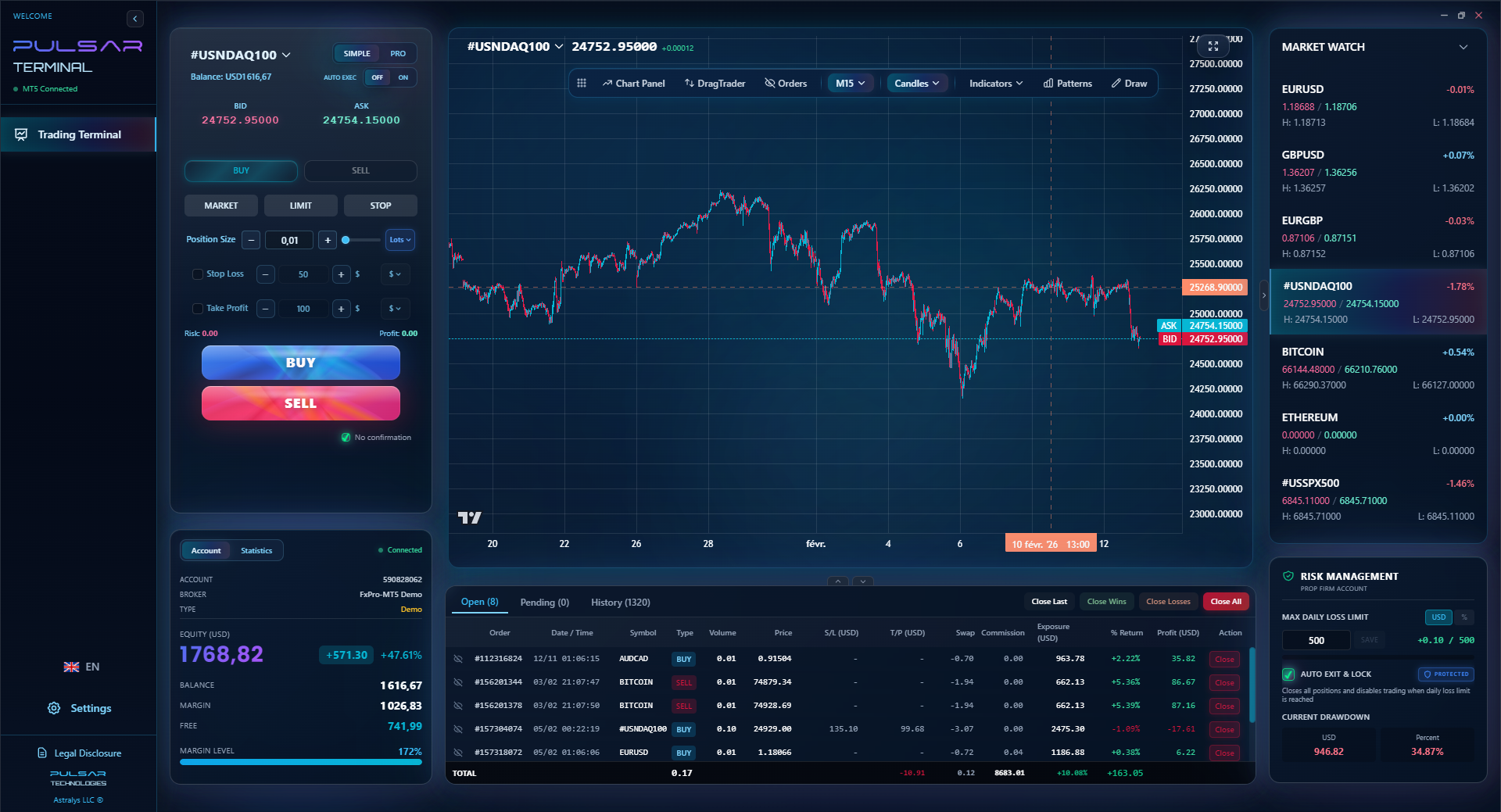
If you're stuck with a basic platform but need professional trade management, Pulsar Terminal adds advanced order types like trailing stops and multi-TP/SL directly to your MT5, bridging the gap between convenience and control.
Pulsar Terminal
Công cụ MT5 tất-cả-trong-một: đặt lệnh kéo-thả, multi-TP/SL, trailing stop, grid trading, Volume Profile và bảo vệ prop firm. Hơn 1.000 trader sử dụng mỗi ngày.
Your Rand is not trapped here. You have excellent, fully legal options.
1. Use a Top-Tier FSCA-Regulated International Broker: This is the best path for most. You get global pricing with local regulation and support. Funding is straightforward via EFT.
- For Raw Spreads & Low Cost: IC Markets review or Pepperstone review. Their Razor or Raw accounts offer spreads from 0.0 pips plus a small commission. This is the professional model.
- For Platform Choice & Bonuses: XM review or Exness review. They often have local deposit promotions and offer both MT4 and MT5.
You fund your ZAR account with them via EFT, it converts to USD at a competitive rate, and you trade. Your profits can be withdrawn back to your FNB account. The process takes a day or two, which is a good cooling-off period.
2. Use FNB for What It's Good For, and a Broker for the Rest: This is the hybrid model I recommend to many. Use your FNB foreign currency account (FCA) to hold USD or EUR you've acquired for long-term investment or expense purposes. Use a dedicated broker with tight spreads for your active speculative trading. Keep the functions separate.
3. Invest in Your Education First: Before funding any account, spend that money on courses, books, or a subscription to a proper trading terminal. Learning to use tools like the RSI indicator properly on a demo account will pay back far more than jumping into live markets with a subpar platform. Understanding what a pip definition really means for your bottom line is foundational.
💡 Mẹo của Winston
Use your bank's platform as a news feed and rate checker. Use a professional broker's platform to execute. Sentiment is free. Execution is where you pay.
“FNB forex trading is a feature, not a platform. It's a convenient add-on for bank customers who have occasional, simple forex needs.”
FNB forex trading is a feature, not a platform. It's a convenient add-on for bank customers who have occasional, simple forex needs.
For the aspiring or serious trader, it's a dead end. The excessive costs hidden in the spread and the lack of professional tools put you at a permanent disadvantage before you even analyze your first chart. In a game where the edge is already slim, you're voluntarily giving up several points just by walking into the arena.
My advice? Open an account with a proper FSCA-regulated broker on a demo first. Get used to the real spread definition and real tools. Then, when you're ready, fund it with an amount you can afford to lose. Keep your FNB app for what it does best: managing your life admin. Don't let convenience cost you your capital. The South African market is vibrant and full of opportunity, but you need the right gear to compete.
FAQ
Q1Is FNB forex trading legal and regulated in South Africa?
Yes, absolutely. FNB operates as an Authorised Dealer in foreign exchange with the South African Reserve Bank (SARB) and is regulated by the Financial Sector Conduct Authority (FSCA). It's a fully legal service for South African residents.
Q2What is the minimum deposit to start forex trading on the FNB app?
FNB doesn't publish a specific minimum. Because it's linked directly to your transactional account, the 'minimum' is effectively whatever you have available. However, this is dangerous. I strongly advise creating a separate savings pocket and treating that as your dedicated, risk-only trading capital with a strict minimum you set yourself.
Q3Can I trade gold (XAU/USD) or cryptocurrencies on FNB's platform?
No, you cannot. The FNB forex trading offering is limited to major currency pairs, including some ZAR crosses (USD/ZAR, EUR/ZAR). For instruments like gold, oil, indices, or cryptocurrencies, you must use a dedicated online broker that offers those markets.
Q4How do the spreads on FNB compare to a broker like IG or FXTM?
They are significantly wider. During active market hours, spreads on pairs like EUR/USD can be 2-3 times larger on FNB. For USD/ZAR, I've seen 8-pip spreads on FNB when dedicated brokers were offering 2-3 pips. This difference is a direct and substantial cost to your trading.
Q5Can I use automated trading or Expert Advisors (EAs) on FNB's platform?
No. The FNB Share Investor platform is a proprietary, simplified interface. It does not support MetaTrader 4/5, and therefore cannot run Expert Advisors or any form of automated algorithmic trading. It's strictly for manual trading.
Q6If I already have an FNB Forex Currency Account (FCA), can I use those funds to trade?
No, you cannot directly trade from your FCA on the speculative trading platform. The FCA is for holding foreign currency for future payments or expenses. The forex trading platform is a separate CFD product. You would need to convert and transfer funds from your FCA to your main ZAR account, then allocate them to trading within the app - a process that itself incurs costs.
Q7What happens if I make a profit? Are there tax implications?
Yes. Profits from speculative forex trading (CFDs) in South Africa are generally considered capital gains. You have an annual exclusion (currently R40,000). Gains above that are included in your taxable income and taxed at your marginal rate (up to 45%). It's crucial to keep detailed records of all trades, including the spread cost, for SARS.
Bài học của Prof. Winston
Điểm chính:
- ✓Spreads on FNB can be 3x wider than dedicated brokers.
- ✓The R1 million discretionary allowance is for transfers, not use trading.
- ✓No automated trading or advanced order types available.
- ✓Separate trading capital mentally, even if the platform doesn't.
Bài viết này hữu ích thế nào?
Nhấp vào ngôi sao để đánh giá
Nhận định giao dịch hàng tuần
Phân tích & chiến lược miễn phí hàng tuần. Không spam.
Về tác giả
David van der Merwe
Nhà giao dịch Thị trường Mới nổi
Trader tại Johannesburg với 11 năm kinh nghiệm về tiền tệ thị trường mới nổi. Chuyên về cặp ZAR, giao dịch theo quy định FSCA và phân tích thị trường Nam Phi.
Bình luận
Cảnh báo rủi ro
Giao dịch các công cụ tài chính tiềm ẩn rủi ro đáng kể và có thể không phù hợp với tất cả nhà đầu tư. Hiệu suất trong quá khứ không đảm bảo kết quả trong tương lai. Nội dung này chỉ mang tính chất giáo dục và không nên được coi là lời khuyên đầu tư. Hãy luôn tự nghiên cứu trước khi giao dịch.
Bạn cũng có thể thích

Cara Trading Forex Sukses: 7 Prinsip dari Trader Profesional
Cara trading forex sukses dengan 7 prinsip trader pro: manajemen modal, disiplin, journal trading, backtest. Data nyata, bukan janji profit palsu.
Jam Trading Forex Terbaik untuk Trader Indonesia: Panduan Lengkap dengan Tabel Waktu
Panduan jam trading forex untuk trader Indonesia. Tabel 4 sesi dunia, jam emas 20:00-00:00, sesi mana yang harus dihindari. Data akurat + tips dari trader berpengalaman.
Top 5 Sàn Forex Uy Tín Nhất 2026: Review Jujur dari Trader Indonesia
Top 5 sàn forex uy tín 2026 untuk trader Indonesia. Review jujur: spread, deposit, withdraw, dukungan lokal. Exness, XM, IC Markets & lebih.
Tải Pulsar Terminal
Tất cả các công cụ tính này được tích hợp trong Pulsar Terminal với dữ liệu thời gian thực từ tài khoản MT5 của bạn.
Tải Pulsar Terminal