


Let me guess.

Olumide Adeyemi
Nhà tiên phong Giao dịch Tây Phi ·  Nigeria
☕ 11 phút đọc
Bạn sẽ học được:
- 1The PDF Trap: Why Most Free 'Secrets' Are Useless
- 2The Books That Actually Work (And How to Read Them)
- 3From Reading to Trading: Building Your Own System
- 4Applying Theory to Nigerian Market Realities
- 5Beyond the Basics: Risk Management is Your Real Strategy
- 6Modern Tools: Where PDFs End and Real-Time Learning Begins
- 7Your Action Plan: From Downloading to Doing
Let me guess. You've downloaded a dozen 'forex books pdf' files, each promising the secret to instant wealth. You've read about 'millionaire traders' and complex indicators, but your account is still struggling. I've been there. The truth is, 90% of those free PDFs are outdated, generic, or just plain wrong for our market. They don't talk about the 10% capital gains tax to FIRS, the real spreads on EUR/USD, or how to handle use responsibly. This guide will cut through the noise. I'll show you which books are actually worth your time, how to adapt the lessons for Nigeria, and where to find the real education that builds lasting skill, not just temporary hype.
We've all done it. Scoured the internet for that one magical forex books pdf that will unlock everything. The problem isn't with books themselves, it's with the garbage masquerading as education. Most free PDFs you find are either:
- Massively outdated: Written before smartphones, discussing platforms that no longer exist.
- Too generic: Written for a global audience, with zero mention of Nigerian-specific factors like tax obligations or which international brokers actually accept us seamlessly.
- Pure marketing: A 10-page teaser that ends with a $5000 course offer.
I downloaded a famous 'Price Action Secrets' PDF years ago. It spent 50 pages explaining support and resistance, then the final chapter revealed the 'secret' was just buying at support and selling at resistance. No discussion of false breaks, no context on volume, nothing about the spread definition eating into those tiny moves. It was a total waste of an evening.
Real education understands context. It knows that a strategy built for the London session might behave differently when you're trading from Lagos in the afternoon. The first filter for any resource, PDF or otherwise, is its publication date and intended audience.

Warning: Be extremely wary of any 'forex books pdf' that promises a guaranteed, no-loss system. If it worked, the author wouldn't be selling it for free online; they'd be using it. Trading is a probabilistic game, not a magic trick.
Forget the flashy e-books. The foundational knowledge hasn't changed much in decades. You need to understand the psychology of the crowd, the mechanics of the market, and your own mind. Here are the categories that matter.
Market Mechanics & Mindset
Start with 'Trading in the Zone' by Mark Douglas. Don't just read it; study it. His concepts on probability and accepting losses are more valuable than any indicator. For understanding how prices move, 'The Market Wizards' series by Jack D. Schwager is essential. It interviews real traders (not gurus) about their failures and successes. The common thread isn't a secret indicator; it's risk management and discipline.
Technical Analysis Deep Dives
Once your head is right, get into the charts. 'Technical Analysis of the Financial Markets' by John J. Murphy is the bible. It's thick, but it systematically explains everything from chart patterns to indicators. Pair this with a book on a single methodology. For candlestick patterns, 'Japanese Candlestick Charting Techniques' by Steve Nison is the original source. For a pure price action approach, 'Reading Price Charts Bar by Bar' by Al Brooks is intense but incredibly detailed.
The Nigerian Filter
This is the critical step most miss. As you read, constantly ask: "How does this apply to me?"
- use: A book might warn against high use. Good advice. But you need to know that brokers like Exness or HFM might offer 1:1000+ to Nigerian clients. The book's lesson is to use minimal use; your job is to set your own cap (e.g., never above 1:30) regardless of what's offered.
- Costs: The book discusses slippage and commissions. You must add the 10% Capital Gains Tax on your net annual profit to your cost calculations. A trade isn't truly profitable until that tax is accounted for.
- Strategy: A scalping strategy book might assume 0.1 pip spreads. Your reality on a standard account with a broker like XM might be 1.0 pip on EUR/USD. You must test if the strategy still works with your real costs.

Pro Tip: Don't read passively. Have a demo account open. Read a chapter on a chart pattern, then spend a week searching for that pattern on live charts. Mark up 50 examples before you even think about trading it with real money. This turns theory into pattern recognition.

💡 Mẹo của Winston
A library of a thousand forex books pdf is worthless compared to one single, well-executed trade from a plan you understand completely. Mastery comes from depth, not breadth.
“Real education understands context. It knows that a strategy built for the London session might behave differently when you're trading from Lagos.”
Books give you the bricks, but you have to build the house. A common failure point is trying to implement every idea from every forex books pdf at once. You end up with a contradictory mess of indicators and rules.
Here’s a better way. Pick ONE core concept from ONE book. Let's say you're intrigued by the MACD indicator divergence from Murphy's book.
- Isolate & Define: Go to your chart. Define exactly what a valid MACD divergence looks like for you. (e.g., Price makes a lower low, MACD histogram makes a higher low. Close of candle must be above the previous swing low).
- Backtest Manually: Don't use an automated backtester yet. Go back in your chart history, month by month, and mark every single instance of your setup. Use a spreadsheet to record the entry price, stop loss, and take profit if you had used a fixed risk-reward (start with 1:1.5).
- Forward Test on Demo: Now, trade that single setup on a demo account for at least 50 trades. No deviations. This tests your discipline and the setup in current market conditions.
- Analyze & Adjust: What was your win rate? Your average profit vs. average loss? Did spreads or slippage affect outcomes? Only now do you tweak one variable at a time.
I did this with a simple RSI indicator overbought/oversold strategy in 2019. After 100 demo trades, the win rate was 48%. Not great. But by adding a filter - only taking signals in the direction of the daily chart trend - the win rate jumped to 62% in the next 100 trades. That’s the process: read, define, test, refine.
This systematic approach is what separates a student from a gambler. It also directly prepares you for the kind of disciplined journaling you’ll need if you ever want to pass a prop firm challenge, where rules are absolute.
The global forex market is the same for everyone, but your local environment isn't. Your trading plan must have a section dedicated to Nigerian realities.
Taxes are not optional. The FIRS requires a 10% Capital Gains Tax on your trading profits. This isn't a broker fee; it's your responsibility to declare and pay. I set aside 10% of every profitable withdrawal into a separate savings account. Come tax season, it's already there. Failing to plan for this is planning to fail.
Broker Choice is Critical. You're likely using an internationally regulated broker. This is fine and legal, but you must do your homework. Check their average spread on the pairs you trade. That ‘free’ commission-free account might have a 1.8-pip spread on GBP/USD, which will kill a scalping strategy. Compare raw spread accounts with commissions from brokers like IC Markets or Pepperstone. Use a position size calculator that lets you input your specific spread to see the real cost per trade.
Infrastructure Matters. What’s your backup plan during a NEPA (power) outage? A UPS is a basic tool. What about internet? Having a mobile data hotspot ready is cheaper than a blown trade. I learned this the hard way in 2021. I was in a good EUR/NGN trade, the power went out, my UPS beeped and died, and by the time I got my phone hotspot connected, I had hit my stop loss and missed the reversal. A $200 lesson in infrastructure.
Economic Calendar. Pay attention to local data releases from the CBN (Monetary Policy Rate announcements, GDP) as they cause volatility in the Naira pairs (like USD/NGN). But also, know that Nigerian news can affect global commodity prices (like Oil - XAU/USD), which then affects pairs like USD/CAD. Your edge might be in understanding these local-global connections that a trader in London overlooks.
💡 Mẹo của Winston
Your first profitable trade is a milestone. Your first properly documented, analyzed losing trade is a greater sign of maturity. It means you're learning, not just hoping.
“Your entry technique is maybe 20% of the battle. The other 80% is risk management and psychology.”
Here’s the uncomfortable truth I learned after blowing my second account: Your entry technique is maybe 20% of the battle. The other 80% is risk management and psychology. No forex books pdf will save you if you can't manage risk.
Position Sizing is Everything. Never risk more than 1-2% of your account on a single trade. This isn't a suggestion; it's the rule that keeps you in the game. If you have a $1000 account, your max loss per trade is $10-$20. Use a calculator to determine your lot size based on your stop loss distance. I once broke this rule, risking 5% on a "sure thing" in XAU/USD. The trade went 20 pips against me, I lost $100 in minutes, and the emotional spiral that followed caused me to lose another $300 trying to revenge trade. Stick to the 1% rule.
The Psychology of Loss. Books will tell you to accept losses. It’s harder than it sounds. A string of 3-4 losses can make you doubt your entire system. Your brain will scream to change the rules, to double down on the next trade. This is when your trading journal is your anchor. Go back and look at your historical data. Your system has had losing streaks before and recovered. Trust the process.
use is a Double-Edged Sword. Just because you have access to 1:500 use doesn't mean you should use it. High use on a small account amplifies the impact of every pip, which amplifies your emotions. For most swing trading strategies, use above 1:20 is unnecessary and dangerous. It increases your chance of a margin call exponentially.
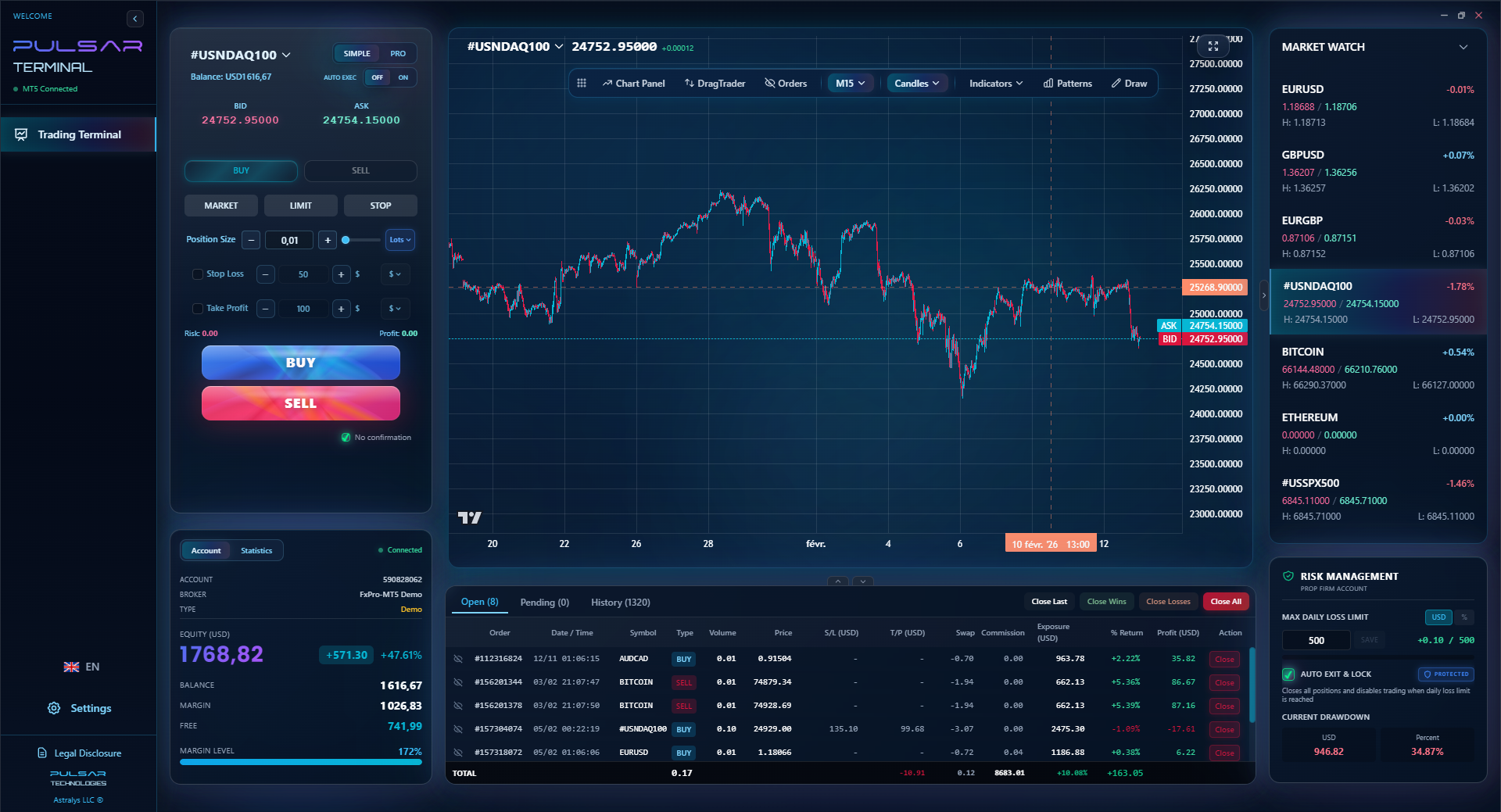
Managing complex risk rules like the 1% rule and setting multiple take-profit levels is tedious; Pulsar Terminal automates this with drag-and-drop order tools and partial closure features directly on your MT5 platform.
Pulsar Terminal
Công cụ MT5 tất-cả-trong-một: đặt lệnh kéo-thả, multi-TP/SL, trailing stop, grid trading, Volume Profile và bảo vệ prop firm. Hơn 1.000 trader sử dụng mỗi ngày.
The age of the static PDF is fading. Education is now dynamic. While books build your foundation, these tools help you apply it.
Trading Journals (Digital): Apps like TraderSync or Edgewonk are game-changers. They force you to log not just your P&L, but your emotional state, the market context, and screenshots. You can't lie to the data. Reviewing my journal showed me that 80% of my losses came from trades taken after 10 PM Lagos time, when I was tired and liquidity was thin. I made a rule: no new trades after 9:30 PM.
Backtesting Software: Platforms like TradingView or Soft4FX allow you to test your refined strategy from the books against years of historical data. You can see how it would have performed through the 2020 crash or the 2022 USD surge. This builds confidence in your edge.
Community & Mentorship: Find serious communities, not Telegram signal groups. Look for forums or discords where traders dissect their losing trades. A good mentor won't give you signals; they'll question your trading plan and point out your blind spots. I paid for a 3-month mentorship early on. The mentor's first act was to make me delete 7 of the 9 indicators on my chart. The clarity was immediate.
Market Analysis Platforms: These go beyond basic charting. They help you see the market structure - where big volume is sitting, where institutional orders might be clustered. This is the next level of understanding after you've mastered the basic patterns from the books.
💡 Mẹo của Winston
The market doesn't care how many books you've read. It only responds to the orders you place. Let your trading be simple, clear, and based on evidence from your own testing.
“The goal isn't to finish a library of books. The goal is to build one strong, tested, and emotionally manageable way of interacting with the market.”
Let's turn this into a clear, 6-month plan. Stop collecting forex books pdfs and start building.
Month 1-2: Foundation.
- Read 'Trading in the Zone'. Journal your emotional reactions to its lessons.
- Open a demo account. Don't trade yet. Just watch the price flow of EUR/USD for an hour each day.
- Research and choose a reputable broker. Compare their spreads and deposit/withdrawal methods for Nigeria.
Month 3-4: Skill Building.
- Study 'Technical Analysis' by Murphy. Focus on one chapter per week.
- On your demo, practice identifying every single concept from that chapter on the charts.
- Define your first, simple trading setup (e.g., a pullback to a moving average with an RSI filter).
Month 5: Validation.
- Execute your defined setup on demo only. Aim for 50 trades. Log every detail in a journal.
- Analyze the results. What's the win rate? Profit factor?
- Refine ONE element of the setup based on the data.
Month 6: Transition.
- Fund a live micro account with the minimum amount (e.g., $50-$100).
- Trade your refined system with real money, but with nano lots. The goal is to experience live execution and emotion, not to make profit.
- Continue journaling. If you can be profitable for 2 consecutive months on this micro account, you can consider scaling up gradually.
The goal isn't to finish a library of books. The goal is to build one strong, tested, and emotionally manageable way of interacting with the market. That's how you move from being a consumer of PDFs to a creator of your own success.
FAQ
Q1Are there any free forex books pdf that are actually good for beginners in Nigeria?
Yes, but be selective. Look for free offerings from established, reputable educators (like Babypips' 'School of Pipsology' which is web-based but can be saved as a PDF). Avoid anything with 'secret', 'guaranteed', or '100% win rate' in the title. Even a good free PDF is just a starting point; you'll need to invest in deeper books and, more importantly, in your own practice and data analysis.
Q2How do I handle the 10% capital gains tax on forex profits in Nigeria?
You are responsible for declaring your annual net profit (total profits minus total losses) to the Federal Inland Revenue Service (FIRS) and paying 10% on that amount. The best practice is to set aside 10% of every profitable withdrawal into a separate savings account dedicated to tax. Keep detailed records of all your trades, deposits, and withdrawals. Consult with a local accountant familiar with trading income for specific filing procedures.
Q3Can I really learn to trade just from books and PDFs?
You can learn the theory and mechanics from books. They are essential for building a foundation in concepts like risk management, technical analysis, and psychology. However, you cannot learn the skill of trading from a book alone, just as you can't learn to drive a car by only reading a manual. The final, critical education comes from screen time, deliberate practice on a demo account, and the emotional lessons learned from executing a live trading plan with real risk.
Q4What's more important for a new Nigerian trader: a good strategy or a good broker?
This is a trick question. They are both critical, but in order: First, a good broker. You need a reliable, fairly-priced platform to execute on. A brilliant strategy will fail on a broker with constant requotes, wide spreads, or withdrawal issues. Once you have a trustworthy broker (regulated internationally, with good reviews from Nigerian traders), then you can focus 100% on developing and testing a good strategy. Don't let poor infrastructure sabotage your learning.
Q5How much money do I need to start trading forex in Nigeria?
You can start learning with $0 on a demo account. To start trading live with minimal financial risk, many brokers like Exness or FBS allow you to open a live 'cent' or micro account with as little as $5-$10. This lets you trade with real money but in tiny amounts (cents per pip). The goal of this first live account is not to make money, but to learn the mechanics of live execution and manage the psychology of real wins and losses without significant financial danger.
Q6Should I focus on Naira pairs (like USD/NGN) or major pairs (like EUR/USD)?
For most beginners, major pairs like EUR/USD or GBP/USD are better. They have much higher liquidity, which means tighter spreads, less slippage, and more predictable technical behavior. The USD/NGN market can be influenced heavily by local CBN policies and can have wider spreads and gaps. Start with the majors where global information and analysis are abundant. You can explore Naira pairs later once you have a solid foundation and understand the unique risks involved.
Bài học của Prof. Winston
Điểm chính:
- ✓Filter every lesson through your Nigerian reality: 10% tax, local brokers, and infrastructure.
- ✓Risk a maximum of 1-2% per trade. This is non-negotiable for survival.
- ✓Spend 80% of your time testing and refining one strategy, not collecting 100.
- ✓A trading journal is your most important tool, more than any indicator.
Bài viết này hữu ích thế nào?
Nhấp vào ngôi sao để đánh giá
Nhận định giao dịch hàng tuần
Phân tích & chiến lược miễn phí hàng tuần. Không spam.
Về tác giả
Olumide Adeyemi
Nhà tiên phong Giao dịch Tây Phi
Một trong những nhà đào tạo forex tích cực nhất tại Nigeria. 8 năm kinh nghiệm giao dịch từ Lagos. Chuyên về chiến lược vốn thấp và thử thách prop firm dành cho trader châu Phi.
Bình luận
Cảnh báo rủi ro
Giao dịch các công cụ tài chính tiềm ẩn rủi ro đáng kể và có thể không phù hợp với tất cả nhà đầu tư. Hiệu suất trong quá khứ không đảm bảo kết quả trong tương lai. Nội dung này chỉ mang tính chất giáo dục và không nên được coi là lời khuyên đầu tư. Hãy luôn tự nghiên cứu trước khi giao dịch.
Bạn cũng có thể thích

Cara Trading Forex Sukses: 7 Prinsip dari Trader Profesional
Cara trading forex sukses dengan 7 prinsip trader pro: manajemen modal, disiplin, journal trading, backtest. Data nyata, bukan janji profit palsu.
Jam Trading Forex Terbaik untuk Trader Indonesia: Panduan Lengkap dengan Tabel Waktu
Panduan jam trading forex untuk trader Indonesia. Tabel 4 sesi dunia, jam emas 20:00-00:00, sesi mana yang harus dihindari. Data akurat + tips dari trader berpengalaman.
Top 5 Sàn Forex Uy Tín Nhất 2026: Review Jujur dari Trader Indonesia
Top 5 sàn forex uy tín 2026 untuk trader Indonesia. Review jujur: spread, deposit, withdraw, dukungan lokal. Exness, XM, IC Markets & lebih.
Tải Pulsar Terminal
Tất cả các công cụ tính này được tích hợp trong Pulsar Terminal với dữ liệu thời gian thực từ tài khoản MT5 của bạn.
Tải Pulsar Terminal