


I lost $1,200 in a single afternoon back in 2018, not from a bad trade, but from a simple bank transfer.

Olumide Adeyemi
Nhà tiên phong Giao dịch Tây Phi ·  Nigeria
☕ 12 phút đọc
Bạn sẽ học được:
- 1The FOREX.com Reality Check: Why It's Not an Option
- 2Nigeria's Forex 'Legal Gray Area': What You're Really Signing Up For
- 3The Real Costs: Spreads, Swaps, and the Silent Killer – Funding
- 4The use Trap: Why 1:1000 is a Death Sentence
- 5Practical Alternatives: Doing Your Own Broker Due Diligence
- 6Trading in the New Naira Reality (2024-2026)
- 7Building a Sustainable Edge: It's Not About the Broker
I lost $1,200 in a single afternoon back in 2018, not from a bad trade, but from a simple bank transfer. I’d funded an account with a broker that was ‘perfect on paper’ - great regulation, tight spreads. What I didn’t factor in was the 45-day wait and the 15% ‘processing fee’ my Nigerian bank slapped on the international transaction to get my profits back. The trade was a winner, but the logistics were a disaster. That’s the reality for Nigerian traders. And it’s why a headline name like FOREX.com, which doesn’t even accept clients from here, is a distraction from the real game. This isn’t about finding a famous broker; it’s about navigating a market where the rules are written in pencil, the costs are hidden, and your biggest risk isn’t the chart - it’s getting your money in and out.
Let's get this out of the way first. As of 2026, FOREX.com does not accept retail clients from Nigeria. Full stop. It doesn't matter how slick their platform looks or how strong their FCA regulation is. If you're sitting in Lagos, Abuja, or Port Harcourt, you cannot open an account with them. This isn't a minor inconvenience; it's a core lesson in how global retail forex works. Brokers operate under licenses that specify which jurisdictions they can serve. FOREX.com's parent company, StoneX, has decided the regulatory and operational headache of serving Nigerian clients isn't worth it, likely due to our complex capital controls and the CBN's stance. Chasing a broker that explicitly excludes you is the first sign you're not doing your homework. The real work begins when you look past the big names and find who does operate here, and more importantly, how they do it.

Warning: Any website or individual claiming to offer a FOREX.com account to a Nigerian resident is running a scam. Period. They might be offering a managed account or a white-label solution, but it will not be a direct, legitimate account with FOREX.com.
The conversation needs to shift. Instead of 'Is FOREX.com good?', you should be asking, 'What do I actually need from a broker as a Nigerian trader?' The answer is a mix of practical access, sane costs, and a clear understanding of whose rules actually protect you.
“High use doesn't increase your chance of profit; it increases the precision required and magnifies every mistake.”
Here’s the uncomfortable truth: you are largely on your own. The Securities and Exchange Commission (SEC) Nigeria does not license or regulate spot retail forex brokers. Let me repeat that for emphasis. The local regulator for investments does not oversee the forex brokers you and I are using. When a locally based firm claims 'SEC regulated,' check the fine print. They are likely registered for other financial services, not for running a retail forex brokerage. Your protection, therefore, comes almost entirely from the international regulator overseeing your chosen broker.
The Two Layers of Regulation
You operate in two worlds. In Nigeria, the Central Bank (CBN) governs currency flows. Their 2023 market unification and the new 2025 FX Code are about institutional and interbank transparency, not about protecting Joe from Ajegunle who’s scalping EUR/USD. Their goal is Naira stability, not trader safety. Your broker, however, should be licensed by a body that does care about retail client protection. This is where top-tier authorities like the UK's FCA, Australia's ASIC, or Cyprus's CySEC come in. They mandate client fund segregation, negative balance protection, and dispute resolution. Your money's safety hinges on this foreign entity.
The Taxman Cometh
Don't forget the Federal Inland Revenue Service (FIRS). The standard line is a 10% capital gains tax on your gross trading profits. In practice, tracking and enforcing this on retail forex is notoriously difficult, but it's on the books. I know traders who keep careful records and pay it, and I know many more who've never been contacted. The risk of an audit for a small retail trader is low, but it's not zero. Ignorance isn't a defense, so at least be aware of the obligation.
The takeaway? You are venturing into an international, largely unregulated-from-a-Nigerian-perspective space. Your due diligence on your broker's overseas license is the most important research you'll do. A deep-dive broker review that focuses on their real regulatory standing is worth more than any trading signal.

💡 Mẹo của Winston
A broker is a utility, not a strategy. Spend 1% of your research time picking one, and 99% learning how not to lose money with it.
“Your protection hinges on a foreign regulator's rulebook, not Nigeria's. Your due diligence on that license is your first trade.”
Forget the advertised minimum deposit. The real cost of trading from Nigeria is a three-headed beast: the trade cost, the holding cost, and the funding cost. Most traders blow up because they only look at the first one.
Let's break it down with real numbers from my own trading journal. Last quarter, I was testing a swing trading strategy on XAU/USD.
1. The Trade Cost (Spreads & Commissions): On a 'raw spread' account with a broker like IC Markets, I paid 0.0 pips spread plus a $7 commission per lot. For a 1-lot trade, that's $7 to enter and $7 to exit. On a standard account elsewhere, the spread might be 1.5 pips on Gold. That’s $15 per lot with no commission. You need to know which model you're on and factor it into your position size calculator. A 1.5-pip spread means your trade starts 1.5 pips in the red.
2. The Holding Cost (Swap Fees): I held that Gold trade for 8 days. The daily swap rate (finance charge) was -$4.80 for a sell position. That's -$38.40 just for holding the position overnight. On a trade that netted a 200-pip gain ($2000), that's a 1.9% drag. On a marginal trade, it can erase your profit. This is why understanding the cost of a pip isn't enough.
3. The Silent Killer (Funding & Conversion): This is where I got burned. You deposit ₦500,000. The broker auto-converts it to USD at their rate, which might include a 1-2% markup. That's ₦5,000-₦10,000 gone before you place a trade. You profit $1000 and withdraw. The broker converts back to Naira, another markup. Your Nigerian bank receives a USD wire, converts it, and may charge a $25 flat fee plus a poor exchange rate. I’ve seen up to 5% of a withdrawal evaporate in this double-conversion gauntlet.

Example: You deposit ₦300,000 (approx $200). You make a 25% return, so your account is now $250. You withdraw. After conversion markups and bank fees, you receive ~₦345,000. Your '25%' gain in Naira terms is just 15%. The system is designed to leak your money.
The smartest move I made was switching to brokers that allow funding and withdrawal in USDT (cryptocurrency). The transfer fees are a few cents, and the conversion happens on a crypto exchange at a market rate. It cuts the funding cost from ~5% to under 1%. It's not without its own volatility risk, but for cost efficiency, it's a game-changer for Nigerian traders.
“Your protection hinges on a foreign regulator's rulebook, not Nigeria's. Your due diligence on that license is your first trade.”
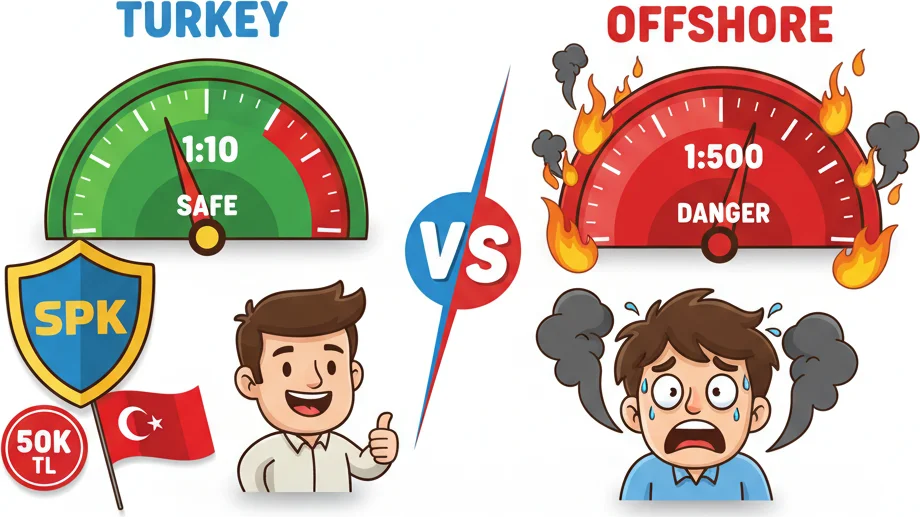
Walk through any Nigerian forex forum, and you'll see brokers advertising use of 1:1000, even 1:2000. It’s marketed as a benefit. Let me be frank: it’s a predatory feature designed to ensure you lose your money faster. I’ll give you a personal confession. When I started, I thought, 'Great! With ₦50,000, I can control ₦50,000,000 worth of currency! The profits will be insane!' What actually happened was more educational. I bought 5 mini lots of GBP/USD (controlling $50,000) with a $500 account at 1:100 use. The pair moved 50 pips against me - a normal daily fluctuation. My loss was $250. I’d lost 50% of my account in a few hours on a routine market move. That was my lesson.
High use doesn’t increase your chance of profit; it increases the precision required and magnifies every mistake. It turns a small spread from a minor cost into a significant hurdle. It makes your margin call level terrifyingly close. Professional traders use use as a tool for efficiency, not amplification. They might use 1:10 or 1:20 on a core position. The 1:1000 offer is for gamblers, not traders.
Your first act of real risk management is to manually lower your use. Open your account settings and set it to 1:50 or 1:30. If your broker doesn't allow this, find a new broker. A platform like Pepperstone or XM allows you to select your use tier. This self-imposed limit forces you to think about position size. It makes a 50-pip stop-loss a manageable event, not an account-ending catastrophe. Risk management isn't a fancy indicator; it's the boring, administrative work of capping your own destructive potential before you even see a chart.
💡 Mẹo của Winston
The use they advertise is the use they expect you to misuse. Set yours to 1:30 and forget it exists.
“The real cost of trading from Nigeria is a three-headed beast: the trade cost, the holding cost, and the silent killer - funding.”
So, if not FOREX.com, then who? The answer isn't a single name. It's a checklist. Your broker needs to pass these tests, in this order:
- Real International Regulation: Go to the regulator's website (e.g., fca.org.uk, asic.gov.au). Search their register for the broker's exact legal name. Don't just trust the logo on the broker's site. Confirm the license is active and covers retail forex.
- Naira-Friendly Funding: Do they accept deposits from Nigerian banks or cards? What about USDT? Test their deposit/withdrawal page. Look for user reviews from other Nigerians specifically about funding speed and fees.
- Sane use Options: Can you select use of 1:100 or lower? If they only offer 1:500+, it's a red flag about their client priorities.
- Platform & Tools: Do they offer MT4/MT5? This is non-negotiable for most serious traders. The environment of indicators, Expert Advisors (EAs), and analysis tools is built on MetaTrader.
Here’s a comparison of common paths Nigerian traders take:
| Path | Example Brokers | Pros | Cons | Best For... |
|---|---|---|---|---|
| Top-Tier Int'l Reg | IC Markets (ASIC), Pepperstone (FCA/ASIC) | Strong client protection, fund segregation, professional execution. | Higher minimum deposits, stricter verification, funding can be slower. | Traders with $500+ capital who prioritize safety over extreme use. |
| Global Broker (CySEC etc.) | Exness, XM, FBS | Lower minimums, often accept Nigerian clients readily, good USDT support. | Regulation may be less stringent than FCA, use can be very high. | Traders starting with smaller capital who need flexible funding options. |
| Unregulated/Offshore | Various 'bucket shops' | Crazy bonuses, insane use. | Your funds are not protected. High risk of platform manipulation or withdrawal issues. | No one. Avoid. |
Your final step is to open a demo account and test everything - execution speed, slippage on news, and the actual process of depositing and withdrawing a small amount of real money ($10) before committing serious capital.
“The real cost of trading from Nigeria is a three-headed beast: the trade cost, the holding cost, and the silent killer - funding.”
The ground is shifting under our feet. The CBN's reforms mean the old parallel market rates are converging with the official ones, but volatility has skyrocketed. The USD/NGN pair hit 1717 in late 2024. For a forex trader, this isn't just news; it's a fundamental change in risk.
First, your cost of living in Naira terms is now directly tied to your trading performance in USD. If the Naira weakens 20% in a year, you need a 20% USD profit just to maintain your local purchasing power. This adds immense psychological pressure.
Second, the CBN's push for an all-electronic FX matching system by 2026 is for the interbank market (minimum trade $100,000). It won't affect your retail trades directly, but it increases overall market transparency. This can lead to faster price discovery and potentially less manipulation in the long run, but in the short term, it means more efficient and sometimes more violent moves.
Third, diversification is no longer a luxury. Nigerian traders are rightly looking beyond just EUR/USD. Trading XAU/USD (Gold) as a hedge against currency devaluation, or US30 (Dow Jones) to bet on global economic health, is becoming standard. The brokers that will thrive here are the ones offering this multi-asset access seamlessly. The days of a forex-only platform are numbered.
The successful Nigerian trader in 2026 isn't just a chart technician. They're a part-time compliance officer (checking regulations), a foreign exchange analyst (watching USD/NGN), and a logistics manager (navigating payments). The trading itself is almost the last piece of the puzzle. Tools that help manage the complexity, like a platform that integrates advanced order types, become critical. Managing multiple take-profit levels or a trailing stop on a volatile Gold trade manually is a recipe for error.
💡 Mẹo của Winston
Your first profitable month is a data point. Your first profitable year is evidence. Choose a broker you trust to be around for the latter.
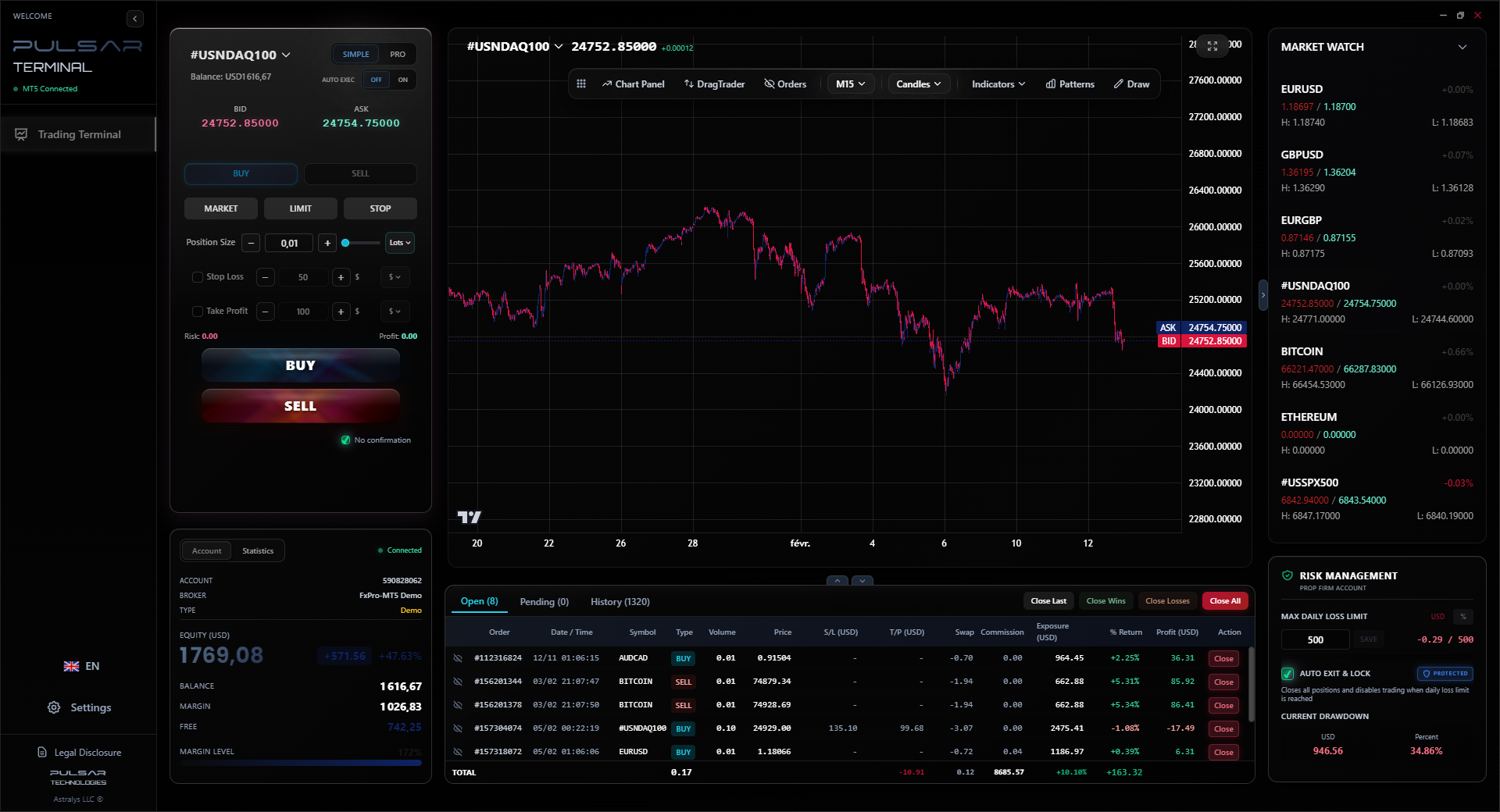
Managing complex trades and strict risk rules in a volatile market is exhausting; Pulsar Terminal automates advanced orders like trailing stops and multi-level take-profits directly on your MT5, so you can focus on your strategy, not your mouse.
Pulsar Terminal
Công cụ MT5 tất-cả-trong-một: đặt lệnh kéo-thả, multi-TP/SL, trailing stop, grid trading, Volume Profile và bảo vệ prop firm. Hơn 1.000 trader sử dụng mỗi ngày.
“The broker is the least important part of a winning strategy. The edge comes from your process.”
After 12 years, I can tell you the broker is the least important part of a winning strategy. The edge comes from you. Specifically, from your process. Here’s what that looks like, stripped of all hype.
Your Process Checklist:
- Pre-Trade: Do you have a written rule for what constitutes a valid setup? Is your position size calculated using a position size calculator based on a fixed percentage of your capital (I risk 1% max)? Have you checked for major news events?
- In-Trade: Is your stop-loss set immediately? Have you defined your take-profit level? Are you using a basic indicator confluence (like RSI for overbought/oversold and MACD for momentum) to confirm entry, not predict the future?
- Post-Trade: Do you journal the trade? Not just 'won/lost,' but the reason for entry, the emotional state, the quality of the setup (A, B, or C-grade).
I used to hunt for the 'perfect' broker or the 'secret' indicator. My turnaround began when I focused on executing a simple EUR/USD breakout strategy with ruthless consistency on a single, reliable platform. The broker was just the conduit. The profit came from doing the same boring thing, over and over, while managing my losses.

Pro Tip: Your first $1000 in the market should be spent on education and demo trading, not live capital. Use that time to test funding/withdrawal with $10 on your chosen broker. If that process is slow or costly, you've just saved $990.
The Nigerian forex market is tough, opaque, and filled with pitfalls. But that complexity is also its gift. It filters out the unprepared. By focusing on the unsexy fundamentals - regulation, costs, process, and risk - you build a foundation that most of your competition will never have. That’s your real edge.

FAQ
Q1Can I legally use a VPN to open a FOREX.com account from Nigeria?
No, and attempting to is a terrible idea. You would be lying on a legal application (address, residency), which is fraud. If FOREX.com discovers this, they will freeze your account and any funds in it. Also,, when you try to verify your identity or withdraw, you will need to provide proof of address you cannot provide. You will lose your money. Always trade with a broker that explicitly accepts clients from your country of residence.
Q2What is the safest way for a Nigerian to fund a forex trading account?
In 2026, funding via cryptocurrency (USDT) is generally the safest in terms of cost, speed, and reliability. It bypasses most bank restrictions and high fees. First, buy USDT on a local crypto exchange like Binance or Patricia with Naira. Then, transfer the USDT to a broker that accepts crypto deposits. Always send a small test amount first. Traditional bank wires are slow, expensive, and can be rejected by your bank for 'forex trading' purposes.
Q3I have a small account (less than $100). Which broker should I use?
With a small account, your primary focus should be on a broker with a very low minimum deposit and support for micro or cent lots (0.01 lots). This allows you to practice proper risk management. Brokers like Exness or XM offer these features and accept Nigerian clients. Remember, with a small account, your goal is to learn and preserve capital, not get rich. Use low use (1:20 or 1:30) to survive the learning curve.
Q4Does the CBN's new electronic FX system mean forex trading is now fully legal in Nigeria?
No. The Electronic Foreign Exchange Matching System (EFEMS) is for institutional players and banks (minimum trade $100,000). It does not create a regulatory framework for retail spot forex brokers. The legal status for individual Nigerians trading with international brokers remains the same: not explicitly illegal, but not protected by Nigerian regulators. Your protection still comes from the broker's international license.
Q5How do I check if a broker is truly regulated?
Do not rely on the broker's website alone. Go directly to the regulator's official online register. For example, for the UK's FCA, visit register.fca.org.uk and search for the broker's exact legal name (e.g., 'Pepperstone Limited'). Check that the license is 'Active' and that the 'Permission' includes activities like 'dealing in investments as principal' or 'rolling spot forex contract trading.' This takes 10 minutes and is the most important research you can do.
Q6Are 'bonuses' offered by brokers a good thing?
Almost never. Bonuses typically come with restrictive terms, like high trading volume requirements (lot targets) you must hit before withdrawing your own money. They are a marketing tool designed to encourage you to trade more and risk more. Top-tier, well-regulated brokers rarely offer deposit bonuses. If a broker's main attraction is a 100% bonus, consider it a red flag. Focus on raw trading conditions (spreads, execution) instead.
Q7What trading platform do most serious Nigerian traders use?
MetaTrader 5 (MT5) is becoming the standard for serious traders, though MT4 is still widely used. MT5 offers more timeframes, a built-in economic calendar, and better hedging capabilities. The key is that your chosen broker supports it. The platform's strength is its vast environment of custom indicators, scripts, and tools that can be added to enhance analysis and automate parts of your trading process.
Bài học của Prof. Winston
Điểm chính:
- ✓FOREX.com doesn't serve Nigeria. Chasing excluded brokers is a scam red flag.
- ✓Your real regulator is overseas (FCA, ASIC). Verify licenses directly.
- ✓Funding costs can steal 5% of profits. USDT is the efficient path.
- ✓use above 1:50 is for gambling, not trading. Manually lower it.
- ✓Profit in USD, live in Naira. Market volatility is now a personal risk.
Bài viết này hữu ích thế nào?
Nhấp vào ngôi sao để đánh giá
Nhận định giao dịch hàng tuần
Phân tích & chiến lược miễn phí hàng tuần. Không spam.
Về tác giả
Olumide Adeyemi
Nhà tiên phong Giao dịch Tây Phi
Một trong những nhà đào tạo forex tích cực nhất tại Nigeria. 8 năm kinh nghiệm giao dịch từ Lagos. Chuyên về chiến lược vốn thấp và thử thách prop firm dành cho trader châu Phi.
Bình luận
Cảnh báo rủi ro
Giao dịch các công cụ tài chính tiềm ẩn rủi ro đáng kể và có thể không phù hợp với tất cả nhà đầu tư. Hiệu suất trong quá khứ không đảm bảo kết quả trong tương lai. Nội dung này chỉ mang tính chất giáo dục và không nên được coi là lời khuyên đầu tư. Hãy luôn tự nghiên cứu trước khi giao dịch.
Bạn cũng có thể thích

Cara Trading Forex Sukses: 7 Prinsip dari Trader Profesional
Cara trading forex sukses dengan 7 prinsip trader pro: manajemen modal, disiplin, journal trading, backtest. Data nyata, bukan janji profit palsu.
Jam Trading Forex Terbaik untuk Trader Indonesia: Panduan Lengkap dengan Tabel Waktu
Panduan jam trading forex untuk trader Indonesia. Tabel 4 sesi dunia, jam emas 20:00-00:00, sesi mana yang harus dihindari. Data akurat + tips dari trader berpengalaman.
Top 5 Sàn Forex Uy Tín Nhất 2026: Review Jujur dari Trader Indonesia
Top 5 sàn forex uy tín 2026 untuk trader Indonesia. Review jujur: spread, deposit, withdraw, dukungan lokal. Exness, XM, IC Markets & lebih.
Tải Pulsar Terminal
Tất cả các công cụ tính này được tích hợp trong Pulsar Terminal với dữ liệu thời gian thực từ tài khoản MT5 của bạn.
Tải Pulsar Terminal