


I lost 80,000 NGN in my first month.

Olumide Adeyemi
Nhà tiên phong Giao dịch Tây Phi ·  Nigeria
☕ 12 phút đọc
Bạn sẽ học được:
- 1Why Most 'Beginner PDFs' Set You Up to Fail
- 2The Nigerian Forex Reality Check: Rules & Money
- 3Picking Your First Broker: Safety Over Bonuses
- 4Building Your First Trading Plan (The Anti-PDF Method)
- 5From Demo to Live: Making the Leap Without Freezing
- 6Pitfalls on the Path: Classic Nigerian Beginner Traps
- 7Beyond the PDF: Your Continuous Learning Toolkit
- 8Your Action Plan: First Steps Tomorrow

I lost 80,000 NGN in my first month. I thought I'd found a 'sure' strategy in a flashy PDF I downloaded. EUR/USD was trending up, so I bought at 1.1050 with way too much size. A news spike hit, my stop-loss was too tight, and I was out at 1.1025. Gone. Just like that. That experience taught me that what most 'forex for beginners pdf' files leave out is far more important than what they include. This isn't another theoretical document. This is the field manual I wish I'd had, written for the Nigerian trader navigating our unique market, regulations, and realities.
Let's be honest. Most free trading guides, especially those generic 'forex for beginners pdf' downloads, are marketing tools. They're designed to get you excited, not educated. They show perfect back-tested results on static charts, but they're silent on the chaos of live markets.
The biggest omission? Psychology and context. They won't tell you how it feels to watch a trade go 50 pips against you before it turns profitable, or how to handle the anxiety when your internet drops during a volatile NFP release. They certainly won't mention Nigeria's 10% capital gains tax on your profits, payable to the FIRS. That's a real cost that eats into your bottom line.
They also promote a one-size-fits-all approach. A strategy built for a London session scalper won't work for a Lagos-based trader who can only check charts after work. You need a plan that fits your life, not the other way around. The real education starts when you move beyond the glossy PDF and into the messy, emotional, and technical reality of putting real money on the line.

Warning: Any guide that promises consistent daily profits or a 'secret indicator' is selling a dream, not a skill. Sustainable trading is about probability and risk management, not magic bullets.

💡 Mẹo của Winston
A plan you don't follow is just a wish. Print your trading rules and tape them next to your screen. If you feel the urge to break them, close the platform instead.
Before you place a single trade, you need to understand the ground you're standing on. The regulatory scene here has changed, and it matters for your safety.
The New Regulatory Guard
For years, we operated in a bit of a grey area with international brokers. That's shifting. The big news is the Investments and Securities Act (ISA) 2025. Now, it's illegal for any online forex platform to operate here without registering with the SEC. This is good news long-term - it means more oversight and (hopefully) fewer scam platforms targeting Nigerians.
Simultaneously, the CBN's new guidelines are reshaping the official market. They've introduced the Electronic Foreign Exchange Matching System (EFEMS) and set rules, like the $150,000 monthly cap for BDCs. This doesn't directly stop you from trading EUR/NGN on MetaTrader, but it shapes the broader financial environment your Naira moves in.
Your Real Starting Numbers
Let's talk about the money you'll actually need. Yes, some brokers like FBS or JustMarkets let you start with $1. But let me tell you from experience, trading with $10 (about 15,000 NGN) is more of a video game than a serious venture. The spreads and commissions will eat you alive.
For a beginner who wants to learn properly without blowing up in a week, I recommend a starting capital of $200 to $500 (approx. 300,000 - 750,000 NGN). This allows you to use sensible position sizes, withstand normal market noise, and actually practice risk management. If that sounds like a lot, consider that it's the cost of a decent smartphone - an investment in your financial education.
Here’s a breakdown of what you’re really working with:
| Cost/Factor | Typical Range for Beginners | Why It Matters |
|---|---|---|
| Minimum Deposit | $10 - $200 (Broker Dependent) | Defines your entry point. A $100 min at AvaTrade vs. $0 at XTB. |
| Real Starting Capital | $200 - $500 (Recommended) | Allows for proper practice and emotional buffer. |
| Spread (EUR/USD) | 0.6 - 1.2 pips | Your primary trading cost. A 0.9 pip spread means the trade starts 0.9 pips in the red. |
| use Offered | Up to 1:2000 (Be Careful!) | A tool, not a goal. IC Markets offers 1:500, Exness offers ‘unlimited’. More use = faster ruin if misused. |
| Risk Per Trade | 1-2% of account balance | The golden rule. On a $500 account, that's risking $5-$10 per trade. Use a position size calculator. |
Remember, your first goal isn't to get rich. It's to not get poor. Protecting your capital is job number one.
“Your first goal isn't to get rich. It's to not get poor. Protecting your capital is job number one.”
I made my first deposit with a broker offering a 100% welcome bonus. Big mistake. The withdrawal conditions were a nightmare, and the spreads were wide. I learned that a broker is your gateway to the market; if it's shaky, everything else collapses.
For Nigerian traders, you're likely using an internationally regulated broker. That's fine, but you need to check which regulation. A broker licensed by Cyprus's CySEC or South Africa's FSCA generally has stricter client fund protection rules than one regulated only in an offshore jurisdiction. Brokers like XM or Pepperstone hold licenses from multiple top-tier authorities.
Look for these practicalities:
- Local Bank Deposits/Withdrawals: Can you fund your account in Naira? HFM, for instance, offers Naira-denominated accounts. How long do withdrawals take? 24 hours is good; 5 business days is a red flag.
- Platform Stability: Does their MT4/MT5 server have a Lagos or nearby server? This reduces latency, which is crucial for scalping.
- Customer Support: Test their live chat. Ask a question about withdrawal fees. If they take hours to respond in English, imagine trying to resolve a missed trade execution.
Don't get dazzled by use. Yes, Exness offers insane use. But as a beginner, you should manually limit yourself to 1:10 or 1:20 max. High use is the fastest route to a margin call. Your broker choice should feel like a solid foundation, not a casino doorway.

A trading plan isn't a vague intention to 'buy low, sell high.' It's a specific, written set of rules that removes emotion. Here’s how to build one that works in Nigeria.
The Core: One Pair, One Timeframe
Start with EUR/USD. It's the most liquid, has the tightest spreads, and moves in clear trends. Forget exotic pairs for now. Pick one timeframe to analyze - like the 1-hour chart for swing trading over days - and one lower timeframe (like 15-minute) for precise entry. Stick to this for at least three months.
Define Your Edge with Simple Tools
Your edge is a repeatable condition that gives you a probabilistic advantage. Don't overcomplicate it. For example:
- Trend & Pullback: Price is above the 200-period Moving Average (trend up). Wait for a pullback to a key support level or the 50-period MA. Use the RSI indicator to see if it's oversold (below 30). Enter on the first bullish candle closing above the pullback low.
- Breakout Retest: Price breaks above a clear resistance level on the 1-hour chart. Wait for it to pull back and retest that same level (now turned support). Enter on a bullish rejection candle at that level.
I back-tested the breakout retest strategy on GBP/USD for Q1 2023. Of 12 signals, 7 were winners, 3 losers, 2 breakeven. The win rate was about 58%, but the key was the risk/reward: I aimed for 1.5 times the risk. So even with a sub-60% win rate, it was profitable. That's the math you need to understand.
The Non-Negotiables: Entry, Exit, Risk
For every single trade, write down before you click buy:
- Entry Price: e.g., 1.0850
- Stop-Loss Price: e.g., 1.0825 (25 pips risk). This is based on a technical level, not a random number.
- Take-Profit Price: e.g., 1.0900 (50 pips target). This gives a 1:2 risk/reward ratio.
- Position Size: If your account is $500 and you risk 1% ($5), with a 25-pip stop, your position size is $5 / (25 pips * $0.10 per pip on a micro lot) = 2 micro lots. Always use a position size calculator.
This discipline turns gambling into a business operation.
💡 Mẹo của Winston
Your first 100 trades are data collection, not income generation. Focus on the quality of your execution, not the balance. The money will come as a byproduct of good process.
“High use is the fastest route to a margin call.”
Demo trading feels like playing FIFA with God mode on. Live trading is like stepping onto a real pitch. The ball moves faster, the tackles hurt, and the crowd (your emotions) is screaming.
I was profitable for 4 months on demo. My first live trade? I froze. EUR/USD hit my perfect entry level. My hand hovered over the mouse. I second-guessed, waited for 'one more candle,' and missed a 40-pip move. The fear of real loss is paralyzing.
Here's how to bridge the gap:
- Trade a 'Live' Demo: Start your demo account with your actual intended capital ($500). Trade only your written plan. Track every trade in a journal - entry reason, emotion, outcome. Do this for 100 trades. If you're not consistently profitable, don't go live.
- The Micro-Account Bridge: Open a live cent or micro account with the minimum deposit ($10-$50). The money is real, so the psychology is real, but the financial risk is tiny. A 50-pip loss might be $0.50. This is where you learn to click the button.
- Scale Up Slowly: Once you're comfortable and profitable on the micro account for a month, then and only then fund your main trading account. Start by trading half your intended position size for the first 10 trades.
The goal isn't to avoid fear. It's to act correctly despite the fear. That's a skill no PDF can teach you; you have to earn it through repetition.

Pro Tip: When you go live, disable the 'Profit & Loss' display on your MT4/MT5 chart. Focus on whether the price is hitting your technical levels, not the fluctuating dollar amount. It reduces emotional noise.
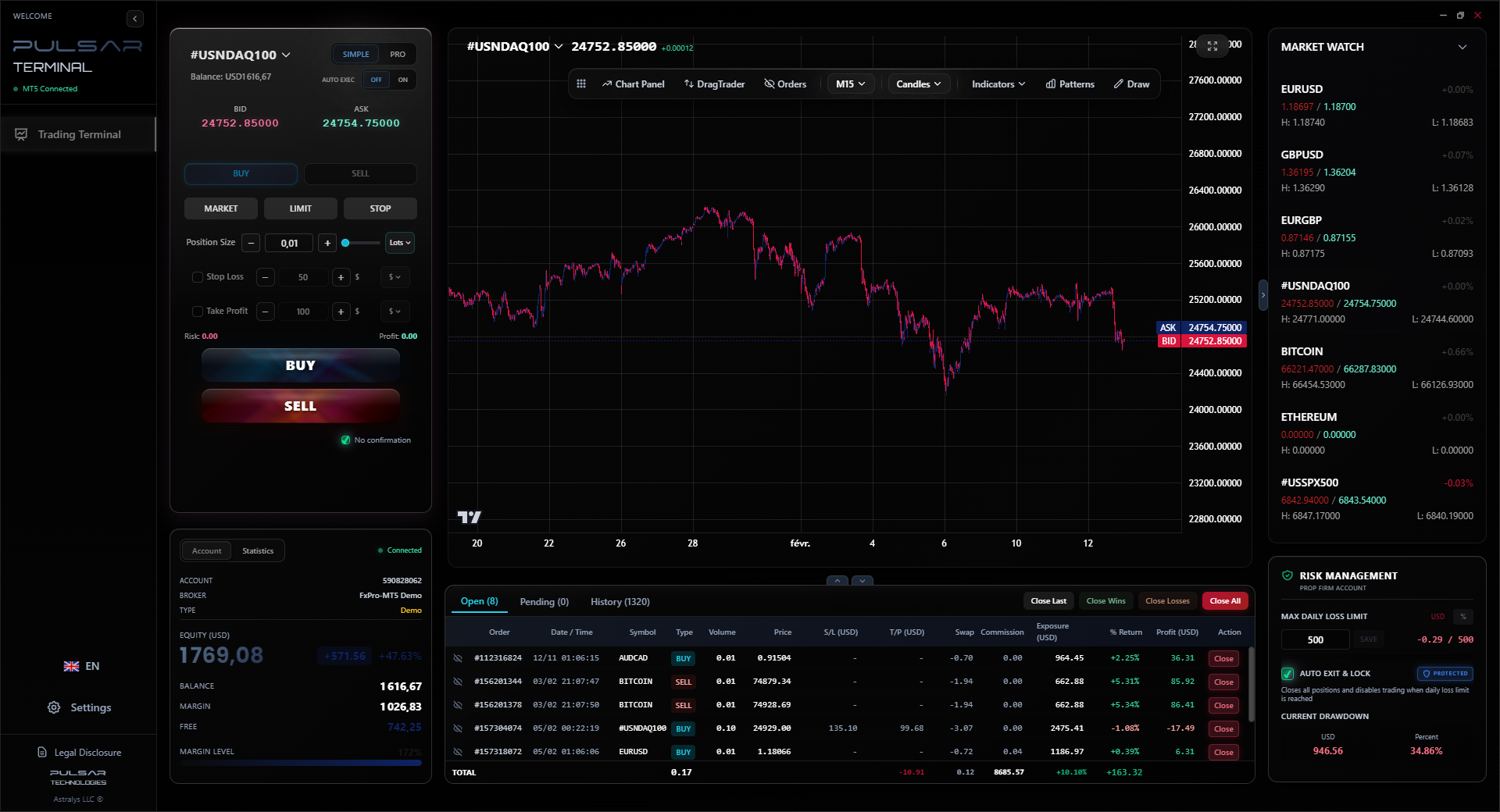
Executing your plan under pressure is hard; a tool like Pulsar Terminal lets you set multi-level take-profits and trailing stops with one click on MT5, so you can manage trades calmly instead of frantically.
Pulsar Terminal
Công cụ MT5 tất-cả-trong-một: đặt lệnh kéo-thả, multi-TP/SL, trailing stop, grid trading, Volume Profile và bảo vệ prop firm. Hơn 1.000 trader sử dụng mỗi ngày.
We have a unique cultural context that creates specific trading mistakes. I've made most of these myself.
Trap 1: The 'Maga Must Pay' Mentality. After a loss, the urge to 'revenge trade' and win back the money immediately is strong. You increase your lot size, trade outside your plan, and usually dig a deeper hole. I once lost 30,000 NGN, then doubled my position on the next trade in anger. Lost another 45,000 NGN in 10 minutes. Walk away after a loss. Full stop.
Trap 2: Signal Squad Dependency. Joining WhatsApp or Telegram groups where a 'guru' posts signals. You become a passive order-placer, learning nothing. When the guru eventually fails (and they all do), you're left with empty pockets and zero skill. I followed a signal to buy XAU/USD at $1845. It went to $1820. The guru vanished. My $200 was gone. Your own analysis is your only true asset.
Trap 3: Ignoring the Tax Man. That 10% capital gains tax is real. The FIRS may not knock on your door for small sums, but as you grow, keep clean records. Set aside 10% of your net profits quarterly. Treat it as a business expense from day one.
Trap 4: Chasing Naira Pairs. USD/NGN or GBP/NGN can be tempting, but they are often less liquid and have massive spreads compared to major forex pairs. The volatility can be erratic. Stick to the major pairs like EUR/USD or XAU/USD while you're learning the basics of price action.

“Your own analysis is your only true asset.”
A single 'forex for beginners pdf' is a starting point, not the destination. Real trading mastery is a continuous education. Here’s what your toolkit should include.
A Trading Journal (Non-Negotiable): This is your most important tool. Use a simple Google Sheet. Log: Date, Pair, Direction, Entry/Exit, Stop-Loss, Take-Profit, Risk (%), Result (Pips & $), Screenshot, and Reason for Entry/Exit. Most crucially, add a column for 'Emotion/Mistake.' Review it weekly. You'll see your patterns - like cutting winners too early or moving stops - and can fix them.
Trusted, Practical Resources:
- Books: Trading in the Zone by Mark Douglas (for psychology). The Daily Trading Coach by Brett Steenbarger.
- Analysis: Learn to read the MACD indicator for momentum and trend changes. Understand support/resistance. These are your building blocks.
- Community (Carefully): Find a small group or forum focused on analysis and review, not signal-begging. Discuss why a trade worked, not just what the trade was.
Your education evolves as you do. The beginner phase is about survival and mechanics. The intermediate phase is about refining your edge and psychology. There's always more to learn, and the market will happily teach you - often through losses - if you're willing to listen.
💡 Mẹo của Winston
The market doesn't know you exist. It doesn't care about your rent, your goals, or your previous loss. Trade the chart in front of you, not the story in your head.

Don't try to do everything at once. Here’s a 7-day launch plan.
Day 1: Research and select one reputable broker from our reviews (like IC Markets or XM). Open a demo account. Day 2: Download MT5. Watch a basic tutorial on how to place orders, set stops, and attach a simple Moving Average to the chart. Don't trade yet. Day 3: Choose your one pair (EUR/USD). On the 1-hour chart, just watch. Mark obvious support and resistance levels from the past week with horizontal lines. Day 4: Paper trade. Pick one of the two simple strategies from Section 4. Without using real money, practice identifying 3 potential set-ups. Write down your hypothetical entry, stop, and target. Day 5: Build your trading plan template in a document. Fill in your chosen pair, strategy, risk per trade (1%), and daily loss limit (3%). Day 6: Execute 5 paper trades on your demo account, following your plan exactly. Log them in your journal. Day 7: Review your journal. What felt good? What was hard? If you followed your rules, you're ready to consider a micro-account. If you broke them, repeat the week.
This journey is a marathon. Your first goal is consistency in process, not profitability. The profits will follow the process. Now, go build your foundation.

FAQ
Q1Is forex trading legal in Nigeria?
Yes, forex trading is legal for individuals in Nigeria. The landscape is becoming more regulated with the new Investments and Securities Act (ISA) 2025, which requires online forex platforms to register with the SEC. Nigerian traders primarily use internationally regulated brokers.
Q2How much money do I need to start forex trading in Nigeria?
You can technically start with as little as $1 on some platforms, but for serious learning, I recommend $200-$500 (approx. 300k-750k NGN). This allows for proper position sizing and risk management without being wiped out by a single bad trade or wide spreads.
Q3What is the best forex trading strategy for beginners?
The best strategy is a simple, rule-based one you can execute consistently. Start with price action on a major pair like EUR/USD. Focus on one concept, like trading pullbacks in a trend or breakouts with a retest. Master that before adding complexity. Avoid complicated indicator systems at first.
Q4Do I pay tax on forex trading profits in Nigeria?
Yes. Forex trading profits are subject to a 10% Capital Gains Tax, payable to the Federal Inland Revenue Service (FIRS). It's crucial to keep accurate records of your trades and profits for tax purposes as your trading grows.
Q5Why did I fail with a demo account but lose money live?
This is almost always due to psychology. On demo, there's no fear or greed. Live trading triggers emotions that cause you to break your rules - moving stop-losses, exiting early, or revenge trading. Bridge the gap with a micro account where the money is real but the stakes are small.
Q6Can I use a 'forex for beginners pdf' as my only guide?
No. A PDF can provide basic concepts, but it's static and can't teach market feel, emotional control, or adaptive thinking. Use it as an introductory text, but your real education comes from a written trading plan, a detailed journal, and screen time watching live price action.
Bài học của Prof. Winston
Điểm chính:
- ✓Start with $200-$500, not $10.
- ✓Never risk more than 2% per trade.
- ✓Master one pair and one strategy first.
- ✓A trading journal is non-negotiable.
- ✓Set aside 10% for capital gains tax.
Bài viết này hữu ích thế nào?
Nhấp vào ngôi sao để đánh giá
Nhận định giao dịch hàng tuần
Phân tích & chiến lược miễn phí hàng tuần. Không spam.
Về tác giả
Olumide Adeyemi
Nhà tiên phong Giao dịch Tây Phi
Một trong những nhà đào tạo forex tích cực nhất tại Nigeria. 8 năm kinh nghiệm giao dịch từ Lagos. Chuyên về chiến lược vốn thấp và thử thách prop firm dành cho trader châu Phi.
Bình luận
Cảnh báo rủi ro
Giao dịch các công cụ tài chính tiềm ẩn rủi ro đáng kể và có thể không phù hợp với tất cả nhà đầu tư. Hiệu suất trong quá khứ không đảm bảo kết quả trong tương lai. Nội dung này chỉ mang tính chất giáo dục và không nên được coi là lời khuyên đầu tư. Hãy luôn tự nghiên cứu trước khi giao dịch.
Bạn cũng có thể thích

Cara Trading Forex Sukses: 7 Prinsip dari Trader Profesional
Cara trading forex sukses dengan 7 prinsip trader pro: manajemen modal, disiplin, journal trading, backtest. Data nyata, bukan janji profit palsu.
Jam Trading Forex Terbaik untuk Trader Indonesia: Panduan Lengkap dengan Tabel Waktu
Panduan jam trading forex untuk trader Indonesia. Tabel 4 sesi dunia, jam emas 20:00-00:00, sesi mana yang harus dihindari. Data akurat + tips dari trader berpengalaman.
Top 5 Sàn Forex Uy Tín Nhất 2026: Review Jujur dari Trader Indonesia
Top 5 sàn forex uy tín 2026 untuk trader Indonesia. Review jujur: spread, deposit, withdraw, dukungan lokal. Exness, XM, IC Markets & lebih.
Tải Pulsar Terminal
Tất cả các công cụ tính này được tích hợp trong Pulsar Terminal với dữ liệu thời gian thực từ tài khoản MT5 của bạn.
Tải Pulsar Terminal