


I was glued to my screen on October 7th, 2016.

Olumide Adeyemi
Nhà tiên phong Giao dịch Tây Phi ·  Nigeria
☕ 11 phút đọc
Bạn sẽ học được:
I was glued to my screen on October 7th, 2016. Cable - GBP/USD - had just flash-crashed, plummeting over 800 pips in minutes. My phone was buzzing with alerts from a WhatsApp group. One guy was celebrating a huge buy order he’d placed at the absolute low. Another was silent. I knew why. He’d been margin called and wiped out. That day wasn't an anomaly; it was a brutal lesson in market reality. Most of the forex lessons you need aren't about finding the perfect entry. They're about surviving long enough to be wrong, repeatedly, and still have capital left. Let's talk about why most traders in Nigeria, and everywhere else, blow up their accounts.
Forget indicators for a second. The primary reason you'll fail is because you're fighting a mathematical war you don't understand. Brokers publish the stats: 72% to 89% of retail traders lose money. That's not a coincidence; it's a consequence.
Think about a typical trade. You buy EUR/USD at 1.0850 with a 20-pip stop loss and a 40-pip take profit. That's a 1:2 risk-to-reward ratio, which sounds smart. But what's your edge? If your strategy only wins 40% of the time, the math works against you. (0.4 wins * 40 pips) - (0.6 losses * 20 pips) = 16 - 12 = +4 pips average. That's a tiny, fragile edge that gets eaten by the spread and slippage.
Now, the real killer: position size. You have a ₦500,000 account. A 20-pip stop on a standard lot (100,000 units) is $200. That's about ₦300,000 at current rates. One loss wipes over half your account. It sounds ridiculous when stated plainly, but I've seen it happen countless times. The temptation to 'get back to even' after a loss leads to even bigger, more desperate bets. This is why using a position size calculator isn't optional; it's your lifeline.

Warning: use is a debt instrument, not a performance enhancer. Trading a $10,000 position with $100 of your own money (1:100 use) means a 1% move against you wipes your capital. On volatile pairs like GBP/JPY, that can happen before you can blink.
My first major blow-up came from ignoring this math. I was scalping USD/NGN futures (before they became nearly impossible for retail). I had a ₦200,000 account. I took a 5-lot position, convinced the CBN was about to intervene. The spread was 50 pips wide. I was down ₦25,000 before the price even moved. The market moved against me by another 30 pips. Margin call. Account balance: ₦1,842. The lesson cost me ₦198,158. The market didn't care about my analysis.
Trading psychology isn't fluffy self-help. It's about recognizing that your evolutionary wiring is your worst enemy. You are programmed to avoid pain (losses) and seek pleasure (wins) in the most counterproductive ways possible.
Loss Aversion is Your Default Setting
Studies show the pain of losing $100 is about twice as powerful as the pleasure of gaining $100. In trading, this means you'll hold losing trades hoping they'll break even ('It'll come back'), and you'll cut winning trades short to 'lock in profit' and avoid the pain of seeing it reverse. I've closed a trade on EUR/USD for a 15-pip gain only to watch it run 120 pips in my direction. The frustration from that one trade can poison your next ten decisions.
The Narrative Fallacy
We crave stories. 'The RSI is oversold, price is at support, and the Fed is dovish... this is a sure buy.' The market doesn't care about your coherent story. Price action is a messy, probabilistic outcome of millions of orders. Believing your story too strongly makes you ignore contrary evidence. I once held a long GBP/USD trade through three key support levels because my 'story' about Brexit negotiations being positive was so compelling. I lost 2.3% of my account on a single, stubborn trade.

Pro Tip: Keep a trade journal. Not just entries and exits, but your emotional state and the 'story' you told yourself. Review it weekly. You'll see your repetitive psychological mistakes staring back at you.
The platforms themselves are designed to trigger these responses. Flashing colors, alert sounds, the constant stream of P&L - it's a dopamine casino. Turning off all sound notifications and moving your P&L display off the main chart is a first step toward sanity. A tool that helps remove emotion, like setting automated multi-level exits, can be a game-saver. This is where a disciplined approach, possibly aided by external tools, separates the survivors from the casualties.

💡 Mẹo của Winston
If you can't explain your trade's thesis in one simple sentence, you don't have a thesis. You have a hope.
“You do not control whether your next trade wins or loses. You only control how much you lose if it's wrong.”
In Nigeria, we're bombarded with ads from brokers promising '100% deposit bonuses' and 'use up to 1:3000'. Let me be blunt: these are traps for the uninformed. A bonus is just more use with strings attached, and insane use is a shortcut to a margin call.
What actually matters?
- Regulation: This is non-negotiable. Your broker must be regulated by a reputable authority like the UK's FCA, Australia's ASIC, or South Africa's FSCA. This ensures client fund segregation and a recourse if things go wrong. Don't touch an unregulated broker, no matter how fancy their website looks.
- Execution & Slippage: During news events like US NFP, does your platform freeze? Do your market orders get filled 5 pips away from your click? This is where real money is lost. I've tested many. On a high-volatility day with IC Markets, my limit order was filled precisely. With a lesser-known broker, the same order slipped 3 pips. That's $30 per lot gone instantly.
- Costs: Look beyond the headline. Is it a 'zero spread' account with a $7 round-turn commission? Or a wider spread with no commission? You need to calculate the total cost per trade. For a typical Nigerian trader starting out, a broker like XM or Exness with a low minimum deposit and clear cost structure is often a more practical starting point than chasing the absolute tightest spreads.
Here’s a quick comparison of what to really look at:
| Feature | What to Look For | Red Flag |
|---|---|---|
| Withdrawals | Process within 24-48 hours, multiple local options (bank transfer, crypto, e-wallets). | Delays of 5+ business days, 'pending verification' loops. |
| Spreads on EUR/USD | Consistent averages below 1.0 pip on standard accounts. | Widening to 3+ pips during London open. |
| Platform | Stable MT4/MT5 or a reliable proprietary platform. | Frequent disconnections, especially during news. |
Your broker is your infrastructure. If it's shaky, your trading house will collapse no matter how good your strategy is.
You've probably spent hours, maybe weeks, searching for the holy grail strategy online. The one that gives 90% win rates. Here's the secret: it doesn't exist. And if it did, no one would sell it for $97 on Instagram.
Profitable trading isn't about winning most of the time. It's about making more on your winners than you lose on your losers. This is the core of all swing trading and trend-following methodologies. A strategy can be profitable with a 40% win rate if the average winner is three times the size of the average loser.
The bigger lesson is about strategy-market fit. A scalping strategy that works beautifully on EUR/USD during the London-New York overlap will bleed money on AUD/USD during the Asian session. A news-trading strategy requires a broker with instant execution and no requotes; without that, it's useless.
I learned this the hard way. I perfected a mean-reversion strategy using RSI and Bollinger Bands on the 15-minute chart. It worked great in a ranging market for two months. I was up 12%. Then, a strong trending move started on USD/CAD. I kept fading the moves, believing it would 'revert to the mean.' In one week, I gave back all my profits and another 8% of my account. The strategy didn't change; the market regime did. I failed to recognize when to stop using it.
Your job is to find a simple, logical strategy, understand its core condition (e.g., 'this works in a ranging market'), and have the discipline to NOT use it when that condition isn't met. This is far more important than adding another indicator to your chart. Most strategies built on the MACD or moving averages are just variations on a theme. The edge comes from your risk management and timing, not the complexity of the formula.
💡 Mẹo của Winston
The market's job is to inflict the maximum pain on the maximum number of participants. Your job is to not be one of them.
“Focus on the process, not the profits. Your daily goal should be 'follow my trading plan perfectly.'”
If you take only one thing from this article, let it be this: You do not control whether your next trade wins or loses. You only control how much you lose if it's wrong.
This is the foundation. Everything else is decoration.
The 1% Rule (And Why You'll Break It)
The golden rule is to risk no more than 1% of your trading capital on any single trade. On a ₦1,000,000 account, that's ₦10,000. This ensures you can survive a string of losses - a drawdown - without crippling your account.
You will be tempted to break it. When you're on a winning streak, you'll think, 'I'm in tune with the market, I'll risk 3%.' That's how streaks end. When you're down, you'll think, 'I need to risk 5% on this high-probability trade to get back to even.' That's the direct path to a margin call.
From Stop Loss to Stop Strategy
Placing a stop-loss order is basic. The advanced lesson is knowing why it's placed there. Is it below a recent swing low? Is it beyond a volatility measure (like ATR)? If price hits your stop, it doesn't just mean the trade failed. It means your analysis for that trade was wrong. The market is telling you, 'Your idea is invalid.' Accept the message. Don't re-enter the same trade 5 pips lower.
Practical Application: A Trade Example
Let's say you're trading XAU/USD (Gold). Account: $5,000. Your 1% risk is $50.
- You identify a buy setup at $2,180, with a logical stop loss at $2,170. That's a 10-point risk.
- How much can you trade? $50 risk / 10 points = $5 per point.
- On XAU/USD, a standard lot is $100 per point. So, you can trade 0.05 lots ($5/$100).
- Your take-profit is at $2,200, a 20-point target. Potential reward: 20 points * $5 = $100.
You've just defined a 1:2 risk-reward trade before you even click 'buy.' The position size is dictated by your risk, not by how confident you feel. This is professional discipline. Tools that help you set this up visually and execute it with one click remove the friction and emotional hesitation from this critical process.
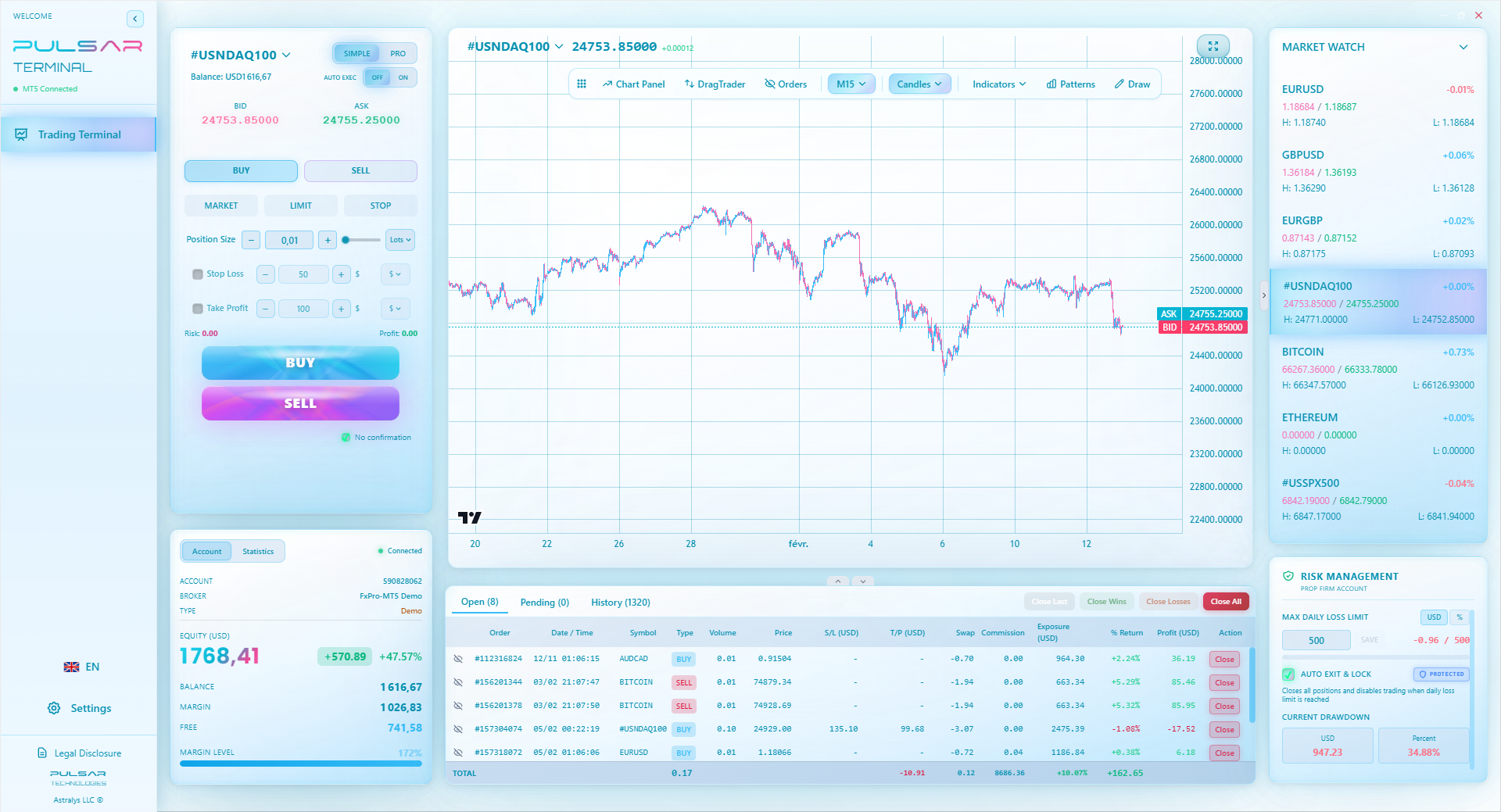
Manually calculating and setting multi-level take-profits and stop-losses for every trade is time-consuming and prone to emotional error; Pulsar Terminal automates this directly on your MT5 chart, turning your risk management plan into a one-click execution.
Pulsar Terminal
Công cụ MT5 tất-cả-trong-một: đặt lệnh kéo-thả, multi-TP/SL, trailing stop, grid trading, Volume Profile và bảo vệ prop firm. Hơn 1.000 trader sử dụng mỗi ngày.
The final, and perhaps most important, of all forex lessons is this: focus on the process, not the profits. Your daily goal should not be 'make ₦50,000.' Your daily goal should be 'follow my trading plan perfectly.'
A good process includes:
- Pre-Market Routine: Analyzing the broader context. Is today a high-impact news day? What is the overall trend on the daily chart? I spend 30 minutes each morning doing this, no screens on yet.
- Trade Checklist: A literal list of criteria your setup must meet before you trade. (e.g., Is price at a key level? Is the trend on the higher timeframe aligned? Is volatility suitable?).
- Post-Trade Review: Win or lose, why did the trade work or not? Did you follow your rules? Log it.
When you make a great trade that loses money (a well-managed loss), you should feel a sense of satisfaction. When you make a terrible trade that wins money (like chasing a move with no stop), you should be alarmed. You got paid for reckless behavior, which reinforces it.
I used to end each day looking at my P&L. If I was up, I was happy. If I was down, I was stressed. This made me a reactive, emotional trader. Now, I end the day by reviewing my trade journal against my checklist. The P&L is almost an afterthought. This shift in focus is what allowed me to move from consistently blowing up accounts to building sustainable growth over years. It turns trading from a gambling activity into a skilled profession. It's the difference between hoping to win and building a system that generates wins over time, which is the only thing that lasts in this business.
💡 Mẹo của Winston
A losing trade where you followed your rules is a better trade than a winning trade where you broke them. One builds discipline, the other builds bad habits.
FAQ
Q1What is the biggest mistake new forex traders in Nigeria make?
Over-leveraging. Using 1:500 or 1:1000 use with a small account means even a tiny move against you triggers a margin call. They confuse high use with high opportunity, when it's actually high risk.
Q2How much money do I really need to start forex trading?
Technically, you can start with $5 or $10 with some brokers. Realistically, you need enough to trade sensible position sizes while risking 1% or less. For practical learning without immediate pressure, I'd suggest a minimum of $200-$500. This lets you experience real market moves without one trade ending your journey.
Q3Are forex trading bonuses worth it?
Almost never. Bonuses come with trading volume requirements (lots you must trade before withdrawing). They incentivize over-trading to 'unlock' your own money. It's better to choose a broker with low, transparent costs and no bonus strings attached.
Q4Can I make a living trading forex from Nigeria?
A very small percentage of traders do. It requires significant capital (not just startup funds, but a large enough account to draw a consistent income without over-risking), years of disciplined practice, and a strong business mindset. For 99% of people, it should start as a side activity while you learn.
Q5Which is better, MT4 or MT5?
For pure forex trading, MT4 is simpler and perfectly adequate. MT5 offers more timeframes, more order types, and access to other markets like stocks and futures. Most brokers offer both. Start with MT4 for its simplicity and massive community support.
Q6How do I know if my broker is cheating me?
Look for excessive slippage on stop-loss orders (especially during news), frequent platform outages at key times, and unexplained widening of spreads on your account compared to their advertised averages. A regulated broker from a reputable jurisdiction is far less likely to engage in this.
Q7What's one thing I can do today to improve my trading?
Start a trade journal. For every trade, write down the pair, entry/exit, reason for the trade, your emotional state, and the outcome. Review it weekly. This single habit will teach you more about your own weaknesses than any book or course.
Bài học của Prof. Winston
Điểm chính:
- ✓Risk a maximum of 1% per trade. Always.
- ✓use kills more accounts than bad analysis.
- ✓A 40% win rate can be profitable with proper risk/reward.
- ✓Your psychology is your primary adversary.
Bài viết này hữu ích thế nào?
Nhấp vào ngôi sao để đánh giá
Nhận định giao dịch hàng tuần
Phân tích & chiến lược miễn phí hàng tuần. Không spam.
Về tác giả
Olumide Adeyemi
Nhà tiên phong Giao dịch Tây Phi
Một trong những nhà đào tạo forex tích cực nhất tại Nigeria. 8 năm kinh nghiệm giao dịch từ Lagos. Chuyên về chiến lược vốn thấp và thử thách prop firm dành cho trader châu Phi.
Bình luận
Cảnh báo rủi ro
Giao dịch các công cụ tài chính tiềm ẩn rủi ro đáng kể và có thể không phù hợp với tất cả nhà đầu tư. Hiệu suất trong quá khứ không đảm bảo kết quả trong tương lai. Nội dung này chỉ mang tính chất giáo dục và không nên được coi là lời khuyên đầu tư. Hãy luôn tự nghiên cứu trước khi giao dịch.
Bạn cũng có thể thích

Cara Trading Forex Sukses: 7 Prinsip dari Trader Profesional
Cara trading forex sukses dengan 7 prinsip trader pro: manajemen modal, disiplin, journal trading, backtest. Data nyata, bukan janji profit palsu.
Jam Trading Forex Terbaik untuk Trader Indonesia: Panduan Lengkap dengan Tabel Waktu
Panduan jam trading forex untuk trader Indonesia. Tabel 4 sesi dunia, jam emas 20:00-00:00, sesi mana yang harus dihindari. Data akurat + tips dari trader berpengalaman.
Top 5 Sàn Forex Uy Tín Nhất 2026: Review Jujur dari Trader Indonesia
Top 5 sàn forex uy tín 2026 untuk trader Indonesia. Review jujur: spread, deposit, withdraw, dukungan lokal. Exness, XM, IC Markets & lebih.
Tải Pulsar Terminal
Tất cả các công cụ tính này được tích hợp trong Pulsar Terminal với dữ liệu thời gian thực từ tài khoản MT5 của bạn.
Tải Pulsar Terminal