


Most traders think forex liquidity is just about tight spreads.

David van der Merwe
Nhà giao dịch Thị trường Mới nổi ·  South Africa
☕ 15 phút đọc
Bạn sẽ học được:
- 1What Liquidity Really Means (It's Not Just Spreads)
- 2The ZAR Pair Liquidity Trap
- 3How Your Broker's Liquidity Access Makes or Breaks You
- 4Liquidity Cycles: When the Market Truly Opens and Closes for You
- 5When Liquidity Vanishes: Trading Around News and Volatility
- 6How to Actually Check Your Broker's Liquidity (Before You Deposit)
- 7Putting It All Together: A Liquidity-Conscious Trading Plan

Most traders think forex liquidity is just about tight spreads. They see a 0.0 pip quote on EUR/USD and think they've got a free ticket to profits. That's the first myth that gets people blown up. The real story of forex liquidity in South Africa is about what happens when you click 'buy' or 'sell' - the slippage on USD/ZAR during load-shedding announcements, the frozen platforms during London open, and why your perfect stop-loss on a volatile pair is just a polite suggestion to the market. I've lost real money learning this the hard way. Let's set the record straight on what liquidity actually means for your ZAR account.
When brokers advertise 'high liquidity,' they're usually talking about the interbank market's ability to handle massive orders. For you, the retail trader, liquidity breaks down into three tangible things: execution speed, price depth, and slippage. The $6.6 trillion daily global volume means nothing if your 2-lot order can't get filled at your price.
I learned this painfully in 2018. The SARB made an unexpected comment on interest rates. I was short USD/ZAR with a tight stop. My broker (a well-known international name) showed a 'live' price. I clicked to close. The order hung for 4 seconds - an eternity - and filled 45 pips below where my screen showed. That was R900 gone in a blink, not from a bad trade, but from failed execution. That's liquidity, or the lack of it.
Execution Speed: This is the time between your click and your fill. On major pairs like EUR/USD during London hours, it should be under 100ms. On USD/ZAR? Don't be surprised by 500ms to 2 seconds. That's where the risk is.
Price Depth: This is the market's ability to absorb your order without moving the price. You can probably market sell 10 lots of EUR/USD without issue. Try selling 10 lots of USD/ZAR instantly. The price will move against you. That movement is slippage, and it's a direct cost.

Warning: A tight spread is a marketing tool. A broker can show a 0.8 pip spread on USD/ZAR but have such poor liquidity that every market order slips 5 pips. You're paying the spread PLUS the slippage. Always check execution statistics, not just the advertised spread.
This is why your choice of broker matters immensely. A broker with true access to Tier-1 liquidity providers will have better depth. Some brokers, like IC Markets or Pepperstone, publish their liquidity sources and average execution speeds. That's data worth looking at before you deposit.
Your trading style dictates how much you should care. If you're a scalping strategy enthusiast trying to grab 5 pips on EUR/GBP, then execution speed and slippage are your primary concerns. Your entire profit can be wiped by one bad fill. If you're a swing trading investor holding for days, the spread and overnight swap fees matter more than millisecond execution.

💡 Mẹo của Winston
Liquidity is a coward. It runs for the exits at the first sign of trouble. Your job is to never be in its way when it does.
“A tight spread is a marketing tool. The real cost is slippage.”
This is the South African special. We love trading our own currency. USD/ZAR, EUR/ZAR, GBP/ZAR. It feels familiar. It's also where most local traders get slaughtered by hidden liquidity gaps.
The Two-Tier Market
Global forex liquidity is concentrated in the majors (EUR/USD, USD/JPY) and crosses. ZAR pairs are exotic. Their liquidity comes from a different pool: local banks, corporates hedging imports/exports, and speculative international flow. When global markets are calm, USD/ZAR might trade smoothly. But when risk sentiment shifts - or when there's a local political or economic announcement - the big liquidity providers widen their quotes or step away entirely.
I've watched the order book on USD/ZAR thin out to almost nothing 10 minutes before a major SARB announcement. The spread might jump from 15 pips to 80 pips in seconds. If you're in a trade without a guaranteed stop (which costs extra), you're at the mercy of whatever price the market gives you.
A Real Example with Numbers
Let's say you're trading GBP/ZAR. The spread is typically 25-40 pips. That's your immediate cost. You buy at 23.1000. You need the pair to move 40 pips just to break even on the spread. Now, imagine UK inflation data hits. The initial spike causes slippage. Your intended entry at 23.1000 becomes a fill at 23.1075. You're down 75 pips before the market even starts trending. This isn't theory. I've had it happen. It forces you to hold losing trades longer, hoping for a bigger move, which increases your risk of a margin call.

Example:
- Pair: GBP/ZAR
- Standard Spread: 30 pips
- Your Planned Entry: 23.1000
- Actual Fill After Slippage: 23.1075
- Immediate 'Cost': 75 pips
- Break-Even Point: 23.1075 + 30 pips = 23.1375 You need a move to 23.1375 just to be back at zero. That's a 1.5 Rand move per standard lot just to cover entry costs.
When to Trade ZAR Pairs
If you must trade them, align with global and local liquidity windows. The overlap between the London session (3 PM - 5 PM SAST) and when local banks are active is your best bet. Avoid trading around budget speeches, SARB meetings, or major credit rating announcements. The volatility isn't worth the liquidity drought. Consider trading the more liquid EUR/USD or XAU/USD and simply thinking in ZAR terms for your profit targets.

“Your perfect stop-loss on a volatile pair is just a polite suggestion to the market.”
Not all brokers are created equal. The 'liquidity' they offer you is a filtered version of the real market. There are three main models, and understanding which one you're in is critical.
1. The Market Maker (Dealing Desk) Model: This broker internalizes your order. They are the counterparty to your trade. Liquidity is what they decide to provide. During normal times, it can be fine. During high volatility, they may hedge their risk by widening spreads dramatically or imposing restrictions. Your stop-loss can be ignored if it's in their 'unhedgeable' zone. Many local FSCA-regulated brokers operate on this model. It's not inherently evil, but you need to know the conflict of interest exists.
2. The Straight-Through Processing (STP) Model: Your order is routed directly to a liquidity provider (a big bank or institution). The broker adds a mark-up (the spread) but doesn't trade against you. Execution is generally better, but you're dependent on that single provider's liquidity.
3. The Electronic Communication Network (ECN) Model: This is what most serious traders think of for true liquidity. Your order is placed into a central pool where multiple liquidity providers (banks, hedge funds, other traders) compete to fill it. You pay a small commission, but you get the raw spread. This is where you find spreads of 0.0 pips on EUR/USD. Brokers like IC Markets and Pepperstone offer true ECN accounts.
Here’s a comparison of what this means for you:
| Feature | Market Maker | STP | ECN |
|---|---|---|---|
| Counterparty | The Broker | Single Liquidity Provider | Multiple LPs & Traders |
| Typical Spread on EUR/USD | 1.2 - 1.5 pips (fixed) | 0.8 - 1.2 pips (variable) | 0.0 - 0.3 pips + commission |
| Slippage Risk | High during news (Requotes) | Medium | Low/Negative (can get better price) |
| Best For | Beginners, small accounts | Intermediate traders | High-volume, scalpers, pros |
My transition was a wake-up call. I moved from a market maker to a true ECN broker. The first time I got a trade filled with negative slippage (my limit order was filled at a better price than I asked for), I realized I'd been paying a hidden tax for years. The commission of $3.50 per lot was far cheaper than the hidden cost of wide spreads and requotes.

Pro Tip: Open a demo account with a true ECN broker. Place trades during the London open (8 AM GMT) and during major news events like US Non-Farm Payrolls. Watch the execution speed and slippage. Compare it to your current broker. The difference is your hidden cost of trading.
“Your perfect stop-loss on a volatile pair is just a polite suggestion to the market.”
Forex liquidity isn't constant. It ebbs and flows with the world's business hours. For a South African trader, our time zone (GMT+2) is actually a massive advantage if you use it right.
The Dead Zone (Late NY Close to Asia Open): From around 10 PM to 4 AM SAST, liquidity dries up. Spreads on majors widen slightly, but spreads on exotics like ZAR pairs can balloon. Avoid entering new positions here unless you're specifically trading the Asian session range. Your stops are vulnerable to random spikes.
The Asian Session (4 AM - 11 AM SAST): Liquidity is moderate, driven by Tokyo, Singapore, and Hong Kong. Pairs like USD/JPY, AUD/USD, and NZD/USD are most active. It's often a range-bound session. Not the best time for ZAR pairs.
The Golden Overlap: London & SA (11 AM - 1 PM SAST): This is when European banks come online. Liquidity for EUR, GBP, and CHF pairs surges. This is also when local South African banks are fully active, providing the best liquidity for USD/ZAR you'll get all day. This 2-3 hour window is prime time for execution.
The Liquidity Peak: London & NY Overlap (3 PM - 5 PM SAST): This is the most liquid period of the entire 24-hour cycle. Both European and American banks are trading. Volume is enormous. Spreads are at their absolute tightest. Slippage is minimal for standard orders. This is when you want to enter your most important trades. If you're a day trader, this should be your main session. The high volume also means trends are more likely to be sustained and less prone to fakeouts.
I structure my entire day around this. I do my analysis in the morning. I may take a small position in the Asian session if a setup is perfect. But I save the bulk of my capital and my main entries for the London-NY overlap. The quality of fills is incomparable. It turned my trading from a struggle against the platform into a smoother process. Tools that help you visualize session times, like many features in advanced trading terminals, are useful for planning around these cycles.
💡 Mẹo của Winston
If you wouldn't swim in a pond you couldn't see the bottom of, don't trade a pair where you can't see the order book depth.

“The pursuit of perfect liquidity might lead you away from the pairs you 'want' to trade and towards the pairs you 'should' trade.”
This is the ultimate test of your broker and your risk management. A high-impact news event like US CPI, SARB interest rate decisions, or the South African budget speech doesn't just increase volatility - it often destroys usable liquidity.
What Actually Happens: The big banks and liquidity providers (LPs) aren't stupid. They know news is unpredictable. To protect themselves, they do two things: 1) They massively widen the spread between their bid and ask quotes. 2) They reduce the size they're willing to trade at any price. Your broker's 'liquidity feed' might show a 50-pip wide spread on EUR/USD for a few seconds. That's not an error. That's the real market.
If you have a stop-loss or take-profit order in the market, it becomes a market order when triggered. If the spread is 50 pips wide, your stop will be filled at the worst possible price in that range. I've seen traders with stops 20 pips away get filled 60 pips into a loss because of this. It feels like robbery, but it's the mechanics of an order book evaporating.
My Failed 'News Trade' Experiment: Early in my career, I thought I could game the NFP (US Non-Farm Payrolls). I'd place a buy stop and a sell stop a few pips above and below the pre-news range, hoping to catch the breakout. The theory was sound. The liquidity reality was brutal. One month, the news hit. My buy stop was triggered. The fill was 18 pips above my order price due to slippage. The market immediately reversed and hit my sell stop (which also slipped). I was filled out for a loss on both sides in under 10 seconds. I lost 2.5% of my account on a 'clever' strategy because I didn't respect the liquidity vacuum.
How to Handle It:
- Flat is a Position: The safest trade before major news is no trade. Close your positions 30-60 minutes before the event. The small profit you might miss isn't worth the risk of a catastrophic slippage fill.
- Use Wider Stops: If you must hold through news, your stop needs to be placed far beyond the expected initial spike. This means a smaller position size to keep the risk in check. Use a position size calculator to work this out.
- Avoid Market Orders: Never use a market order in the 5 minutes before or after high-impact news. Use limit orders if you must enter, accepting you might miss the move.
- Guaranteed Stops: Some brokers offer guaranteed stop-loss orders (GSLOs) for a premium. You pay extra, but your stop is filled exactly at your price, no slippage. For a large, volatile news trade, this fee can be worth it as insurance.
Managing this risk manually is incredibly stressful. This is where automation shines. A tool that can automatically widen your stop-loss to a 'news safe' distance before a scheduled event, or move your position to breakeven once a certain profit is reached, removes emotion and error. It's one less thing to panic about when the charts are going haywire.

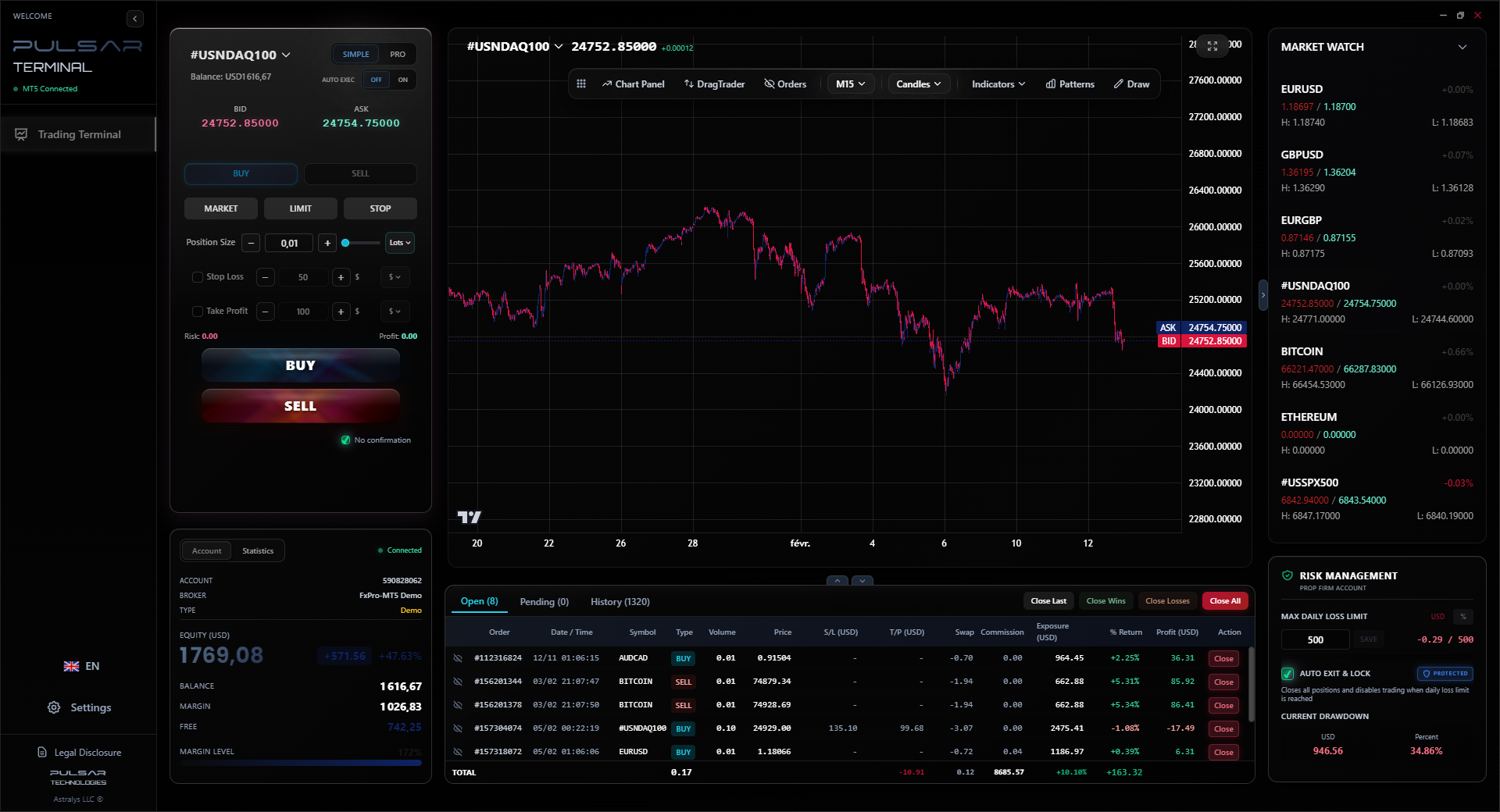
Managing stop-losses and entries around volatile news events is a high-stress task, which is why tools like Pulsar Terminal automate breakeven moves, trailing stops, and can even widen stops before scheduled news—all directly on your MT5 chart.
Pulsar Terminal
Công cụ MT5 tất-cả-trong-một: đặt lệnh kéo-thả, multi-TP/SL, trailing stop, grid trading, Volume Profile và bảo vệ prop firm. Hơn 1.000 trader sử dụng mỗi ngày.
“The pursuit of perfect liquidity might lead you away from the pairs you 'want' to trade and towards the pairs you 'should' trade.”
Don't take a broker's word for it. Test it. Here's a practical checklist I use when evaluating a new broker, especially ones popular in SA like XM or Exness.
1. The Demo Account Stress Test:
- Time: Test during the London open (10 AM GMT / 12 PM SAST) and during a medium-impact news event.
- Action: Place a market order for 2-3 standard lots on EUR/USD. How long does the execution window stay open? Is it instantaneous, or does it hang? Note the slippage.
- Action: Try the same with 0.5 lots on USD/ZAR. The slippage will be worse, but how much worse? 5 pips? 20 pips?
2. Examine the Order Book (If Available): Some platforms, especially cTrader and certain MT5 plugins, show a depth of market (DOM) display. This shows the buy and sell orders stacked at different prices. A healthy DOM will have substantial volume at prices close to the current bid/ask. A sparse DOM with big gaps means poor liquidity depth.
3. Look for Published Statistics: Reputable brokers are transparent. Do they publish:
- Average execution speed? (Look for < 100ms for majors)
- Percentage of orders executed at requested price? (Should be > 95%)
- Are they willing to name their Tier-1 liquidity providers? (Names like Citibank, JP Morgan, Goldman Sachs, HSBC).
4. The Withdrawal Test (The Final Proof): This sounds unrelated, but it's connected to a broker's financial health. A broker with strong, real liquidity partnerships processes client withdrawals smoothly and quickly (1-3 business days). A broker that struggles with withdrawals, makes excuses, or takes weeks might be internalizing trades and using client money for operations - a huge red flag for everything, including liquidity integrity.
I made the mistake of skipping these checks with a flashy, high-use broker years ago. The deposits were easy. The trades during quiet times were fine. The first time I tried to withdraw R15,000, it was a month-long nightmare of excuses. The broker's 'liquidity' was a facade. Your capital is only as safe as your broker's weakest link.

“Your capital is only as safe as your broker's weakest link.”
Forex liquidity isn't a background topic. It should be a primary filter for every decision you make. Here’s how to build it into your routine.
Your Daily Liquidity Checklist:
- What session is it? Am I trading in the dead zone or the London overlap?
- Any high-impact news scheduled today? (Use an economic calendar). If yes, will I be flat, or have I adjusted my position size and stop distance accordingly?
- What pair am I trading? If it's a ZAR exotic, have I accepted the wider spread and higher slippage risk into my risk-reward calculation? A 1:2 risk-reward on EUR/USD is not the same as 1:2 on USD/ZAR once real execution costs are factored in.
- What order type am I using? For entry, can I use a limit order to avoid slippage? For exit, is my stop-loss placed at a technically logical level that also accounts for normal spread widening?
Position Sizing is Your Best Defence: Liquidity gaps cause larger losses than expected. The only antidote is to trade smaller. If your standard position size is 2% of your account per trade, consider dropping to 1% or 0.5% when trading exotics or ahead of known volatile periods. That unexpected 30-pip slippage on a 0.5% trade is a nuisance. On a 2% trade, it's a devastating blow to your monthly target. Always use a position size calculator that lets you input the spread as an initial cost.
Final, Uncomfortable Truth: The pursuit of perfect, low-cost liquidity might lead you away from the pairs you 'want' to trade (like ZAR pairs) and towards the pairs you 'should' trade for execution quality (like majors). There's a reason the pros focus on EUR/USD. It's not boring. It's efficient. Your edge as a trader is hard enough to find. Don't let poor forex liquidity grind it away before you even start.
Focus on the process. Trade when the market is deep. Use brokers that give you real market access. Size your positions for the worst-case fill. Do that, and you've solved 80% of the problems that destroy retail accounts before a trend even has a chance to begin.
💡 Mẹo của Winston
The spread is the ticket price. Slippage is the hidden service fee. Most traders only budget for the ticket.

FAQ
Q1What is the most liquid forex pair for a South African trader to focus on?
Hands down, it's EUR/USD. It has the tightest spreads (often below 0.5 pips on ECN accounts), the deepest liquidity, and the fastest execution 24 hours a day. While USD/ZAR feels familiar, its wider spreads (15-40 pips) and lower liquidity make it a more expensive and risky pair to trade frequently. Build your strategy on EUR/USD for efficiency, and treat ZAR pairs as occasional, higher-risk trades.
Q2How does load-shedding affect forex liquidity for South African traders?
It doesn't affect global liquidity itself, but it completely destroys your personal access to it. If your power or internet drops during a trade, your platform disconnects. You cannot adjust stops, take profits, or close positions. During this blackout, a news event could hit and your stop-loss becomes a market order whenever you reconnect, likely filled at a terrible price due to slippage. The solution is a reliable UPS, mobile data hotspot backup, and using a broker with a reliable mobile app. Also, avoid holding sensitive positions during known load-shedding slots.
Q3Is a 0.0 pip spread always better than a 1-pip spread?
Not always. A 0.0 pip spread usually comes with a commission per lot traded (e.g., $3.50 per side). A 1-pip spread is commission-free. You need to do the math. For a 1-lot trade on EUR/USD, a 1-pip spread costs you $10. A 0.0 spread + $7 commission (in and out) costs $7. The ECN account is cheaper. But for a 0.1 lot (mini lot) trade, the 1-pip spread costs $1, while the commission is still $0.70, making them similar. High-volume traders save massively on ECN. Low-volume traders might find commission-free accounts simpler and cost-comparable.
Q4Can I get negative slippage?
Yes, and it's a sign of a good broker. Negative slippage happens when your order is filled at a better price than you requested. It's common with limit orders during fast-moving markets. For example, you place a buy limit at 1.08500 on EUR/USD. The price dips quickly to 1.08480 and your order is filled there, giving you an extra 0.2 pips of profit instantly. This happens with brokers who have true ECN/STP models and fast execution. You'll almost never see it with a market maker broker.
Q5Why does my stop-loss sometimes get hit even though the price didn't reach it on my chart?
This is usually due to spread widening. Your stop-loss is triggered by the bid price. The chart typically shows the mid-price (average of bid and ask). If the spread is normally 1 pip, the chart and bid are close. During volatile times, the spread can widen to 5 or 10 pips. The bid price can hit your stop while the mid-price on your chart is still several pips away. This isn't a broker 'hunting' your stop (usually), it's the mechanics of a two-price market under stress.
Q6What's the single best time of day to trade for good liquidity?
The overlap between the London and New York sessions, from 3 PM to 5 PM South African Standard Time (SAST). This is when trading volume and liquidity peak globally. Spreads are at their absolute tightest, execution is fastest, and slippage is minimal for standard orders. If you can only trade one window, make it this one.
Q7Are FSCA-regulated brokers better for liquidity?
Not necessarily for liquidity itself. An FSCA license ensures they follow South African rules on client fund segregation, reporting, and use caps (30:1 for retail). It's crucial for your safety as a South African resident. However, the quality of their liquidity depends on their specific business model and liquidity partnerships. A large international broker like IG or Saxo (both FSCA-regulated) will have superb liquidity. A smaller local FSCA broker might use a single, less powerful liquidity provider. Always check the execution model (ECN/STP/Market Maker) and test it on demo.
Bài học của Prof. Winston
Điểm chính:
- ✓Test liquidity in demo during news, not calm markets.
- ✓Trade ZAR pairs only during London-SA overlap (11am-1pm SAST).
- ✓Size positions for 2x the expected slippage on exotics.
- ✓The London-NY overlap (3pm-5pm SAST) is your liquidity sweet spot.
Bài viết này hữu ích thế nào?
Nhấp vào ngôi sao để đánh giá
Nhận định giao dịch hàng tuần
Phân tích & chiến lược miễn phí hàng tuần. Không spam.
Về tác giả
David van der Merwe
Nhà giao dịch Thị trường Mới nổi
Trader tại Johannesburg với 11 năm kinh nghiệm về tiền tệ thị trường mới nổi. Chuyên về cặp ZAR, giao dịch theo quy định FSCA và phân tích thị trường Nam Phi.
Bình luận
Cảnh báo rủi ro
Giao dịch các công cụ tài chính tiềm ẩn rủi ro đáng kể và có thể không phù hợp với tất cả nhà đầu tư. Hiệu suất trong quá khứ không đảm bảo kết quả trong tương lai. Nội dung này chỉ mang tính chất giáo dục và không nên được coi là lời khuyên đầu tư. Hãy luôn tự nghiên cứu trước khi giao dịch.
Bạn cũng có thể thích

Cara Trading Forex Sukses: 7 Prinsip dari Trader Profesional
Cara trading forex sukses dengan 7 prinsip trader pro: manajemen modal, disiplin, journal trading, backtest. Data nyata, bukan janji profit palsu.
Jam Trading Forex Terbaik untuk Trader Indonesia: Panduan Lengkap dengan Tabel Waktu
Panduan jam trading forex untuk trader Indonesia. Tabel 4 sesi dunia, jam emas 20:00-00:00, sesi mana yang harus dihindari. Data akurat + tips dari trader berpengalaman.
Top 5 Sàn Forex Uy Tín Nhất 2026: Review Jujur dari Trader Indonesia
Top 5 sàn forex uy tín 2026 untuk trader Indonesia. Review jujur: spread, deposit, withdraw, dukungan lokal. Exness, XM, IC Markets & lebih.
Tải Pulsar Terminal
Tất cả các công cụ tính này được tích hợp trong Pulsar Terminal với dữ liệu thời gian thực từ tài khoản MT5 của bạn.
Tải Pulsar Terminal