


Most Nigerian traders get the forex market open time completely wrong.

Olumide Adeyemi
Nhà tiên phong Giao dịch Tây Phi ·  Nigeria
☕ 11 phút đọc
Bạn sẽ học được:
- 1The 24-Hour Cycle is a Lie (Here's the Reality)
- 2Forex Trading Sessions (Nigeria Time)
- 3The Best Time to Trade in Nigeria (For Real Life)
- 4The Worst Times to Trade (Volatility Traps)
- 5Matching the Session to Your Trading Strategy
- 6Practical Nigerian Considerations: Light, Data, and Reality
- 7Building Your Time-Based Routine
Most Nigerian traders get the forex market open time completely wrong. They think '24 hours' means you can trade anytime and get the same results. That's a fast track to blowing your account. The truth is, the market has a heartbeat, and if you're not trading in sync with it, you're just gambling. I'll show you exactly when to be at your screen, when to walk away, and how to use Nigeria's time zone to your advantage.
Yes, the forex market is open 24 hours a day from Monday morning in Wellington to Friday evening in New York. But liquidity, volatility, and opportunity are not evenly distributed. It's like saying Lagos is busy 24/7. Sure, but compare the energy of a 2 AM street in Ikeja to the gridlock of 8 AM on the Third Mainland Bridge. The difference is night and day.
The market moves on the overlap of major financial centers. When banks, hedge funds, and corporations in two major regions are all active at the same time, volume spikes. This is when real price discovery happens, and it's when you want to be trading. Trading during the dead hours is like trying to sell pure water in an empty stadium. You might get a taker, but the spreads are wide, the moves are erratic, and you're at the mercy of any random bit of news.
For us in Nigeria (West Africa Time, GMT+1), this creates a specific schedule. Our 9 AM is London's 8 AM. Our 2 PM is when New York traders are just finishing their first coffee. This positioning is actually a hidden advantage if you know how to use it.

Warning: Trading during low-liquidity periods (like the Asian session for EUR/USD) often means wider spreads. Your broker isn't cheating you; there's simply less competition to tighten the price. A 3-pip spread can turn a good scalp into a losing trade before the price even moves. Always check the live spread before entering.
Let's break down the four main sessions in our local time (GMT+1). Forget Sydney or Tokyo open times; this is your practical schedule.
The Asian Session (Lagos Time: 12:00 AM – 9:00 AM)
This is the quiet one. Major pairs like EUR/USD often move in tight ranges. It's a graveyard for scalpers looking for big moves, but it can be good for studying consolidation patterns. The main action is in JPY pairs (like USD/JPY). If you're not trading the Yen, consider this your research or sleep time.
The London Session (Lagos Time: 8:00 AM – 5:00 PM)
This is where the engine starts. London is the world's largest forex hub. Volume pours in from 8 AM our time. This session sets the tone for the day. Most major trends begin or accelerate here. If you have a day job, your lunch break (12 PM - 1 PM Nigeria time) falls right in the heart of the London morning - a prime time for a quick trade check.
The London/New York Overlap (Lagos Time: 1:00 PM – 5:00 PM)
This is the golden hour. The two biggest markets are open together from 1 PM to 5 PM our time. This is the most volatile, liquid, and opportunity-rich window of the entire day. Spreads are at their tightest. If you can only trade one block of time, make it this one. I've placed more profitable trades between 2 PM and 4 PM Nigerian time than in all other hours combined.
The New York Session (Lagos Time: 1:00 PM – 10:00 PM)
New York opens at 1 PM our time, creating the overlap. After London closes at 5 PM, New York carries on alone. Volatility can continue, especially around US economic data releases (which often come out at 2:30 PM or 3:30 PM our time). The market starts to wind down after 7 PM Nigeria time.
Here’s a simple table to visualize your trading day:
| Session | Nigeria Time (GMT+1) | Key Characteristic | Best For |
|---|---|---|---|
| Asian | 12:00 AM – 9:00 AM | Low volatility, ranging markets | JPY pairs, analysis, sleep |
| London | 8:00 AM – 5:00 PM | High volume, trend initiation | All major pairs, swing trading setups |
| Overlap | 1:00 PM – 5:00 PM | Highest volatility & liquidity | Scalping, major pair breakouts |
| New York | 1:00 PM – 10:00 PM | US data-driven moves | Trading news, following London trends |

💡 Mẹo của Winston
The market's 'lunchtime' is your dinnertime. The most reliable moves often consolidate between 5-7 PM Nigeria time after the US lunch lull, offering clean breakout setups for the final New York push.
“The 24-hour market is a myth of convenience; the 4-hour overlap is the reality of profit.”
Theory is fine, but you have a life. You might have a 9-5, lectures, or family. Here’s how to fit trading into a Nigerian schedule.
The Early Bird Trader (Before Work): If you're up by 5 AM, you're catching the tail end of Asia and the very start of London. It's usually quiet. Use this time for analysis, setting alerts, and planning your trades for the London open. Don't force trades here.
The Lunch Break Power Hour (12 PM - 1 PM): This is a secret weapon. You're deep into the London session. Check your charts, manage any open positions, and look for setups forming ahead of the New York overlap. I once closed a 65-pip profit on GBP/USD during a 30-minute break just by trailing a stop-loss I’d set earlier.
The Evening Trader (From 5 PM Onwards): London is closed, but New York is still active until about 7-8 PM our time. This is a good time to review the day's action, close any remaining positions, and avoid holding overnight unless you're on a swing trade. Overnight swaps (finance charges) can eat into profits.
The Weekend Warrior: The market is closed. Use this time for your most important work: reviewing your trades, journaling, and planning for the week ahead. This is where you improve, not while the market is moving.

Pro Tip: Your most dangerous time is 8-9 PM Nigeria time on a Sunday. The market re-opens (Asia). Gaps are common, and liquidity is thin. Unless you're an expert, avoid trading the Sunday open. I learned this the hard way with a nasty gap against my position that wiped out a week's gains in seconds.
Knowing when not to trade is more important than knowing when to trade. Here are the traps.
Major News Events: High-impact news (like US Non-Farm Payrolls at 2:30 PM Nigeria time) creates insane volatility. Spreads can widen to 20 pips or more in a blink. Your stop-loss might get skipped (slippage). Unless you're a seasoned news trader with a specific strategy, stay out 15 minutes before and after the release. I don't care if your RSI indicator is screaming oversold. The machine algos don't care about your RSI.
The Dead Zone (10 PM - 4 AM Nigeria Time): This is the middle of the Asian session and the early US afternoon. Volume dries up. Pairs can drift aimlessly. It's incredibly boring and a great way to lose money out of frustration by overtrading. Go to bed.
Friday Afternoon (After 7 PM Nigeria Time): Traders are closing positions for the weekend. Unpredictable moves can happen as liquidity vanishes. Don't open new trades hoping for a weekend miracle. More often, you get a surprise news headline that gaps against you on Sunday.
Bank Holidays in London or New York: If London is on holiday, the market feels empty. Volume is maybe 30% of normal. Same for a US holiday. Check a calendar. On these days, treat it like an extended Asian session - low expectations.
Remember, a key part of risk management is choosing your battles. Using a position size calculator is useless if you're trading during a liquidity vacuum where normal rules don't apply.
💡 Mẹo của Winston
Set an alarm for 7:55 AM. The first 5 minutes of the London open (8 AM) often see a false spike in one direction before the real trend reveals itself. Wait for the dust to settle.
“Your most important trading tool isn't an indicator, it's a clock set to London and New York time.”
Your strategy dictates your ideal forex market open time.
Scalpers: You need movement and tight spreads. Your only real window is the London/New York Overlap (1 PM - 5 PM Nigeria time). This is when you get 5-10 pip moves in minutes. Trying to scalp during the Asian session is a recipe for death by a thousand spreads.
Day Traders: You can operate during the entire London and Overlap session (8 AM - 5 PM). This gives you time to catch a trend initiated in London and ride it into the New York momentum. Pairs like EUR/USD and GBP/USD are your playground.
Swing Traders: You have more flexibility. You can place orders during the quieter Asian or early London sessions, aiming to catch the bigger moves that develop over days. Your focus is less on intraday volatility and more on daily and weekly chart patterns. News events become more important for your fundamental analysis.
Gold (XAU/USD) Traders: Pay attention. Gold often gets its directional cue when London opens (8 AM Nigeria time) and then sees its biggest spikes during the New York session (1 PM+) around US dollar news. Its volatility doesn't always align perfectly with forex pairs. Check our dedicated XAU/USD guide for more on this.
The biggest mistake I see? A swing trader glued to the screen at 2:30 PM during high news volatility, getting shaken out of a good position, or a scalper trying to force trades at 4 AM. Know your role and your session.
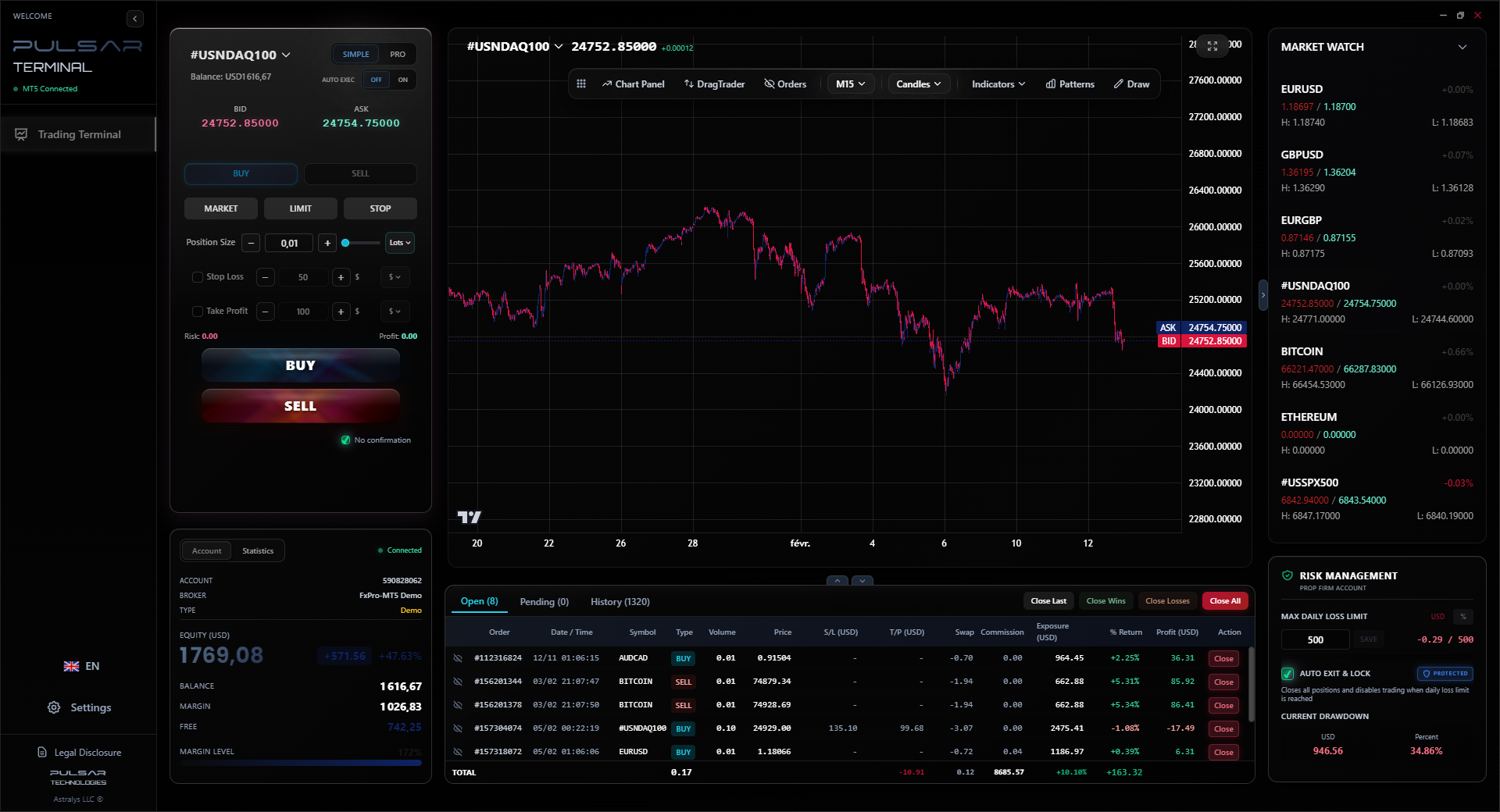
When you're trading volatile sessions, managing multiple trades and stop-losses manually is a nightmare; Pulsar Terminal lets you set multi-level take-profits and trailing stops on MT5 with one click, so you can focus on the charts, not the order tickets.
Pulsar Terminal
Công cụ MT5 tất-cả-trong-một: đặt lệnh kéo-thả, multi-TP/SL, trailing stop, grid trading, Volume Profile và bảo vệ prop firm. Hơn 1.000 trader sử dụng mỗi ngày.
We have unique challenges. Let's address them.
Electricity (NEPA/DisCo): You can't trade the London overlap if there's no light. Have a backup. A decent power bank for your laptop, a small inverter, or a plan to use your phone's hotspot and trade on a mobile app. Brokers like Exness and XM have strong mobile platforms. A generator is ideal, but mind the fuel cost.
Internet Data: Trading consumes very little data, but reliability is everything. A 5-second disconnect during a volatile period can mean a missed stop-loss or a failed entry. Use a stable network. The monthly data cost of ₦10,000 – ₦20,000 is a necessary business expense. Don't cheap out and use a shaky public Wi-Fi for trading.
Funding Your Account: Remember the CBN rule: you can't use official banking channels to fund international trading accounts. You'll use payment processors or crypto. This means your deposit and withdrawal times can be slower than advertised. Factor this into your capital management. Don't plan to withdraw profits to pay a bill due the next day.
Taxes: Set aside 10% of your gross profits for capital gains tax. Keep simple but clear records of your trades. The taxman may not understand forex, but they understand numbers in an account.
Broker Choice: Your broker's server location matters. If you're trading the London session, a broker with servers in London (like IC Markets or Pepperstone) will give you faster execution than one with servers in the Seychelles. Lower latency means better fills, especially for scalping.
💡 Mẹo của Winston
If you must hold a trade over the weekend, calculate the swap (rollover) fees. Holding a GBP/JPY position over a weekend can cost you more in fees than a small winning trade makes.
“In Nigeria, your lunch break isn't for eating; it's for checking the stop-loss you set at the London open.”
Success comes from consistency, not luck. Here’s a sample routine for a Nigerian day trader with a job.
6:00 AM: Wake up. Quickly scan the markets on your phone. Any major moves in Asia? Check economic calendar for the day. No trading.
7:30 AM - 8:30 AM: London is opening. Assess the price action. Are we continuing yesterday's trend? Look for key levels on the 1-hour chart. Maybe place a pending order if a clear setup is there.
12:30 PM (Lunch): Critical check. How are your orders/trades? Manage them. The golden overlap is about to start. Adjust stop-losses to breakeven if in profit.
1:00 PM - 4:00 PM: If you can, this is active monitoring time. If you can't, ensure all trades have stop-loss and take-profit orders set. This is when you might actively look for new scalping entries if you're free.
7:00 PM: Market is winding down. Close any day trades you don't want to hold overnight. Review all closed trades. What worked? What didn't? Update your journal.
Friday 6:00 PM: Close all speculative positions unless you have a strong swing trading thesis. Don't give back weekend gap risk.
This routine turns the chaotic 24-hour forex market open time into a structured business schedule. It removes emotion and impulse. You trade when the odds are in your favor, not just when you're bored.
FAQ
Q1What is the best forex market open time for a beginner in Nigeria?
Stick to the London session, from 10 AM to 12 PM Nigeria time. It's active but not as chaotic as the overlap. Avoid news times and weekends completely. Focus on learning price action when the market is moving predictably.
Q2Can I trade forex at night in Nigeria?
You can, but you shouldn't as a beginner. The active night session (US session) runs from about 1 PM to 10 PM Nigeria time. After 10 PM, liquidity drops sharply into the Asian 'dead zone.' Trading after midnight is typically low-volatility and frustrating.
Q3What time does the forex market open on Sunday in Nigeria?
The market re-opens for the new week around 11 PM Nigerian time on Sunday (which is Monday morning in Asia). This is a notoriously tricky time with wide spreads and potential gaps. It's best to wait until the London open (8 AM Monday Nigeria time) for stable conditions.
Q4Is the forex market open on Saturday in Nigeria?
No. The global forex market is closed from approximately 10 PM Nigeria time on Friday until 11 PM Nigeria time on Sunday. No legitimate broker will allow live trading during this period.
Q5What is the most volatile forex market open time for Nigeria?
The most volatile period is the London/New York overlap, from 1 PM to 5 PM Nigeria time. This is when the highest volume occurs, leading to faster, larger price movements. This is also when major US economic data is often released (around 2:30 PM our time).
Q6How does Nigeria's time zone (GMT+1) affect forex trading?
It's a major advantage. Our time zone places us perfectly to trade the European morning (London session) before work and the key London/New York overlap in the early afternoon. We don't have to stay up extremely late or wake up in the middle of the night to catch the most liquid sessions.
Q7Do spreads change at different market open times?
Absolutely. Spreads are tightest during the high-volume London/New York overlap (1-5 PM Nigeria time). They are widest during low-liquidity periods like the late Asian session (4-8 AM Nigeria time) or around major news events. Always check the live spread before entering a trade.
Bài học của Prof. Winston
Điểm chính:
- ✓Trade the London/NY overlap (1-5 PM WAT) for highest probability.
- ✓Avoid the Asian session (12-8 AM WAT) for EUR/USD scalping.
- ✓Always check live spreads before entering any trade.
- ✓Never trade the Sunday market open (11 PM WAT).
- ✓Set aside 10% of gross profits for capital gains tax.
Bài viết này hữu ích thế nào?
Nhấp vào ngôi sao để đánh giá
Nhận định giao dịch hàng tuần
Phân tích & chiến lược miễn phí hàng tuần. Không spam.
Về tác giả
Olumide Adeyemi
Nhà tiên phong Giao dịch Tây Phi
Một trong những nhà đào tạo forex tích cực nhất tại Nigeria. 8 năm kinh nghiệm giao dịch từ Lagos. Chuyên về chiến lược vốn thấp và thử thách prop firm dành cho trader châu Phi.
Bình luận
Cảnh báo rủi ro
Giao dịch các công cụ tài chính tiềm ẩn rủi ro đáng kể và có thể không phù hợp với tất cả nhà đầu tư. Hiệu suất trong quá khứ không đảm bảo kết quả trong tương lai. Nội dung này chỉ mang tính chất giáo dục và không nên được coi là lời khuyên đầu tư. Hãy luôn tự nghiên cứu trước khi giao dịch.
Bạn cũng có thể thích

Cara Trading Forex Sukses: 7 Prinsip dari Trader Profesional
Cara trading forex sukses dengan 7 prinsip trader pro: manajemen modal, disiplin, journal trading, backtest. Data nyata, bukan janji profit palsu.
Jam Trading Forex Terbaik untuk Trader Indonesia: Panduan Lengkap dengan Tabel Waktu
Panduan jam trading forex untuk trader Indonesia. Tabel 4 sesi dunia, jam emas 20:00-00:00, sesi mana yang harus dihindari. Data akurat + tips dari trader berpengalaman.
Top 5 Sàn Forex Uy Tín Nhất 2026: Review Jujur dari Trader Indonesia
Top 5 sàn forex uy tín 2026 untuk trader Indonesia. Review jujur: spread, deposit, withdraw, dukungan lokal. Exness, XM, IC Markets & lebih.
Tải Pulsar Terminal
Tất cả các công cụ tính này được tích hợp trong Pulsar Terminal với dữ liệu thời gian thực từ tài khoản MT5 của bạn.
Tải Pulsar Terminal