


I remember staring at the USD/ZAR chart in late 2024, convinced it was about to break lower.

David van der Merwe
Nhà giao dịch Thị trường Mới nổi ·  South Africa
☕ 10 phút đọc
Bạn sẽ học được:
- 1What Exactly is Market Structure? It's Not Just Lines on a Chart
- 2The Four Market Structure Patterns You Need to Memorize
- 3Applying This to ZAR Pairs: It's a Different Beast
- 4A Real Trade Plan: From Spotting to Executing
- 5Mistakes I Made (So You Don't Have To)
- 6The Right Tools for the Job in South Africa
- 7How to Practice Without Losing a Cent
I remember staring at the USD/ZAR chart in late 2024, convinced it was about to break lower. I'd seen a nice little pullback and what looked like a lower high. I went short at 18.75, feeling clever. The market didn't agree. It ripped right past my entry, took out the previous high, and didn't stop until it hit 19.93 in April 2025. I was stopped out for a 1,180 pip loss. That trade cost me over R 11,800 on a standard lot. The painful lesson? I completely misread the underlying market structure. I was trading a minor pullback within a much stronger, intact uptrend. Understanding these patterns isn't just theory, it's the difference between catching a trend and getting run over by one.
Forget fancy indicators for a second. Market structure is the raw skeleton of price action. It's how the market organizes itself through a series of highs and lows. Think of it like the foundation of a house. You can have the prettiest wallpaper (indicators), but if the foundation is cracked, the whole thing collapses.
In simple terms, market structure tells you two things: the current trend's health and where it might be changing. In South Africa, with our volatile ZAR pairs, getting this right is critical. A sudden shift in structure on USD/ZAR can mean thousands of rands in minutes.
There are three core states: uptrend (making higher highs and higher lows), downtrend (lower highs and lower lows), and range (price bouncing between two horizontal levels). Most of your trading mistakes, like my USD/ZAR disaster, happen when you mistake one state for another. A good swing trading plan always starts by defining the structure.

💡 Mẹo của Winston
A trend isn't over until it makes a lower low in an uptrend or a higher high in a downtrend. Everything before that is just noise. Wait for that Change of Character.
“Understanding these patterns isn't just theory, it's the difference between catching a trend and getting run over by one.”
1. Break of Structure (BOS) & Change of Character (CHoCH)
This is the bread and butter. A Break of Structure happens when price decisively moves past a previous significant high (in an uptrend) or low (in a downtrend). It confirms the trend is still alive. A Change of Character is more important. It's when price breaks a prior low in an uptrend or a prior high in a downtrend. This is the first warning sign the trend might be exhausted.
I used to ignore CHoCH signals, thinking they were just deep pullbacks. Big mistake. On EUR/ZAR in Q1 2026, price broke below a key swing low at 20.15 after a long rise. That was the CHoCH. It didn't crash immediately, but it consolidated and then fell another 800 pips. That early warning was priceless.
2. Fair Value Gaps (FVGs) & Imbalances
These are my secret weapon for entries. A Fair Value Gap is a three-candle pattern where the middle candle's range doesn't overlap with the range of the candle before or after it. It leaves a 'gap' or imbalance on the chart. The market has a tendency to return to fill these gaps. On fast-moving pairs like GBP/ZAR, I'll often place a limit order to buy in a bullish FVG during a pullback. It's not a guaranteed fill, but when it works, your risk is tiny because your stop can go just below the gap.

Example: Price candles at 22.50, 22.80 (high) to 22.60 (low), then 22.90. The middle candle's low (22.60) is above the first candle's high (22.50). That's a FVG between 22.50 and 22.60. The market will often dip back into that zone.
3. Order Blocks
Think of these as the engine rooms for big moves. An order block is a consolidation area (often a candle or a small cluster) right before a strong, impulsive price move. The idea is that large orders were filled there. When price returns to that same area, those big players might add to their positions, causing another reaction. I look for bullish order blocks below price in an uptrend - areas to buy the dip.
4. Liquidity Pools
This sounds complex, but it's simple. Markets move to take liquidity - to trigger stops. The most obvious liquidity pools are above obvious highs (where sell stops are) and below obvious lows (where buy stops are). A classic move is a 'liquidity grab': price will spike above a high, trigger all the stops, and then reverse sharply. Seeing this pattern stopped me from chasing breakouts many times. Always ask: is this a real breakout, or just a liquidity grab?
“A break of structure during the London open on GBP/ZAR is more significant than one at 3 AM SA time. Who is driving the move?”
Trading USD/ZAR, EUR/ZAR, or GBP/ZAR with these patterns requires a specific mindset. The spreads are wider, the moves are more volatile, and news hits harder. You can't apply the same tight stop-losses you would on EUR/USD.
Here’s what works for me locally:
- Wider Confirmation: On majors, I might enter on a single candle closing beyond a structure point. On ZAR pairs, I wait for a 4-hour or even daily candle to close beyond the level. The fakeouts are brutal.
- Respect the Range: ZAR pairs can spend weeks in a massive range, especially around local budget speeches or SARB announcements. During these times, fade the extremes - sell near the range high, buy near the range low. The middle is no-man's land.
- Commodity Correlation is Key: A strong gold price often supports the ZAR. If XAU/USD is breaking its market structure to the upside, think twice before taking a heavy short on USD/ZAR. I keep a chart of gold (XAU/USD guide) open at all times.
My most consistent ZAR trade? Selling USD/ZAR rallies into old breakdown levels (previous support turned resistance). In early 2026, when it rallied back to 18.50 (a major previous support area from late 2023), the market structure showed clear weakness - it couldn't make a higher high. That was a high-probability short.

Warning: The 30:1 use cap from the FSCA is a blessing in disguise for ZAR pairs. With their volatility, using higher use from an offshore broker might get you a margin call on a normal daily swing. Stick to sensible position size calculator inputs.
💡 Mẹo của Winston
The most powerful order blocks form on high timeframes after a long, quiet consolidation. That's where the big banks accumulate. Watch the daily and weekly charts.
“A break of structure during the London open on GBP/ZAR is more significant than one at 3 AM SA time. Who is driving the move?”
Let's walk through a recent example on GBP/ZAR, step-by-step.
- Identify the Macro Structure: In March 2026, GBP/ZAR was in a clear daily downtrend (lower highs, lower lows). The last lower high was at 23.80.
- Wait for a Pullback: Price rallied up. The question was: is this a reversal or just a pullback to sell into? I watched for a Change of Character. It didn't break any major highs.
- Find a Confluence Zone: The pullback approached the 23.50-23.60 zone. This was a) near the previous lower high (resistance) and b) a zone where a large Fair Value Gap had been left on the way down.
- Entry & Management: I placed a sell limit order at 23.55. My stop went above the recent swing high at 23.85. My first profit target was the recent low at 22.90. The risk was 300 pips, the reward 650 pips. I used a 2:1 reward-to-risk ratio as a minimum.
- The Result: Price tapped 23.58, filled my order, and dropped. I took half profit at 22.90 and moved my stop to breakeven. The rest ran down to 22.40.
The key was patience and waiting for the structure to give me a high-odds setup. I didn't use a single traditional indicator like RSI indicator or MACD indicator for this decision. Pure structure.

Pro Tip: Draw your structure levels on a higher timeframe (like daily), then drop down to the 4-hour or 1-hour to fine-tune your entry. The higher timeframe defines the story, the lower one gives you the chapter.
“The 30:1 use cap from the FSCA is a blessing in disguise for ZAR pairs.”
We learn more from losses. Here are my expensive lessons:
- Trading Against the Higher Timeframe Structure: This was my USD/ZAR blunder. The weekly chart was screaming uptrend. I tried to pick a top on the 4-hour chart. Never fight the bigger trend. The EUR/USD guide principles of trend apply everywhere, even on volatile pairs.
- Overcomplicating It: I used to mark up every tiny high and low. My chart was a spiderweb of lines. It was noise. Now, I only mark the most obvious, recent swing points. If it's not clear, it's not a valid structure point.
- Ignoring the 'Why' Behind the Move: A break of structure during the London open on GBP/ZAR is more significant than one at 3 AM SA time. Who is driving the move? If the break happens on low volume or thin liquidity, it's more likely to fail.
- Not Adjusting for the Broker: Your broker's feed matters. I once plotted structure levels using data from IC Markets review (an ECN broker), then tried to trade them on a different broker with a dealing desk. The levels were slightly off, and my stops got picked off. Stick to one good, low-spread definition broker like Pepperstone review or Exness review for consistency.
💡 Mẹo của Winston
If you can't clearly draw the structure within 10 seconds of looking at a chart, walk away. The market is in a messy transition, and that's when amateurs lose money.
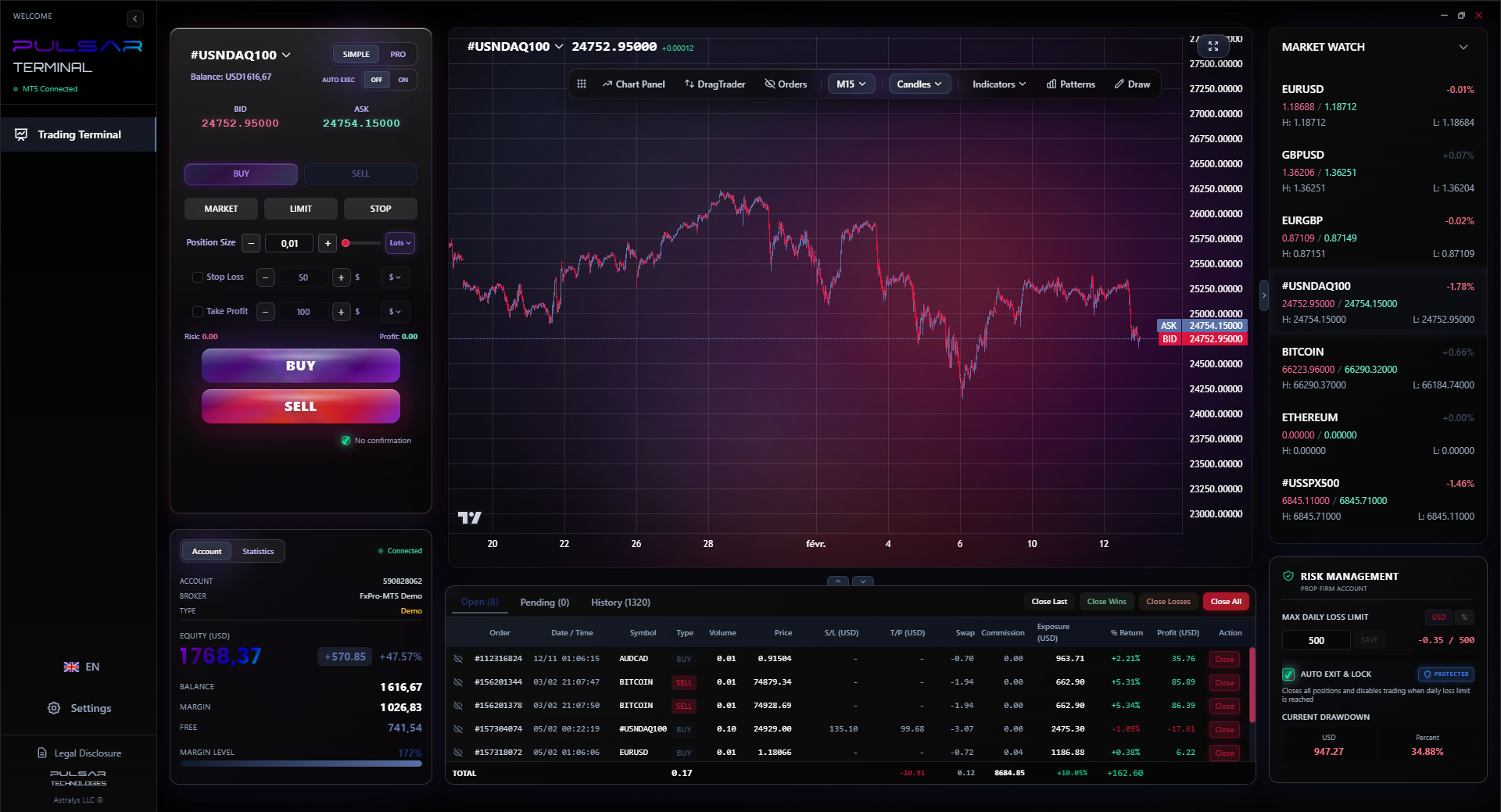
Manually moving stops to breakeven after a partial close is a hassle; Pulsar Terminal automates this and manages multi-target trades directly on your MT5 chart.
Pulsar Terminal
Công cụ MT5 tất-cả-trong-một: đặt lệnh kéo-thả, multi-TP/SL, trailing stop, grid trading, Volume Profile và bảo vệ prop firm. Hơn 1.000 trader sử dụng mỗi ngày.
“The 30:1 use cap from the FSCA is a blessing in disguise for ZAR pairs.”
You can't build a house with a spoon. Here’s what you need locally.
Platforms:
- MetaTrader 4/5: The universal standard. MT5 is better for depth of market. Every decent broker, from XM review to local FSCA-regulated ones, offers it.
- TradingView: Unbeatable for drawing and analysis. I do all my structure analysis on TradingView, then execute on MT5.
Broker Considerations:
- Regulation is Non-Negotiable: Only use FSCA-regulated brokers. Check the FSP number on their site. It protects your funds.
- Spreads on ZAR Pairs: Compare. The spread definition on USD/ZAR can vary from 30 pips to 80 pips between brokers. That's a huge cost difference. Look for tight spreads, especially if you're into scalping strategy.
- Execution Speed: For structure trading, you need fast execution. A slow broker means your order fills at a worse price when you're trading a break of structure.
A Local Reality Check: Funding and withdrawing. Use brokers that support instant EFTs into South African bank accounts. Dealing with international wire transfers and SARB approvals is a headache you don't need. Check the payment methods before you deposit.
“If you can't clearly draw the structure within 10 seconds of looking at a chart, walk away.”
You wouldn't perform surgery after just reading a book. Don't trade real money until you've drilled this.
- Go Historical: Pick a pair, like USD/ZAR. Open a chart from 2023. Hide all the candles to the right. Start scrolling forward candle by candle. Mark the structure (highs/lows), predict where you think price will go next, then reveal the next candle. It's humbling and educational.
- Paper Trade for 3 Months: Open a demo account with a reputable broker. Treat it like real money. Use a realistic account size (e.g., R 20,000). Track every trade in a journal. Note the market structure setup for each one. Your goal isn't profit, it's consistency in identifying and acting on these patterns.
- Start Small for Real: When you go live, start with a micro account. Risk no more than 1% of your capital per trade. Your first 100 real trades are still part of your education. The goal is to survive long enough for the lessons to sink in.
Remember, understanding forex market structure patterns gives you a map in a chaotic market. It won't predict every turn, but it will tell you if you're climbing a mountain or walking into a valley. In South Africa's fast-moving market, that knowledge isn't just power, it's protection.
FAQ
Q1What's the most important market structure pattern for beginners to learn first?
Start with the Break of Structure (BOS) and Change of Character (CHoCH). They are the fundamental building blocks. If you can correctly identify whether a trend is making new extremes (BOS) or showing its first sign of failure (CHoCH), you're already ahead of 50% of retail traders. Practice spotting these on daily charts first, where they are clearest.
Q2How do I know if a break of structure is real or a fakeout (liquidity grab)?
Look for two things: closing momentum and follow-through. A real break will typically have a strong candle that closes decisively beyond the level. A fakeout often has a long wick that spikes past the level but then closes back within the old range. Also, wait for a retest. Price often comes back to retest the broken level as new support/resistance. If it holds, the break is more valid.
Q3Are these patterns reliable on all timeframes?
They exist on all timeframes, but their significance changes. A structure break on a weekly chart carries far more weight than one on a 5-minute chart. For direction, trust the higher timeframe structure (like 4-hour or daily). Use the lower timeframes (1-hour, 15-minute) to find precise entries within that higher-timeframe context. Don't get lost in the noise of a small timeframe.
Q4How does the 30:1 use limit in South Africa affect trading with these patterns?
It forces better risk management, which is a good thing. With volatile ZAR pairs, a 200-pip stop-loss is common. At 30:1 use, the margin required is higher, so you naturally trade smaller position sizes. This prevents you from blowing up your account on one bad structure read. Always use a position size calculator.
Q5Can I use market structure patterns for scalping?
Absolutely, but it's advanced. Scalping requires reading structure on very low timeframes (1-min, 5-min), where noise is high. The patterns form and break quickly. It's intense. I'd recommend mastering structure on the 1-hour and 4-hour charts first. If you want to try scalping strategy, use it on major pairs like EUR/USD during high-liquidity sessions, not on ZAR pairs initially.
Q6Do I still need indicators if I'm trading market structure?
You don't need them. Pure price action is sufficient. However, some traders use simple indicators as confluence. For example, a break of structure that also causes the MACD indicator to cross can add confidence. But the structure should be your primary guide. Indicators are lagging; structure is real-time.
Q7What's the biggest psychological challenge when trading structure?
Patience and accepting being wrong. You will draw a structure level, and price will blow right through it, invalidating your idea. The challenge is to not get married to your analysis. The market is always right. When structure breaks against you, accept it, exit if necessary, and wait for the next clear setup. Revenge trading after a structure fails is a sure path to losses.
Bài học của Prof. Winston
Điểm chính:
- ✓Trade with the higher timeframe structure, not against it.
- ✓A Change of Character (CHoCH) is your first exit warning signal.
- ✓Use Fair Value Gaps for low-risk, high-probability entries.
- ✓On ZAR pairs, wait for a daily close to confirm a break.
- ✓Risk a maximum of 1% per trade, no matter how sure you are.
Bài viết này hữu ích thế nào?
Nhấp vào ngôi sao để đánh giá
Nhận định giao dịch hàng tuần
Phân tích & chiến lược miễn phí hàng tuần. Không spam.
Về tác giả
David van der Merwe
Nhà giao dịch Thị trường Mới nổi
Trader tại Johannesburg với 11 năm kinh nghiệm về tiền tệ thị trường mới nổi. Chuyên về cặp ZAR, giao dịch theo quy định FSCA và phân tích thị trường Nam Phi.
Bình luận
Cảnh báo rủi ro
Giao dịch các công cụ tài chính tiềm ẩn rủi ro đáng kể và có thể không phù hợp với tất cả nhà đầu tư. Hiệu suất trong quá khứ không đảm bảo kết quả trong tương lai. Nội dung này chỉ mang tính chất giáo dục và không nên được coi là lời khuyên đầu tư. Hãy luôn tự nghiên cứu trước khi giao dịch.
Bạn cũng có thể thích

Cara Trading Forex Sukses: 7 Prinsip dari Trader Profesional
Cara trading forex sukses dengan 7 prinsip trader pro: manajemen modal, disiplin, journal trading, backtest. Data nyata, bukan janji profit palsu.
Jam Trading Forex Terbaik untuk Trader Indonesia: Panduan Lengkap dengan Tabel Waktu
Panduan jam trading forex untuk trader Indonesia. Tabel 4 sesi dunia, jam emas 20:00-00:00, sesi mana yang harus dihindari. Data akurat + tips dari trader berpengalaman.
Top 5 Sàn Forex Uy Tín Nhất 2026: Review Jujur dari Trader Indonesia
Top 5 sàn forex uy tín 2026 untuk trader Indonesia. Review jujur: spread, deposit, withdraw, dukungan lokal. Exness, XM, IC Markets & lebih.
Tải Pulsar Terminal
Tất cả các công cụ tính này được tích hợp trong Pulsar Terminal với dữ liệu thời gian thực từ tài khoản MT5 của bạn.
Tải Pulsar Terminal