


You're staring at the charts, the Naira's bouncing like a yoyo, and you're wondering if there's a method to this madness.

Olumide Adeyemi
Nhà tiên phong Giao dịch Tây Phi ·  Nigeria
☕ 10 phút đọc
Bạn sẽ học được:
- 1Why News Matters More in Nigeria
- 2The Nigerian News Hierarchy: What Actually Moves the Market
- 3A Practical News Trading Setup for Nigerian Traders
- 4Global Headlines vs. Local Drama: Two Different Games
- 5Your Survival Guide: Risk Management When News Hits
- 6Essential Tools & Resources You Actually Need
- 7Putting It All Together: A Week in the Life
You're staring at the charts, the Naira's bouncing like a yoyo, and you're wondering if there's a method to this madness. Is there a way to actually make sense of all the noise? The truth is, in Nigeria, forex news analysis isn't just about reading headlines. It's about understanding a market where official rates, parallel market prices, and CBN pronouncements create a unique, volatile playground. I've traded through multiple CBN governors, currency devaluations, and policy flip-flops. Let me show you how to separate the signal from the noise.
Forget what you've heard about trading in calm, developed markets. Here, news isn't background noise; it's the main event. The spread between the official CBN window and the parallel market can be 50 NGN or more. A single tweet from a government official can send USD/NGN spiking 5% in an hour. I learned this the hard way in 2023. I was short USD/NGN, thinking the downtrend would continue. Then a rumor hit Twitter (X) about a major policy shift. Within 90 minutes, my position was down 120 pips. I got stopped out, and of course, the rumor was false. The market snapped back, but my money was already gone.
This volatility is a double-edged sword. It creates massive risk, but also huge opportunity for those who know how to read the signs. Your standard technical analysis on EUR/USD might work fine, but with Naira pairs, you're trading politics as much as economics. The key is knowing which news sources move the market and which are just hot air.

Warning: Never hold a significant position in NGN pairs over a weekend when the CBN is due to make an announcement. I've seen too many accounts blown up on a Sunday night because traders got greedy and didn't want to pay the weekend swap. Close it out, take the small cost, and live to trade Monday.
“In Nigeria, you're trading politics as much as economics.”
Not all news is created equal. You need to know which announcements have real teeth.
Tier 1: CBN Directives and Monetary Policy Committee (MPC) Meetings
This is the big one. When the CBN speaks, the market listens. The MPC meeting statements, especially regarding interest rates (the Monetary Policy Rate, or MPR) and foreign exchange management, are non-negotiable. You must know when these are scheduled. The recent Nigeria Foreign Exchange Code (effective Dec 2024) is a perfect example. It didn't just tweak rules; it reshaped the entire wholesale market framework for banks. If you weren't analyzing that document, you missed the structural shift.
Tier 2: FAAC Allocations and External Reserve Data
The Federation Account Allocation Committee (FAAC) news tells you how much liquidity is hitting the states. More liquidity can pressure the Naira. The external reserves number is critical. Remember April 2026? Reserves dropped $850 million in three weeks, killing a nine-month uptrend. That's a fundamental shift in market sentiment. I used that data to go long USD/NGN, entering around 1385 and exiting at 1410. It wasn't a fancy trade, just basic forex news analysis of a hard number.
Tier 3: Fuel Price Announcements and Inflation Figures
These are proxies for economic stress. Rising fuel costs directly feed into inflation, which pressures the CBN to hike rates. The World Bank's 4.2% growth forecast for 2026 is positive, but you must weigh it against these local pressures.
What to Ignore (Mostly)
Political grandstanding from non-financial officials. Endless analyst opinions on TV that don't cite new data. Focus on primary sources: the CBN website, the National Bureau of Statistics, and credible financial newswires.

💡 Mẹo của Winston
The market's initial reaction to news is often an emotional overrejection. The real money is made trading the rational correction that follows in the next 15-60 minutes.
“Survive first, get rich later. Reduce your normal position size by 50% for high-impact news.”
Here's how I structure my trading around news. It's not about guessing the outcome; it's about preparing for volatility.
1. The Pre-News Checklist (1 Hour Before):
- Know the Expected Figure: What is the consensus forecast for the MPC rate? What was the last reserves number?
- Check Correlated Pairs: Is USD/JPY or EUR/USD showing unusual strength? That can amplify moves in USD/NGN.
- Set Alerts: Price alerts 20 pips above and below the current market. No time to stare at the screen.
- Calculate Your Position Size for a Worst-Case Scenario. I reduce my normal size by 50% for high-impact news. If my usual lot size is 0.1, I trade 0.05. Survive first, get rich later.
2. The 5-Minute Window (Strategy): I don't trade the initial spike. It's pure chaos. I wait for the first 2-3 minutes of insane volatility to pass. Then, I look for a rejection. For example, if USD/NGN spikes 80 pips on news and then fails to make a new high for 60 seconds, that's a potential short signal. The RSI indicator on a 1-minute chart can help spot these extreme overbought/oversold conditions in the aftermath.
3. The Broker Problem: This is crucial. During major CBN news, spreads on NGN pairs can widen to 100 pips or more with some brokers. You think you're entering at 1390, but your fill is at 1400. That's a loss before you even start. I use brokers with a reputation for stable execution during volatility, like IC Markets or Pepperstone. Test your broker with smaller trades during minor news events first.

Example: MPC rate decision. Expected: Hold at 18.75%. Actual: Hike to 19.25%.
- Immediate Reaction: Naira strengthens. USD/NGN drops 70 pips.
- My Play: I wait. If the price stalls and the MACD indicator on the 5-min chart shows loss of downward momentum, I might look for a long entry to catch the "sell the rumor, buy the fact" retracement. The initial move is often overdone.
“Survive first, get rich later. Reduce your normal position size by 50% for high-impact news.”
You need two separate playbooks.
Trading EUR/USD or XAU/USD (Global Pairs): Here, you're trading US Non-Farm Payrolls, ECB speeches, and US inflation. The advantage? These events are scheduled years in advance. The data is usually clean and reported uniformly. The market reaction is often more "textbook." A strong NFP number should boost the USD. This is where classic forex news analysis strategies work well. I often use a scalping strategy on the EUR/USD after FOMC meetings, aiming for 15-20 pips as the market digests the statement.
Trading USD/NGN (Local Pairs): This is a different beast. The news is local, the liquidity is thinner, and the reactions are emotional. A "positive" news story (like the Naira being the world's 2nd best performer in Q1 2026) can sometimes lead to profit-taking and a weaker Naira in the short term. You have to ask: "Is this news already priced in?" The Bloomberg BMatch system rollout, which won awards in 2026, was a long-term positive for market transparency. But the trading opportunity was in the uncertainty during its implementation phase, not the celebration after.
| Aspect | Global News (e.g., EUR/USD) | Local Nigerian News (e.g., USD/NGN) |
|---|---|---|
| Predictability | High (Scheduled calendars) | Low (CBN can act anytime) |
| Data Quality | Standardized, audited | Sometimes opaque, revised later |
| Liquidity Impact | Spreads widen moderately | Spreads can blow out completely |
| Best Strategy | Fade the initial spike, or follow the breakout | Extreme caution. Often better to watch and trade the aftermath. |
The smart move for most Nigerian traders? Use global news to trade major pairs for consistent, smaller gains. Use local news to inform longer-term swing trading views on the Naira, not for intraday punts.
💡 Mẹo của Winston
If you can't explain in one sentence *why* a specific piece of news should move a currency pair, you have no business trading it. No story, no trade.
“The biggest move often happens *after* the initial spike. Don't jump in on the first tiny pullback.”
This is where I see most traders fail. They get the analysis right but get slaughtered on execution.
1. Guaranteed Slippage: Assume you will get slipped. If your stop loss is 30 pips away, the market might gap 50 pips past it. Your stop becomes a market order filled at a terrible price. The solution? Don't place tight stops before major news. If you must have a stop, make it a mental one and be prepared to manually exit at a reasonable loss.
2. The Margin Call Monster: Increased volatility means your margin requirement can spike. A 200-pip move against you on a highly leveraged account is a one-way ticket to a margin call. Before a major event like FAAC or reserve data, I deliberately reduce my overall use. I might go from 1:50 to 1:20. It feels like you're leaving money on the table, but it's what keeps you in the game.
3. The Post-News Trap: The biggest move often happens after the initial spike. The market takes a breath, then resumes the trend. Don't jump in on the first tiny pullback. Wait for a clear 5-minute or 15-minute candle to close in the direction you want to trade. Patience isn't just a virtue here; it's a capital preservation tool.

Pro Tip: Have two accounts. One for "normal" trading, and a small, separate account specifically for news plays. Fund the news account with money you can afford to lose completely. This psychological trick lets you trade the volatility without the fear that paralyzes you.
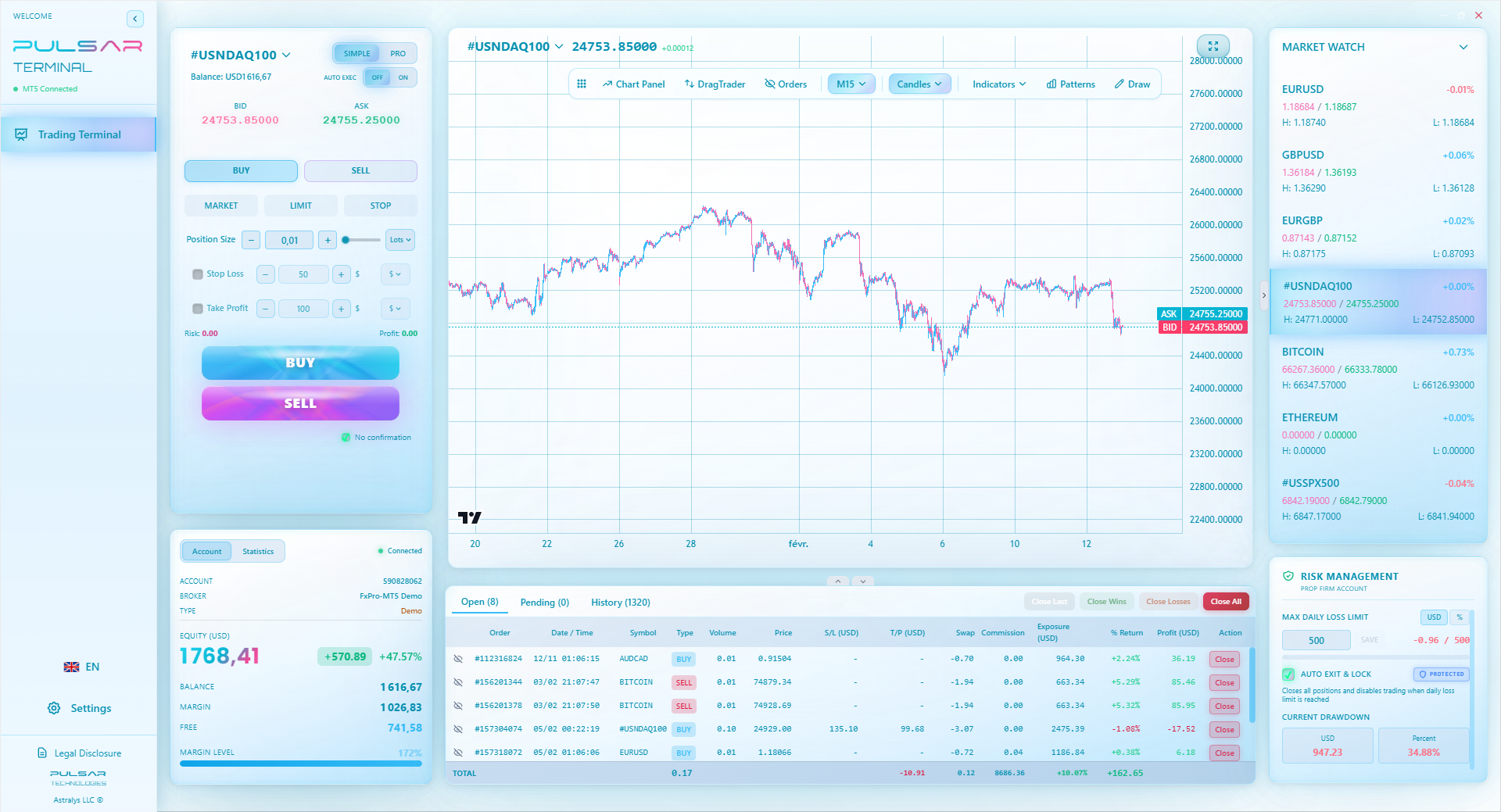
Managing multiple trades and tight stops during volatile news events is nearly impossible manually, which is where a tool like Pulsar Terminal's drag-and-drop order management and automated trailing stops on MT5 becomes a lifesaver.
Pulsar Terminal
Công cụ MT5 tất-cả-trong-một: đặt lệnh kéo-thả, multi-TP/SL, trailing stop, grid trading, Volume Profile và bảo vệ prop firm. Hơn 1.000 trader sử dụng mỗi ngày.
“The biggest move often happens *after* the initial spike. Don't jump in on the first tiny pullback.”
You don't need a Bloomberg terminal. You need the right free tools.
Economic Calendars: Use Investing.com's calendar. Filter for "High Impact" events. Mark these in your local time (WAT). The US session is 2-11pm your time. Plan your life around it.
Primary Sources (Bookmark These):
- Central Bank of Nigeria Website: For MPC communiqués, circulars, and the FX code.
- National Bureau of Statistics: For inflation, GDP, and trade balance data.
- FMDQ Securities Exchange: For official FX market data (though access can be limited).
News Aggregators: Avoid Nairaland forums for trade ideas. The signal-to-noise ratio is terrible. Use Reuters or Bloomberg headlines (free versions are fine) for the raw facts.
Charting Tools: Your trading platform's charts are enough. The key is setting up simple indicators like a 50 and 200-period moving average to see the trend before the news hits. Is price above or below these key levels? That context determines if a news spike is likely to continue or reverse.
Remember, the tool is only as good as the trader. I once spent $200/month on a fancy news wire service, only to realize I was just getting the same information 10 seconds faster. It made no difference to my bottom line. Save your money.
💡 Mẹo của Winston
Your profit target on a high-impact news trade should be at least 3 times your stop loss. If you're risking 20 pips, aim for 60+. The volatility justifies the wider stop and demands a bigger reward.
“Missing one trade is not a problem; losing your capital is.”
Let's walk through a hypothetical week with real mechanics.
Monday: External Reserves data is due. Last reading: $49.18bn. Forecast: $49.0bn. The trend is down. My bias: Bearish for Naira (Bullish for USD/NGN). I check my position size calculator. Max risk: 1% of account. I plan to sell USD/NGN if it rallies after a bad number, looking for a continuation of the downtrend in reserves. I set a price alert at 1395.
Wednesday: US CPI Data. I'm not touching USD/NGN. I'm watching XAU/USD (Gold). High US inflation could sink gold. I have a small swing trading position in gold. I decide to tighten my stop loss to breakeven before the news, protecting my capital from a volatility wipeout.
Thursday: CBN Governor gives a speech. This is unpredictable. I close any NGN-related positions before the speech. I will only trade in the 30 minutes after, if a clear direction emerges. My lot size will be 25% of normal.
Friday: End of week. I review. Did I follow my rules? Did I let a news trade run beyond my planned exit? I note that the spread on my broker for USD/NGN widened to 15 pips during the CBN speech, from a normal 5. I factor that into my risk models for next time.
The goal isn't to trade every news event. It's to be prepared, pick your battles, and survive. Over a year, if you can be net positive on your high-impact news trades, you're in the top 10% of traders here.
FAQ
Q1Is forex news trading legal in Nigeria?
Yes, trading forex as an individual is legal. However, you must use a broker that is licensed to operate. Many brokers serving Nigeria are regulated offshore (like by CySEC or FCA) as the local SEC framework for retail forex is still developing. Never use a broker promising guaranteed returns or pooling funds; that's an illegal scheme.
Q2What's the most important news source for trading the Naira?
Hands down, the Central Bank of Nigeria (CBN). Their Monetary Policy Committee (MPC) statements, foreign exchange circulars (like the 2024 FX Code), and data on external reserves are the primary market movers. Ignore political noise; focus on the CBN's official communications.
Q3How much money do I need to start news trading?
More than you think. Due to inevitable slippage and spread widening, you need a buffer. I'd say a minimum of $500 in a live account, and even then, trade micro lots (0.01). Your first goal is to experience the volatility without blowing up. A $100 account will likely be wiped out by a single bad fill on a major news day.
Q4Should I trade the official rate or the parallel market rate?
You trade the rate your broker provides, which is based on the interbank market. It will generally track between the official and parallel rates but can be more volatile. The parallel market rate is a sentiment indicator. A widening gap between it and the official rate signals stress and potential for an official devaluation or policy change.
Q5Can I make a living from forex news trading in Nigeria?
A very small percentage do. It's incredibly stressful and requires immense discipline. Most successful traders I know use news to inform longer-term swings or to avoid losses, not as their primary income source. Have a steady income first, then let trading supplement it. Don't quit your job.
Q6What's the biggest mistake Nigerian traders make with news?
Overtrading and over-leveraging. They see volatility as a guaranteed opportunity and throw too much money at it with too much use. They also trade based on rumors from social media instead of waiting for the official data. The market will always be there. Missing one trade is not a problem; losing your capital is.
Bài học của Prof. Winston
Điểm chính:
- ✓CBN announcements are Tier 1 market movers; ignore political noise.
- ✓Always assume 50-100 pip spread widening on NGN pairs during news.
- ✓Reduce position size by 50% before scheduled high-impact events.
- ✓Trade the 5-minute chart after the initial spike, not during it.
- ✓Use global news for majors (EUR/USD), local news for Naira swing context.
Bài viết này hữu ích thế nào?
Nhấp vào ngôi sao để đánh giá
Nhận định giao dịch hàng tuần
Phân tích & chiến lược miễn phí hàng tuần. Không spam.
Về tác giả
Olumide Adeyemi
Nhà tiên phong Giao dịch Tây Phi
Một trong những nhà đào tạo forex tích cực nhất tại Nigeria. 8 năm kinh nghiệm giao dịch từ Lagos. Chuyên về chiến lược vốn thấp và thử thách prop firm dành cho trader châu Phi.
Bình luận
Cảnh báo rủi ro
Giao dịch các công cụ tài chính tiềm ẩn rủi ro đáng kể và có thể không phù hợp với tất cả nhà đầu tư. Hiệu suất trong quá khứ không đảm bảo kết quả trong tương lai. Nội dung này chỉ mang tính chất giáo dục và không nên được coi là lời khuyên đầu tư. Hãy luôn tự nghiên cứu trước khi giao dịch.
Bạn cũng có thể thích

Cara Trading Forex Sukses: 7 Prinsip dari Trader Profesional
Cara trading forex sukses dengan 7 prinsip trader pro: manajemen modal, disiplin, journal trading, backtest. Data nyata, bukan janji profit palsu.
Jam Trading Forex Terbaik untuk Trader Indonesia: Panduan Lengkap dengan Tabel Waktu
Panduan jam trading forex untuk trader Indonesia. Tabel 4 sesi dunia, jam emas 20:00-00:00, sesi mana yang harus dihindari. Data akurat + tips dari trader berpengalaman.
Top 5 Sàn Forex Uy Tín Nhất 2026: Review Jujur dari Trader Indonesia
Top 5 sàn forex uy tín 2026 untuk trader Indonesia. Review jujur: spread, deposit, withdraw, dukungan lokal. Exness, XM, IC Markets & lebih.
Tải Pulsar Terminal
Tất cả các công cụ tính này được tích hợp trong Pulsar Terminal với dữ liệu thời gian thực từ tài khoản MT5 của bạn.
Tải Pulsar Terminal