


Let's be brutally honest.

David van der Merwe
Nhà giao dịch Thị trường Mới nổi ·  South Africa
☕ 8 phút đọc
Bạn sẽ học được:
- 1The South African Mind Trap: Why Our Market Breeds Bad Psychology
- 2Fear, Greed, and the Rand: The Two Emotions That Wreck Accounts
- 3Building a Bulletproof Routine: Your Psychological Airbag
- 4Risk Management Isn't Math, It's Therapy
- 5Local Pitfalls: FSCA, Scams, and Social Media Pressure
- 6From Surviving to Thriving: The Advanced Mindset
Let's be brutally honest. Your strategy isn't the problem. Your broker isn't the problem. The problem is the person staring back at you in the mirror. I've lost more money to my own psychology than to any market crash or bad spread. In South Africa, with the ZAR's volatility and the constant noise, your mind is your biggest asset and your worst enemy. This guide isn't about fancy indicators. It's about the mental game that separates the 10% who survive from the 90% who fund their accounts. I'll show you the exact psychological traps I fell into, and how you can avoid them.
Trading the ZAR pairs feels different. One minute you're up, the next a political headline from Pretoria or a load-shedding announcement sends your trade into a tailspin. This environment is a perfect breeding ground for toxic psychology.
Our market's volatility isn't just a chart pattern. It's a psychological weapon. It trains you to be impatient. You see a quick 50-pip move on USD/ZAR and think every trade should be that fast. When it's not, you get bored. Boredom leads to overtrading. I remember forcing three terrible trades on EUR/ZAR one afternoon simply because 'something had to happen.' I lost R2,300 in an hour chasing action that wasn't there.
The local news cycle feeds Fear of Missing Out (FOMO) like nothing else. You hear the rand is 'crashing' or 'rallying,' and you panic-click an order without a plan. I once bought USD/ZAR at 18.85 because a news alert screamed 'Rand Weakens.' I didn't check that it was already up 200 pips that day. It reversed instantly. I took a 60-pip stop. The headline was right, but my timing, driven by FOMO, was disastrous.

Warning: Trading ZAR pairs without understanding this amplified emotional cycle is like trying to scalping strategy during a hurricane. The strategy might be sound, but the environment will destroy you.
This is why a rock-solid, FSCA-regulated broker is non-negotiable. At least then you know your platform won't fail you during these volatile spikes, adding technical stress to your emotional burden. I've had good experiences with the stability of platforms from brokers like IC Markets and Exness during local market chaos.
Let's break down the big two. They're not abstract concepts. They're specific feelings in your gut that lead to specific, costly mistakes.
Fear: The Freeze and the Frenzy
Fear has two faces in forex. First, there's the freeze. You've done your analysis, your entry signal is there... but you hesitate. 'What if I'm wrong?' You watch the trade take off without you. That's a loss of opportunity, which hurts almost as much as losing money.
The second face is panic. Your trade goes 20 pips against you, and your brain screams 'GET OUT!' You break your plan and hit close. Ten minutes later, price sails to your original take-profit. I've done this more times than I care to admit. In early 2023, I was in a long GBP/ZAR trade. It dipped, touching my mental (but not actual) pain threshold. I closed at 23.10 for a small loss, only to watch it climb to 23.80 over the next week. The fear of a larger loss cost me a potential 700-pip win.
Greed: The Silent Account Killer
Greed is sneakier. It feels good. You're in a winning trade. Your take-profit is at 1.0850 on EUR/USD. Price hits 1.0848 and starts to stall. Greed whispers, 'Let it run, they'll raise the rates, aim for 1.0900!' You move your TP. Price reverses. You don't want to give back profit, so you hold. Now you're in a losing trade from a winning position, all because greed overruled your discipline.
Greed also makes you size up too fast. You have two good wins of R500 each. Suddenly, you're risking R2,000 on the next trade because you 'feel it.' This is how a single loss wipes out a week of careful work. Always use a position size calculator. It's the antidote to greedy sizing.

💡 Mẹo của Winston
Your first loss is often your cheapest loss. Chasing a trade to break even is how R500 mistakes become R5,000 disasters.
“Boredom is a skill. It's the skill of not needing action to feel validated as a trader.”
You can't wish away emotions. But you can build a routine that contains them. This is your trading psychology airbag.
The Pre-Market Checklist: This is non-negotiable. Before you even look at a chart, you write down: 1) Your maximum risk for the day (e.g., 2% of capital). 2) The maximum number of trades. 3) The specific setups you're looking for. This sheet of paper is your contract with your sane self. When the market gets crazy, you refer back to it.
The Trading Journal (The Real One): Most journals are garbage. They record entry, exit, profit. Useless. Your journal must record your psychology. 'Felt anxious after morning news, entered USD/ZAR early.' 'Got overconfident after two wins, ignored RSI indicator divergence.' This is how you spot your personal patterns. I realized 80% of my losing trades happened between 10:30 AM and 12:00 PM SAST. I was trading out of boredom before lunch. Now, I don't trade during that window.
The Post-Loss Ritual: When you hit a stop-loss, what do you do? If your answer is 'look for another trade immediately,' you're a revenge trader. Your ritual should be to walk away. Close the platform. My rule is one loss = minimum one hour break. Go make coffee. Do some push-ups. This breaks the emotional feedback loop that leads to a losing streak.

Pro Tip: Use your platform's tools as psychological enforcers. Set your stop-loss and take-profit the second you enter the trade. Then, if you can, walk away. Let the trade run. Tools like trailing stops automate the process of locking in profit, which fights greed. Some advanced platforms even help manage this discipline for you.
We talk about risk management as a calculation. It's not. It's the single most effective psychological tool you have. A proper risk-per-trade (I use 1%) is a permission slip. It tells your brain, 'It is okay to lose this trade.' That simple statement disarms fear.
When you know the worst-case scenario is a manageable, pre-defined R500 loss, you don't panic. You can let the trade breathe. I learned this trading XAU/USD. Gold moves fast. My first few trades, I'd set a 50-pip stop, gold would drop 45 pips, I'd sweat and close. I was emotionally stopped out. Then I started using a proper 1% risk. If my stop was 100 pips away, so be it. My position size was smaller. Suddenly, I could watch a 50-pip drawdown calmly. The trade often recovered and hit my target. The math didn't change the market. It changed my mind.
Never, ever add to a losing position to 'average down.' That's not a strategy. It's desperation masked as intellect. It's your ego refusing to admit it was wrong. One loss is always better than one catastrophic loss. Understanding your margin call level isn't just about broker rules. It's about knowing the point where your broker will forcibly end your self-sabotage.
💡 Mẹo của Winston
If you wouldn't enter the trade now, at this price, with this chart, then you should probably close it. Holding a losing position hoping it will come back is not a strategy, it's a prayer.
“A well-executed trade that hits a stop-loss is a good trade. A sloppy, impulsive trade that makes money is a bad trade.”
Your psychology is also attacked from the outside. South Africa has a specific set of traps.
The 'Regulation' Mirage: Just because a broker 'accepts' South Africans doesn't mean it's regulated here. You must see the FSCA license number. Trading with an unregulated entity adds a layer of underlying anxiety. 'Will they pay me?' That stress affects every decision. The peace of mind from using a properly licensed broker like those we review (e.g., XM or Pepperstone for their global standards) is a psychological advantage.
Social Media Prophets & WhatsApp Groups: This is a massive one. You're in a losing streak, feeling doubtful. Then you see a 'guru' on Twitter or in a WhatsApp group posting screenshot after screenshot of wins. FOMO and insecurity mix. You think, 'They know something I don't.' You start chasing their signals, abandoning your own plan. I paid R1,500 for a 'signal service' from a local 'expert' in 2021. Every signal was late or a loser. They were selling hope, not analysis. The FSCA warnings about social media scams in late 2025 are real. That pressure to keep up with the fake Joneses will destroy your account.
The Get-Rich-Quick ZAR Fantasy: The dream of turning R10,000 into R100,000 on a few USD/ZAR trades is a psychological virus. It makes you seek home runs instead of consistent singles. Swing trading for steady gains feels boring in comparison. But boring is profitable. The fantasy leads to insane risk, use abuse, and blowouts.
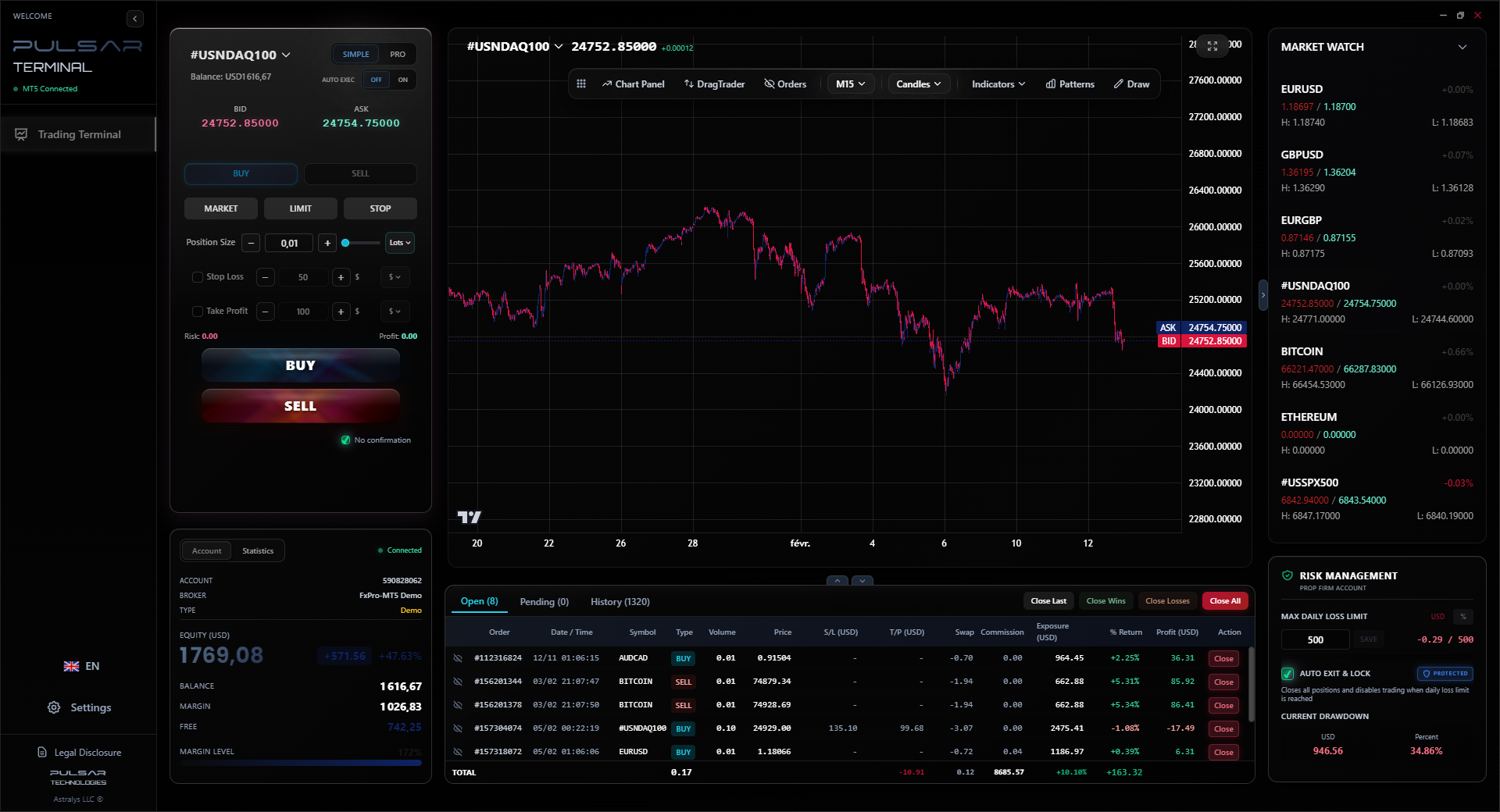
When your psychology is under attack from social media noise and FOMO, having a disciplined, automated system for order management is critical. Pulsar Terminal lets you set complex multi-take-profit and trailing stop orders on MT5 before you enter, so your plan executes flawlessly no matter how you feel in the moment.
Pulsar Terminal
Công cụ MT5 tất-cả-trong-một: đặt lệnh kéo-thả, multi-TP/SL, trailing stop, grid trading, Volume Profile và bảo vệ prop firm. Hơn 1.000 trader sử dụng mỗi ngày.
Once you've controlled the basic emotions, you graduate to higher-level psychological challenges.
Process Over Outcome: This is the holy grail. You must learn to judge yourself on whether you followed your plan, not on whether the trade made money. A well-executed trade that hits a stop-loss is a good trade. A sloppy, impulsive trade that makes money is a bad trade. Celebrating a lucky win reinforces bad behavior. This mindset removes the emotional rollercoaster of wins and losses. The outcome is irrelevant to your self-worth.
Embracing Boredom: The markets are chaotic 5% of the time. The other 95% is waiting. Can you sit there, with cash in your account, and do nothing? That's a skill. It's the skill of not needing action to feel validated as a trader. My most profitable months are often my quietest in terms of trade count.
Reviewing Your Biases: We all have them. Do you prefer buying over selling? Do you ignore sell signals because you're 'bullish on the rand'? Use your journal to find these. Then, deliberately take trades that go against your bias. It's uncomfortable, but it's how you grow. Sometimes, the best MACD indicator signal is the one that contradicts your gut feeling.
FAQ
Q1What's the #1 psychological mistake new South African traders make?
Revenge trading after a loss on a ZAR pair. The rand's volatility creates quick, sharp moves that can stop you out. The emotional urge to 'get that money back immediately' leads to impulsive, larger trades that usually compound the loss.
Q2How does FSCA regulation help my trading psychology?
Massively. It removes the background anxiety of being scammed. Knowing your funds are segregated and the broker is held to local standards lets you focus 100% on your market analysis and your own emotions, not on whether your broker is legitimate.
Q3I keep moving my stop-loss to avoid a loss. How do I stop?
This is loss aversion in action. The trick is to set your stop-loss based on your strategy's rules (e.g., below a swing low) and then do not touch it. Consider it a physical barrier. Better yet, use a platform that allows you to set it and then 'hide' the order line, so you're not tempted to drag it.
Q4Is it normal to feel physically stressed while trading?
Yes, especially when starting or during high volatility. A raised heart rate, sweating, tension. This is a sign your position size is too large. Scale down your risk until the physical symptoms disappear. You should be able to watch a trade with detached curiosity, not panic.
Q5How long does it take to master trading psychology?
You never master it. You manage it, daily. It's a constant practice, like fitness. The first 6-12 months are about becoming aware of your worst habits. Years two and beyond are about refining your mental routine and catching subtler biases.
Q6Can I use automated trading to avoid psychology?
Partially. An Expert Advisor (EA) can execute without emotion. But your psychology is still involved in choosing, testing, funding, and most importantly, not interfering with the EA. The moment you turn it off after two losing trades, psychology is back in charge.
Bài học của Prof. Winston
Điểm chính:
- ✓Risk management (1-2% per trade) is a psychological tool, not just a mathematical one.
- ✓Your pre-market checklist is a contract with your sane, non-emotional self.
- ✓Journal your emotions, not just your P&L, to find destructive patterns.
- ✓The peace of mind from an FSCA-regulated broker is a tangible trading edge.
Bài viết này hữu ích thế nào?
Nhấp vào ngôi sao để đánh giá
Nhận định giao dịch hàng tuần
Phân tích & chiến lược miễn phí hàng tuần. Không spam.
Về tác giả
David van der Merwe
Nhà giao dịch Thị trường Mới nổi
Trader tại Johannesburg với 11 năm kinh nghiệm về tiền tệ thị trường mới nổi. Chuyên về cặp ZAR, giao dịch theo quy định FSCA và phân tích thị trường Nam Phi.
Bình luận
Cảnh báo rủi ro
Giao dịch các công cụ tài chính tiềm ẩn rủi ro đáng kể và có thể không phù hợp với tất cả nhà đầu tư. Hiệu suất trong quá khứ không đảm bảo kết quả trong tương lai. Nội dung này chỉ mang tính chất giáo dục và không nên được coi là lời khuyên đầu tư. Hãy luôn tự nghiên cứu trước khi giao dịch.
Bạn cũng có thể thích

Cara Trading Forex Sukses: 7 Prinsip dari Trader Profesional
Cara trading forex sukses dengan 7 prinsip trader pro: manajemen modal, disiplin, journal trading, backtest. Data nyata, bukan janji profit palsu.
Jam Trading Forex Terbaik untuk Trader Indonesia: Panduan Lengkap dengan Tabel Waktu
Panduan jam trading forex untuk trader Indonesia. Tabel 4 sesi dunia, jam emas 20:00-00:00, sesi mana yang harus dihindari. Data akurat + tips dari trader berpengalaman.
Top 5 Sàn Forex Uy Tín Nhất 2026: Review Jujur dari Trader Indonesia
Top 5 sàn forex uy tín 2026 untuk trader Indonesia. Review jujur: spread, deposit, withdraw, dukungan lokal. Exness, XM, IC Markets & lebih.
Tải Pulsar Terminal
Tất cả các công cụ tính này được tích hợp trong Pulsar Terminal với dữ liệu thời gian thực từ tài khoản MT5 của bạn.
Tải Pulsar Terminal