


I remember staring at my screen in 2018, watching a USD/ZAR trade I’d held for three days finally hit my stop-loss.

David van der Merwe
Nhà giao dịch Thị trường Mới nổi ·  South Africa
☕ 9 phút đọc
Bạn sẽ học được:
I remember staring at my screen in 2018, watching a USD/ZAR trade I’d held for three days finally hit my stop-loss. I was down R2,300. The worst part? I’d broken my own rules, used too much use on a whim, and hadn’t accounted for the bank fees on the currency conversion. That loss stung, but it taught me more about the forex traders lifestyle in South Africa than any winning trade ever could. It’s not just charts and pips; it’s navigating FSCA rules, calculating tax for SARS, and dealing with a volatile Rand, all before your morning coffee.
Let's get this straight first. Trading here is legal, but it's a boxed-in playground. The Financial Sector Conduct Authority (FSCA) is your new landlord, and they have strict house rules. If your broker isn't on their Financial Service Provider (FSP) register, walk away. You're not being cautious; you're being smart with your capital.
The big rule? use is capped at 30:1 for retail traders. You'll see brokers like Exness or XM advertising "unlimited" or 1:1000, but that's for their offshore entities. For their FSCA-licensed arm, it's 30:1. This isn't a limitation, it's a lifesaver. That loss I mentioned earlier? It would have been a margin call disaster with 1:500 use. The 30:1 cap forces a level of discipline that, frankly, most new traders desperately need.
Client money protection is non-negotiable. Regulated brokers must keep your funds in segregated accounts. It means if the broker goes under (it happens), your trading capital isn't part of their bankruptcy estate. It's the bare minimum you should accept.

Warning: Ignoring FSCA regulation is a direct path to losing your entire deposit. Unlicensed "bucket shops" still operate. Always verify the FSP number on the regulator's website yourself.

💡 Mẹo của Winston
Your first R100,000 in trading isn't for profit. It's tuition. Pay it, learn the lessons, and don't rush to get it back.
So, what does a day actually look like? Forget the Lamborghini ads. For most, it's a solitary, screen-focused grind that happens alongside, or instead of, a regular job.
The Schedule Advantage
We have a secret weapon: time zones. Johannesburg is GMT+2. That means the London open hits at 10:00 AM our time, and the New York open at 4:00 PM. You can trade the most liquid sessions during normal daylight hours. I structure my day around this: analysis and planning before 10 AM, active trading during the London overlap, and reviewing or managing swing positions into the US session. It's a proper workday, not a midnight hustle.
The Income Spectrum
Let's talk numbers, because the hype is ridiculous. Based on what I've seen and lived:
- Beginners/Bad Months: You're not earning. You're learning. That means small, consistent losses or breaking even. Anyone telling you different is selling a course.
- Competent Retail Traders: With a disciplined scalping strategy or swing trading approach and a R50,000 account, pulling R400-R1,500 net profit in a good week is a solid, realistic target. That's R1,600-R6,000 a month. It's a side income, not a fortune.
- Funded Professionals: This is where the forex traders lifestyle in South Africa shifts. A trader consistently managing a R500,000 prop firm account or personal capital can target 2-5% monthly returns. That's R10,000 to R25,000. The official stats say the average salary for a Foreign-Exchange Trader here is around R330,924 a year. That's about R27,500 a month – a believable figure for a full-time professional.
I had a run in 2021 where I made R18,000 in three weeks on XAU/USD swings. I felt invincible. The next month, I gave back R9,000 of it because I broke my rules, thinking I'd "cracked the code." The lifestyle is a constant battle against your own ego.

Example: You trade a standard lot (100,000 units) of EUR/USD. A 10-pip move is worth $100. With the Rand at R18.50/$, that's R1,850. But remember your broker's spread – if it's 1 pip on EUR/USD, you're already down R185 the second you enter. This is why a position size calculator is your best friend.
“Starting with less than R10,000 usually leads to blown accounts. It's not capital; it's a suicide mission.”
Your profit is what's left after the vultures eat. In South Africa, the vultures have names: Spread, SARS, and the Bank.
Trading Costs: For majors like EUR/USD, expect spreads from 0.0 pips (plus a commission) to 1.5 pips on standard accounts. But if you're trading ZAR pairs – and many locals do – the game changes. USD/ZAR spreads can be 5 pips or more. On a R100,000 position, a 5-pip spread is an immediate R50 cost. You need a much bigger price move just to break even. Brokers like Pepperstone or IC Markets offer decent conditions, but always check their ZAR pair spreads specifically.
The Tax Man Cometh: This is the part most new traders blissfully ignore until they get a letter. SARS views frequent forex trading as income, not capital gains. Every Rand of profit gets added to your other income and taxed at your marginal rate (up to 45%). You must declare it. I keep a stupidly simple spreadsheet: date, pair, P&L in Rands. My accountant gets it every February. There's no such thing as "tax-free trading" unless you're losing money.
Banking & Exchange Controls: Funding your broker? If they're international (like most FSCA brokers are), you're using your annual R1 million Single Discretionary Allowance or your R10 million Foreign Capital Allowance. Your bank will convert your Rands to USD/EUR at their rate, plus a fee. When you withdraw, they convert it back. These hidden fees chip away at your bottom line. Some brokers, like Khwezi Trade, offer local ZAR accounts to avoid this, but you sacrifice global product range.
💡 Mẹo của Winston
If you can't explain your trade setup in one sentence, you don't have a setup. You have a hope.
Treating this as a hobby leads to poverty. Treat it as a business, even a micro-business, and you have a shot.
1. The Foundation: Capital & Risk. You need real money. Starting with R500 is a joke for anything besides learning what a pip definition is. A realistic starter stake is R10,000-R25,000. This allows for sensible position sizing where a 2% risk per trade (R200-R500) doesn't force you to use insane use. Your first goal is survival, not a BMW.
2. The System: Keep It Stupid Simple. The local market loves complexity, but complexity fails. Pick one major pair like EUR/USD and one indicator, like the RSI indicator or MACD indicator. Master it. I wasted a year jumping between 10 different exotic ZAR crosses. I only became consistent when I focused 80% of my effort on GBP/USD and USD/JPY.
3. The Tools. MT4/MT5 is the standard. But the default platforms are basic. This is where professional tools come in. Having a platform that lets you set multiple take-profits, automate trailing stops, and visualize order blocks quickly isn't a luxury; it's how you execute a business plan without emotion.
4. The Community (Or Lack Thereof). Be wary. The local "trading guru" scene is plagued by charlatans selling dreams. Find one or two serious traders to compare notes with, but your edge comes from your own screen time, not a WhatsApp signal group.

Pro Tip: Your trading journal is your most important tool. Note the time, your emotional state, and the trade rationale. After three months, you'll see patterns – like losing trades always happen when you trade after 8 PM. Then, you make a rule: no trading after 8 PM. That's how a lifestyle becomes sustainable.
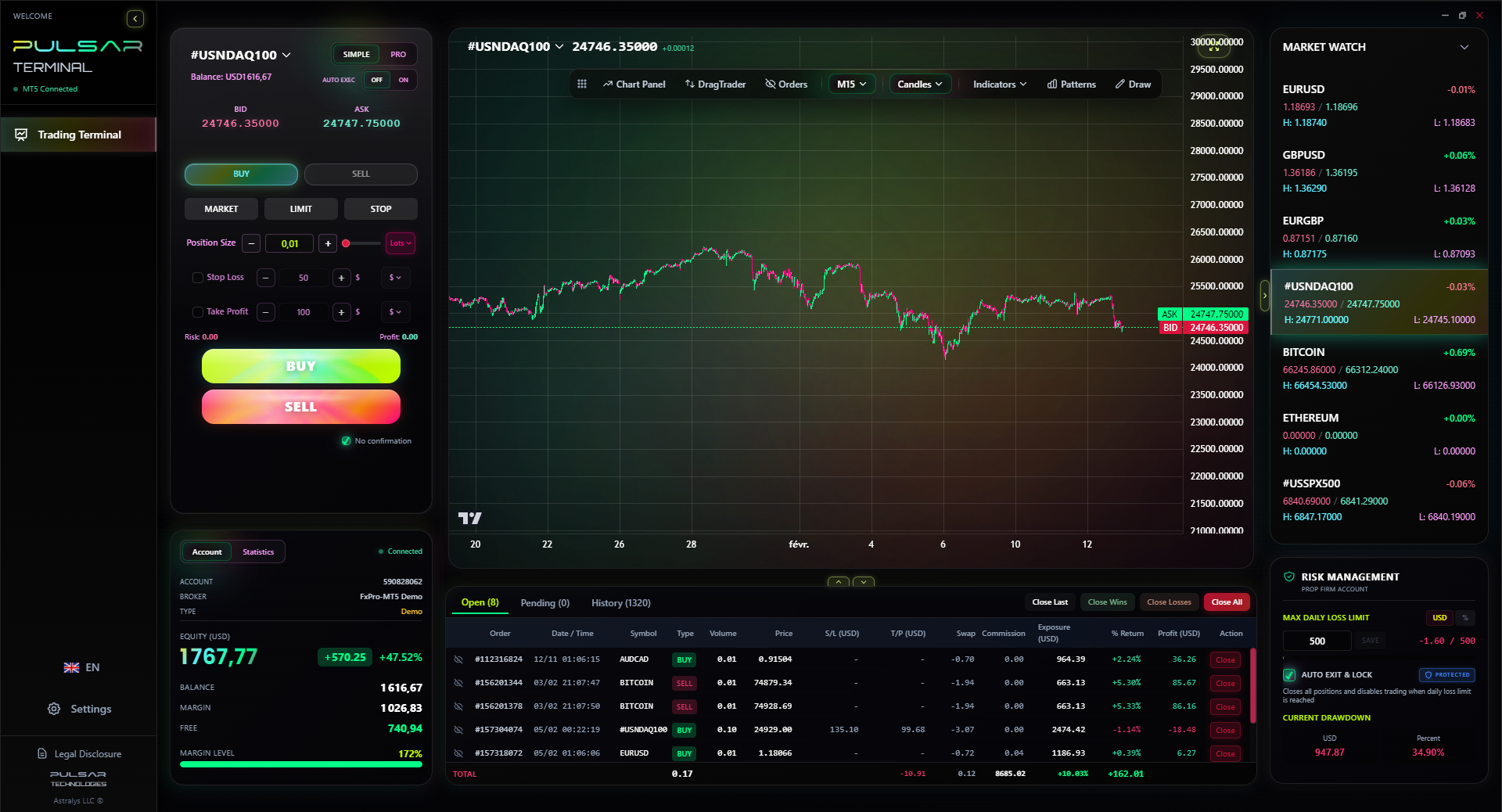
When you're managing multiple trades and strict risk limits, a tool that automates partial closures and breakeven stops directly on your MT5 chart removes emotion and saves crucial seconds.
Pulsar Terminal
Công cụ MT5 tất-cả-trong-một: đặt lệnh kéo-thả, multi-TP/SL, trailing stop, grid trading, Volume Profile và bảo vệ prop firm. Hơn 1.000 trader sử dụng mỗi ngày.
“SARS views frequent forex trading as income. Every Rand of profit gets added to your other income and taxed at your marginal rate.”
Your broker is your business partner. Choose a bad one, and your business fails before you even place a trade.
| Broker Consideration | What It Means For You |
|---|---|
| FSCA Regulation | Non-negotiable. Client fund safety and use caps. |
| ZAR Account Option | Saves on bank conversion fees. Limits you to the broker's ZAR-denominated instruments (often just majors and USD/ZAR). |
| Deposit/Withdrawal Method | EFT is universal but slow. Credit/debit card or e-wallets (like Ozow) are faster. Check for fees. |
| Spread on USD/ZAR | If you trade the Rand, this is your primary cost. Compare! |
The International Giants: Brokers like Exness, IC Markets, and XM have strong local presence and FSCA licenses. They offer global markets, tight spreads on majors, and strong platforms. Your money is sent offshore, so you use your allowance.
The Local Specialists: Brokers like Khwezi Trade are fully local. You deposit and withdraw in Rands instantly via EFT. It's simpler for banking, but you're often limited to forex and a few CFDs. It's a trade-off: convenience for range.
My setup? I use an FSCA-licensed international broker for most of my trading. I accept the bank fees as a cost of doing business because I want access to global indices and commodities. I started with XM years ago for their low minimum deposit, but as my capital grew, I moved to a broker with raw spreads and a commission structure that suited my higher volume.
💡 Mẹo của Winston
The Rand doesn't care about your analysis. Always know where your stop-loss is before you know where your take-profit is.
The Rand isn't a currency; it's a mood ring for global risk sentiment. In April 2025, USD/ZAR hit nearly R20. By April 2026, it was back near R16.30. That's a 18% swing. If you were on the wrong side of that, you were wiped out.
This volatility is your biggest challenge and your biggest opportunity. It demands iron-clad risk management. A 1% daily loss limit isn't a suggestion; it's law. You will use stop-losses on every single trade, no exceptions. The fear of a margin call should be ever-present, keeping you humble.
The lifestyle is isolating. You win alone, you lose alone. You'll have weeks where nothing makes sense and the market seems to hunt your stops personally. This is normal. The successful forex traders lifestyle in South Africa isn't about avoiding these periods; it's about having a routine so rigid you can trade through them on autopilot. Go for a walk. Turn off the screens. The charts will be there tomorrow. The key is making sure your account is still there too.
The dream is freedom: location independence, flexible hours. The reality is discipline: rigid routines, careful record-keeping, and emotional control. One is a fantasy sold to you. The other is a profession you build, one carefully managed trade at a time.
FAQ
Q1How much money do I need to start forex trading in South Africa?
Technically, some brokers let you start with R100. Practically, you need at least R10,000 to R25,000. This lets you risk R200-R500 per trade (1-2% of your capital) on sensible position sizes without relying on dangerous use to make the trade worthwhile. Starting with less usually leads to blown accounts.
Q2Do I pay tax on forex trading profits in South Africa?
Yes, absolutely. SARS treats frequent trading as income, taxed at your marginal rate. You must declare all profits (and can deduct losses) in your annual tax return. Keep detailed records of every trade, deposit, and withdrawal. Ignoring this is tax evasion.
Q3What's the best time of day to trade forex in South Africa?
The most liquid and best times are during the London session (10:00 AM - 7:00 PM SAST) and the London-New York overlap (4:00 PM - 7:00 PM SAST). This is when spreads are tightest and moves are most pronounced. Avoid the dead Asian session overnight.
Q4Can I use use higher than 30:1?
If you're classified as a retail client by an FSCA-licensed broker, no, 30:1 is the legal maximum for forex majors. Some brokers offer "professional" status with higher use if you pass certain criteria (large portfolio, experience), but this removes certain client protection rights. For 99% of traders, 30:1 is more than enough.
Q5Is trading USD/ZAR a good idea for South Africans?
It's familiar, but it's an exotic pair. This means wider spreads (5+ pips vs. 1 pip on EUR/USD), less liquidity, and more volatile, news-driven moves. It can be profitable, but it's inherently riskier and more expensive to trade than major pairs. Don't trade it just because it's in Rands.
Q6How do I know if my broker is legit?
Go directly to the FSCA's website and use their online register of Financial Service Providers (FSPs). Search for the broker's name or their listed FSP number. If they're not there, they are not legally allowed to serve you. Don't just trust the logo on their website.
Bài học của Prof. Winston
Điểm chính:
- ✓FSCA regulation is non-negotiable for safety.
- ✓Start with real capital: R10k minimum.
- ✓Tax is a certainty, not a maybe.
- ✓30:1 use is a protective cage.
- ✓Trade the London/New York overlap for liquidity.
Bài viết này hữu ích thế nào?
Nhấp vào ngôi sao để đánh giá
Nhận định giao dịch hàng tuần
Phân tích & chiến lược miễn phí hàng tuần. Không spam.
Về tác giả
David van der Merwe
Nhà giao dịch Thị trường Mới nổi
Trader tại Johannesburg với 11 năm kinh nghiệm về tiền tệ thị trường mới nổi. Chuyên về cặp ZAR, giao dịch theo quy định FSCA và phân tích thị trường Nam Phi.
Bình luận
Cảnh báo rủi ro
Giao dịch các công cụ tài chính tiềm ẩn rủi ro đáng kể và có thể không phù hợp với tất cả nhà đầu tư. Hiệu suất trong quá khứ không đảm bảo kết quả trong tương lai. Nội dung này chỉ mang tính chất giáo dục và không nên được coi là lời khuyên đầu tư. Hãy luôn tự nghiên cứu trước khi giao dịch.
Bạn cũng có thể thích

Cara Trading Forex Sukses: 7 Prinsip dari Trader Profesional
Cara trading forex sukses dengan 7 prinsip trader pro: manajemen modal, disiplin, journal trading, backtest. Data nyata, bukan janji profit palsu.
Jam Trading Forex Terbaik untuk Trader Indonesia: Panduan Lengkap dengan Tabel Waktu
Panduan jam trading forex untuk trader Indonesia. Tabel 4 sesi dunia, jam emas 20:00-00:00, sesi mana yang harus dihindari. Data akurat + tips dari trader berpengalaman.
Top 5 Sàn Forex Uy Tín Nhất 2026: Review Jujur dari Trader Indonesia
Top 5 sàn forex uy tín 2026 untuk trader Indonesia. Review jujur: spread, deposit, withdraw, dukungan lokal. Exness, XM, IC Markets & lebih.
Tải Pulsar Terminal
Tất cả các công cụ tính này được tích hợp trong Pulsar Terminal với dữ liệu thời gian thực từ tài khoản MT5 của bạn.
Tải Pulsar Terminal