


I paid ₦250,000 for a 'forex university' mentorship in 2019.

Olumide Adeyemi
Nhà tiên phong Giao dịch Tây Phi ·  Nigeria
☕ 10 phút đọc
Bạn sẽ học được:
- 1What "Forex University" Really Means in Nigeria
- 2The Real Cost of Forex Education: From Free to ₦1 Million
- 3A Real-World Curriculum: What They Won't Teach You in a Flashy Seminar
- 4How to Vet a Mentor or Course (Without Getting Scammed)
- 5Your Trading Journal: The Most Important Course You'll Ever Take
- 6Funding Your Education and Your Trading Account
- 7The Graduation: Moving from Student to Consistent Trader
I paid ₦250,000 for a 'forex university' mentorship in 2019. The guru promised a 'secret strategy' that would print money. Six months later, my $500 account was at $127. The strategy was just a basic moving average crossover he'd copied from a free YouTube video. That loss hurt, but the real cost was the time and blind faith I'd invested. My journey since has been about unlearning the hype and building a real education, piece by painful piece. Here’s what a Nigerian forex university should actually teach you.
Forget the fancy brochures and Lamborghini thumbnails. In our context, a forex university isn't a physical campus. It's the entire environment of learning you navigate to become a trader. This includes the good (free YouTube tutorials from genuine traders), the bad (overpriced signal groups), and the outright ugly (Ponzi schemes disguised as trading academies).
The core idea is self-education, but with a crucial filter. The Nigerian market is unique. You're dealing with Naira volatility, specific payment gateways that get blocked, and brokers like Exness or XM that are popular here for their accessibility. A proper education addresses these realities, not just generic chart patterns.
When I started, I didn't understand spreads or how a wider spread on USD/NGN pairs could eat my profits. My first "guru" never mentioned it. A real forex university curriculum for a Nigerian must start with the mechanics of your own environment. It's about building knowledge that survives the specific challenges we face, from power outages interrupting trades to understanding the tax implications with FIRS.

💡 Mẹo của Winston
Your first investment shouldn't be in a trade. It should be in a notebook. Write down every reason for every entry and exit. Your biggest edge will come from studying your own mistakes, not a guru's supposed wins.
“A real forex university curriculum for a Nigerian must start with the mechanics of your own environment.”
Let's talk numbers, because this is where dreams get priced. I've seen it all, from the 'pay what you want' WhatsApp groups to the exclusive masterminds costing more than a used car.
The Self-Taught Route (₦0 - ₦50,000) This is where I eventually found my footing. It's not free, because your currency is time. You'll spend 1-2 years consuming content from platforms like TradingView, BabyPips, and forums. You'll lose real money testing strategies. The cost here is psychological capital - the frustration and drawdowns while you learn. You might spend ₦20,000 on a few well-regarded books or a solid online course about price action or the MACD indicator.
The Mid-Tier Course (₦50,000 - ₦300,000) This is the danger zone. It's enough money to feel like you've made a serious investment, but not enough to guarantee quality. Many local physical classes in Ikeja or Port Harcourt fall here. The value depends entirely on the instructor's actual trading record (ask for verified myfxbook stats, not screenshots). I once took a ₦120,000 course that was 80% motivational speaking and 20% recycled internet content.

Warning: A high price tag does not equal a profitable strategy. The most expensive mentor I ever encountered (₦975,000) was later exposed for using client funds to prop up his own fake performance statements.
The Broker's Toolkit (Often Free) This is an underrated goldmine. Brokers like IC Markets and Pepperstone offer extensive, free webinars, seminars, and e-books. Their research is legit because their business depends on educated traders who survive. I learned more about risk management from a free XM webinar than from my expensive mentor. Always exhaust these free resources first.
📊 Example: Let's say you start with a ₦500,000 trading capital. Spending ₦300,000 (60% of your capital) on education before you even place a trade is a terrible risk-reward ratio. A better path: start with a free scalping strategy guide, practice on a demo, then use a small portion of profits to fund further learning.
“Spending 60% of your trading capital on education before you even place a trade is a terrible risk-reward ratio.”
If I were to design a practical forex university syllabus for Nigeria, it would look nothing like the sales pages. Forget 'secret indicators.' Here’s the core curriculum.
Module 1: Mechanics & Survival (Weeks 1-4)
This is non-negotiable. You must understand what a pip is, how the spread works, and what use truly means. Most importantly, learn about the margin call. My second biggest loss came from not understanding how my broker (HFM at the time) would close my positions if margin fell below 50%. I was leveraged 1:500 on GBP/USD, a news event hit, and I was wiped out in minutes. This module includes choosing a broker. Read our Exness review and IC Markets review to understand the pros and cons for Nigerian traders.
Module 2: Risk Management is Your Only Job (Weeks 5-8)
Trading isn't about being right. It's about managing what happens when you're wrong, which is often. This means position sizing. Never risk more than 1-2% of your account on a single trade. I use a simple position size calculator before every entry. This one habit saved me during the 2022 GBP flash crash. I was wrong on the direction, but my 1% risk limit meant a manageable ₦15,000 loss, not a blown account.
Module 3: Market Analysis - Keeping It Simple (Ongoing)
You need one or two ways to read the market. I combine support/resistance with the RSI indicator for divergence. I spent years collecting 20 indicators on my chart. It was noise. Now, my charts are clean. This module also includes understanding sessions (when London overlaps with New York, volatility spikes) and economic calendars. Trading NFP news without a plan is gambling.

Pro Tip: Your strategy must survive a 'NEPA take light' scenario. Use stop-loss and take-profit orders religiously. If the power goes out, your trade should already have its rules defined and active in the market.
“Spending 60% of your trading capital on education before you even place a trade is a terrible risk-reward ratio.”
The market is saturated with 'professors' who have never passed a prop firm challenge. Here’s my checklist, forged from bitter experience.
- Demand Verifiable Track Record: Ask for a live, verified myfxbook or FXBlue link. A screenshot of a trading platform is worthless. Anyone can edit HTML or use a simulator. If they say it's 'private,' walk away.
- Ask About Their Largest Drawdown: Profitable traders are proud of their risk management, not just their wins. If they claim they never have losing months, they're lying. My best year had a 24% drawdown in February. It's part of the game.
- Sample the Teaching Style: Any credible educator offers a free webinar, a YouTube channel with substantial content, or a cheap introductory module. Do they explain the 'why'? Or do they just say 'buy here, sell there'? I fell for the latter.
- Community Check: Find past students. Ask in Nigerian trading forums on Facebook or Nairaland. "Has anyone taken XYZ's course? What was the after-sales support like?" Silence or vague answers are red flags.
- Beware of Guarantees: If they promise specific monthly returns (e.g., "Make 50% monthly!"), run. It's a marketing trap. Real trading involves losses.
I learned this the hard way. My ₦250,000 mentor had a gorgeous website and fake testimonials. His 'verified' statement was a PDF he created himself. After my loss, I found a dozen others with the same story. Now, I'd rather pay for a structured platform like a prop firm challenge (where my skills are tested) than a vague mentorship. At least the prop firm's rules are clear.
💡 Mẹo của Winston
If a mentor can't openly discuss their worst losing streak and what they learned from it, they haven't learned enough to teach you. Vulnerability is a sign of real experience.
“Trading isn't about being right. It's about managing what happens when you're wrong, which is often.”
This is the single piece of advice that turned my trading around. Your journal isn't just a log of wins and losses. It's the feedback loop for your personal forex university.
In 2021, I noticed I was consistently losing on EUR/USD trades entered after 2 PM Lagos time. My journal entries showed a pattern: I was chasing moves during the low-liquidity afternoon session. The solution was simple: I stopped trading that pair after London closed. My profitability improved immediately. Without the journal, I'd have just blamed 'bad luck.'
What to record for every trade:
- Instrument & Direction: (e.g., GBP/USD, Buy)
- Entry/Exit Price & Time: Be precise.
- Stop-Loss & Take-Profit: Did you stick to your plan?
- Position Size & Risk (%): Use your position size calculator.
- Chart Screenshot: Mark your entry reasoning (e.g., "bounce off daily support").
- Emotional State: Were you anxious, greedy, bored? This matters more than you think.
- Post-Trade Analysis: Why did it work or fail? Was it your analysis, or just market noise?
Review this weekly. Look for patterns in your losers. Are you overtrading? Are you cutting winners too short? This self-directed study is worth more than any ₦500,000 course. It forces you to confront your own psychology, which is 80% of this game.
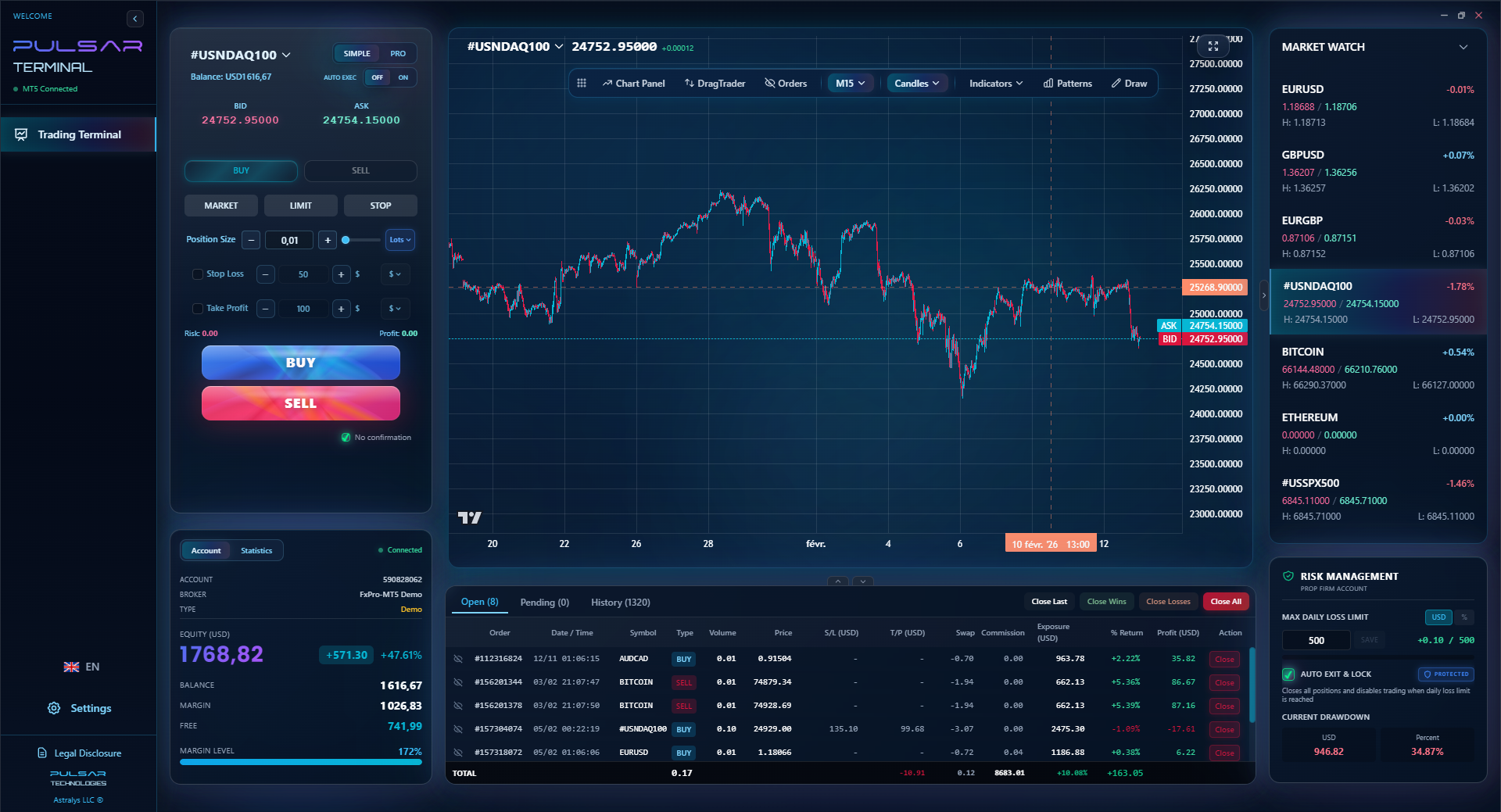
Manually calculating risk for every trade and managing multiple positions is where discipline often fails; a tool like Pulsar Terminal automates this directly on your MT5 chart, enforcing the rules your forex university taught you.
Pulsar Terminal
Công cụ MT5 tất-cả-trong-một: đặt lệnh kéo-thả, multi-TP/SL, trailing stop, grid trading, Volume Profile và bảo vệ prop firm. Hơn 1.000 trader sử dụng mỗi ngày.
“Trading isn't about being right. It's about managing what happens when you're wrong, which is often.”
In Nigeria, getting knowledge is one thing. Getting money onto a trading platform is another battle entirely. Let's break down the practicalities.
Payment Methods That Work (For Now): The landscape changes monthly. As of my last deposit in Q1 2026:
- Cryptocurrency (USDT): This has become the most reliable method for funding brokers like Pepperstone or IC Markets. It's fast, and bypasses bank restrictions. The downside is volatility during the transfer window and network fees.
- Fintech Apps: Some apps with virtual dollar cards still work intermittently. Success varies by bank and by the day.
- Direct Bank Transfer to Broker: Some international brokers have local payment partners. You pay in Naira, they credit your account in USD. Check your broker's deposit page for local bank details.
A Critical Rule: Never use the official CBN window rates to fund trading. It's illegal and considered economic sabotage. The rates you get will be the parallel market rates, which is the real cost of doing business.
Separate Learning Money from Trading Money: This is crucial. Have a budget for education (courses, books, seminars) completely separate from your live trading capital. If your total investable capital is ₦1,000,000, maybe allocate ₦100,000 max to education over a year. The remaining ₦900,000 is your trading bank. Start live trading with only a fraction of that - maybe ₦200,000. The rest stays in your bank account until you've proven your strategy over 6 months of consistent, journaled demo trading. Blowing your entire stake on lessons and then having nothing to trade with is a classic beginner mistake I made.
💡 Mẹo của Winston
The market doesn't care about your rent or your dreams. Your trading plan shouldn't either. Base your position size on your account balance, not your personal bills. That separation is the foundation of a professional mindset.
“Your journal isn't just a log of wins and losses. It's the feedback loop for your personal forex university.”
You don't graduate from forex university with a certificate. You graduate with a proven, documented edge and the discipline to execute it. Here's what that transition looks like.
First, you move from demo to live with a painfully small account. I'm talking $100 or ₦50,000. The goal isn't to get rich. The goal is to survive for 100 trades while maintaining your rules. The psychological pressure is different with real money, even small amounts.
Second, you specialize. You can't master all 50+ pairs. Maybe you become an expert on XAU/USD (Gold) because it reacts well to your swing trading strategy. Or you focus on the EUR/USD during the London session. My niche became trading GBP pairs during high-impact news volatility. I know its personality.
Finally, you embrace continuous learning. The market changes. The strategies that worked in 2021 need adjustment in 2026. I still attend free broker seminars. I still backtest new ideas on demo. The day you think you've 'graduated' for good is the day the market humbles you.
My own graduation moment came after 18 months of journaling. I had three consecutive months of 2-5% net growth, with a max drawdown of 8%. The profits weren't huge, but the consistency was. That's when I knew my education had finally moved from theory to practice. The forex university never truly ends, but you eventually learn how to study for its endless exams.
FAQ
Q1Is forex trading legal in Nigeria?
Yes, forex trading is legal for individuals in Nigeria. However, the retail online forex trading space isn't heavily regulated locally by the SEC or CBN for individuals. Most Nigerian traders use internationally regulated brokers. It's illegal to source foreign exchange from the official CBN window to fund trading accounts.
Q2What is the minimum amount I need to start trading forex in Nigeria?
You can start learning with $0 on a demo account. For live trading, some brokers like Exness allow deposits as low as $1 (about ₦1,500). However, I strongly advise starting with an amount you can afford to lose completely - like ₦20,000 to ₦50,000 - and using proper risk management (risking 1% per trade). The real minimum is the cost of your education, which can be free if you're disciplined.
Q3How do I avoid forex trading scams in Nigeria?
Avoid anyone guaranteeing profits, promising huge returns, or refusing to show a verifiable, long-term track record. Be wary of signal sellers on WhatsApp. Use brokers with strong international regulation (like FCA, ASIC, FSCA). Never give your trading account login details to a 'account manager.' Real education teaches you to fish, not just sells you a fish.
Q4Do I pay tax on my forex trading profits in Nigeria?
Yes. According to the Federal Inland Revenue Service (FIRS), forex trading profits are typically subject to Capital Gains Tax, which is 10% of your gross profits. It's your responsibility to declare and pay this tax. Keep detailed records of all your trades for this purpose.
Q5What is the best trading platform for beginners in Nigeria?
MetaTrader 4 (MT4) is still the most common and beginner-friendly platform. It's widely supported by almost all brokers (like XM, IC Markets, and Pepperstone), has a simple interface, and there are thousands of free tutorials on how to use it. Start with MT4 before exploring MT5 or proprietary platforms.
Q6Can I make a living from forex trading in Nigeria?
It's possible, but it's incredibly difficult and takes years of disciplined practice, education, and emotional control. Most traders should not expect to replace a full-time income, especially in the first 3-5 years. Treat it as a serious side business that requires continuous capital and time investment. Focus on consistency over get-rich-quick schemes.
Q7Why do most Nigerian forex traders fail?
Most fail due to a lack of proper education (jumping in with no plan), poor risk management (using too much use, no stop-loss), emotional trading (fear and greed), and the pursuit of 'quick money' through scams or unsustainable strategies. They skip the university phase and try to graduate without studying.
Bài học của Prof. Winston
Điểm chính:
- ✓The most expensive course is the one that teaches you nothing but hype.
- ✓Risk only 1-2% per trade. No exception.
- ✓A verified track record beats a flashy car photo every time.
- ✓Your trading journal is your true mentor. Review it weekly.
- ✓Funding is a operational challenge in Nigeria. Plan for it.
Bài viết này hữu ích thế nào?
Nhấp vào ngôi sao để đánh giá
Nhận định giao dịch hàng tuần
Phân tích & chiến lược miễn phí hàng tuần. Không spam.
Về tác giả
Olumide Adeyemi
Nhà tiên phong Giao dịch Tây Phi
Một trong những nhà đào tạo forex tích cực nhất tại Nigeria. 8 năm kinh nghiệm giao dịch từ Lagos. Chuyên về chiến lược vốn thấp và thử thách prop firm dành cho trader châu Phi.
Bình luận
Cảnh báo rủi ro
Giao dịch các công cụ tài chính tiềm ẩn rủi ro đáng kể và có thể không phù hợp với tất cả nhà đầu tư. Hiệu suất trong quá khứ không đảm bảo kết quả trong tương lai. Nội dung này chỉ mang tính chất giáo dục và không nên được coi là lời khuyên đầu tư. Hãy luôn tự nghiên cứu trước khi giao dịch.
Bạn cũng có thể thích

Cara Trading Forex Sukses: 7 Prinsip dari Trader Profesional
Cara trading forex sukses dengan 7 prinsip trader pro: manajemen modal, disiplin, journal trading, backtest. Data nyata, bukan janji profit palsu.
Jam Trading Forex Terbaik untuk Trader Indonesia: Panduan Lengkap dengan Tabel Waktu
Panduan jam trading forex untuk trader Indonesia. Tabel 4 sesi dunia, jam emas 20:00-00:00, sesi mana yang harus dihindari. Data akurat + tips dari trader berpengalaman.
Top 5 Sàn Forex Uy Tín Nhất 2026: Review Jujur dari Trader Indonesia
Top 5 sàn forex uy tín 2026 untuk trader Indonesia. Review jujur: spread, deposit, withdraw, dukungan lokal. Exness, XM, IC Markets & lebih.
Tải Pulsar Terminal
Tất cả các công cụ tính này được tích hợp trong Pulsar Terminal với dữ liệu thời gian thực từ tài khoản MT5 của bạn.
Tải Pulsar Terminal