


If I had a rand for every time someone asked me 'Should I trade forex or Bitcoin?' I'd be retired in Camps Bay by now.

David van der Merwe
Nhà giao dịch Thị trường Mới nổi ·  South Africa
☕ 11 phút đọc
Bạn sẽ học được:
- 1The Legal Landscape: Where Your Money is Actually Protected
- 2When Can You Trade? The 24/7 Myth
- 3The Hidden Costs That Eat Your Profits
- 4Embracing (or Surviving) the Chaos
- 5What Actually Works: Technicals, Fundamentals, and Gut Feel
- 6So, Which One is Right for You in South Africa?
- 7Your First Moves: A ZAR-Based Action Plan
If I had a rand for every time someone asked me 'Should I trade forex or Bitcoin?' I'd be retired in Camps Bay by now. Most new traders get this completely backwards. They chase the shiny object (crypto) without understanding the foundational game (forex). I made that mistake myself back in 2017, dumping R50,000 into Bitcoin at the peak and watching it halve while my boring USD/ZAR swing trades quietly paid the rent. Let's set the record straight on what actually works for South African traders, with the real numbers and regulations you need to know for 2026.
This is where most guides gloss over the critical details. In South Africa, your protection depends entirely on what you're trading and who you're trading with.
Forex trading is regulated by the Financial Sector Conduct Authority (FSCA). They operate under the FAIS Act. What this means for you is that a locally licensed broker, like some offerings from Exness review or XM review with their FSCA entities, must keep client funds in segregated accounts. If they go bust, your money isn't part of their estate. It's not a perfect shield, but it's something. I learned this the hard way in 2019 when a small, unregulated CFD provider folded overnight. Took me 18 months and a lawyer to recover 60 cents on the rand.
Crypto is a different beast. As of 2026, the FSCA classifies crypto assets as financial products. This means providers offering crypto derivatives (CFDs on Bitcoin) need a license. However, spot trading - buying actual Bitcoin on an exchange like VALR or Luno - falls into a grayer area. Your funds are not protected in the same way. The exchange holds your coins, and if they get hacked or collapse, you're an unsecured creditor. Remember the Africrypt saga? Exactly.

Warning: Trading Bitcoin CFDs with an international broker that isn't FSCA licensed offers you zero South African legal recourse if something goes wrong. You're relying on their home country's regulations, which might be weak.
The Prop Firm Angle
This distinction becomes crucial if you're looking at prop firms. Many South Africans use firms like FTMO or The5%ers to trade forex with capital they don't own. These firms typically require you to use their preferred FSCA-licensed broker for the evaluation and live account. For crypto prop challenges, the regulatory oversight is virtually non-existent. Always check where the firm's broker is licensed before you pay for a challenge.

💡 Mẹo của Winston
Your first R10,000 in the market is tuition, not investment capital. Expect to learn expensive lessons with it. The goal is to have some left over to trade with seriously.
“The forex market rarely punishes you that quickly for a mental error.”
Here's a classic misconception: 'I'll trade crypto because it's open 24/7.' Sure, the crypto market never closes, but that doesn't mean it's always good to trade.
The forex market is open 24 hours a day, five days a week. Liquidity ebbs and flows with the global sessions. The sweet spot for us in SA is the London overlap (10:00 SAST to 13:00 SAST). That's when the EUR/USD guide and GBP pairs really move. You can plan your life around it. I trade actively for those 3-4 hours, then set swing orders and walk away. It's a job, not a life sentence.
Bitcoin trades 24/7, but liquidity follows the sun. Volume often dries up during Asian hours (our late night/early morning). The most volatile moves frequently happen on weekends or late at night SAST when a news tweet hits a thin market. I got caught in a nasty margin call on a Sunday evening in 2024 because I left a BTC/USD position open over the weekend. A random regulatory headline from the US sparked a 12% drop in an hour. My stop loss was obliterated by the spread widening to over $200.

Pro Tip: If you trade crypto, treat weekends and late-night SAST (post-US close) as extreme risk zones. Either close your positions or use a ridiculously wide stop. Better yet, use a tool that can automate a trailing stop to lock in profits as the market moves, so you don't have to babysit the screen at 2 AM.
“Your first live deposit should be money you can afford to lose without changing your life.”
You think the spread is the only cost? Think again. This is where many South African traders get a nasty surprise, especially with crypto.
Forex Costs:
- Spread: The main cost. On major pairs like EUR/USD with a good broker, you can get spreads from 0.1 pips. On USD/ZAR, expect 150-300 pips because it's an exotic pair. That's R150-R300 per standard lot before you even start.
- Commission: Some brokers, like IC Markets review or Pepperstone review on their RAW accounts, charge a commission per lot. It's transparent.
- Swap/Overnight Financing: Holding a position overnight costs or earns you interest. For USD/ZAR, if you're long USD (short ZAR), you typically earn a positive swap. This can be a meaningful component of a swing trading strategy.
Bitcoin (Crypto CFD) Costs:
- Spread: Can be deceptively wide. I've seen spreads of $50-$100 on BTC/USD during quiet times. That's a huge hurdle.
- Overnight Financing: This is the killer. Crypto CFDs have massive overnight fees because there's no underlying interest rate. You're charged a fixed percentage, often 0.05%-0.1% of the position value per night. On a $10,000 position, that's $5-$10 every single night you hold. It makes long-term holding of crypto CFDs completely uneconomical.
- Commission: Less common, but some brokers charge it.
Let me give you a real example from my journal. In January 2025, I went long on a Bitcoin CFD at $42,100. The spread was $45 on entry. I held for 8 days, paying roughly $8 per night in financing fees. Total hidden costs: $45 + (8 * $8) = $109. I sold at $43,000 for a $900 gross profit. My net profit was only $791. The costs ate over 12% of my gain. A similar position size calculator mistake in forex would have cost me a fraction of that.
| Cost Factor | Forex (EUR/USD Example) | Bitcoin CFD (Example) |
|---|---|---|
| Typical Spread | 0.1 - 1.0 pip definition ($1 - $10 per lot) | $25 - $150 |
| Overnight Fee (per $10k) | Small credit/debit (e.g., +/- $2) | Large debit (~$5 - $10) |
| Best for | Short-term & swing trades | Very short-term (intraday) only |
“Your first live deposit should be money you can afford to lose without changing your life.”
Volatility isn't just a number. It's the feeling in your gut when a position moves 3% against you before you can blink. Let's break it down.
Forex volatility is measured and seasonal. Major pairs like EUR/USD might move 0.5%-0.8% on a normal day. During major news (US Non-Farm Payrolls, ECB meetings), you might see 1.5%-2% moves. Exotics like USD/ZAR can be wilder, moving 2-3% on local political news. You can use tools like the Average True Range (ATR) indicator to plan your stops accordingly. My rule: my stop loss is always placed beyond the current day's ATR. If the ATR on USD/ZAR is 500 pips, my stop needs to be at least 550 pips away.
Bitcoin volatility is a different animal. A 'quiet' day might be a 3% range. A 'volatile' day can be 15-20%. In May 2024, Bitcoin dropped 18% in a single 6-hour period. This has massive implications:
- Position Sizing: You must trade much smaller. If you normally risk 1% of your account on a forex trade, for an equivalent volatility setup in Bitcoin, you might need to risk 0.25% or less. Not adjusting this is the #1 reason new crypto traders blow up.
- Stop Losses: They get hunted. The crypto markets are full of algos designed to trigger clusters of stop losses. You need to place your stops in unconventional places, not just at obvious round numbers.
- Psychology: The emotional rollercoaster is intense. A 5% move in forex is a crisis. In crypto, it's Tuesday. You need ice in your veins, or a very strict automated system that removes emotion.
I once made R22,000 on a Bitcoin scalping strategy in one morning, only to give back R18,000 in the afternoon because I got greedy and over-traded the volatility. The forex market rarely punishes you that quickly for a mental error.
💡 Mẹo của Winston
If a trade idea feels exciting and urgent, it's probably a terrible idea. The best trades are often boring and require patience.
“Bitcoin volatility is a different animal. A 'quiet' day might be a 3% range. A 'volatile' day can be 15-20%.”
The tools in your toolbox need to match the market. What works on the USD/ZAR chart will get you slaughtered on Bitcoin, and vice versa.
Forex Analysis:
- Technical Analysis: Works beautifully. Support/Resistance, trendlines, and classic indicators like the RSI indicator and MACD indicator are reliable because you're analyzing the collective behavior of millions of professional traders and algorithms. Price action patterns tend to repeat.
- Fundamental Analysis: This is king. Interest rate decisions, inflation data (CPI), GDP, and geopolitical events drive long-term trends. You can build a solid swing trade around a central bank's hiking cycle. Trading USD/ZAR? You better be watching SARB meetings, Eskom news, and the country's credit rating like a hawk.
Bitcoin Analysis:
- Technical Analysis: It works... until it doesn't. Crypto markets are driven heavily by retail sentiment and large holders ('whales'). They can and do manipulate prices to liquidate leveraged positions. Support levels break far more easily. I rely more on on-chain data (whale wallet movements, exchange inflows/outflows) than pure price charts.
- Fundamental Analysis: Forget GDP. Crypto fundamentals are adoption metrics, regulatory news, Bitcoin ETF flows in the US, and the 'halving' cycle. A single tweet from a key figure can reverse a trend instantly. It's more like trading a high-beta tech stock than a currency.
My hybrid approach? I use forex for steady, planned income. I allocate a small, speculative portion of my capital (never more than 10%) to crypto trades, and I treat it like venture capital. I'm prepared to lose it all. For forex, I'm using a disciplined swing trading plan with defined entries, exits, and a rock-solid position size calculator. For crypto, I'm often just following momentum with very tight risk management.
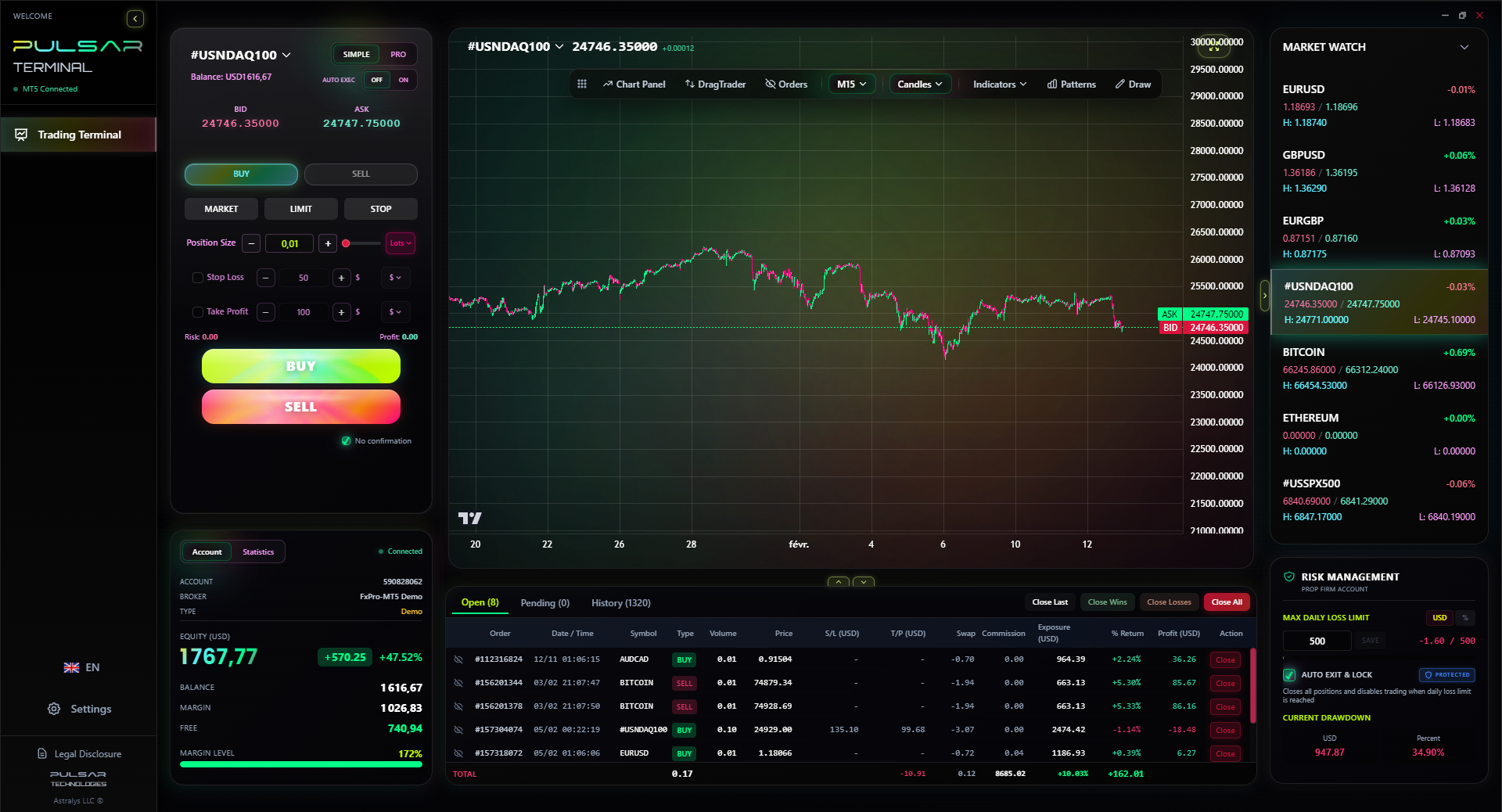
Managing volatile crypto trades requires iron discipline, which is why automating your stop losses and take profits with a tool like Pulsar Terminal is non-negotiable.
Pulsar Terminal
Công cụ MT5 tất-cả-trong-một: đặt lệnh kéo-thả, multi-TP/SL, trailing stop, grid trading, Volume Profile và bảo vệ prop firm. Hơn 1.000 trader sử dụng mỗi ngày.
“Bitcoin volatility is a different animal. A 'quiet' day might be a 3% range. A 'volatile' day can be 15-20%.”
This isn't about which is 'better.' It's about which one fits your personality, your schedule, your risk tolerance, and your goals.
Choose FOREX if you:
- Want a structured, regulated environment.
- Prefer analyzing economic data and 'slower' trends.
- Can trade during London/South African business hours.
- Are looking for consistent, smaller gains with defined strategies.
- Need to use ZAR as your deposit/withdrawal currency easily.
- Are risk-averse and value capital preservation.
Choose BITCOIN/CRYPTO trading if you:
- Have a high risk tolerance and can handle extreme drawdowns.
- Are comfortable with less regulatory protection.
- Want to trade at all hours (but understand the liquidity traps).
- Are fascinated by technological adoption and speculative assets.
- Have a small portion of capital you are truly willing to lose.
- Can manage your psychology during violent 10%+ swings.
My personal setup in 2026? 80% of my active trading capital is in forex, primarily USD/ZAR and EUR/USD swings. The other 20% is in a separate 'crypto' account. I don't mix the two mentally. The forex account pays the bills. The crypto account is for asymmetric bets - I'm aiming for a 5x, knowing I could go to zero. And I never, ever trade crypto without a automated risk management plan in place, because my own emotions have proven to be my worst enemy in that arena.
💡 Mẹo của Winston
Withdraw your initial capital after your first 20% gain. Trading with 'the house's money' removes a huge psychological burden.
“I use forex for steady, planned income. I allocate a small, speculative portion of my capital to crypto trades, and I treat it like venture capital.”
Okay, you've decided. Here's exactly what to do next, step-by-step, for a South African.
Step 1: Education (Don't Skip This) Don't deposit a cent yet. Spend a month on a demo account. For forex, learn about majors, exotics, and how a spread definition works. For crypto, experience the 24/7 volatility with fake money. I demo-traded for 4 months before going live, and it still wasn't enough.
Step 2: Broker Selection
- For Forex: Pick an FSCA-licensed broker that offers ZAR accounts and low-cost USD/ZAR trading. Compare Exness review, IC Markets review, and Pepperstone review for their local offerings. Check their deposit/withdrawal methods (EFT, Ozow, PayFast) and fees.
- For Crypto CFDs: If you go this route, still prefer an FSCA-licensed broker for the safety net. For spot trading, use a reputable local exchange like VALR or Luno for your first R5,000. They make buying actual Bitcoin with ZAR simple.
Step 3: Start Absurdly Small Your first live deposit should be money you can afford to lose without changing your life. R2,000. R5,000 max. Your goal in the first 6 months is not to get rich. It's to not blow up. Trade micro lots (0.01) in forex. Buy R500 worth of Bitcoin, not R50,000.
Step 4: Develop a WRITTEN Plan Before every trade, write down: Entry reason, entry price, stop loss, take profit, and position size. This forces discipline. My biggest losses always came from 'winging it.'
Step 5: Withdraw Profits This is the most important step no one does. Once you grow your account by 20%, withdraw your initial capital. Now you're playing with the house's money. The psychological freedom is incredible. I set a monthly 'salary' withdrawal from my forex account, just like a real job. It keeps me grounded.
The path of a trader is a marathon of learning. Whether you choose forex, Bitcoin, or a bit of both, respect the markets, know the local rules, and always protect your South African rands first. Good luck, and trade well.
FAQ
Q1Is it legal to trade Forex and Bitcoin in South Africa?
Yes, both are legal. Forex trading is regulated by the FSCA. Trading Bitcoin CFDs with an FSCA-licensed broker is regulated. Buying spot Bitcoin on an exchange is legal but operates with less direct consumer protection under current 2026 laws.
Q2Which is more profitable: Forex or Bitcoin trading?
Profitability depends on the trader, not the market. Bitcoin offers higher potential returns per trade but comes with exponentially higher risk and costs (like overnight fees). Forex offers more consistent, lower-volatility opportunities. A disciplined forex trader can achieve steady profits, while crypto trading is more akin to high-stakes speculation.
Q3What is the minimum amount needed to start trading in South Africa?
You can start with very little. Many brokers allow accounts with a few hundred rands. For forex, R1,000-R2,000 is a realistic minimum to trade micro lots safely. For crypto, you can buy R500 worth of Bitcoin on Luno. However, your minimum should be 'risk capital' you can afford to lose completely.
Q4Can I use the same broker for Forex and Bitcoin?
Many international brokers, like Exness or Pepperstone, offer both Forex and Crypto CFD trading on the same platform (like MT5). This is convenient. However, ensure their crypto offering is available to South African clients and understand if that side of their business is FSCA-licensed. For buying actual Bitcoin, you'll likely need a separate crypto exchange account.
Q5How are my profits taxed in South Africa?
SARS views trading profits as income if you're trading frequently (seen as a revenue-generating activity). This income is added to your other income and taxed at your marginal rate. Infrequent, long-term investments may be subject to Capital Gains Tax (CGT). This applies to both forex and crypto profits. Keep careful records of all trades, deposits, and withdrawals. Consult a tax professional familiar with trading.
Q6Is trading Bitcoin CFDs better than buying actual Bitcoin?
It depends on your goal. CFDs allow you to short (bet against) Bitcoin and use use, but you never own the coin and pay heavy overnight fees. They are for short-term speculation. Buying actual Bitcoin (spot) is for long-term holding ('HODLing') with the belief the price will rise over years. For most new South Africans, starting with small amounts of actual Bitcoin on a local exchange is simpler and safer than leveraged CFDs.
Q7What's the biggest mistake South African traders make when starting?
Two things: 1) Trading too large. They risk 5-10% of their account on a single trade because they're impatient to make money. 2) Chasing losses. After a losing trade, they double their position size to 'make it back fast,' which usually leads to a blown account. Proper position sizing and emotional discipline are non-negotiable.
Bài học của Prof. Winston
Điểm chính:
- ✓Forex is regulated (FSCA); crypto protection is minimal.
- ✓Crypto overnight fees can eat 12%+ of your profit.
- ✓Trade Bitcoin with 1/4 the position size of forex.
- ✓Withdraw your initial capital after a 20% gain.
Bài viết này hữu ích thế nào?
Nhấp vào ngôi sao để đánh giá
Nhận định giao dịch hàng tuần
Phân tích & chiến lược miễn phí hàng tuần. Không spam.
Về tác giả
David van der Merwe
Nhà giao dịch Thị trường Mới nổi
Trader tại Johannesburg với 11 năm kinh nghiệm về tiền tệ thị trường mới nổi. Chuyên về cặp ZAR, giao dịch theo quy định FSCA và phân tích thị trường Nam Phi.
Bình luận
Cảnh báo rủi ro
Giao dịch các công cụ tài chính tiềm ẩn rủi ro đáng kể và có thể không phù hợp với tất cả nhà đầu tư. Hiệu suất trong quá khứ không đảm bảo kết quả trong tương lai. Nội dung này chỉ mang tính chất giáo dục và không nên được coi là lời khuyên đầu tư. Hãy luôn tự nghiên cứu trước khi giao dịch.
Bạn cũng có thể thích

Cara Trading Forex Sukses: 7 Prinsip dari Trader Profesional
Cara trading forex sukses dengan 7 prinsip trader pro: manajemen modal, disiplin, journal trading, backtest. Data nyata, bukan janji profit palsu.
Jam Trading Forex Terbaik untuk Trader Indonesia: Panduan Lengkap dengan Tabel Waktu
Panduan jam trading forex untuk trader Indonesia. Tabel 4 sesi dunia, jam emas 20:00-00:00, sesi mana yang harus dihindari. Data akurat + tips dari trader berpengalaman.
Top 5 Sàn Forex Uy Tín Nhất 2026: Review Jujur dari Trader Indonesia
Top 5 sàn forex uy tín 2026 untuk trader Indonesia. Review jujur: spread, deposit, withdraw, dukungan lokal. Exness, XM, IC Markets & lebih.
Tải Pulsar Terminal
Tất cả các công cụ tính này được tích hợp trong Pulsar Terminal với dữ liệu thời gian thực từ tài khoản MT5 của bạn.
Tải Pulsar Terminal