


Let's be honest: funding your forex account with PayPal is a trap most South African traders walk right into.

David van der Merwe
Nhà giao dịch Thị trường Mới nổi ·  South Africa
☕ 12 phút đọc
Bạn sẽ học được:
- 1Why PayPal is a Mixed Bag for South African Traders
- 2The Real Costs and Fees: A Brutal Breakdown
- 3Brokers That Actually Make Sense with PayPal
- 4The Step-by-Step Deposit Process (And What Can Go Wrong)
- 5Withdrawals and The Tax Question
- 6Better Local Alternatives to PayPal
- 7Security and Regulation: Your Non-Negotiables
- 8Final Verdict and My Personal Funding Strategy
Let's be honest: funding your forex account with PayPal is a trap most South African traders walk right into. We're sold on the convenience, the brand name, the feeling of security. But I've watched too many students bleed money on unnecessary fees and poor exchange rates before a single trade is even placed. In this guide, I'm going to prove that while PayPal can work, you're probably better off with a local EFT 90% of the time. I'll show you the real numbers from my own trading journal, name the brokers that actually make sense, and break down the regulatory fine print so you don't get caught out.
PayPal feels like the obvious choice. It's fast, it's familiar, and it's accepted by a ton of international brokers. The problem isn't the service itself, it's the cost structure for us here in South Africa. You're dealing with a double-whammy: the broker's policies and PayPal's own system, which isn't built for the ZAR.
When you deposit, you're converting your rands to USD (or EUR, or GBP) through PayPal's exchange rate. That rate is almost never the interbank rate you see on your trading platform. It's marked up. Then, your broker receives the USD. If they offer a ZAR-denominated account (which is a godsend), they might convert it back. More potential for slippage.
I used PayPal exclusively for my first year trading with an offshore broker. Over 12 months, I deposited a total of R85,000. By my calculations, the combined effect of PayPal's exchange rate margin and the occasional broker processing fee cost me just over R1,200. That's R1,200 gone before I even placed a trade. A complete waste. That money could have covered the spread on dozens of trades or been used in a proper position size calculator to manage my risk better.
The convenience is real, especially for small, urgent top-ups. But for your main funding method, you need to look at the numbers coldly.
Let's get specific. Vague warnings about 'fees' don't help you. Here are the exact numbers you're up against.
PayPal and Bank Fees (The First Hit)
PayPal itself doesn't charge a fee to hold money or for the account. The bite comes from your bank when you link it. Using FNB's PayPal service (one of the most common setups), you'll pay a tiered fee up to a maximum of 1.51% of the transaction value. For a R10,000 deposit, that's R151 right off the top. Some other banks have similar arrangements. Always, always check with your bank first.
Broker Fees (The Second Hit)
This is where it gets better, surprisingly. Many top brokers have wised up and offer zero deposit fees for PayPal to attract international clients. For example, FP Markets and Pepperstone typically charge 0% for PayPal deposits. But you must read the fine print on their South African site page. Some brokers charge for withdrawals. XTB, for instance, hits you with a €10 fee if you withdraw less than €100 back to PayPal.
The Exchange Rate (The Silent Killer)
This is the big one. As I write this, the interbank rate for USD/ZAR is around 18.50. PayPal's rate for converting your rands? It might be 18.65 or worse. That 15-cent difference doesn't sound like much, but on R10,000, it's another R80-100 you're losing. You never see this fee itemized. It's just baked into a worse rate.

Example: You want to deposit $500 (equivalent) into your broker.
- Interbank Rate: 1 USD = 18.50 ZAR. Cost: R9,250.
- PayPal/FNB Rate: 1 USD = 18.65 ZAR. Cost: R9,325.
- FNB Fee (1.51%): R141. Total Cost: R9,466. Your Hidden Cost: R216. That's 2.3% gone before you start.
Compare that to a local EFT to an FSCA-regulated broker with a ZAR account. The fee might be R8.50, and the conversion happens at the broker's commercial rate, which is usually much tighter.

💡 Mẹo của Winston
Your first loss is the fee on your deposit. Calculate it as a percentage of your trading capital. If it's over 1%, you're starting in a hole.
“I've watched too many students bleed money on unnecessary fees before a single trade is even placed.”
Not all brokers are equal when it comes to PayPal. You want one that minimizes the pain. Here are the standouts for South Africans, based on regulation, fees, and platform quality.
| Broker | Key Regulation | PayPal Deposit Fee | Min. Deposit (Approx.) | Why It's a Good Pick for PayPal |
|---|---|---|---|---|
| FP Markets | FSCA, ASIC | 0% on MT4/MT5 | $50 / ~R925 | FSCA-regulated locally, instant PayPal funding, offers ZAR accounts. One of the best combos. |
| Pepperstone | FSCA, ASIC, FCA | 0% | No minimum | Top-tier execution, Razor account with raw spreads. Great for scalping strategy. No minimum helps test funding. |
| IC Markets | ASIC, CySEC | 0% | $200 / ~R3,700 | Raw spreads from 0.0 pips, fantastic for ECN trading. A professional's choice. |
| AvaTrade | FSCA, CBol | 0% | $100 / ~R1,850 | Strong local FSCA presence, user-friendly, good for beginners. |
| eToro | FSCA, CySEC, ASIC | 0% | $50 (varies) | If your strategy is social/copy trading, their PayPal integration is seamless. |
A crucial note: Some brokers, like IG, serve South Africans through their global entity. They're still solid, but your recourse is international. Always prioritize brokers with a physical FSCA license if you're parking significant capital. It's your safety net.

Warning: Broker policies change. XTB, for example, stopped PayPal deposits in late 2024. The week before you read this, double-check the funding page on the broker's .co.za website or contact their support. Don't rely on old blog posts.
Alright, you've weighed the costs and picked a broker like IC Markets. Here's how the deposit actually works, and where the hiccups happen.
- Log into Your Trading Account. Go to the 'Deposit' or 'Funding' section.
- Select PayPal. It'll usually be under 'E-wallets' or 'Online Payments'.
- Enter Amount. You'll enter the amount in your account's base currency (e.g., USD). The broker's system will show an estimated equivalent in ZAR. Do not trust this estimate. It's a rough guide.
- You're Redirected to PayPal. You'll log into your PayPal account. This is where the real conversion quote appears. PayPal will show you the exact amount in ZAR they will charge, including their exchange rate. This is your final chance to back out. Review it.
- Confirm Payment. The funds are typically instant. Within minutes, you should see them in your broker's account balance.
What Can Go Wrong?
- Holds: For first-time deposits or large amounts, PayPal or the broker might place a short hold (24-48 hours) for security. It's annoying but normal.
- Bank Declines: Your linked bank account might decline the transaction if it looks unusual. A quick call to your bank's fraud department usually fixes it.
- Mismatched Names: The name on your PayPal account MUST match the name on your trading account exactly. If you're 'Sipho M. Nkosi' on one and 'Sipho Nkosi' on the other, it can trigger a review and delay.
I learned the name lesson the hard way. My broker account was under 'Jonathan', but my PayPal was 'Jon'. A R15,000 deposit was held for three days while they requested my ID and a utility bill. A rookie mistake that cost me a planned trade on XAU/USD.
💡 Mẹo của Winston
A broker's funding page tells you who they value. If it's a mess with hidden fees, imagine their order execution.
“Funding is the first trade you make. Don't lose it before you begin.”
Getting your profits out is the whole point, right? Withdrawing via PayPal is usually the reverse: you request a withdrawal from your broker to your PayPal email address.
The Process: It's often slower than deposits. Brokers take 1-3 business days to process the request. Once PayPal receives it, the funds are in your PayPal balance instantly. Then you need to withdraw from PayPal to your linked South African bank account. That takes another 1-3 business days. So, from click to cash in your FNB account, budget for up to a week.
Fees Again: Remember, your bank (like FNB) will take that percentage fee again when you withdraw from PayPal to your bank account. You're paying to get your own profits back.
The Tax Man (SARS)
This is critical. Every single rand you withdraw into your South African bank account is visible. FNB reports all PayPal top-up and withdrawal transactions to the South African Reserve Bank (SARB) with a Balance of Payment (BoP) code. This data is accessible to SARS.
Forex trading profits are considered income from a business or speculative activity. They are taxable. The convenience of PayPal creates a perfect audit trail. You cannot hide this income. You need to keep careful records of every deposit and withdrawal, and more importantly, your trade history showing profit and loss. Speak to a tax consultant who understands trading. Don't try to figure this out alone; the cost of a mistake with SARS far outweighs a consultant's fee.
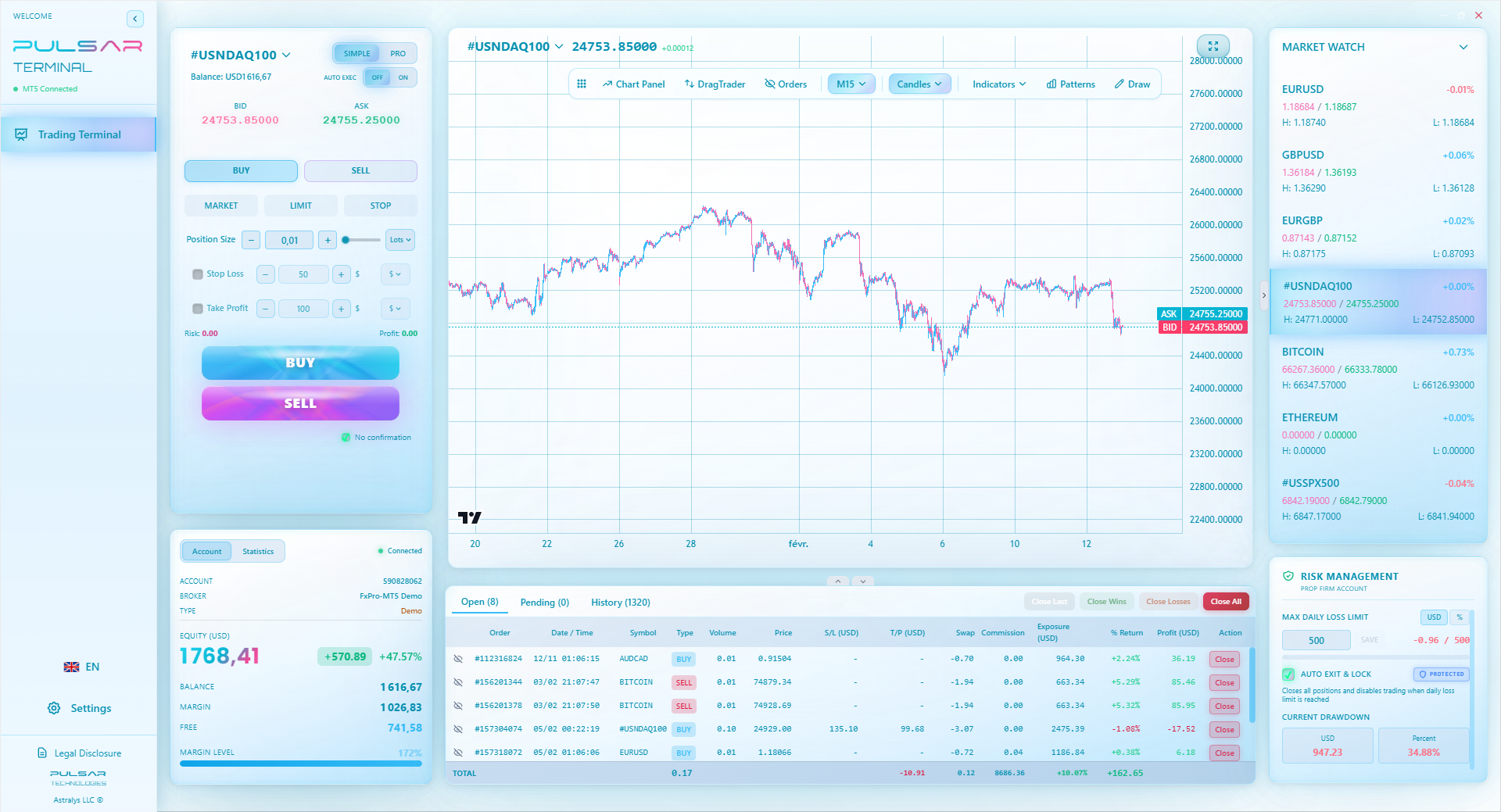
Managing the risk on those quick, PayPal-funded trades is critical, and Pulsar Terminal's drag-and-drop order and risk management tools on MT5 let you set stops and targets precisely the moment you enter.
Pulsar Terminal
Công cụ MT5 tất-cả-trong-một: đặt lệnh kéo-thả, multi-TP/SL, trailing stop, grid trading, Volume Profile và bảo vệ prop firm. Hơn 1.000 trader sử dụng mỗi ngày.
For most South African traders, especially those moving serious volume, local methods are superior. Here's the real competition.
- Direct EFT/Bank Transfer: To an FSCA-regulated broker with a South African bank account. Fees are tiny (often under R10), the exchange is done at the broker's commercial rate (better than PayPal's), and it's fully tracked for tax purposes. The downside? It can take 24-48 hours to clear.
- Instant EFT (Ozow, SID): This is the sweet spot. Services like Ozow connect directly to your online banking. You authorize a payment, and the funds are confirmed to the broker instantly. Fees are low, it uses your bank's exchange rate if applicable, and it's just as fast as PayPal for funding. More and more local brokers support this.
- Credit/Debit Cards: Visa/Mastercard deposits are also instant. The exchange rate is set by your card issuer (usually decent), but beware of cash advance fees. Some banks treat broker deposits as a cash advance, which carries immediate interest. Check with your bank first.
- Other E-Wallets (Skrill/Neteller): These can be useful, but they have the same core issue as PayPal: you're converting ZAR to their internal currency (often EUR) at their rate, then sending to the broker. They're good if you already have funds in them from other activities.
My rule now? For any deposit over R5,000, I use a direct EFT to my FSCA broker. For a quick, sub-R2,000 top-up if I see a setup forming on the EUR/USD, I might use an Instant EFT or, grudgingly, PayPal if it's the only instant option.
💡 Mẹo của Winston
Withdrawals test a broker's character. Fast, cheap withdrawals are a sign of health. Slow, expensive ones are a red flag.
“The convenience of PayPal creates a perfect audit trail for SARS. You cannot hide this income.”
Using PayPal doesn't make you safe. The broker you send the money to does. Never let the convenience of a payment method distract you from the most important factor: who is holding your money?
The Financial Sector Conduct Authority (FSCA) is your first line of defense. A broker licensed by the FSCA is required to segregate client funds. This means your trading capital is held in a separate bank account from the broker's operating money. If the broker goes bankrupt, your funds are (in theory) protected and can be returned to you. This is a non-negotiable for any serious trader.
When you use an offshore broker (even a great one like XM or Pepperstone's global entity), you are subject to their home country's regulations (like CySEC in Cyprus or ASIC in Australia). These are often very strong, but your legal recourse is overseas. For peace of mind and simpler complaint resolution, FSCA regulation is king.
PayPal adds a layer of buyer protection, but that's for unauthorized transactions, not for trading losses. If your broker is a scam, getting money back via a PayPal dispute is a nightmare I wouldn't wish on anyone. It's far better to avoid the scam broker altogether by checking the FSCA's website for their license status.

Pro Tip: Before you fund, search the FSCA's financial services provider register. Type in the broker's licensed name (e.g., 'FP Markets South Africa (PTY) LTD'). If they're not there, walk away. No payment method, not even PayPal, can save you from an unregulated broker.
So, should you fund your forex account with PayPal in South Africa? The answer is: only as a controlled, conscious exception, not your default rule.
The Verdict: PayPal is a premium-priced convenience tool. It's for speed, not for value. Use it when the opportunity cost of waiting for an EFT is higher than the fees you'll pay - like catching a sudden market move based on your MACD indicator signal. For your initial deposit and regular profit withdrawals, local methods are almost always cheaper and just as secure.
My Personal Strategy (What I Actually Do):
- Primary Account: My main trading capital is with an FSCA-regulated broker, funded via a single, large EFT. This avoids countless small fees.
- PayPal's Role: I keep a small balance in my PayPal account, funded from occasional freelance work. If I need to quickly fund a secondary account with an international broker for a specific strategy (like testing a new swing trading approach), I'll use that PayPal balance. This bypasses the bank conversion fee entirely, as the money is already in USD.
- Withdrawals: I never withdraw profits via PayPal. I eat the 1-2 day processing time and use the broker's direct bank withdrawal. It saves the secondary fee and keeps my bank statements clean for my accountant.
Funding is the first trade you make. Don't lose it before you begin. Be smart, be cheap, and put every saved rand into your trading edge, not payment processing.
FAQ
Q1Do any South African forex brokers accept PayPal directly in ZAR?
No. PayPal itself does not support the South African Rand as a wallet currency. You will always convert your ZAR to USD (or another major currency) during the deposit process, using PayPal's exchange rate. However, many brokers like FP Markets accept the USD via PayPal and then credit it to a ZAR-denominated trading account for you, which helps avoid a second conversion later.
Q2What is the fastest way to fund a forex account from South Africa?
Instant EFT services (like Ozow) or credit/debit card deposits are typically the fastest, often instant. PayPal is also instant. A standard bank EFT can take 24-48 hours. Speed comes at a cost, so always weigh the fee against your urgent need to enter a trade.
Q3Are there limits on how much I can deposit via PayPal?
Yes, limits exist on three levels: 1) Your bank's daily transfer limit to PayPal. 2) Your own PayPal account limits (which can be raised by verifying your identity). 3) The broker's deposit limits per transaction. For large amounts (R50,000+), a direct bank transfer is almost always more practical and cost-effective.
Q4Can I use PayPal with any international broker as a South African?
No. The broker must specifically offer PayPal as a deposit method for clients in your region. Many do, but some restrict it. Always check the broker's funding page for your country before assuming. For example, a broker might offer PayPal in Europe but not for South African residents.
Q5How does funding with PayPal affect my taxes in South Africa?
It doesn't change your tax liability, but it creates a clear record. All movements between your SA bank account and PayPal are reported to the SARB. You are still responsible for declaring your net trading profits (income minus expenses) to SARS as taxable income. The PayPal trail just makes it easier for SARS to see the money flow if they ask.
Q6Is it safe to link my bank account to PayPal for forex funding?
From a security standpoint, PayPal is generally very safe and uses strong encryption. The bigger risk is user error: phishing scams, using weak passwords, or not enabling two-factor authentication. As long as you practice good digital hygiene, linking your bank account is standard practice for using the service.
Q7What happens if my PayPal deposit to the broker fails or is delayed?
Remain calm. First, check your PayPal account activity to see if the payment was taken. If it was, but not credited by the broker, contact the broker's support immediately with the PayPal transaction ID. They can trace it. Most delays are resolved within a few hours. If the payment failed, the funds will usually bounce back to your PayPal balance within 3-5 business days.
Bài học của Prof. Winston
Điểm chính:
- ✓PayPal fees can cost you 2-3% before you trade.
- ✓Always prioritize FSCA-regulated brokers for safety.
- ✓Use Instant EFT for speed, direct EFT for value.
- ✓Never let payment convenience override broker regulation.
Bài viết này hữu ích thế nào?
Nhấp vào ngôi sao để đánh giá
Nhận định giao dịch hàng tuần
Phân tích & chiến lược miễn phí hàng tuần. Không spam.
Về tác giả
David van der Merwe
Nhà giao dịch Thị trường Mới nổi
Trader tại Johannesburg với 11 năm kinh nghiệm về tiền tệ thị trường mới nổi. Chuyên về cặp ZAR, giao dịch theo quy định FSCA và phân tích thị trường Nam Phi.
Bình luận
Cảnh báo rủi ro
Giao dịch các công cụ tài chính tiềm ẩn rủi ro đáng kể và có thể không phù hợp với tất cả nhà đầu tư. Hiệu suất trong quá khứ không đảm bảo kết quả trong tương lai. Nội dung này chỉ mang tính chất giáo dục và không nên được coi là lời khuyên đầu tư. Hãy luôn tự nghiên cứu trước khi giao dịch.
Bạn cũng có thể thích

Cara Trading Forex Sukses: 7 Prinsip dari Trader Profesional
Cara trading forex sukses dengan 7 prinsip trader pro: manajemen modal, disiplin, journal trading, backtest. Data nyata, bukan janji profit palsu.
Jam Trading Forex Terbaik untuk Trader Indonesia: Panduan Lengkap dengan Tabel Waktu
Panduan jam trading forex untuk trader Indonesia. Tabel 4 sesi dunia, jam emas 20:00-00:00, sesi mana yang harus dihindari. Data akurat + tips dari trader berpengalaman.
Top 5 Sàn Forex Uy Tín Nhất 2026: Review Jujur dari Trader Indonesia
Top 5 sàn forex uy tín 2026 untuk trader Indonesia. Review jujur: spread, deposit, withdraw, dukungan lokal. Exness, XM, IC Markets & lebih.
Tải Pulsar Terminal
Tất cả các công cụ tính này được tích hợp trong Pulsar Terminal với dữ liệu thời gian thực từ tài khoản MT5 của bạn.
Tải Pulsar Terminal