


Here's a brutal truth: 93.7% of Nigerian forex traders are under 35.

Olumide Adeyemi
Nhà tiên phong Giao dịch Tây Phi ·  Nigeria
☕ 9 phút đọc
Bạn sẽ học được:
- 1What Actually Is a Forex Signal? (It's Not What You Think)
- 2Red Flags Unique to the Nigerian Signal Scene
- 3How to Test a Signal Provider (Without Sending a Kobo)
- 4The Endgame: Learning to Generate Your Own Signals
- 5The Hidden Costs & Risks Nobody Talks About
- 6The Final Verdict: Should a Nigerian Trader Ever Pay for Signals?
Here's a brutal truth: 93.7% of Nigerian forex traders are under 35. That's a huge, hungry market for anyone selling the dream of easy money. And that's exactly why the 'signal seller' industry here is a minefield of overhyped promises and outright theft. A good forex signal isn't just a random arrow on a chart from a guy with a flashy car on Instagram. It's a complete, verifiable trade idea with a clear edge. Let's cut through the noise and figure out what you should actually be paying for.
Most traders get this wrong from the start. A signal isn't magic. It's a specific instruction to enter a trade. A good forex signal must include five non-negotiable pieces of information. Miss one, and you're just gambling on someone's hunch.
The Five Mandatory Components
- Currency Pair: Obviously. But is it a major, minor, or exotic? The volatility changes everything.
- Action (Buy/Sell): Again, basic.
- Entry Price: The exact price level to enter. Not "around 1.0850." The exact price.
- Stop-Loss Price: This is the most important part. It defines your risk. If a signal doesn't give you a stop loss, run. Immediately.
- Take-Profit Price(s): One or more targets to exit for a profit. This shows the provider has a plan for the reward side of the risk-reward equation.
A signal telling you "BUY GBP/USD" is useless. A signal saying "BUY GBP/USD at 1.2625, SL at 1.2590, TP1 at 1.2660, TP2 at 1.2690" is a complete trade idea. That's the baseline.

Warning: Any signal service operating on WhatsApp or Telegram that uses vague language like "strong buy zone" or "look for a dip" is not providing a signal. They're providing entertainment. Your job is to separate the analysts from the entertainers.
I learned this the hard way early on. I paid 50k NGN a month to a popular "guru" whose signals were just screenshots of his chart with a circle drawn around a price area. No entry, no stop. I blew two accounts trying to interpret his "genius." It was my fault for not demanding specifics.
The global forex world has scams. Nigeria has its own special flavour. You need to be aware of the local tactics.
The 'Proof' is Always in USD: Be wary of P&L screenshots only showing dollar profits. Ask for the Naira equivalent after the CBN and bank charges have taken their cut. That 10% capital gains tax on gross profits applies whether your broker is in Cyprus or Lagos. A signal that makes $500 might net you far less after all local deductions. A honest provider will at least acknowledge this reality.
The Prop Firm Flex: This is huge right now. A seller shows a certificate from FTMO, MyForexFunds, or another prop firm as "proof" of skill. Here's the secret: passing a challenge and trading live profitably are two completely different games. The psychology changes when it's your own money, not the firm's. A prop firm certificate is a data point, not a guarantee.
The 'Mentorship' Bait-and-Switch: They offer "free signals" to join a Telegram group. Once there, you're bombarded with stories of life-changing profits and pressured into a 300k NGN "masterclass" that just rehashes free YouTube content. Real education has structure, not just hype.
No Discussion of Broker Costs: Nigerian traders get killed on spreads and commissions if they're not careful. A signal that suggests scalping the GBP/NGN pair without mentioning the massive 50-pip spread you'll face is setting you up to fail. Good providers know local constraints. They might stick to major pairs like EUR/USD where spreads are tight on international platforms like IC Markets or Exness.

Pro Tip: Ask a potential signal provider what broker and account type they use for their live trades. If they're evasive or say "any broker is fine," they've never actually traded their own signals with real money. They're just backtesting.

💡 Mẹo của Winston
If you wouldn't take the trade without the signal, you don't understand the signal. That's a debt, not an edge.
“Passing a prop firm challenge and trading live profitably are two completely different games.”
Never, ever pay for a signal service upfront. Any legitimate provider will offer a trial period or a transparent track record. Your evaluation process should be ruthless.
1. Demand a Verifiable Track Record: Not just screenshots. A real-time, publicly viewable myfxbook or fxblue link. These platforms connect directly to a MetaTrader account and show every trade, including the drawdown. Check the duration. Anyone can be lucky for a month. Look for at least 6-12 months of consistent, real-time results.
2. Paper Trade Their Signals for a Month: This is non-negotiable. Join their free channel or trial. Take every signal exactly as given. Don't second-guess. Use a demo account and a position size calculator to mirror what they suggest. Track the results in a spreadsheet: wins, losses, total P&L, maximum drawdown.
3. Analyze the Strategy, Not Just the Profit: Why are the trades being taken? Can you identify the logic? Is it based on support/resistance, a specific MACD indicator crossover, or news? If it's a black box, you'll never have confidence when a losing streak hits.
4. Calculate the Realistic Naira Return: Let's do math. Say their track record shows 10% average monthly return on a $1,000 account.
- That's $100 profit.
- Minus 10% Capital Gains Tax: $90 left.
- Convert to Naira (let's use 1500/$): 135,000 NGN.
- Now factor in potential bank charges for the international transfer to bring profits home. That 10% return just shrank significantly. A good provider's results should still look attractive after this reality check.
Paying for signals is a tax on your lack of knowledge. The ultimate goal is to fire your signal provider. It takes work, but it's the only path to true independence.
Start with one pair. I always recommend EUR/USD for Nigerians because of its liquidity and generally lower spreads. Learn everything about it. Then, choose one simple strategy. Don't try to learn 10 indicators. Pick a price action setup like a pin bar at a key level, or a simple moving average crossover, and study it relentlessly.
My Personal Breakthrough: I stopped losing consistently when I abandoned complex systems and focused on one thing: the RSI indicator on the 4-hour chart for EUR/USD. I only looked for times when RSI went below 30 and then crossed back above it, while price was also touching a weekly support level I'd drawn. That's it. I paper traded just that setup for 3 months. My first 10 live trades using it netted me 87,000 NGN. It wasn't glamorous, but it was mine. I understood why each trade worked or failed.
This process teaches you the most valuable skill: discretion. You'll learn when a textbook setup is weak because of upcoming news, or when to trail your stop to lock in profit. No signal service can give you that feel. Resources on swing trading or scalping strategy frameworks can give you a structure to build upon.

Example: Your own signal journal entry should look like this: Date: 09/04/2026 Pair: EUR/USD Signal Logic: 4H RSI > 30 after dip, price at weekly S/R level. Entry: 1.0825 | SL: 1.0800 (25 pips) | TP: 1.0875 (50 pips) Risk/Reward: 1:2 Result: Hit TP. +50 pips. Notes: Moved well. No major news during trade.
💡 Mẹo của Winston
The fee for a signal service is the smallest cost. The real cost is the loss of your own judgment. That's priceless.
“Paying for signals is a tax on your lack of knowledge. The ultimate goal is to fire your signal provider.”
Even if you find a legit provider, you're not out of the woods. You're taking on new risks.
Execution Speed is Everything: A signal hits your phone. You have to open your broker app, log in, input the trade. That can take 30-60 seconds. In a fast market, price can blow past your entry or hit your stop loss before you're even filled. This slippage can turn a winning signal into a loser. This is a massive argument for learning to self-execute.
Psychological Dependency: This is the silent killer. When the signals are winning, you feel like a genius. When a losing streak comes (and it will), you have zero internal conviction to stick with the system. You'll second-guess, skip trades, or override the stop loss because "this one feels different." You haven't developed the mental framework to handle loss.
The Tax Man Cometh: Remember, the FIRS wants 10% of your gross profits. If you're following signals that generate 20 trades a month, your accounting becomes a nightmare. You are 100% responsible for declaring this, whether the provider is in Nigeria or not. Keep impeccable records of every single trade copy.
Opportunity Cost of the Fee: Let's say you pay 30k NGN monthly for signals. That's 360k NGN a year. If your trading capital is 500k NGN, you need to make a 72% annual return just to break even on the fee. That's an insane hurdle. It forces the provider to take excessive risk to deliver "jaw-dropping" results, which usually ends in a blown account. A margin call is often just one bad signal away.
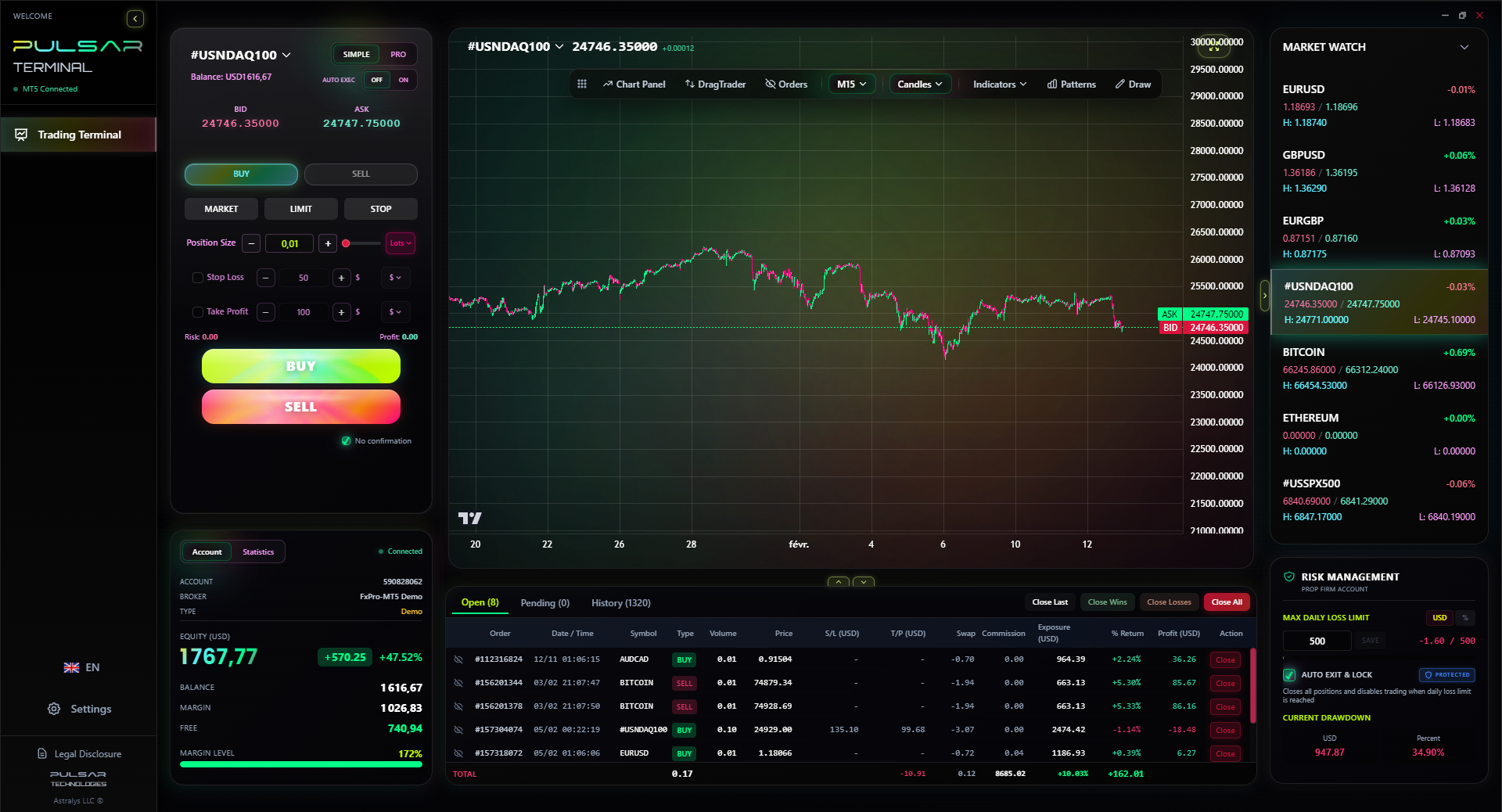
Manually copying signals is slow and error-prone; Pulsar Terminal lets you set up one-click trade templates with pre-defined stops and targets, so you can execute a verified signal in seconds, not minutes.
Pulsar Terminal
Công cụ MT5 tất-cả-trong-một: đặt lệnh kéo-thả, multi-TP/SL, trailing stop, grid trading, Volume Profile và bảo vệ prop firm. Hơn 1.000 trader sử dụng mỗi ngày.
I'll give you my blunt, experienced answer: almost never.
The only conceivable exception is for a very specific, short-term purpose. Maybe you're a fundamentally sound trader who understands XAU/USD but wants to see how a technical expert trades it during the London session for two months. You're paying for a structured observation period, not for blind copying.
For 99% of traders, especially beginners, the money is far better spent elsewhere:
- On Your Education: Buy a classic trading book. Take a well-reviewed course that teaches a complete methodology, not just tips.
- On Better Technology: A faster internet connection, a reliable VPN, or a proper trading journal app.
- On Your Broker: Fund an account with a reputable, low-cost international broker like Pepperstone or XM where the spread (the cost per pip definition) won't eat your profits. That tight spread definition is a signal booster in itself.
- Simply, On More Capital: Adding that 30k monthly fee to your trading account instead gives you a bigger buffer to survive drawdowns while you learn.
The Nigerian market, with its 56.4% growth in forex turnover to $8.6 billion, is full of opportunity. But the predators smell the opportunity too. Your greatest asset isn't a secret signal. It's your own developed skill, patience, and critical thinking. Build that, and you won't need to look for good forex signals. You'll be creating them.
FAQ
Q1Are free forex signal groups on WhatsApp legit?
Almost universally, no. They are lead generators. The 'free' signals are often late, vague, or cherry-picked winners to build trust. The goal is to funnel you into a paid 'VIP' group or a fake investment scheme. Treat them with extreme skepticism.
Q2What is a realistic monthly return I should expect from a good signal service?
Anything promising over 5-10% per month consistently is likely taking dangerous risks. In finance, a 20% annual return is considered excellent. A signal service aiming for 3-5% per month (36-60% annually) with controlled drawdown is far more credible than one shouting about 50% monthly gains.
Q3How do I handle taxes on profits from following signals?
The responsibility is 100% yours. You must declare your gross trading profits to the FIRS and pay the 10% Capital Gains Tax. Keep a detailed log of every trade (entry, exit, profit/loss in Naira). The signal provider won't do this for you, and your international broker won't issue a Nigerian tax document.
Q4Can I use signals for prop firm challenges?
You can, but it's risky. Prop firms have rules against copy-trading and often monitor for it. More importantly, the strict drawdown limits in challenges (e.g., 5% daily loss) mean one delayed or bad signal can fail you instantly. The pressure of a challenge amplifies all the execution and psychological flaws of relying on signals.
Q5What's more important, the win rate or the risk-reward ratio of the signals?
Risk-reward ratio, every single time. A service with a 40% win rate but a 1:3 risk-reward can be highly profitable. A service with an 80% win rate but a 1:0.5 risk-reward (risking 50 pips to make 25) will be wiped out by a few losses. Always analyze the average loss size versus the average win size.
Q6I found a provider with a verified myfxbook. Is that guaranteed safe?
It's the best proof you can get, but not a guarantee. Check if the account is 'live' or 'demo.' Look at the 'history' tab to see if it's been running consistently. Most importantly, see if the trading style matches the signals they send. A myfxbook showing 1 trade a week doesn't match a service sending 5 signals a day.
Bài học của Prof. Winston
Điểm chính:
- ✓A real signal has an exact Entry, Stop Loss, and Take Profit. Nothing less.
- ✓Paper trade any service for a full month before paying 1 Naira.
- ✓Factor in the 10% Capital Gains Tax on all profits before calculating real returns.
- ✓The money for signals is better spent on education or a better broker.
Bài viết này hữu ích thế nào?
Nhấp vào ngôi sao để đánh giá
Nhận định giao dịch hàng tuần
Phân tích & chiến lược miễn phí hàng tuần. Không spam.
Về tác giả
Olumide Adeyemi
Nhà tiên phong Giao dịch Tây Phi
Một trong những nhà đào tạo forex tích cực nhất tại Nigeria. 8 năm kinh nghiệm giao dịch từ Lagos. Chuyên về chiến lược vốn thấp và thử thách prop firm dành cho trader châu Phi.
Bình luận
Cảnh báo rủi ro
Giao dịch các công cụ tài chính tiềm ẩn rủi ro đáng kể và có thể không phù hợp với tất cả nhà đầu tư. Hiệu suất trong quá khứ không đảm bảo kết quả trong tương lai. Nội dung này chỉ mang tính chất giáo dục và không nên được coi là lời khuyên đầu tư. Hãy luôn tự nghiên cứu trước khi giao dịch.
Bạn cũng có thể thích

Cara Trading Forex Sukses: 7 Prinsip dari Trader Profesional
Cara trading forex sukses dengan 7 prinsip trader pro: manajemen modal, disiplin, journal trading, backtest. Data nyata, bukan janji profit palsu.
Jam Trading Forex Terbaik untuk Trader Indonesia: Panduan Lengkap dengan Tabel Waktu
Panduan jam trading forex untuk trader Indonesia. Tabel 4 sesi dunia, jam emas 20:00-00:00, sesi mana yang harus dihindari. Data akurat + tips dari trader berpengalaman.
Top 5 Sàn Forex Uy Tín Nhất 2026: Review Jujur dari Trader Indonesia
Top 5 sàn forex uy tín 2026 untuk trader Indonesia. Review jujur: spread, deposit, withdraw, dukungan lokal. Exness, XM, IC Markets & lebih.
Tải Pulsar Terminal
Tất cả các công cụ tính này được tích hợp trong Pulsar Terminal với dữ liệu thời gian thực từ tài khoản MT5 của bạn.
Tải Pulsar Terminal