


Here's a number that should sober you up: Nigeria's forex market turnover jumped 56.4% to $8.6 billion in 2025.

Olumide Adeyemi
Nhà tiên phong Giao dịch Tây Phi ·  Nigeria
☕ 11 phút đọc
Bạn sẽ học được:
Here's a number that should sober you up: Nigeria's forex market turnover jumped 56.4% to $8.6 billion in 2025. Sounds like a party, right? Wrong. That surge is a symptom of volatility, not stability. If you want to understand how forex operates here, you need to forget the global textbook version. The Nigerian market is a unique beast, shaped by Central Bank directives, a unified exchange window (the NFEM), and a regulatory grey zone where you, the retail trader, operate on the fringes. I've traded through multiple CBN governors and policy flip-flops. Let me show you the real wiring behind the machine.
Most newbies think forex is just buying Euros hoping they go up against the Dollar. In Nigeria, that's only half the story. The foundational operation is the exchange of currency pairs, with price driven by the perpetual tug-of-war between buyers and sellers. But here's the twist: when you trade USD/NGN, you're not trading the physical Naira in your bank account. You're trading a derivative contract, a CFD (Contract for Difference), based on its value.
The real price discovery for the Naira happens in the Nigerian Foreign Exchange Market (NFEM), the unified official window created by the CBN. Your broker's quote for USD/NGN is a reflection of that, plus their own spread. This is critical. You are betting on a price, not physically converting currency. This is why local banks can't help you with speculative trades; they deal in the physical market. You're in the speculative, offshore-derived market.
So, how does forex operate on your screen? Through a broker's trading server. You place an order, it's matched electronically, and your profit or loss is the difference between your entry and exit price, multiplied by your position size. The underlying asset - the actual exchange rate - is set by forces you'll never see directly: CBN interventions, Bureau de Change flows, and foreign portfolio investor movements. Your job is to interpret the shadows those forces cast on your chart.

Warning: Trading USD/NGN CFDs is highly speculative. The CBN can and does intervene, causing gaps and slippage that can wipe out a carefully placed stop-loss. Never confuse CFD trading with trying to arbitrage the street rate.

💡 Mẹo của Winston
The spread isn't a fee, it's a toll bridge. You have to cross it to get to Profitsville. If the bridge is too long (wide spread), maybe you're on the wrong road. Stick to majors.
“In Nigeria, you are betting on a price, not physically converting currency.”
Let's get the legalities straight. Yes, forex trading is legal for you as an individual. No, you are not breaking any law by logging into Exness or IC Markets. The confusion starts with who's actually in charge.
The Central Bank of Nigeria (CBN) Calls the Shots
The CBN is the heavyweight. Its job is Naira stability and managing Nigeria's foreign reserves. It doesn't license or oversee your retail broker. Instead, it controls the environment you trade in. The 2024 Nigeria Foreign Exchange Code tightened rules for banks and authorized dealers. The consolidation into the NFEM was a big move to unify rates and kill off arbitrary windows. For you, this means the underlying rate your CFD is based on is now (theoretically) more transparent.
Their new rules for BDCs in 2026 - letting them buy $150k weekly but sell it within 24 hours - is about controlling liquidity on the street. This trickles up to affect market sentiment and volatility.
The SEC's Hands-Off Approach
The Securities and Exchange Commission (SEC) regulates stocks and bonds. They have no framework for licensing spot forex brokers. They'll issue warnings about scams (and you should listen), but they offer no seal of approval for legitimate brokers. This regulatory vacuum is why you must rely on international oversight.
Your Safety Net: International Regulation
Since there's no local daddy, your broker's credibility comes from abroad. Top-tier regulators are your friends:
- Financial Conduct Authority (FCA) - UK: Stringent. Client money protection.
- Financial Sector Conduct Authority (FSCA) - South Africa: Popular and accessible for Nigerians.
- Cyprus Securities and Exchange Commission (CySEC): Common EU license.
- Australian Securities and Investments Commission (ASIC): strong.
A broker like Pepperstone holding an ASIC license is subject to stricter operational standards than an unregulated offshore entity. This is non-negotiable for protecting your capital.

Pro Tip: Always fund your trading account using the methods your international broker provides (crypto, bank transfer, etc.). Do not ask your local Nigerian bank to help "forex trading transactions" - they will refuse, as it's against CBN guidelines for them. You're operating in a parallel, globally-connected system.
“The regulatory vacuum locally is why your broker's international license is your lifeline.”
The market is a hierarchy. Knowing who moves price helps you understand the noise.
| Tier | Who They Are | What They Do | Impact on You |
|---|---|---|---|
| Tier 1 (Interbank) | Major global banks (Citi, JP Morgan), CBN | Set the baseline exchange rates, provide liquidity. | You see their activity as the "bid/ask" spread. CBN interventions cause seismic shifts. |
| Tier 2 | Smaller banks, hedge funds, large corporations | Trade large volumes for clients or speculation. | Create the sustained trends or reversals you try to ride. |
| Tier 3 (Retail) | Brokers (XM, etc.), you, other traders | Broker aggregates orders; you speculate. | You provide liquidity for each other. Your collective stop-losses can create market swings. |
For Nigerian traders, the pairs list is unique:
- USD/NGN: The main event. Extreme volatility, huge spreads (often 50-100 pips), CBN risk. It's a wild beast. I once caught a 1500-pip move in a week during a policy announcement, but I've also been gapped through my stop-loss overnight.
- Major Pairs (EUR/USD, GBP/USD): Your bread and butter. Tighter spreads, more predictable technical behavior. This is where most serious Nigerian traders make their living. My EUR/USD guide breaks down why.
- Commodity Pairs (XAU/USD - Gold): A favorite hedge against Naira anxiety. When confidence in local currency dips, gold often rises. Understanding XAU/USD dynamics is key.
- Exotic Pairs (USD/ZAR, etc.): Higher risk, higher reward. Can be correlated with regional sentiment.
The drama around the Naira isn't just background noise. A weakening Naira (rising USD/NGN) can push Nigerians to seek dollar-denominated assets, increasing volatility in majors as capital flows shift. You have to watch the local news as closely as the MACD indicator.
“The regulatory vacuum locally is why your broker's international license is your lifeline.”
This is the moment of truth. You click buy. What actually happens?
- Order Transmission: Your click becomes a data packet sent to your broker's server.
- Liquidity Search: For a market order, the broker's system finds a seller at the best available price from their liquidity providers (those Tier 1 & 2 banks). This is where slippage occurs if volatility is high.
- Confirmation: The trade is executed, and a position appears in your account. You are now "long" or "short."
- The Spread: You're instantly in the red by the spread amount. If the EUR/USD spread is 1 pip, and you bought at 1.0850, the price needs to rise to 1.0851 for you to break even.
- P&L Fluctuation: Your profit and loss ticks with every price movement. A single pip movement on a standard lot (100,000 units) is worth $10 for most pairs.
The Nigerian Execution Quirk: Funding and Withdrawals. Depositing can be a hurdle. Broker bank accounts are often overseas. You might use a wire transfer (slow, with CBN scrutiny), a credit/debit card (sometimes declined), or increasingly, cryptocurrency. Crypto is fast and bypasses traditional banking channels, but adds its own volatility layer.
Withdrawals are the real test of a broker. A reputable, internationally regulated broker will process your profit withdrawal in USD to your Nigerian bank account. You'll then convert it at your bank's rate. The process taking 3-5 business days is normal. If a broker makes excuses, that's a huge red flag.
I learned this the hard way early on. Made a nice $800 profit on a scalping strategy run, and the "broker" (an unregulated outfit) demanded endless verification documents for a withdrawal. I never saw that money. The lesson cost me $800 but saved my future capital.
💡 Mẹo của Winston
Your first job isn't to make money. It's to not lose money. A 1% risk per trade isn't a suggestion, it's the law. Break it, and the market will serve you an eviction notice.
“A weakening Naira can push Nigerians to seek dollar-denominated assets, increasing volatility in majors.”
You don't just need the market to move in your direction. It needs to move enough to cover the costs of doing business. Ignore these, and you'll bleed out slowly.
- Spread: The primary cost. It's the difference between the buy and sell price. A 1.2 pip spread on EUR/USD is good. A 50 pip spread on USD/NGN is normal. You pay this on entry.
- Commission: Some brokers charge a separate commission per trade (e.g., $3.50 per 100k lot). This is often paired with raw spreads from liquidity providers.
- Swap/Rollover Fee: The cost of holding a position overnight. It's based on the interest rate differential between the two currencies. Can be positive or negative. Holding a short USD/NGN position overnight often incurs a hefty negative swap due to Nigeria's high-interest rates.
- Inactivity Fees: Charged if you don't trade for several months.
- Funding/Withdrawal Fees: Your bank or payment processor may charge for international transfers.

Example: Let's say you buy 1 standard lot of EUR/USD.
- Entry Price (Ask): 1.0850
- Spread: 1.2 pips. Your break-even is instantly 1.08512.
- Commission: $7.00 round turn. That's another 0.7 pips to cover.
- Total cost to break even: ~1.9 pips or $19. The market must move almost 2 pips in your favor before you make a single cent of profit. This is why a position size calculator is essential - overtrading with oversized positions turns these small costs into a monster.
For swing trading where you hold for days, you must factor in the swap. I once held a GBP/JPY short for two weeks. The trend was right, but the daily negative swap ate nearly 40% of my eventual profit. A painful lesson in total cost accounting.
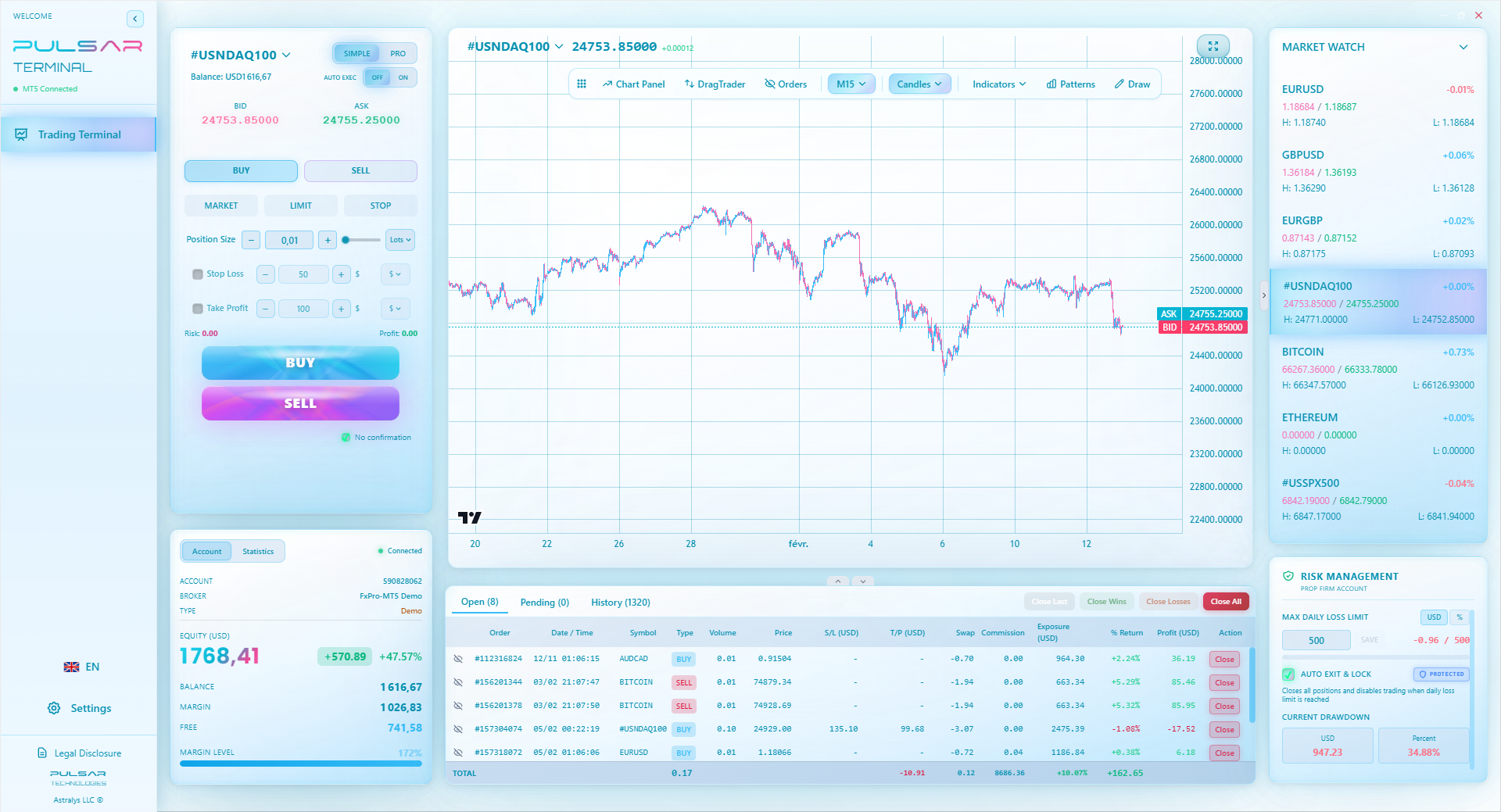
Managing multiple take-profit levels and a trailing stop on a volatile pair like USD/NGN is stressful, but tools like Pulsar Terminal automate these orders directly on your MT5 chart.
Pulsar Terminal
Công cụ MT5 tất-cả-trong-một: đặt lệnh kéo-thả, multi-TP/SL, trailing stop, grid trading, Volume Profile và bảo vệ prop firm. Hơn 1.000 trader sử dụng mỗi ngày.
“A weakening Naira can push Nigerians to seek dollar-denominated assets, increasing volatility in majors.”
Let's stitch it all together with a real scenario. It's Tuesday, March 2026.
7:00 AM WAT: You wake up. Check your phone. Bloomberg reports a slight uptick in Nigeria's external reserves. The Naira might get a slight boost. You note it.
8:30 AM: You're at your desk. You pull up your charts on MT5. You see EUR/USD has been ranging between 1.0800 and 1.0830. The RSI indicator is showing oversold near the range low. You're considering a long.
10:00 AM: News hits: The CBN has announced a new FX manual to enhance surveillance. Market uncertainty. USD/NGN spikes 100 pips on your broker's feed. This injects volatility into all pairs. Your planned EUR/USD trade? On hold. You don't trade during Nigerian policy news spikes.
1:00 PM London Open: European liquidity hits. The EUR/USD range holds. You execute a long at 1.0805, stop loss at 1.0785 (20 pips risk), take profit at 1.0830. You use your position size calculator to ensure this risk is only 1% of your account.
4:00 PM: Price drifts to 1.0820. You're in profit. You consider moving your stop to breakeven. This is where discipline matters. Do you follow your plan, or get greedy?
6:00 PM: US data comes out strong. Dollar strengthens across the board. Your EUR/USD trade hits your stop-loss at 1.0785. A 20-pip loss. You're down 1%.
Analysis: You followed your rules. The news-driven volatility from the CBN announcement earlier likely contributed to the stronger dollar sentiment. The cost? The spread (1.2 pips) plus commission. You lost, but it was a controlled, planned loss. That's how the business operates. You don't win every day. You manage risk every day. The fear of a margin call keeps you honest.
💡 Mẹo của Winston
The CBN governor's speech is a fundamental indicator as powerful as any GDP report. If you trade during a major policy announcement, you're not trading, you're gambling.
“The market doesn't care about your patriotism, your bills, or your dreams. It's a probabilistic game.”
The Nigerian forex landscape isn't static. The CBN's reforms point towards more structure and transparency in the official NFEM. For you, the retail trader, this means:
- Increased Scrutiny on Flows: Funding methods might get tighter. Crypto may become even more prevalent.
- Broker Consolidation: Only brokers with solid international regulation and smooth operations for Nigerians will thrive.
- Education as Armor: With more transparency comes more complexity. Understanding not just charts, but macroeconomics, CBN policy tools, and global risk sentiment is no longer optional.
Your edge will come from adapting your strategy to this environment. Maybe it's avoiding USD/NGN altogether and focusing on the technical purity of majors. Maybe it's using gold (XAU/USD) as a volatility hedge. Perhaps it's adopting shorter timeframes to reduce exposure to overnight CBN risk.
The core question of how does forex operate will always have the same answer: it's a global electronic marketplace of currency values. But in Nigeria, it's that marketplace viewed through a unique, constantly shifting prism of local policy. Your success depends on understanding both the global machine and the local lens.
Final thought from someone who's been in the trenches: The market doesn't care about your patriotism, your bills, or your dreams. It's a probabilistic game. Respect its mechanics, manage your risk obsessively, and never stop learning. The ones who last are the ones who treat trading like a serious business, not a lottery ticket.
FAQ
Q1Is forex trading legal and safe in Nigeria?
Yes, it's legal for individuals. 'Safe' depends entirely on you. It's safe if you use brokers regulated by top-tier international authorities (like FCA, ASIC, FSCA), manage your risk, and treat it as a skilled profession, not gambling. It's unsafe if you use unregulated brokers, trade with money you can't afford to lose, or ignore risk management.
Q2Can I trade the Naira (USD/NGN) directly?
Not in the physical sense. You trade a CFD (derivative) based on the Naira's value. The underlying rate is set by the Nigerian Foreign Exchange Market (NFEM). Be warned: spreads are wide (50-100 pips is common), volatility is extreme due to CBN interventions, and overnight swap fees can be high. It's one of the most challenging pairs for retail traders.
Q3How do I fund my forex trading account in Nigeria?
International brokers offer several options: international bank wire transfers (can be slow), credit/debit cards (may be declined by Nigerian banks), and increasingly, cryptocurrency deposits (like USDT). Avoid asking your local bank to process a 'forex trading' transaction, as they are restricted from doing so. Crypto is becoming the fastest, most reliable method.
Q4Who regulates forex brokers for Nigerian traders?
The Nigerian SEC does not license retail forex brokers. Therefore, Nigerian traders rely on the international regulation of their chosen broker. Look for brokers licensed by the UK's FCA, Australia's ASIC, South Africa's FSCA, or Cyprus's CySEC. These regulators enforce client fund protection and fair practice rules.
Q5What are the biggest costs of trading forex in Nigeria?
- The Spread: The built-in cost of every trade, especially high on pairs like USD/NGN. 2. Commission: Charged per trade by some brokers. 3. Swap Fees: The cost of holding positions overnight, which can be significant on certain pairs. 4. Bank/Payment Fees: For funding and withdrawing, including potential currency conversion losses.
Q6What's the best trading strategy for a Nigerian beginner?
Start by avoiding USD/NGN. Focus on major pairs like EUR/USD with lower spreads and more predictable behavior. Begin with a demo account, then move to a live micro account. Learn one simple strategy well - like price action support/resistance or a basic indicator setup like MACD crossovers. Master risk management first; profitability comes later. Consider swing trading to avoid the stress of rapid-fire decisions.
Q7How does CBN policy affect my forex trading?
Massively. CBN announcements on interest rates, FX market reforms (like the NFEM), or BDC rules directly impact the value of the Naira. This creates volatility that spills over into all currency pairs, as it affects global investor sentiment towards Nigeria. Always be aware of the local economic calendar alongside the global one.
Bài học của Prof. Winston
Điểm chính:
- ✓USD/NGN spreads are 50-100 pips; trade majors first.
- ✓Use only FCA, ASIC, or FSCA-regulated brokers.
- ✓Risk a maximum of 1% of capital per trade.
- ✓CBN policy news = high volatility; avoid trading.
- ✓Funding via crypto is often fastest for Nigerians.
Bài viết này hữu ích thế nào?
Nhấp vào ngôi sao để đánh giá
Nhận định giao dịch hàng tuần
Phân tích & chiến lược miễn phí hàng tuần. Không spam.
Về tác giả
Olumide Adeyemi
Nhà tiên phong Giao dịch Tây Phi
Một trong những nhà đào tạo forex tích cực nhất tại Nigeria. 8 năm kinh nghiệm giao dịch từ Lagos. Chuyên về chiến lược vốn thấp và thử thách prop firm dành cho trader châu Phi.
Bình luận
Cảnh báo rủi ro
Giao dịch các công cụ tài chính tiềm ẩn rủi ro đáng kể và có thể không phù hợp với tất cả nhà đầu tư. Hiệu suất trong quá khứ không đảm bảo kết quả trong tương lai. Nội dung này chỉ mang tính chất giáo dục và không nên được coi là lời khuyên đầu tư. Hãy luôn tự nghiên cứu trước khi giao dịch.
Bạn cũng có thể thích

Cara Trading Forex Sukses: 7 Prinsip dari Trader Profesional
Cara trading forex sukses dengan 7 prinsip trader pro: manajemen modal, disiplin, journal trading, backtest. Data nyata, bukan janji profit palsu.
Jam Trading Forex Terbaik untuk Trader Indonesia: Panduan Lengkap dengan Tabel Waktu
Panduan jam trading forex untuk trader Indonesia. Tabel 4 sesi dunia, jam emas 20:00-00:00, sesi mana yang harus dihindari. Data akurat + tips dari trader berpengalaman.
Top 5 Sàn Forex Uy Tín Nhất 2026: Review Jujur dari Trader Indonesia
Top 5 sàn forex uy tín 2026 untuk trader Indonesia. Review jujur: spread, deposit, withdraw, dukungan lokal. Exness, XM, IC Markets & lebih.
Tải Pulsar Terminal
Tất cả các công cụ tính này được tích hợp trong Pulsar Terminal với dữ liệu thời gian thực từ tài khoản MT5 của bạn.
Tải Pulsar Terminal