


Most guides on how to get forex in Nigeria are either outdated or written by people who've never actually traded here.

Olumide Adeyemi
Nhà tiên phong Giao dịch Tây Phi ·  Nigeria
☕ 12 phút đọc
Bạn sẽ học được:
- 1The Two Markets: Official vs. Parallel (Black Market)
- 2How to Actually Fund Your Trading Account (2026 Methods)
- 3Picking Your Broker: Regulation, Spreads, and Naira-Friendly Features
- 4The Legal Stuff: Is It Legal and What About Tax?
- 5Trading with the Naira: Managing Risk and Volatility
- 6Pitfalls to Avoid: Lessons from My Mistakes
- 7Your 2026 Action Plan: How to Get Forex and Start Trading
Most guides on how to get forex in Nigeria are either outdated or written by people who've never actually traded here. They'll tell you to just go to a bank, ignoring the reality that the parallel market often dictates the real price of your capital. The truth is, getting forex for trading involves navigating a two-tiered system: one for physical dollars to fund your life, and another for the digital dollars that fuel your trading account. I've funded accounts during cash crunches and traded through multiple CBN policy shifts. This isn't theoretical. I'll show you the actual paths, the real costs, and the mistakes that can wipe out your account before you even place a trade.
You need to understand this first. Nigeria has, for all practical purposes, two foreign exchange markets. Your choice between them depends entirely on what you need the forex for.
The Official Market is run through the Central Bank of Nigeria (CBN), commercial banks, and licensed Bureau de Change (BDC) operators. As I write this, the official CBN rate is around ₦1,386 per dollar. This is the rate you see on the news. To get forex here, you typically need valid documentation for things like tuition fees, medical bills, or business travel (Form A, Form M, etc.). The process can be slow, and availability isn't always guaranteed for every request.
Then there's the Parallel Market. This is the "Aboki" or black market. The rate here is purely about supply and demand. Right now, it's roughly ₦1,405 per dollar. It's faster, often requires less paperwork for smaller amounts, but it comes with risks. You're dealing in physical cash, which means security concerns and the chance of receiving counterfeit notes.

Warning: Using the parallel market to fund an international broker via bank transfer is a major red flag for your bank. They may flag the transaction, freeze your account, or ask for a source of funds you can't provide. I learned this the hard way in 2021 when a $500 deposit to an IC Markets review account got my domiciliary account put on hold for two weeks.
For a trader, here's the simple breakdown: Use the official channel for your documented life expenses if you can. Use the parallel market for the physical cash you might need on hand. But for funding your trading account? We need a different approach, which I'll cover in the next section.
This is the core of how to get forex for trading. You're not buying physical notes; you're moving value from your Naira world into a broker's dollar-denominated trading platform. The methods have evolved.
1. Cryptocurrency (The Most Common Path) This is, frankly, the go-to method for most serious retail traders I know. You use a local crypto peer-to-peer (P2P) platform to buy USDT (Tether) with Naira. Then, you send that USDT to a broker that accepts crypto deposits. Brokers like Exness review and XM review have integrated this seamlessly. The spread on the P2P platform becomes your effective exchange rate, which is often closer to the parallel market rate. It's relatively fast and bypasses traditional banking hurdles.
2. Direct Bank Transfer (Card/Deposit) Some international brokers still accept direct deposits from Nigerian debit/credit cards or bank transfers. Your bank will convert your Naira to dollars at their own rate (which is usually a markup on the official rate) and charge an international transaction fee (often 1-5%). The broker receives dollars. The main issue here is success rate. Banks, due to CBN circulars, frequently block these transactions to "save forex." I had a $200 deposit to Pepperstone review fail three times in one month before giving up.
3. E-Wallets: Skrill, Neteller, PayPal You fund the e-wallet with Naira (through your bank or card), the e-wallet converts it, and you transfer to the broker. Fees can stack up, and not all brokers accept all e-wallets. PayPal is particularly tricky for sending to brokers.

Example: Let's say you want $100 in your trading account.
- Via Crypto P2P: Parallel rate ~₦1,405/$ = ₦140,500 + small P2P platform fee.
- Via Bank Card: Bank rate ~₦1,420/$ = ₦142,000 + 3.5% card fee (₦4,970) = ₦146,970. That's a ₦6,470 difference just to get the same $100 to your broker. That's your first loss before you even trade.
The key is to check your chosen broker's deposit page, see what methods they offer for Nigerian clients, and calculate the total landed cost in dollars. Your first trade isn't at the market open; it's the moment you decide how to get forex into your account.

💡 Mẹo của Winston
Your first trade begins when you convert Naira to fund your account. The spread in the parallel market or on a P2P platform is your first commission. Choose your funding path as carefully as you choose your trades.
“The parallel market rate is the most relevant benchmark for calculating the real Naira cost of your trading capital.”
Nigeria's SEC is trying to get more involved, but let's be real: most Nigerian traders use internationally regulated brokers. Your safety net is the Financial Conduct Authority (FCA UK), the Australian Securities and Investments Commission (ASIC), or the Cyprus Securities and Exchange Commission (CySEC).
Don't just look for the biggest use ad. Look for these things:
1. Reliable Deposit/Withdrawal for Nigerians: This is non-negotiable. Does the broker have a clear track record of processing withdrawals back to Nigerian accounts or crypto wallets without drama? Read recent reviews from other Naija traders.
2. Trading Costs: This is where you make or lose money. You have two main account types:
- Standard Accounts: No commission, but the broker's profit is built into the spread (the difference between buy and sell price). An EUR/USD spread of 1.2 pips is common.
- Raw/ECN Accounts: Tighter spreads (even 0.0 pips on majors) but you pay a commission per trade. For a high-volume scalping strategy, this is usually cheaper.
3. Minimum Deposit: Can you start with $50, $100, or $500? This should match your risk capital. Don't deposit money you need for rent.
4. Platform & Tools: Most use MetaTrader 4 or 5. But does the broker offer additional tools for analysis? This is where a platform like Pulsar Terminal, which works with MT5, can add serious firepower for charting and order management.
Here’s a quick comparison of some brokers popular here:
| Broker | Strong Point for Nigerian Traders | Key Thing to Watch |
|---|---|---|
| Exness | Very low spreads, accepts crypto deposits easily. | use can be very high (risk!). |
| XM | Low minimum deposit ($5), good educational resources. | Spreads on standard accounts can be wider. |
| IC Markets | True ECN pricing, great for scalping strategy. | Minimum deposit is higher ($200). |
| Pepperstone | Top-tier regulation (FCA, ASIC), excellent execution. | Deposit methods may be limited at times. |
My personal setup? I use an ASIC-regulated broker with an ECN account. I fund it via USDT, and I use a separate tool for advanced charting and trade management because the native MT5 platform is a bit basic for my swing trading style.
Yes, forex trading with your own capital for personal gain is legal in Nigeria. The CBN governs the forex market, and the SEC oversees securities activities. You are not breaking the law by having an account with an overseas broker.
However, the tax man cometh. The Federal Inland Revenue Service (FIRS) views profits from forex trading as capital gains. According to the Capital Gains Tax Act, you're liable to pay 10% tax on your gross profits.
Let's talk numbers. Say you make a profit of ₦500,000 from trading in a year. Your capital gains tax liability would be 10% of that: ₦50,000. You are responsible for declaring this and paying it. The broker won't do it for you.

Pro Tip: Keep a detailed trading journal. Not just screenshots, but a log of every trade: entry, exit, profit/loss in dollars, and the exchange rate you use to convert to Naira for tax purposes. Use a simple spreadsheet or a dedicated journal. When FIRS asks (and they might), you need clean records. I use the 1% rule for tax: I immediately set aside 1% of the value of any winning trade into a separate savings account to build my tax reserve. It hurts less than a big bill at year-end.
The other legal risk is using unapproved channels to get forex for funding, which could violate CBN's foreign exchange regulations. This is a grey area, but being able to show that your trading capital came from legitimate savings (even if converted via crypto P2P) is prudent.
“Your first trade isn't at the market open; it's the moment you decide how to get forex into your account.”
Trading from Nigeria adds a unique layer of risk: currency risk on your capital. Your account is in USD, but your life is in Naira. If the Naira strengthens dramatically, the Naira value of your dollar profits shrinks. More commonly, if it weakens, your losses in Naira terms can balloon.
The Deposit/Withdrawal Cycle Risk
You buy dollars at Rate A (e.g., ₦1,405) to deposit. You make a 10% profit in dollars. You withdraw. But now, to convert back to Naira, the rate is ₦1,380 (a stronger Naira). Your 10% dollar profit could become a 5% Naira profit or less after the double conversion. You must factor this in.
Practical Risk Management for Naija Traders
- Size for Naira Volatility: Be even more conservative with your position size calculator. If you'd normally risk 2% of your account on a trade in a stable economy, consider 1% or 1.5%. The external volatility from our local market is an unseen margin call waiting to happen.
- Withdraw Profits in Local Cycles: Don't let all your profits sit in USD forever. Periodically withdraw gains to realize them in Naira, especially if you need the money for local expenses. This locks in the exchange rate.
- Hedge with Mindset: Consider your trading capital as "dollarized" savings. This mindset helps you avoid panic withdrawals during temporary Naira strength. One of my best trades ever was holding a gold (XAU/USD guide) position during a period of Naira volatility. The dollar profit from gold offset my anxiety about the local currency.
The tools you use matter. Having a platform that lets you set precise stop-loss and take-profit orders is critical. You can't babysit every trade with our unstable power supply. Automated trade management isn't a luxury here; it's a necessity for consistent swing trading.
💡 Mẹo của Winston
Naira volatility is an invisible trading pair in your portfolio. If you wouldn't trade USD/NGN with 10% of your capital, don't ignore its effect on your dollar-denominated profits and losses.
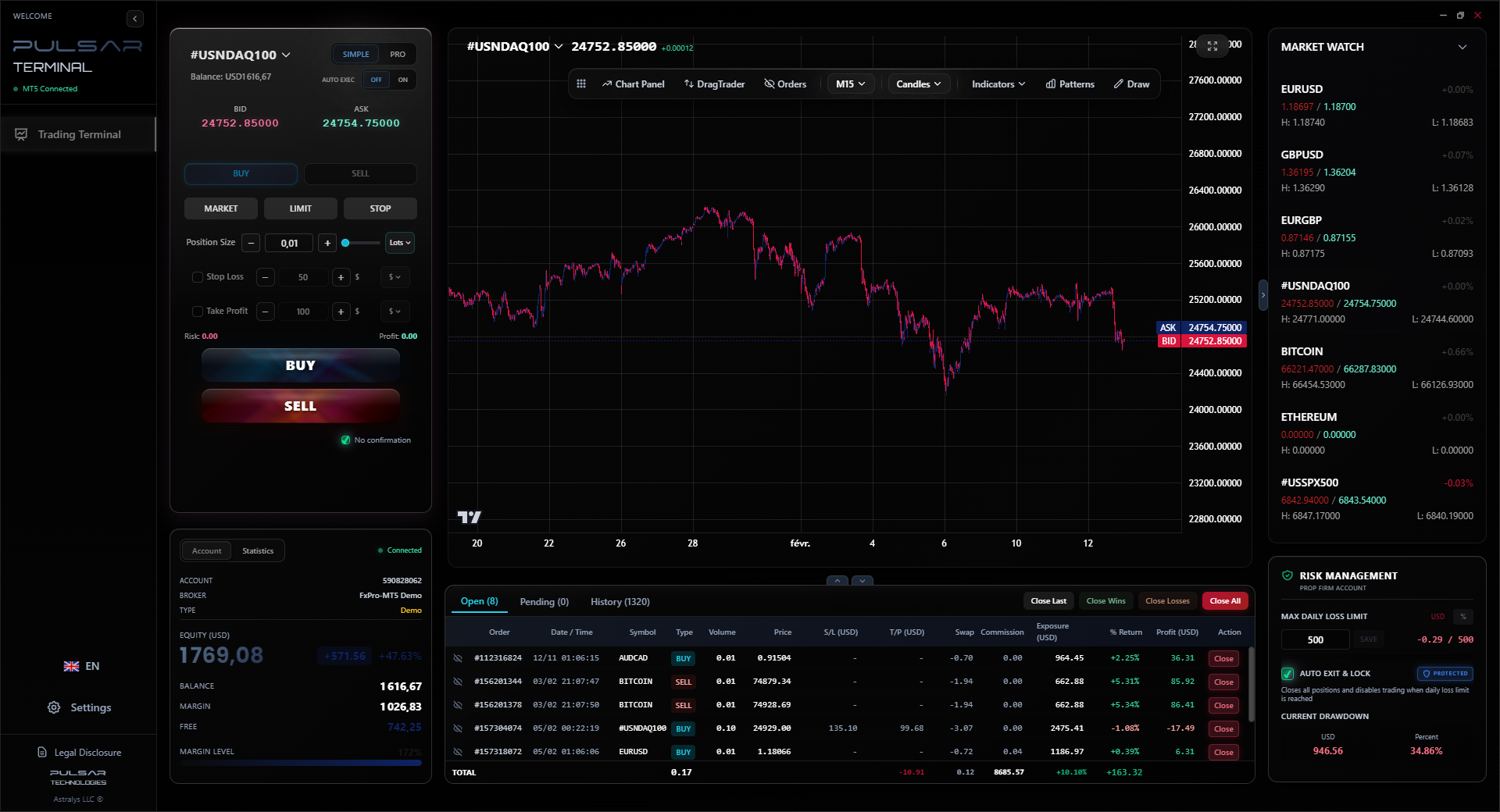
Managing trades precisely is critical with Naira volatility, and Pulsar Terminal's drag-and-drop orders and automated trailing stops on MT5 ensure your strategy executes even during our frequent power outages.
Pulsar Terminal
Công cụ MT5 tất-cả-trong-một: đặt lệnh kéo-thả, multi-TP/SL, trailing stop, grid trading, Volume Profile và bảo vệ prop firm. Hơn 1.000 trader sử dụng mỗi ngày.
I've lost money so you don't have to. Here are the classic Nigerian trader errors.
1. Chasing the Highest use: A broker offers 1:1000 use. You deposit $100 and suddenly control $100,000. One bad move against you and your account is gone. It's a trap. I blew a $500 account in 45 minutes this way in my second year. Start with 1:30 or 1:50 max, even if the broker offers more.
2. Ignoring Total Funding Cost: As we calculated earlier, the cost to get forex into your account varies wildly. Choosing the most expensive method eats into your potential profits before you start. Always do the math.
3. Trading Without a Buffer: You deposit exactly $200 for trading. A month in, you need to pay for data, maybe a VPN, or a better charting tool. You're forced to withdraw from your trading capital, disrupting your strategy. Always deposit more than your "strict trading capital" to cover operational costs.
4. Using Unregulated "Signal Sellers" on WhatsApp: This is an epidemic. Someone with a fancy car picture promises 10 trades a day for a ₦50k monthly fee. They're selling hope, not a strategy. Your first investment should be in your own education, not in paying for someone else's vague tips.
5. Not Backtesting: Our market conditions are unique. A scalping strategy that works in London hours might fail during our low-liquidity afternoon. Use a demo account or backtesting software to test any strategy with historical data before risking real money. I spent 3 months perfecting a simple MACD indicator and RSI indicator divergence strategy on a demo before it made me a single naira.
“In Nigeria, automated trade management isn't a luxury; it's a necessity for survival between power cuts and network issues.”
Let's make this concrete. Here is a step-by-step plan from zero to your first trade.
Step 1: Education & Paper Trading (Weeks 1-4) Don't touch real money. Learn the basics: what a pip is, what a spread is, what a margin call means. Open a demo account with two different brokers (like XM and IC Markets). Practice executing trades. Get comfortable with the platform.
Step 2: Broker Selection & Verification (Week 5) Based on your demo experience, choose one broker. Prioritize regulation and deposit method. Open a real account. Complete their KYC (Know Your Customer) verification. This usually means uploading your passport and a utility bill. Do this before you deposit to avoid delays later.
Step 3: Fund Your Account (Week 6) Decide on your capital. This should be money you can afford to lose completely. Let's say ₦300,000. Research the cheapest method to convert this to USD and get it to your broker (likely crypto P2P). Use a position size calculator to determine that with a $300 account, risking 1% per trade means you can only risk $3.
Step 4: Execute Your First Live Trade (Week 7+) Start small. Your goal for the first 10 trades is not profit. Your goal is to execute your plan perfectly: enter at your planned level, set your stop-loss and take-profit, and manage the trade without emotion. The market will always be there. Your job is to make sure your capital is still there to trade it tomorrow.
The journey of how to get forex and become a trader in Nigeria is a marathon of disciplined steps, not a sprint to quick riches. Control your funding costs, manage your risks obsessively, and focus on the process. The profits will follow the discipline.
FAQ
Q1What is the cheapest way to fund my forex trading account from Nigeria in 2026?
For most traders, using cryptocurrency (USDT) via a peer-to-peer (P2P) platform is the most cost-effective. You buy USDT with Naira at a rate close to the parallel market, then deposit the USDT directly to a broker that accepts crypto. This usually beats bank card conversion rates and international transfer fees.
Q2Can the CBN or my bank block me from trading forex with an international broker?
The CBN doesn't regulate individual offshore brokers, so they don't 'block' them. However, your commercial bank can block or decline specific card payments or transfers to entities they flag as 'forex brokers' or 'high-risk' international merchants, citing CBN forex conservation directives. This is why crypto and e-wallet funding methods have become more reliable.
Q3How much money do I need to start forex trading in Nigeria?
You can start with as little as $5 (about ₦7,000) with some brokers like XM. However, realistically, to practice proper risk management and withstand normal market fluctuations, a starting capital of $200-$500 (₦280k - ₦700k) is more practical. Remember, your first goal is survival, not getting rich.
Q4Do I pay tax on my forex trading profits in Nigeria?
Yes. The FIRS considers trading profits as capital gains, taxable at a rate of 10% on your gross profits. You are responsible for keeping records and declaring this income. The broker will not deduct or remit this tax for you.
Q5Is the parallel (black) market rate the real exchange rate for traders?
For the purpose of calculating the real Naira cost of funding your trading account, yes, the parallel market rate is the most relevant benchmark. The official CBN rate is often not accessible for retail forex trading purposes, and bank card conversions typically apply a premium above the official rate.
Q6What's the biggest mistake new Nigerian forex traders make?
Using excessive use. Brokers often offer 1:500 or 1:1000 to Nigerian clients. A new trader sees a small deposit can control a huge position, not realizing that a 0.2% move against them can wipe out their entire account. Always use use conservatively (1:30 or less) when starting.
Bài học của Prof. Winston
Điểm chính:
- ✓Funding cost is your first trade; calculate it in Naira.
- ✓10% capital gains tax applies to gross forex profits.
- ✓Use use below 1:50, regardless of broker offer.
- ✓Crypto P2P is the most reliable funding method in 2026.
Bài viết này hữu ích thế nào?
Nhấp vào ngôi sao để đánh giá
Nhận định giao dịch hàng tuần
Phân tích & chiến lược miễn phí hàng tuần. Không spam.
Về tác giả
Olumide Adeyemi
Nhà tiên phong Giao dịch Tây Phi
Một trong những nhà đào tạo forex tích cực nhất tại Nigeria. 8 năm kinh nghiệm giao dịch từ Lagos. Chuyên về chiến lược vốn thấp và thử thách prop firm dành cho trader châu Phi.
Bình luận
Cảnh báo rủi ro
Giao dịch các công cụ tài chính tiềm ẩn rủi ro đáng kể và có thể không phù hợp với tất cả nhà đầu tư. Hiệu suất trong quá khứ không đảm bảo kết quả trong tương lai. Nội dung này chỉ mang tính chất giáo dục và không nên được coi là lời khuyên đầu tư. Hãy luôn tự nghiên cứu trước khi giao dịch.
Bạn cũng có thể thích

Cara Trading Forex Sukses: 7 Prinsip dari Trader Profesional
Cara trading forex sukses dengan 7 prinsip trader pro: manajemen modal, disiplin, journal trading, backtest. Data nyata, bukan janji profit palsu.
Jam Trading Forex Terbaik untuk Trader Indonesia: Panduan Lengkap dengan Tabel Waktu
Panduan jam trading forex untuk trader Indonesia. Tabel 4 sesi dunia, jam emas 20:00-00:00, sesi mana yang harus dihindari. Data akurat + tips dari trader berpengalaman.
Top 5 Sàn Forex Uy Tín Nhất 2026: Review Jujur dari Trader Indonesia
Top 5 sàn forex uy tín 2026 untuk trader Indonesia. Review jujur: spread, deposit, withdraw, dukungan lokal. Exness, XM, IC Markets & lebih.
Tải Pulsar Terminal
Tất cả các công cụ tính này được tích hợp trong Pulsar Terminal với dữ liệu thời gian thực từ tài khoản MT5 của bạn.
Tải Pulsar Terminal