


Here’s a number that should make you pause: over 70% of new forex traders in Nigeria lose their first deposit within six months.

Olumide Adeyemi
Nhà tiên phong Giao dịch Tây Phi ·  Nigeria
☕ 13 phút đọc
Bạn sẽ học được:
- 1Is Forex Trading Legal in Nigeria? (The Real Answer)
- 2How Much Money Do You Really Need to Start?
- 3Choosing a Forex Broker in Nigeria: Beyond the Flashy Ads
- 4Learning the Basics (Without the Boring Stuff)
- 5Developing Your First Trading Plan (Your Rulebook)
- 6Common Mistakes Every Nigerian Beginner Makes (I Made Them All)
- 7Placing Your First Live Trade (A Step-by-Step Walkthrough)
- 8Next Steps and Continuous Learning
Here’s a number that should make you pause: over 70% of new forex traders in Nigeria lose their first deposit within six months. It’s not because the market is rigged, but because they jump in without a map. I did the same thing back in 2014, wiring ₦150,000 to a flashy broker I saw on Instagram, only to watch it vanish in two weeks of frantic, clueless clicking. Getting into forex isn't about finding a secret signal; it's about building a system you can survive with. This guide will walk you through exactly how to get into forex the right way, from understanding Nigeria's unique rules to placing your first educated trade.
This is the first question everyone asks, and the answer is yes, but with a massive, critical asterisk. Trading forex as an individual is perfectly legal. The Central Bank of Nigeria (CBN) and the Securities and Exchange Commission (SEC) oversee the financial markets. However, the specific rules for online retail trading are still a grey area that's evolving.
The real catch, the one that trips people up, is funding. The CBN has been very clear: you cannot use the official foreign exchange window (the one you'd use for business imports or school fees) to fund a speculative trading account. They call that "economic sabotage." So, where does the money come from? This is why most serious Nigerian traders use internationally regulated brokers that accept deposits via other means - e-wallets, crypto, or direct card payments where possible.
You will pay tax on your profits. The Federal Inland Revenue Service (FIRS) expects a 10% capital gains tax on your net trading profits. Keep a clean record of your trades; it makes life easier later.

Warning: Never use a Bureau de Change (BDC) or any unofficial channel promising to fund your trading account for a fee. Not only is it against CBN rules, but it's also a fast track to getting scammed. Stick to the deposit methods your broker officially provides.
The regulatory landscape is improving. By 2026, the CBN aims to have most foreign exchange transactions processed through a transparent electronic system. For now, your safety net is choosing a broker with strong international regulation, which we'll cover next.
You'll see brokers advertising accounts you can open with $1 or $10. Technically true. Practically, a recipe for disaster. Starting with ₦15,000 (about $10) forces you to use insane use just to see any meaningful movement in your account balance. That's not trading; it's gambling with a 99% failure rate.
Let me give you a real example from my early days. I started a second attempt with $300 (about ₦420,000 at the time). I thought it was a serious amount. I traded mini lots (0.1), which is 10,000 units of currency. A bad 50-pip move against me on EUR/USD would wipe out over $50. That's 16% of my account gone in one trade. I learned about risk management the hard, expensive way.
A Realistic Starting Capital
For effective learning and proper risk management, you need a buffer. I now tell anyone asking me how to get into forex to start with a minimum of $500, and ideally $1000. In Naira, that's roughly ₦700,000 to ₦1.4 million, depending on the rate. Why?
- It allows sane position sizing. With $1000, risking a recommended 1-2% per trade means $10-$20 at risk. You can trade smaller micro lots (0.01) and actually practice strategy without panic.
- It absorbs the cost of learning. You will have losing trades. A larger account doesn't prevent losses, but it prevents a single loss from being catastrophic.
- It covers spreads and swaps. These small costs eat into tiny accounts much faster.

Example: Let's say you use our position size calculator. Account: $1,000. Risk per trade: 1.5% ($15). Stop-loss distance: 30 pips on EUR/USD. The calculator tells you to trade 0.05 lots. That's a manageable, professional approach. Try that with a $50 account and the numbers become impossible.
Start with money you can afford to lose completely. This isn't savings for your rent; it's tuition fee for a very tough school.

💡 Mẹo của Winston
Your first profitable month is your most dangerous. It convinces you you've cracked the code. That's when you break your rules, size up too fast, and give it all back. Stay humble.
“A stop-loss is not a suggestion; it's an insurance policy you set before you even enter the trade.”
This is your most important decision. A good broker is a silent partner; a bad one is a thief. Ignore the Instagram influencers shouting about "instant withdrawals!" Look for substance.
Regulation is Non-Negotiable. Since local CBN licensing for retail forex is ambiguous, your protection comes from international regulators. Look for brokers licensed by the Cyprus Securities and Exchange Commission (CySEC), the Australian Securities and Investments Commission (ASIC), or the Financial Sector Conduct Authority (FSCA) in South Africa. These are serious regulators with client fund protection rules.
Deposit and Withdrawal Methods. This is the Nigerian-specific hurdle. Many local banks have restricted Naira cards for international online payments. Your broker must offer viable alternatives:
- E-wallets: Neteller and Skrill are widely accepted and reliable.
- Cryptocurrency: USDT (Tether) is becoming a very common option. It's fast and often has low fees.
- Direct Bank Transfer: Sometimes possible to the broker's foreign corporate account, but can be slow and expensive.
Trading Conditions That Matter:
- Spreads: The difference between buy and sell price. Look for tight spreads on majors like EUR/USD. A raw spread of 0.1-0.3 pips is excellent.
- use: Brokers like Exness offer very high use (even 1:Unlimited). This is a double-edged sword. I never use more than 1:30, no matter what they offer. High use is the fastest way to a margin call.
- Platform: MT4 or MT5 is standard. Ensure they support it.
A Quick Comparison of Popular Choices:
| Broker | Key Feature for Nigerians | Min. Deposit | Good For |
|---|---|---|---|
| Exness | Very high use, accepts crypto, popular locally | $10 | Traders comfortable with crypto funding |
| IC Markets | Raw spreads, true ECN environment | $200 | Serious traders wanting institutional pricing |
| XM | Great education, strong regulation | $5 | Beginners focused on learning |
| Pepperstone | Low spreads on Razor account, excellent execution | $0 | Active traders & scalpers |
I have personal accounts with both IC Markets and Pepperstone. I use IC for my main swing trades because their spreads are razor-thin on news events. I used Pepperstone for a scalping strategy experiment last year because their order execution is incredibly fast. Do your own research, but start with regulated, well-established names.
You don't need a finance degree, but you must speak the language. Let's break down the critical jargon you'll see every day.
- A Pip: The smallest price move a currency pair can make. For most pairs, it's 0.0001. If EUR/USD moves from 1.0850 to 1.0851, that's 1 pip. Knowing what a pip is worth is fundamental to calculating your risk.
- Spread: The broker's fee, built into the price. It's the difference between the buy (ask) and sell (bid) price. A low spread means you start your trade with less of a handicap.
- use & Margin: use is borrowed capital. 1:100 use means you control $10,000 with $100 of your own money (margin). It magnifies gains AND losses. Margin is your collateral.
- Long/Short: "Going long" means you buy, expecting the price to rise. "Going short" means you sell, expecting it to fall. Forex lets you profit from markets going down, which is a powerful concept.
- Lot Size: The volume of your trade. Standard lot = 100,000 units. Mini lot = 10,000. Micro lot = 1,000. Nano lot = 100. Start with micro lots.

Pro Tip: Don't get lost in complex indicators at first. Master these core concepts first: support/resistance, trend lines, and candlestick patterns. A pin bar at a clear support level taught me more than any fancy algorithm ever did.
Your first week of learning shouldn't be on a live chart. Use a demo account (virtual money) for at least two months. Practice placing trades, setting stop-losses, and calculating your position size. It feels fake until you get that first margin call in demo - then you'll be thankful it wasn't real money.
“Your goal for the first 10 live trades isn't profit. It's to execute your plan perfectly, win or lose.”
A trading plan is your business plan. It removes emotion. Mine fits on one page, and I haven't changed its core rules in four years. Here’s what yours must include:
1. Your Strategy: How do you find trades? Will you use price action? Follow the trend with moving averages? For example, my core strategy is a simple trend-following method on the 4-hour chart. I wait for a pullback to a key moving average, then enter. I documented a similar approach in my guide on swing trading.
2. Your Risk Management Rules (THE MOST IMPORTANT PART):
- Risk Per Trade: Never risk more than 1-2% of your account balance on a single trade. With a $1,000 account, that's $10-$20.
- Stop-Loss: Every trade must have a stop-loss order set before you enter. It's not a suggestion; it's an insurance policy. Decide where it goes based on your chart analysis, not on how much you're willing to lose.
- Daily/Weekly Loss Limit: If you lose 5% of your account in a day, you stop trading. Close the platform. Go for a walk. This rule alone saved me from a $2,000 meltdown in 2020.
3. Your Tools: Which charts? Which indicators? I use only three: a 200-period EMA for trend, horizontal lines for support/resistance, and the RSI indicator to spot potential reversals. I used to clutter my charts with 10 indicators. It was noise. Simplicity wins.
4. Your Trading Journal: This is where you grow. Record every trade: entry, exit, why you took it, your emotional state, screenshot of the chart. Review it weekly. I found that 80% of my losses were from trades taken outside my plan's hours. The journal showed me the pattern I was too stubborn to see.
Your plan turns you from a gambler reacting to the market into a business owner executing a system.
💡 Mẹo của Winston
If you can't explain your trade setup in one simple sentence ('price bouncing at weekly support'), it's probably too complicated. Complexity is the enemy of execution.
Let me save you some money and heartache by being brutally honest about where you'll likely slip up.
1. Chasing the Naira Pairs (NGN/USD, NGN/GBP). They are incredibly volatile and often have massive spreads. The liquidity is poor compared to majors like EUR/USD or GBP/USD. Stick to the major pairs when you're learning. The EUR/USD guide is a great place to start understanding a liquid market.
2. Over-leveraging. The broker offers 1:1000, so you use it. This is suicide. I once used 1:500 on a gold (XAU/USD) trade with a $500 account. A $15 move against me (which happened in minutes) wiped out the entire thing. use is a tool, not a strategy.
3. Trading Without a Stop-Loss. "It'll come back," you say. Sometimes it doesn't. I watched a GBP/JPY trade go 200 pips against me because I was too proud to admit I was wrong. That loss took me three weeks of disciplined trading to recover. A stop-loss is your professional admission that you might be wrong.
4. Ignoring the Economic Calendar. The CBN makes interest rate announcements. The US releases Non-Farm Payroll data. These events cause massive, unpredictable spikes. Trading during high-impact news as a beginner is like driving blindfolded. Mark the calendar and stay out of the market 30 minutes before and after major releases.
5. Funding Struggles Leading to Bad Choices. Frustration with bank restrictions can push people towards shady "funding agents." Be patient. Set up a Neteller account. Use a broker with clear crypto deposits. The legitimate path might have a few more steps, but it keeps your money safe.
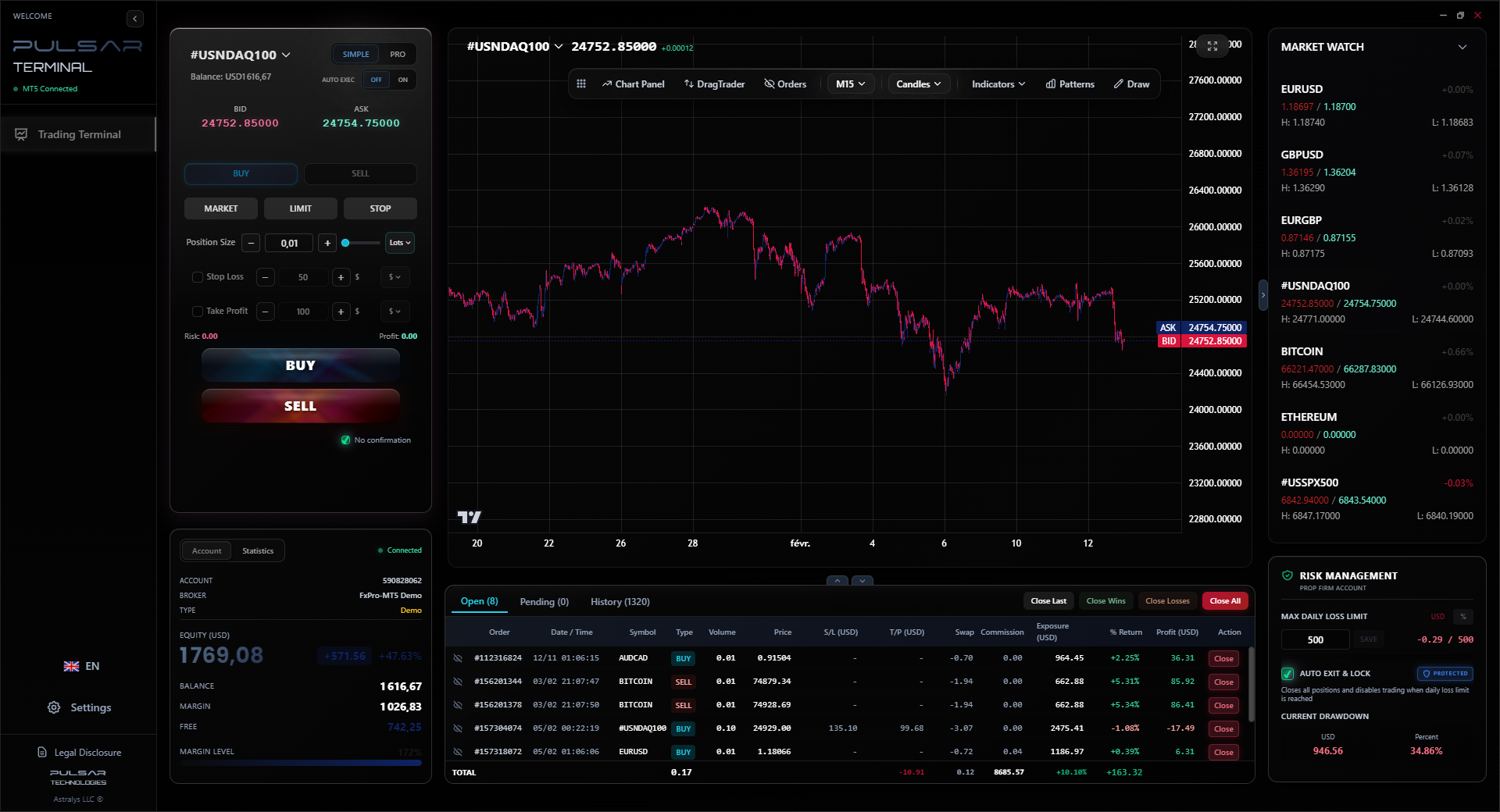
When your trading plan includes rules like moving stops to breakeven or taking partial profits at multiple levels, a tool that automates this on MT5 removes emotion and saves you from costly manual errors.
Pulsar Terminal
Công cụ MT5 tất-cả-trong-một: đặt lệnh kéo-thả, multi-TP/SL, trailing stop, grid trading, Volume Profile và bảo vệ prop firm. Hơn 1.000 trader sử dụng mỗi ngày.
“The legitimate funding path might have a few more steps, but it keeps your money safe from scams.”
You've practiced on demo, you have a plan, you've funded your account with an amount you can lose. Now it's time for the real thing. The nerves are part of the process. Here's exactly what to do.
Step 1: Analysis (Sunday Evening or Monday Morning). Don't just jump in. Look at the weekly chart for the overall trend. Then zoom into the 4-hour or 1-hour chart. Is there a clear level of support or resistance? Is the price trending? Use your plan's criteria. Let's say you're looking at EUR/USD and you see it's bouncing off a support level that has held before, and the MACD indicator is showing bullish momentum on the 1-hour chart. That might be a potential long setup.
Step 2: Calculate Your Trade.
- Account Balance: $1,000
- Risk per trade (1.5%): $15
- Distance from your planned entry to your stop-loss: Let's say 25 pips.
- Pip value for a micro lot (0.01) on EUR/USD: ~$0.10.
- To risk $15, with a 25-pip stop, you need a pip value of $0.60 ($15 / 25 pips).
- Therefore, your lot size should be 0.06 lots (because 0.01 lot = $0.10 per pip, so 0.06 lots = $0.60 per pip).
Step 3: Place the Order. On your MT4 platform, right-click the chart, select "Trading" -> "New Order."
- Set volume to 0.06.
- Set your stop-loss price 25 pips below your entry.
- Set your take-profit. A good starting rule is a risk-to-reward ratio of at least 1:1.5. So, if you're risking 25 pips, aim for a profit of 38 pips. Set that price.
- Click "Buy by Market."
Step 4: Walk Away and Manage. Once the order is filled, DO NOT stare at it. Set an alert for if it hits your take-profit or stop-loss. Go do something else. If you've followed your plan, the trade is now in the market's hands. Your job is done until it closes or you need to adjust based on a pre-defined rule (like moving your stop to breakeven after a certain move).
Your goal for the first 10 live trades isn't profit. It's to execute your plan perfectly, win or lose. That's how you build discipline.
Forex trading isn't a one-time skill you learn; it's a continuous practice. The market changes, and you must adapt. Here’s how to keep growing after your first trades.
Find a Community, Not a Guru. Avoid the "mentors" selling guaranteed signals for ₦100k. Instead, find a forum or Discord group where traders share charts and discuss analysis (not just their wins). Listening to others' reasoning can sharpen your own.
Backtest Your Ideas. Had a losing trade on a "head and shoulders" pattern? Go back on your chart, find 50 previous head and shoulders patterns, and see what happened. Did they usually work? What were the common factors? This turns a loss into data.
Consider Technology That Helps. As your strategy gets more complex, manual order management can become a bottleneck. If you find yourself wanting to set multiple take-profit levels or use automated trailing stops, explore tools that integrate with MT5. For instance, managing a prop firm challenge with strict daily loss limits is much easier with software that can automatically enforce those rules for you.
Specialize. You can't master every pair and every strategy. Maybe you get good at trading gold (XAU/USD) during London sessions. Or perhaps you find your rhythm with a specific scalping strategy on the 5-minute chart. Depth beats breadth every time in trading.
Finally, remember why you wanted to know how to get into forex. It was probably for freedom, extra income, or intellectual challenge. On the hard days - and there will be many - reconnect with that reason. This is a marathon run in daily sprints. Pace yourself, follow your plan, and protect your capital above all else. You've got this.
FAQ
Q1Can I start forex trading in Nigeria with ₦50,000?
Technically, yes. Some brokers accept deposits that small. But I strongly advise against it. ₦50,000 (roughly $35) is far too little for meaningful practice. The required use to trade anything would be astronomical, turning your account into a lottery ticket. Save until you have at least ₦500,000 to ₦700,000. It's the difference between learning to drive in a simulator and trying to learn on a busy highway in a go-kart.
Q2Which is the best broker for beginners in Nigeria?
There's no single "best," but for a total beginner, I often point to XM or Exness. XM has fantastic educational resources and customer support, which is crucial when you're starting. Exness is very popular locally, has low minimum deposits, and offers multiple funding options including crypto, which solves a lot of Nigerian payment headaches. Always open a demo account with a few first to test their platform.
Q3How do I withdraw my forex profits in Nigeria?
You withdraw through the same method you deposited, wherever possible. If you funded with Skrill, you withdraw to your Skrill wallet and then from Skrill to your local bank account. If you used USDT, you withdraw USDT to your crypto wallet and then sell it on a local peer-to-peer (P2P) platform. The process is usually the reverse of your deposit. Withdrawals can take from a few hours to a couple of business days.
Q4Is forex trading taxable in Nigeria?
Yes. Profits from forex trading are considered capital gains and are subject to a 10% tax by the Federal Inland Revenue Service (FIRS). You are responsible for declaring this income and paying the tax. Keep detailed records of all your trades, deposits, and withdrawals.
Q5How long does it take to become profitable?
This is the hardest truth: expect to spend 6-12 months learning and likely losing money before you even approach consistent breakeven. It took me 18 months and two blown accounts before my third account started a steady climb. Treat the first year as a paid apprenticeship. Your goal is to lose as little as possible while learning as much as possible.
Q6Can I trade forex on my phone?
You can, and MT4/MT5 have good mobile apps. But I beg you: do your analysis and planning on a computer with a proper screen. Use your phone only for monitoring trades you've already planned on desktop or for closing positions in an emergency. Trying to analyze complex charts on a 6-inch screen is a great way to make expensive mistakes.
Bài học của Prof. Winston
Điểm chính:
- ✓Start with at least $500. Less is a tuition fee to the market.
- ✓Risk only 1-2% per trade. Survival is your first strategy.
- ✓Choose brokers with international regulation, not just local ads.
- ✓A one-page trading plan is more valuable than 100 indicators.
- ✓Withdraw your first profit. It makes the success real.
Bài viết này hữu ích thế nào?
Nhấp vào ngôi sao để đánh giá
Nhận định giao dịch hàng tuần
Phân tích & chiến lược miễn phí hàng tuần. Không spam.
Về tác giả
Olumide Adeyemi
Nhà tiên phong Giao dịch Tây Phi
Một trong những nhà đào tạo forex tích cực nhất tại Nigeria. 8 năm kinh nghiệm giao dịch từ Lagos. Chuyên về chiến lược vốn thấp và thử thách prop firm dành cho trader châu Phi.
Bình luận
Cảnh báo rủi ro
Giao dịch các công cụ tài chính tiềm ẩn rủi ro đáng kể và có thể không phù hợp với tất cả nhà đầu tư. Hiệu suất trong quá khứ không đảm bảo kết quả trong tương lai. Nội dung này chỉ mang tính chất giáo dục và không nên được coi là lời khuyên đầu tư. Hãy luôn tự nghiên cứu trước khi giao dịch.
Bạn cũng có thể thích

Cara Trading Forex Sukses: 7 Prinsip dari Trader Profesional
Cara trading forex sukses dengan 7 prinsip trader pro: manajemen modal, disiplin, journal trading, backtest. Data nyata, bukan janji profit palsu.
Jam Trading Forex Terbaik untuk Trader Indonesia: Panduan Lengkap dengan Tabel Waktu
Panduan jam trading forex untuk trader Indonesia. Tabel 4 sesi dunia, jam emas 20:00-00:00, sesi mana yang harus dihindari. Data akurat + tips dari trader berpengalaman.
Top 5 Sàn Forex Uy Tín Nhất 2026: Review Jujur dari Trader Indonesia
Top 5 sàn forex uy tín 2026 untuk trader Indonesia. Review jujur: spread, deposit, withdraw, dukungan lokal. Exness, XM, IC Markets & lebih.
Tải Pulsar Terminal
Tất cả các công cụ tính này được tích hợp trong Pulsar Terminal với dữ liệu thời gian thực từ tài khoản MT5 của bạn.
Tải Pulsar Terminal