


You're probably sitting there, phone in hand, seeing all the 'forex lifestyle' posts and wondering, 'Can I actually make money from this, or is it just another way to lose my hard-earned Naira?' I get it.

Olumide Adeyemi
Nhà tiên phong Giao dịch Tây Phi ·  Nigeria
☕ 12 phút đọc
Bạn sẽ học được:
- 1What is Forex, and Why Do So Many Nigerians Trade It?
- 2The Legal Stuff: Rules, Regulations, and Taxes
- 3Understanding the Costs: Real Numbers from a Nigerian Perspective
- 4Your First Trade: A Step-by-Step Walkthrough
- 5Simple Strategies a Beginner Can Actually Use
- 6Risk Management: Your Survival Guide
- 7Pitfalls Every Nigerian Beginner Faces (And How to Avoid Them)
- 8Your First 90-Day Learning Plan
You're probably sitting there, phone in hand, seeing all the 'forex lifestyle' posts and wondering, 'Can I actually make money from this, or is it just another way to lose my hard-earned Naira?' I get it. The noise is deafening. I started trading in Nigeria over a decade ago, and I've seen it all - the hype, the scams, the real opportunities. This isn't about getting rich quick. It's a practical, no-fluff guide on how to trade forex for beginners, written specifically for you, right here in Nigeria. We'll talk real numbers, local regulations, and the mistakes I made so you don't have to.
Forex, or foreign exchange, is simply the global marketplace for trading national currencies against one another. It's the largest financial market in the world, open 24 hours a day, five days a week. You're betting on whether one currency will strengthen or weaken against another.
So why has it exploded here? A few reasons. First, accessibility. With a smartphone and an internet connection, you're in. Second, the potential for profit outside the traditional 9-to-5 is incredibly appealing, especially with youth unemployment a persistent challenge. Third, it's a global market. Your success isn't tied to the Nigerian economy alone; you can profit from movements in the US Dollar, Euro, or British Pound.
But let's be brutally honest. The main reason you see so much hype is that the affiliate marketing is insane. Every 'guru' gets paid to sign you up with a broker. That doesn't mean the opportunity isn't real - it just means you need to filter out the sales pitch from the substance. The daily trading volume in Nigeria alone is between ₦300 million to ₦450 million. That's a lot of people trying their hand at this.

Warning: Don't confuse activity with achievement. Just because millions are trading doesn't mean millions are profitable. The learning curve is steep.
This is where most beginner guides gloss over the details, but getting this wrong can cost you. Let's break it down plainly.
Is it legal for you to trade? Yes. As a Nigerian individual, you are allowed to open an account and trade with your own money through international brokers regulated outside Nigeria (like in Cyprus, South Africa, or the UK). There's no law against that.
Who regulates what? The Central Bank of Nigeria (CBN) manages the Naira and regulates banks. They've told banks not to give out forex for speculative trading. The Securities and Exchange Commission (SEC) Nigeria regulates stocks and bonds, NOT retail forex brokers. So if a broker claims to be 'SEC-licensed' for forex, run. They're misleading you. For safety, you want a broker regulated by a top-tier international body. I've had good experiences with brokers like Exness and IC Markets for their international oversight.
The Tax Man Cometh. This is non-negotiable. Any profit you make from forex trading is subject to a 10% Capital Gains Tax on your gross profits. Yes, gross. If you make ₦1,000,000 in a year, you owe ₦100,000 in tax. You must report this income. I learned this the hard way early on and had to sort it out with a tax professional. Factor this into your profit calculations from day one.
Choosing a Broker in Nigeria
You need a broker that accepts Nigerian clients, offers good Naira deposit/withdrawal options, and is properly regulated abroad. Look for low spreads on major pairs, clear fee structures, and a reliable platform like MetaTrader 4 or 5. Always start with a demo account to test their execution speeds before putting real money in.

💡 Mẹo của Winston
Your first ₦100,000 profit is the most expensive to make. It pays for all your lessons. Don't rush it.
“Good risk management turns a mediocre strategy into a profitable one. Bad risk management destroys genius.”
Trading isn't free. If you don't understand the costs, they'll eat your account before you even get started. Let's talk Naira and Dollars.
The Spread: This is the difference between the buy and sell price. It's your primary cost of doing business. On the EUR/USD, a good spread might be 0.6 pips. A pip is usually the fourth decimal place (0.0001). If the spread is wider than 1.5 pips on EUR/USD during London hours, you're probably paying too much.
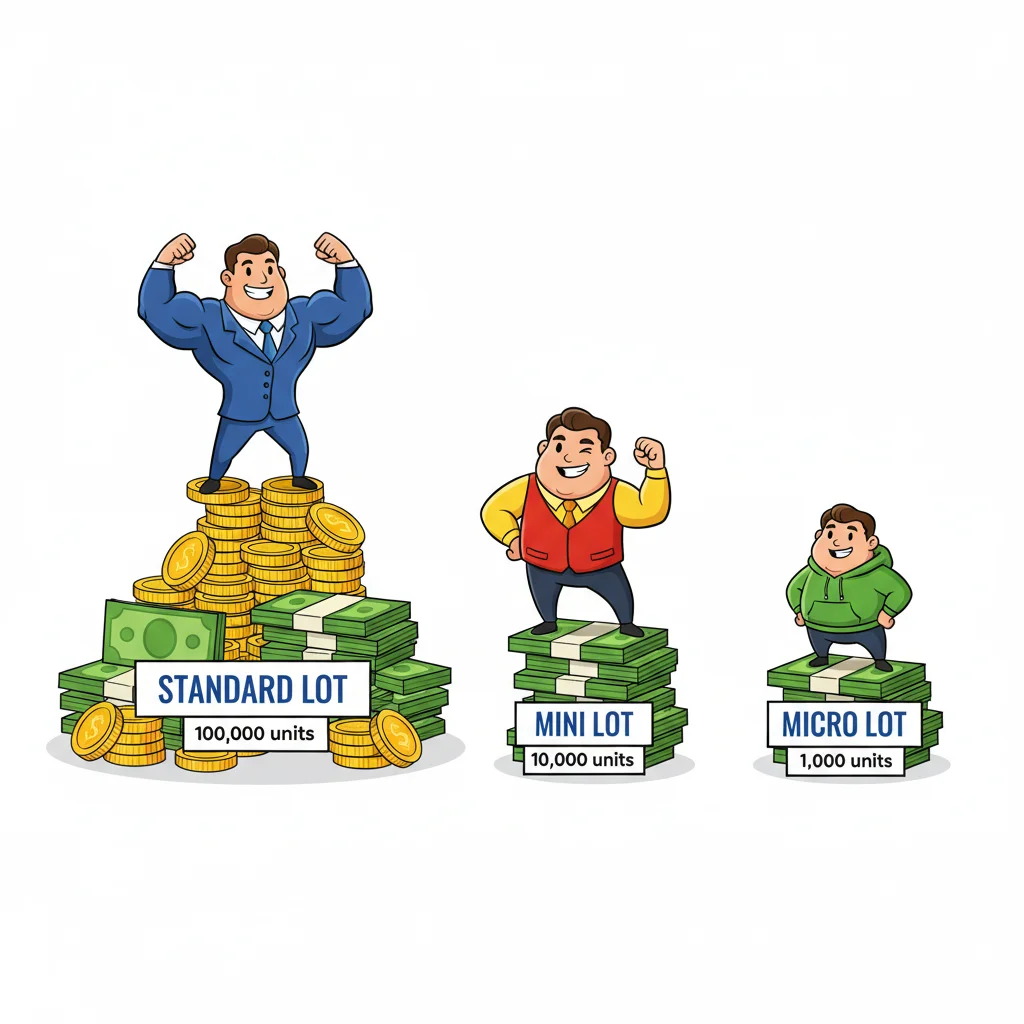
Commissions: Some accounts have raw spreads (like 0.0 pips) but charge a commission. This is often better for active traders. It might be $6 per standard lot (100,000 units). So, if you trade one lot, you pay $6 to open and $6 to close.
Swap Fees: This is the interest for holding a position overnight. It can be a cost or a small credit. If you're swing trading and holding for days, you need to check the swap rates on your broker's platform. I once held a GBP/JPY trade over a weekend and was shocked by the triple swap charge on Monday.
Deposit and Withdrawal Fees: This is crucial for us. Bank transfers can be slow and cost $20-$50. Using e-wallets like Skrill or Neteller is faster, but they might charge 2-3%. Some brokers, however, absorb these fees for you. Always check.

Example: Let's say you deposit ₦100,000 (approx. $125). You pay a 2% fee to fund your account: that's ₦2,000 gone before you place a single trade. You then trade EUR/USD with a 1-pip spread. On a micro lot (0.01 lots), that's about a $0.10 cost. Seems small, but do that 10 times a day, and it adds up fast. Use a position size calculator to always know your exact risk and cost per trade.
Enough theory. Let's walk through what placing your first real trade actually looks like. I'll use a simple example.
Step 1: The Analysis. You've been watching the EUR/USD. The price has been bouncing off a support level around 1.0850. You think it might bounce up again. This isn't a recommendation, just an example.
Step 2: Deciding on Risk. This is the most important step. Let's say your account has $500. A good rule for beginners is to risk no more than 1% per trade. That's $5. You decide your stop loss (the point where you admit you're wrong) will be 20 pips below your entry at 1.0830.
Step 3: Calculating Position Size. You need to figure out how many units to buy so that a 20-pip loss equals $5. A standard lot move of 1 pip = $10. A mini lot (0.1) = $1 per pip. A micro lot (0.01) = $0.10 per pip. If you risk 20 pips, a micro lot would mean a $2 risk (20 pips * $0.10). That's under your $5 limit. You could trade 0.025 lots for a $5 risk. This is where a calculator is essential.
Step 4: Placing the Order. You go to your platform, click on EUR/USD, and a order window pops up. You set volume to 0.03 (slightly under your max). You set your stop loss at 1.0830. You set a take profit target at 1.0950 (a 100 pip potential gain). You click 'Buy'. That's it. You're in the market.
Step 5: Managing the Trade. Now, you wait. Don't stare at it. You've already defined your risk and reward. The hardest part is sticking to your plan. I can't tell you how many times I moved my stop loss 'just a little further' only to watch the trade hit it anyway, now for a bigger loss. Discipline is everything.

Pro Tip: Always write down your trade plan before you click the button. Entry, Stop Loss, Take Profit, and the reason for the trade. If the reason (e.g., 'bounce from support') is no longer valid, get out, even if the stop hasn't been hit.
“If you can't handle the feeling of a stopped-out trade, you're not ready to trade with real money.”
You don't need a complicated system with 15 indicators. In fact, that's a surefire way to get confused and lose money. Here are two foundational approaches.
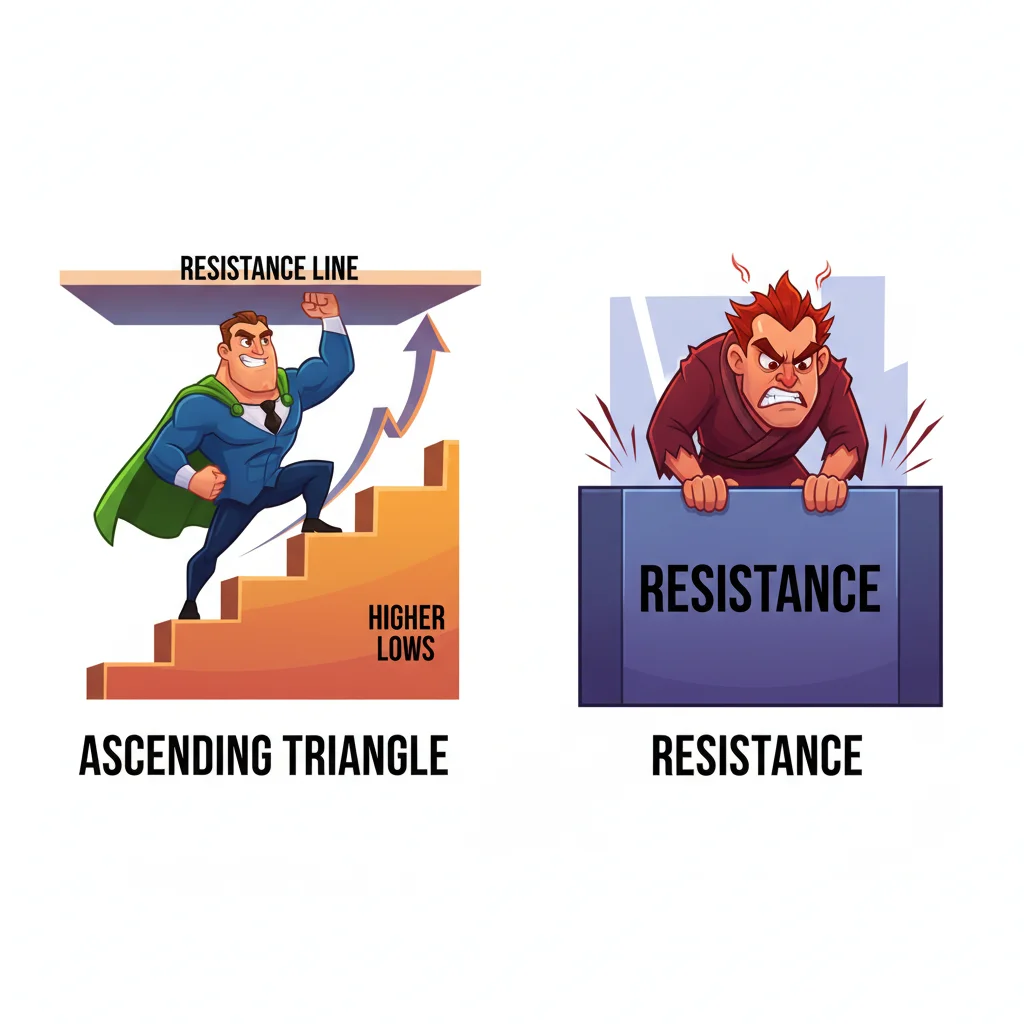
1. Support and Resistance Trading. This is the bread and butter. Price tends to react at certain levels. Support is where buying interest is strong enough to stop the price from falling further. Resistance is where selling interest stops it from rising. Your job is to identify these levels on the chart (look for previous highs and lows) and look for price to bounce or break through them. For example, if price hits a clear resistance level for the third time and starts to turn down, that might be a sell signal. It's simple, but it works.
2. Trend Following with a Moving Average. A trend is your friend. To identify one, add a simple 50-period Moving Average to your chart. If the price is consistently above the moving average, the short-term trend is up. Look for buying opportunities on pullbacks towards that moving average. If price is below it, the trend is down. Look for selling opportunities on rallies up to the moving average. This helps you avoid the classic beginner mistake of trying to buy at the very bottom or sell at the very top.
Where Indicators Help. Once you understand price action, you can add one or two indicators for confirmation. The RSI indicator can show if a market is overbought or oversold. The MACD indicator can help confirm trend changes. But the price itself is the ultimate indicator.
My biggest early mistake was trying to use every indicator under the sun. I had RSI, MACD, Stochastic, Bollinger Bands... my chart looked like a rainbow vomited on it. I was paralyzed. Start with a clean chart and naked price action. Learn to read the story it's telling.
💡 Mẹo của Winston
A chart with three clean lines (support, resistance, trend) is worth more than a chart cluttered with a dozen confused indicators.
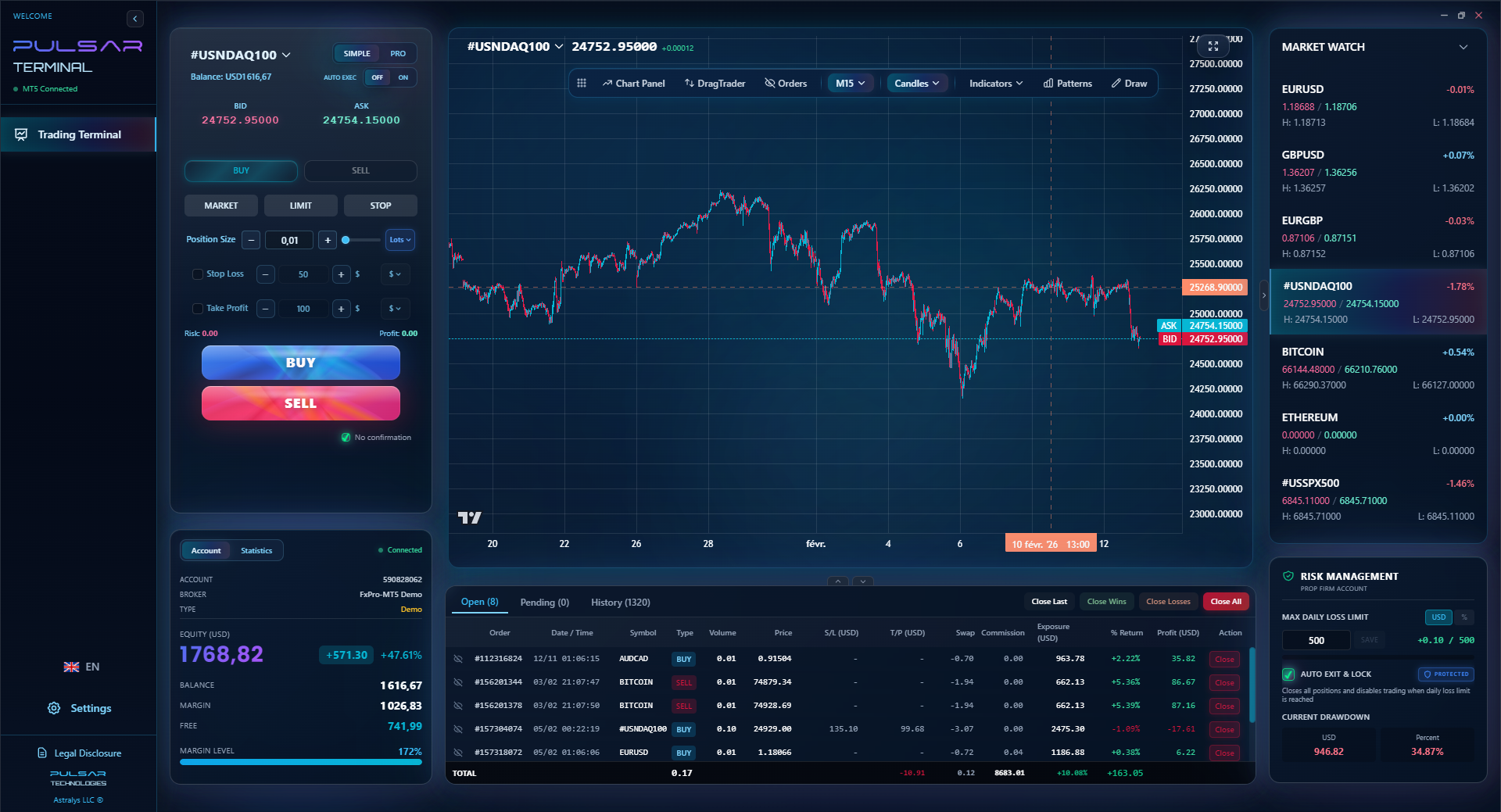
Managing multiple trades and setting precise stops and targets is key to a beginner's strategy, and Pulsar Terminal's drag-and-drop order system and multi-TP/SL tools make executing that plan on MT5 simple and stress-free.
Pulsar Terminal
Công cụ MT5 tất-cả-trong-một: đặt lệnh kéo-thả, multi-TP/SL, trailing stop, grid trading, Volume Profile và bảo vệ prop firm. Hơn 1.000 trader sử dụng mỗi ngày.
This section is more important than any strategy. Good risk management turns a mediocre strategy into a profitable one. Bad risk management destroys genius.
The 1% Rule. Never risk more than 1% of your trading account on a single trade. With a $500 account, that's $5. This means if you have a string of 10 losses (which happens), you've only lost 10% of your capital. You're still in the game. Blow 10% per trade, and two losses cripple you.
Stop Losses Are Not Optional. Your stop loss is your lifeline. It's a pre-defined exit point where you accept the trade idea was wrong. Placing it is an act of strength, not weakness. Basing it on a logical chart level (like beyond a support zone) is better than an arbitrary number.
Beware of Overleveraging. use lets you control a large position with a small deposit. In Nigeria, you might see offers of 1:1000 or even 1:2000. This is a trap for beginners. With 1:1000 use on a $500 account, you can control $500,000 in currency. A 10-pip move against you could wipe you out. I recommend beginners use no more than 1:10 or 1:20 use until they are consistently profitable. It forces you to think about position size.
The Psychology of a Loss. You will have losing trades. Everyone does. The goal isn't to be right every time; it's to make more on your winners than you lose on your losers. If you can't handle the feeling of a stopped-out trade, you're not ready to trade with real money. A margin call is what happens when your losses exceed your available funds - it's the broker closing your trades to prevent you from going into debt. Good risk management means you should never see one.
“Your goal in your first live trades is NOT to make money. Your goal is to execute your plan perfectly.”
Let me save you some pain and money by sharing the most common mistakes I see.
1. Changing Your Strategy Every Week. You try support/resistance, lose two trades, then jump to a scalping strategy, then to news trading. You never master one approach. Pick one simple method and test it for at least 50 trades on a demo account. Track your results.
2. Trading Based on 'Signals' from WhatsApp Groups. If the signal provider was so good, why are they selling signals for ₦5,000 a month instead of trading their own millions? At best, you're following someone else's plan with no understanding of the risk. At worst, it's a scam to pump a price for their own gain.
3. Letting a Small Loss Turn into a Catastrophe. This is the 'I'll just wait for it to come back' syndrome. It rarely does. Have the discipline to stick to your initial stop loss.
4. Trading Too Big, Too Soon. After two winning trades, you feel like a genius and triple your position size. The next trade is a loss, and it wipes out your previous gains and more. Stick to your pre-defined risk percentage, no matter how confident you feel.
5. Ignoring the Total Cost. As we discussed, fees, spreads, and swaps matter. A strategy that looks profitable on paper might be a loser after costs. Always factor them in.
The market is a ruthless teacher. It doesn't care about your rent, your dreams, or your 'sure feeling.' It only responds to collective buying and selling pressure. Your job is to align yourself with that pressure, protect your capital, and stay in the game long enough to learn.
💡 Mẹo của Winston
The market's job is to find the price where the most people will be wrong. Your job is to not be one of them.
Here's a practical roadmap to go from zero to placing your first educated trade.
Weeks 1-4: Education & Demo Trading.
- Learn the absolute basics: what a pip is, what a spread is, how to read a candlestick chart.
- Open a demo account with a reputable broker like XM or Pepperstone.
- Practice placing trades, setting stops and targets. Get comfortable with the platform.
- Watch the market without trading. Just observe how it moves.
Weeks 5-8: Strategy & Backtesting.
- Choose ONE simple strategy from this guide (e.g., support/resistance).
- Go back on your demo chart and practice identifying those levels. Look at past price action and ask, 'Where would I have entered? Where would my stop be?'
- Start paper trading your strategy on the demo account. Place 2-3 trades per week at most. Journal every single one: entry, exit, reason, result, and emotional state.
Weeks 9-12: Live Trading (Micro Lots).
- Fund a live account with money you can afford to lose completely. I'm talking an amount that, if it vanished, wouldn't affect your rent or feeding.
- Trade only in micro lots (0.01). Your goal in this phase is NOT to make money. Your goal is to execute your plan perfectly and manage your emotions with real money on the line.
- Review your journal weekly. Are you sticking to your 1% risk rule? Are you following your strategy, or deviating?
Remember, this is a skill like any other. You wouldn't pick up a guitar for the first time and expect to play a concert in 90 days. Be patient with yourself. The market will always be there tomorrow.
FAQ
Q1How much money do I need to start forex trading in Nigeria?
You can start with as little as $50 or ₦40,000 with some brokers. However, I strongly recommend starting with at least $200-500 (₦160k-₦400k). This gives you enough buffer to trade micro lots and absorb a few losses while learning without immediately facing a margin call. Remember, your goal is to learn, not get rich from day one.
Q2Which is the best forex broker for beginners in Nigeria?
There's no single 'best,' but look for brokers with: 1) Strong international regulation (not just 'registered' in Nigeria), 2) Low minimum deposits, 3) Easy Naira deposit/withdrawal options with low fees, and 4) A reliable platform like MT4/MT5. Brokers like Exness and IC Markets are popular choices among Nigerian traders for these reasons. Always test with a demo account first.
Q3Can I trade forex on my phone in Nigeria?
Absolutely. Most brokers offer full-featured mobile apps for MetaTrader 4 and 5. You can analyze charts, place trades, and manage your account from your smartphone. This is one of the key drivers of forex's popularity here. Just make sure you have a stable internet connection.
Q4Is forex trading a scam?
The forex market itself is not a scam; it's a legitimate global financial market. However, the industry around it is filled with scams: fake investment schemes ("send me ₦100k, I'll return ₦500k"), dishonest signal sellers, and unregulated brokers who manipulate prices. Your protection is education and only using well-regulated brokers.
Q5How much time do I need to dedicate to forex trading daily?
It depends on your style. If you're scalping, you might be glued to the screen for hours. As a beginner, I recommend a swing trading approach where you analyze the market for 30-60 minutes in the evening (London/NY overlap is a good time), set your trades, and then check in briefly the next day. This prevents burnout and emotional trading.
Q6Do I need to pay tax on my forex trading profits in Nigeria?
Yes. The Federal Inland Revenue Service (FIRS) requires you to pay a 10% Capital Gains Tax on your gross forex trading profits. This is the law. Keep detailed records of all your trades and profits. Consult a tax professional for specific advice on filing.
Bài học của Prof. Winston
Điểm chính:
- ✓Risk max 1% of your account per trade. No exceptions.
- ✓Tax is 10% on gross profits. Factor it in from day one.
- ✓Master one simple strategy before trying another.
- ✓Use use under 1:20 as a beginner.
- ✓A stop loss is a pre-paid insurance policy, not a suggestion.
Bài viết này hữu ích thế nào?
Nhấp vào ngôi sao để đánh giá
Nhận định giao dịch hàng tuần
Phân tích & chiến lược miễn phí hàng tuần. Không spam.
Về tác giả
Olumide Adeyemi
Nhà tiên phong Giao dịch Tây Phi
Một trong những nhà đào tạo forex tích cực nhất tại Nigeria. 8 năm kinh nghiệm giao dịch từ Lagos. Chuyên về chiến lược vốn thấp và thử thách prop firm dành cho trader châu Phi.
Bình luận
Cảnh báo rủi ro
Giao dịch các công cụ tài chính tiềm ẩn rủi ro đáng kể và có thể không phù hợp với tất cả nhà đầu tư. Hiệu suất trong quá khứ không đảm bảo kết quả trong tương lai. Nội dung này chỉ mang tính chất giáo dục và không nên được coi là lời khuyên đầu tư. Hãy luôn tự nghiên cứu trước khi giao dịch.
Bạn cũng có thể thích

Cara Trading Forex Sukses: 7 Prinsip dari Trader Profesional
Cara trading forex sukses dengan 7 prinsip trader pro: manajemen modal, disiplin, journal trading, backtest. Data nyata, bukan janji profit palsu.
Jam Trading Forex Terbaik untuk Trader Indonesia: Panduan Lengkap dengan Tabel Waktu
Panduan jam trading forex untuk trader Indonesia. Tabel 4 sesi dunia, jam emas 20:00-00:00, sesi mana yang harus dihindari. Data akurat + tips dari trader berpengalaman.
Top 5 Sàn Forex Uy Tín Nhất 2026: Review Jujur dari Trader Indonesia
Top 5 sàn forex uy tín 2026 untuk trader Indonesia. Review jujur: spread, deposit, withdraw, dukungan lokal. Exness, XM, IC Markets & lebih.
Tải Pulsar Terminal
Tất cả các công cụ tính này được tích hợp trong Pulsar Terminal với dữ liệu thời gian thực từ tài khoản MT5 của bạn.
Tải Pulsar Terminal