


Here's a fact that might surprise you: in 2025, Indian gold ETFs saw a record ₹430 billion in net inflows, yet most retail traders I meet are still buying physical jewelry and paying 3% GST plus making charges.

Rajesh Sharma
Chuyên gia Phân tích Forex Cao cấp ·  India
India
☕ 13 phút đọc
Bạn sẽ học được:
- 1Your Gold Trading Menu: From SGBs to XAU/USD
- 2The Real Cost of Trading Gold in India: Taxes, Fees, and Spreads
- 3Picking Your Weapon: Brokers and Platforms for Indian Traders
- 4How to Actually Trade Gold: Strategies That Work on XAU/USD
- 5Risk Management: The Only Thing Between You and a Margin Call
- 6Trading MCX Gold: Playing the Local Angle
- 7Your First Trade: A Step-by-Step Action Plan

Here's a fact that might surprise you: in 2025, Indian gold ETFs saw a record ₹430 billion in net inflows, yet most retail traders I meet are still buying physical jewelry and paying 3% GST plus making charges. That's a huge gap between where the smart money is going and what the average person does. Trading gold isn't just about buying a bangle for Diwali anymore. It's about accessing a global, 24/5 market where you can profit whether prices go up or down. Let's break down exactly how to trade gold in India, cut through the noise, and look at what actually works.
First things first, you need to know your options. They're not all created equal, and your choice depends entirely on your goals: long-term saving or active trading.
For the Long-Term Investor (The 'Set and Forget' Crowd)
- Sovereign Gold Bonds (SGBs): The government's baby. You get 2.5% annual interest on your investment, paid every six months. The big win? Zero tax on gains if you hold for the full 8 years. The scheme was discontinued for new issues in 2024, but you can still buy older tranches on the secondary market through your demat account. It's a solid, boring, tax-efficient play.
- Gold ETFs: This is where the massive money flowed in 2025. You're basically buying a stock (like GOLDBEES) that represents physical gold. One unit is roughly 1 gram. You need a demat account. It's super liquid - you can buy and sell during market hours instantly. Costs are low: just your broker's equity brokerage fee. Long-term capital gains (held over 3 years) are taxed at 20% with indexation benefit.
- Digital Gold (Paytm, etc.): Incredibly convenient. You can start with ₹1. The gold is stored for you. But honestly? It's often the most expensive way to own gold electronically due to higher premiums. Good for tiny, habitual savings, not for serious investment.
For the Active Trader (That's Probably You)
This is where the real action is.
- Gold Futures on MCX: This is the domestic derivatives market. You trade contracts for 1kg of gold. The margin requirement is key - you only need a fraction of the contract's value to control it. For the mini-gold contract (100 grams), initial margin can be between ₹5,000 to ₹10,000 depending on volatility. It's regulated, transparent, and trades in INR. Perfect for trading based on local demand, festivals, and rupee-dollar dynamics.
- Trading XAU/USD with International Brokers: This is my personal playground. XAU/USD is the global spot gold price quoted in US dollars per ounce. You trade it as a CFD (Contract for Difference) with brokers like Exness or IC Markets. Why do I prefer it?
- 24/5 Market: It moves when MCX is closed. News breaks? You can react.
- Massive Liquidity: The spreads (the difference between buy and sell price) are often razor-thin. I regularly see spreads under 0.30 on a raw account, which is about ₹2.5 per gram.
- use: It's a double-edged sword, but it allows for smaller capital outlays. You can control a $100,000 position with much less. This is why a solid position size calculator is non-negotiable.

Warning: use on international CFD brokers can be very high (like 1:500). This is not a 'use it all' button. It's a precision tool. I never use more than 1:10 for gold, and even that's aggressive. A 1% move against you with 1:500 use wipes out 500% of your margin. Game over.
The rest of this guide will focus mainly on active trading via MCX Futures and XAU/USD, because that's where you apply strategy, not just hope.

💡 Mẹo của Winston
Gold hates rising real yields. Before you enter any long trade, check the US 10-year Treasury yield. If it's making a new high, think twice.
This is where most guides get vague. Let's get specific with numbers. If you don't understand your costs, you're just donating to the broker and the taxman.
The Tax Man Cometh
- Physical/Digital Gold & ETFs (if sold within 3 years): Profit is added to your income, taxed at your slab rate. Could be 30%+. Ouch.
- ETFs & Physical (held over 3 years): Long-Term Capital Gains (LTCG) tax of 20% with indexation. Indexation adjusts your purchase price for inflation, which can significantly lower your taxable profit. It's a good deal.
- SGBs (held to 8-year maturity): Zero tax on gains. The 2.5% interest is taxable as income.
- MCX Futures & Options: These are considered speculative business income. Profits are added to your total income and taxed per your slab. There's a Tax Collected at Source (TCS) of 0.1% on the total sale value if turnover exceeds ₹50 lakh in a year. Keep those statements.
- Trading XAU/USD with an International Broker: This is the greyest area. Legally, you must declare your global income in India. Profits from trading would be classified as 'Income from Other Sources' or speculative business income, taxed at your slab rate. I know many who don't declare it, but that's between you and the IT department. I declare mine.
The Broker's Cut
- MCX Futures: You pay brokerage (often a flat fee per lot), exchange charges, and GST on brokerage. For a standard 1kg gold contract, round-turn costs can be around ₹150-₹300.
- XAU/USD CFDs: Two main pricing models:
- Spread-Only: The broker's profit is built into the buy/sell difference. A typical spread might be 0.30 (around ₹25 per ounce). This is simple.
- Commission + Raw Spread: You pay a tiny spread (often 0.03-0.10) plus a commission per lot. On a standard lot (100 oz), commission might be $3.50 per side ($7 round-turn, about ₹580). This is usually cheaper for active traders.

Example: Let's say you buy 1 lot of XAU/USD on a commission account. Entry price: $2400. Spread: 0.05. Commission: $3.50. Your true entry cost is $2400.05 + $3.50 commission. You need the price to move above $2400.055 just to break even. That's your first target.
GST on physical purchase? Still 3% on the gold value + 5% on making charges if it's jewelry. A terrible 'investment' vehicle due to this instant loss.

“Trading gold isn't just about buying a bangle for Diwali anymore. It's about accessing a global, 24/5 market.”
Where you trade is as important as how you trade. Here’s my take on the landscape for active gold trading.
For MCX Futures: You need a broker registered with SEBI for commodity trading. Most major discount brokers (Zerodha, Upstox, Angel One) offer this. Platform choice is usually their proprietary web or mobile platform. They work fine for execution.
For XAU/USD CFDs: This is the critical choice. You're going offshore. Regulation is your first filter. Look for brokers regulated by ASIC (Australia), CySEC (Cyprus), or FSA (Seychelles). They have client money protection rules.
Funding & Withdrawal: This is the practical hurdle for Indians. You'll be sending money internationally. Methods that usually work:
- International Bank Transfer (SWIFT): Slow, expensive with bank fees.
- Credit/Debit Cards: Often the easiest. Some banks may block it; you might need to call and authorize 'international transactions'.
- E-Wallets: Skrill, Neteller, and sometimes even UPI through payment gateways offered by the broker. XM, for instance, has streamlined this for Indian clients.
My Experience: I've funded accounts with IC Markets and Pepperstone using a Visa debit card from HDFC. The first time took 30 minutes of authorizations with the bank. The money arrived in the trading account in under an hour. Withdrawals back to the same card took 2 business days.
Platform: 95% of serious traders use MetaTrader 4 or 5 (MT4/MT5). It's the industry standard for a reason. All the brokers I recommend offer it. Don't get distracted by flashy proprietary platforms; MT4/5 has all the tools you need, especially when paired with a good scalping strategy or swing trading plan.
A Quick Broker Comparison for XAU/USD:
| Broker | Why It's Good for Gold | Watch Out For |
|---|---|---|
| IC Markets | Raw spreads from 0.03, low commission. True institutional pricing. | Minimum deposit ~$200 (₹16.5k). Can be overwhelming for beginners. |
| Pepperstone | Excellent Razor account, great execution speed. | Slightly higher minimum deposit than some. |
| XM | Fantastic for beginners. Low minimum deposit ($5), easy funding for Indians. | Costs are in the spread, which can be higher than raw accounts. |
| Exness | Offers insane use (use with extreme caution). Popular in emerging markets. | Regulation can be a mix of strict and lighter tiers. Stick to their CySEC entity. |

Okay, you've got an account. Now what? Throwing darts at a chart isn't a strategy. Gold has personality. It's a 'safe haven,' but it's also a dollar-denominated asset. When the US dollar strengthens, gold often falls, and vice-versa.
What Moves Gold Prices?
- Real Interest Rates (US Treasury Yields): This is the big one. Gold pays no interest. When US real yields (yield minus inflation) go up, holding gold becomes less attractive. Watch the 10-year Treasury yield like a hawk.
- The US Dollar (DXY Index): Inverse relationship. A strong dollar = weaker gold, typically.
- Geopolitical Fear & Inflation: War, crises, money printing → people flock to gold.
- Central Bank Buying: Like the RBI stocking up. This creates underlying demand.
- Indian Demand: Festive season (Diwali, weddings) can put a floor under local MCX prices, but doesn't usually drive the global XAU/USD market.
A Simple, High-Probability Strategy
I'll give you one I've used for years. It combines trend and momentum.
- The Trend Filter: Use the 100-period Simple Moving Average (SMA) on the 4-hour chart. If price is above the SMA, I only look for buy setups. If price is below, I only look for sell setups. This keeps you on the right side of the medium-term flow.
- The Entry Trigger: Wait for price to pull back to the 100 SMA. Then, use the RSI indicator (settings: 14 period) on the 1-hour chart. For a buy setup in an uptrend, wait for RSI to dip to 40-45 and start curling back up. That's your signal the pullback might be over.
- Risk Management: Place your stop-loss below the recent swing low that coincided with the RSI dip. Your take-profit should be at least 1.5 times your risk (Risk/Reward of 1:1.5).
A Real Trade from My Journal (March 2026): XAU/USD was in a clear uptrend, above the 100 SMA on 4H. It pulled back from $2420 to $2395, right to the 100 SMA. On the 1H chart, RSI hit 42 and turned up. I entered a buy at $2397.
- Stop-Loss: Placed at $2389 (below the intraday low). Risk: $8 per ounce.
- Take-Profit: Set at $2409. Target: $12 per ounce.
- Outcome: Trade hit take-profit in about 8 hours. A clean 1:1.5 R:R win.
This isn't a 'get rich quick' system. It's a methodical way to catch continuations in the trend. For spotting trend changes, I lean more on the MACD indicator on the daily chart, looking for divergences between price and the MACD histogram.
💡 Mẹo của Winston
The best gold trades often start quietly. Look for tight, consolidating price action after a strong trend move. The big breakout is coming.
“High use is the fastest path to a margin call. Your broker might offer 1:500. I beg you, don't.”
I'll be blunt: I've blown up an account. Early in my career, I traded gold like it was a stock. I didn't respect the volatility. A $50 move in a day is normal. That's over ₹4,000 per ounce.
The Golden Rules (pun intended):
- Position Size is Everything: Never risk more than 1-2% of your account on a single trade. Use a calculator. If you have a ₹1,00,000 account, your max risk per trade is ₹1,000-₹2,000. If your stop-loss on XAU/USD is $10 away, that means you can only trade 0.1 lots (a mini lot). Not 1 lot. This is the most important page on this site: the position size calculator.
- Understand What a Pip is for Gold: On XAU/USD, a 1 pip move is typically $0.01 for a micro lot (0.01), $0.10 for a mini lot (0.1), and $1.00 for a standard lot (1.0). A $10 move is 1000 pips in gold terms. Knowing your pip definition value keeps the P&L real.
- Beware of News: US Non-Farm Payrolls, CPI inflation data, Fed meetings. These can cause $30-$100 spikes in seconds. Your stop-loss can get skipped (slippage). Either don't hold positions into major news, or widen your stops dramatically.
- use is a Trap: Your broker might offer 1:500. I beg you, don't. In your MT4/5 settings, set your maximum use to 1:10 or 1:20. It forces discipline. High use is the fastest path to a margin call.

Pro Tip: When you enter a trade, immediately set your stop-loss and take-profit orders. Do not 'watch it and see.' Emotion will kill your plan. If you're wrong, the stop takes you out. If you're right, the take-profit banks the profit. Remove yourself from the equation.

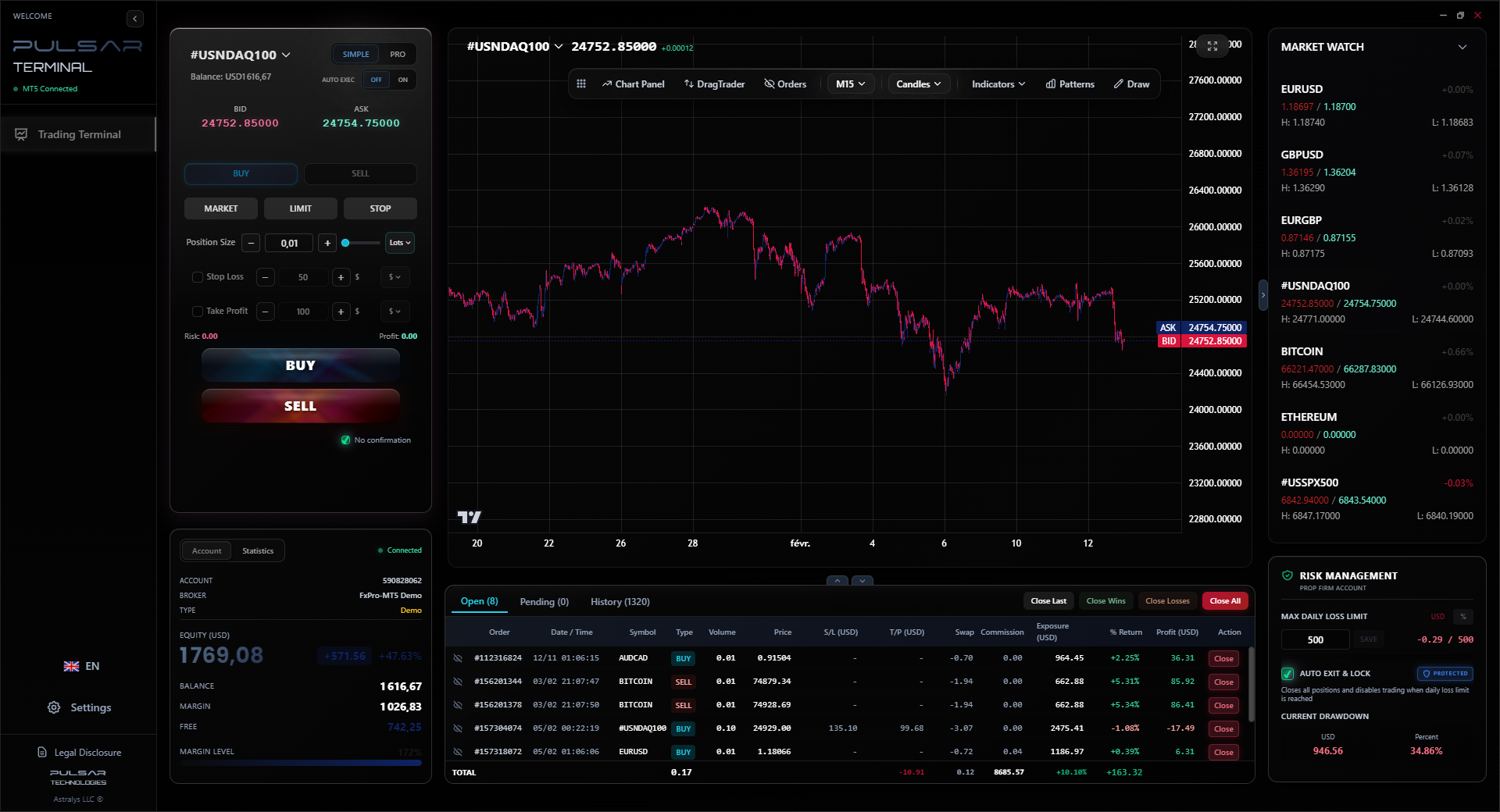
Managing multiple take-profit levels and moving stops to breakeven on volatile gold trades is manual and stressful, but Pulsar Terminal automates this directly on your MT5 chart.
Pulsar Terminal
Công cụ MT5 tất-cả-trong-một: đặt lệnh kéo-thả, multi-TP/SL, trailing stop, grid trading, Volume Profile và bảo vệ prop firm. Hơn 1.000 trader sử dụng mỗi ngày.
XAU/USD is global. MCX Gold (GOLD1!) is uniquely Indian. You can find edges here that the global crowd misses.
What Moves MCX Gold Differently?
- The USD/INR Exchange Rate: This is crucial. MCX Gold price = (International Gold in $ * USD/INR rate) + premiums/duties. If international gold is flat but the rupee weakens (USD/INR goes up), MCX gold will rise. You're effectively trading gold and the rupee.
- Import Duties and Taxes: Changes in customs duty (like the 2024 cut from 15% to 6%) directly impact the local price premium over the international price.
- Seasonal Demand: Akshaya Tritiya, Diwali, the wedding season (Oct-Jan). Physical demand surges, which can support MCX futures prices even if international markets are soft. Look for calendar-based strength.
- Trading Hours: MCX has specific sessions. The gap between the evening close and the next morning open can be risky if big news breaks globally. Your position is frozen while the world moves.
A Hybrid Approach: Some of my most successful trades have been pairs trades. If I see the rupee weakening dramatically but gold is stagnant globally, I might buy MCX Gold and simultaneously sell a smaller position in XAU/USD as a hedge. This isolates the rupee-strength play. It's advanced, but it shows how understanding both markets creates opportunities.
The spread definition on MCX can be wider than on spot XAU/USD, especially in illiquid contracts. Always trade the most liquid, near-month contract.
💡 Mẹo của Winston
Your first profit target should always be to move your stop-loss to breakeven. Protecting capital is rule number one. Profits come after.

“Your first goal is survival. Your second goal is consistent small profits. The big money comes from compounding.”
Let's make this actionable. Here's exactly what to do next.
- Education First: Paper trade for a month. Open a demo account with IC Markets or Pepperstone. Practice the 100 SMA + RSI strategy. Get a feel for the volatility without losing a paisa.
- Choose Your Path: Decide if you're starting with MCX (domestic, rupee-based) or XAU/USD (global, 24/5). I recommend beginners start with a small XAU/USD account on a major broker. The global market is more technically driven.
- Open a Live Account: Once your demo is consistently profitable (for at least 3 weeks), fund a small live account. Start with the minimum you can - maybe ₹10,000-₹25,000. The goal is to learn live execution and emotion management, not to get rich.
- Write a Trading Plan: One page. It must include:
- Your chosen strategy (e.g., "4H Trend, 1H RSI pullback").
- Your maximum risk per trade (e.g., "1% of account").
- Your daily loss limit (e.g., "Stop trading if down 3% for the day").
- The times you will trade (e.g., "London open 1:30 PM IST, US open 7:00 PM IST").
- Execute & Review: Take your first tiny trade. Follow your plan. Win or lose, review it. Did you follow the rules? Journal the trade. This feedback loop is how you improve.
Remember, your first goal is survival. Your second goal is consistent small profits. The big money comes from compounding those small wins over years, not from one insane leveraged bet.

FAQ
Q1Is trading gold with international brokers legal for Indians?
Yes, it is legal to open an account and trade with international brokers regulated by reputable authorities like ASIC or CySEC. The legal requirement is that you must declare any profits earned as part of your global income in India and pay the applicable income tax. The act of trading itself is not illegal.
Q2What is better for a beginner: Gold ETF or trading XAU/USD?
For a complete beginner with a long-term savings goal, a Gold ETF is better. It's simple, low-cost, and you can't use use to blow up your account. If you want to actively trade and learn market analysis, start with a DEMO account trading XAU/USD. Never start live trading with use as a beginner.
Q3How much money do I need to start trading gold?
It varies wildly. For MCX Mini Gold (100g), you need margin of roughly ₹5,000-₹10,000. For XAU/USD with an international broker, you can start with as little as $50-100 (₹4,000-₹8,000) on some brokers, but that's extremely risky due to position sizing. A more sensible minimum for a live XAU/USD account where you can properly manage risk is around ₹25,000-₹50,000.
Q4Why does the price of gold in India differ from the international price?
The Indian price (like on MCX) is the international London price (in USD per ounce) converted to Indian Rupees using the USD/INR exchange rate. On top of that, you add import duties (currently 6%), GST, and local dealer premiums for logistics and profit. So, MCX price = (International Price * USD/INR) + duties & premiums.
Q5What is the most tax-efficient way to invest in gold in India?
If you can find them on the secondary market, Sovereign Gold Bonds (SGBs) held to maturity are the most tax-efficient - zero tax on capital gains. For active traders, there's no perfectly tax-efficient method. MCX profits are taxed as per your income slab. The key is to maintain flawless records of all your trades for accounting.
Q6Can I trade gold on weekends?
No. The primary spot (XAU/USD) and futures markets are closed from Friday evening (around 10:00 PM IST) to Sunday evening (around 9:00 PM IST). Some crypto-based platforms offer 'synthetic' gold trading 24/7, but these are not the real underlying market and come with different risks.
Bài học của Prof. Winston
Điểm chính:
- ✓Never risk more than 1-2% of your account on a single gold trade.
- ✓Use the 100-period SMA on the 4-hour chart as your primary trend filter.
- ✓MCX gold price = International price * USD/INR + duties (currently 6%).
- ✓Declare your trading profits to the IT department as 'Income from Other Sources'.
Bài viết này hữu ích thế nào?
Nhấp vào ngôi sao để đánh giá
Nhận định giao dịch hàng tuần
Phân tích & chiến lược miễn phí hàng tuần. Không spam.
Về tác giả
Rajesh Sharma
Chuyên gia Phân tích Forex Cao cấp
Hơn 10 năm giao dịch tại thị trường Ấn Độ và Nam Á. Bắt đầu với phái sinh tiền tệ trên NSE trước khi chuyển sang forex quốc tế. Chuyên về cặp USD/INR và các cặp tiền thị trường mới nổi.
Bình luận
Cảnh báo rủi ro
Giao dịch các công cụ tài chính tiềm ẩn rủi ro đáng kể và có thể không phù hợp với tất cả nhà đầu tư. Hiệu suất trong quá khứ không đảm bảo kết quả trong tương lai. Nội dung này chỉ mang tính chất giáo dục và không nên được coi là lời khuyên đầu tư. Hãy luôn tự nghiên cứu trước khi giao dịch.
Bạn cũng có thể thích

Cara Trading Forex Sukses: 7 Prinsip dari Trader Profesional
Cara trading forex sukses dengan 7 prinsip trader pro: manajemen modal, disiplin, journal trading, backtest. Data nyata, bukan janji profit palsu.
Jam Trading Forex Terbaik untuk Trader Indonesia: Panduan Lengkap dengan Tabel Waktu
Panduan jam trading forex untuk trader Indonesia. Tabel 4 sesi dunia, jam emas 20:00-00:00, sesi mana yang harus dihindari. Data akurat + tips dari trader berpengalaman.
Top 5 Sàn Forex Uy Tín Nhất 2026: Review Jujur dari Trader Indonesia
Top 5 sàn forex uy tín 2026 untuk trader Indonesia. Review jujur: spread, deposit, withdraw, dukungan lokal. Exness, XM, IC Markets & lebih.
Tải Pulsar Terminal
Tất cả các công cụ tính này được tích hợp trong Pulsar Terminal với dữ liệu thời gian thực từ tài khoản MT5 của bạn.
Tải Pulsar Terminal