


It was October 2024, and the E-mini S&P 500 futures contract was in freefall, down 80 points in a session.

James Mitchell
Chuyên gia Phân tích Giao dịch Cao cấp
☕ 12 phút đọc
Bạn sẽ học được:
- 1What Instant Funding Really Means (And What It Doesn't)
- 2Why 'Instant' is the Most Dangerous Word in Trading
- 3The Real Cost Structure: Fees They Don't Highlight
- 4The Coming Regulatory Squeeze (2025-2026)
- 5How to Survive (and Maybe Thrive) with an Instant Account
- 6Instant Funding vs. The Traditional Challenge: Which is Right for You?
- 7The Final Verdict: A Tool for the Few, a Trap for the Many
It was October 2024, and the E-mini S&P 500 futures contract was in freefall, down 80 points in a session. My phone buzzed with notifications - not from my broker, but from three different traders in a group chat. All three had just been liquidated from their shiny new 'instant funding' prop accounts. They’d paid $500 each for the privilege of skipping an evaluation, only to lose the entire $50,000 simulated capital in under two hours. Their common thread? They traded size they’d never traded before, chasing a move with the terrified excitement of someone playing with house money. That’s the instant funding futures prop firm promise in a nutshell: a shortcut that often leads straight off a cliff.
Let's clear the air. An instant funding futures prop firm isn't handing you a briefcase of cash. You're not getting direct access to a brokerage account with $100,000 of the firm's capital. Instead, you pay a one-time fee - often significantly higher than a standard evaluation challenge - and you're placed into a simulated trading environment. If you pass their standard rules (usually a profit target with strict daily and overall loss limits), you 'graduate' to a funded account where you keep a split of the simulated profits.
The 'instant' part means you skip the initial challenge or evaluation phase. You start in what is the funded trader stage, but with all the same risk parameters hanging over your head. The psychological trap is immense. Because you didn't have to grind through a 30-day challenge, you feel less connected to the 'capital.' It feels more like a video game than a serious trading endeavor, which is a recipe for reckless decisions.

Warning: The capital is always simulated. You are trading in a demo account that the firm manages. Your profits are calculated from that demo performance, and then the firm pays you a share from its own treasury. This is a crucial distinction that many traders gloss over in their excitement.
From a regulatory standpoint, this model is how these firms operate in a gray area. They're not managing your money; they're assessing your skill for a fee and then paying you from their profits. But as the CFTC's recent scrutiny shows, that gray area is getting smaller. The moment they start giving advice or acting like a fund manager, the rules change.
I need you to understand this: the primary function of a prop firm evaluation isn't to test your strategy. It's to test your psychology and your process under constraints. By paying to skip it, you remove the single most valuable learning period the model offers.
The Missing Pressure Cooker
When I passed my first futures prop challenge back in 2017, the two-month grind taught me more than two years of trading my own small account. The constant awareness of the daily loss limit forced me to develop a pre-market routine and a hard stop-loss discipline I never had before. With instant funding, you're thrown into the deep end without learning how to swim with weights on. The first time you hit a 3% daily drawdown, you panic, because you haven't built the mental callus to handle it.
The Illusion of a Head Start
Traders think, "Great, I can start earning today!" But you're not. You're starting risking today. The profit target you need to hit before your first payout is still there. I've seen the numbers: that 5-10% pass rate for evaluations doesn't magically improve for instant funding accounts. If anything, it's worse because the traders are less disciplined.
Here’s a personal failure. In 2023, I bought into a $25,000 instant futures account to test a new scalping strategy on the Micro NASDAQ (MNQ). Cost me $275. I was up $1,200 in two days. Got cocky. On day three, I broke my own rule and held a losing trade through a news event, hoping it would turn. I hit the daily loss limit of $750 in one trade. Account suspended. I paid for a reset, repeated a similar mistake two weeks later, and wrote off the entire experiment. I skipped the grind, and my discipline skipped town with it.

Pro Tip: If you're considering an instant account, impose your own "evaluation phase." Trade it for one month with micro contracts only. Don't even think about scaling up until you've navigated a full market cycle - a rally, a pullback, a chop day - without breaching a self-imposed daily loss limit half the size of the firm's.

💡 Mẹo của Winston
The fee you pay for 'instant' access is the price of skipping your education. The market will charge you that tuition anyway, plus interest, through losses.
“The instant funding model monetizes impatience. It sells the dream of skipping the hard part, knowing the hard part is where most failures are safely contained.”
That upfront fee is just the entry ticket. The real economics of an instant funding futures prop firm will eat into your profits if you're not careful. Let's break it down with real numbers from current U.S. firms.
The Upfront Hit: An instant funding fee is typically 2-3x the cost of a standard evaluation. For a $50,000 futures account, a challenge might cost $150-$300. The instant version? Plan on $500 to $1,000. You're paying a premium for the shortcut.
The Ongoing Bleed: This is where they get you. You must account for these costs before you calculate your potential profit split.
| Fee Type | Typical Cost | Notes |
|---|---|---|
| Platform/Subscription | $0 - $30/month | Often mandatory for their platform. |
| Exchange Data Feeds | $15 - $25/month | CME real-time data isn't free. CBOE (for VIX) is extra. |
| Per-Trade Commission | $0.50 - $2.00/contract | Deducted from your trade P&L before profit splits. |
| Withdrawal/Processing | $0 - $35/withdrawal | Some have monthly fees; others charge per ACH/wire. |
The Profit Split Illusion: They advertise "Up to 90% split!" Sounds great. But that's 90% of what? It's 90% of the profits after commissions and fees. If you're a high-frequency scalper, commissions can demolish your edge. Let's do the math.

Example: You make 100 trades in a month on the MES (E-mini S&P), averaging 2 contracts per trade. Your gross profit is $2,000.
- Commissions: 200 contracts * $1.50 = $300
- Data/Platform Fees: $40
- Net Profit: $2,000 - $340 = $1,660
- Your 80% Share: $1,328
- Your Effective Take-Home: 66.4% of your gross profit.
Suddenly, that 80% split feels different. You need a strategy strong enough to overcome this friction. Many scalping strategies simply aren't.
This isn't theoretical anymore. The CFTC has this industry in its crosshairs. The days of the wild west are numbered, and that changes the risk calculus for you, the trader.
The core issue is classification. Right now, these firms operate as service providers - you pay for an evaluation. But the CFTC is actively considering whether they should be classified as Commodity Trading Advisors (CTAs). This is a seismic shift.
If that reclassification happens (and many in the legal community think it will by late 2026), here’s what changes:
- Firm Registration & Audits: Every prop firm offering futures would need to register with the CFTC, undergo regular audits, and meet strict minimum capital requirements. The low-cost, offshore model evaporates.
- Segregated Funds: Client (trader) funds would need to be held in segregated accounts. This adds operational cost and complexity.
- Standardized Disclosures: Firms would have to provide clear, standardized risk disclosures. No more burying the margin call rules in page 27 of the terms.
What does this mean for you? In the short term, some smaller firms might shut down. Others might drastically change their rules or fee structures to survive. The instant funding model, with its high upfront cost, might become less attractive or even non-viable. Your chosen firm's long-term stability is now a genuine risk factor. You're not just betting on your trading; you're betting on their business model surviving a regulatory hurricane.
I learned this the hard way with a forex prop firm years ago. It was abruptly shut down by regulators, and my pending payout of about $1,800 was stuck in limbo for months. I eventually got it, but the stress wasn't worth it. Your capital and profits are only as safe as the firm's legal footing.
💡 Mẹo của Winston
Always calculate your profit split *after* commissions and fees. The advertised number is a marketing tool; your net percentage is your reality.
“Your personal daily loss limit on a prop account should be half of the firm's. Their rules protect them; your rules must protect you.”
If you've read this far and still want to proceed, here's the only way to approach an instant funding futures prop firm without becoming a statistic. It requires more discipline, not less.
Step 1: Trade Smaller Than You Think
Your account says $100,000. Ignore it. Use a position size calculator and base your size on a fraction of that. I treat a $100k prop account like a $25k personal account. The risk limits are there to protect the firm, not to guide your personal risk management. Your personal daily loss limit should be half of theirs.
Step 2: Master One Contract
Futures are not a joke. The EUR/USD moves in ticks; the E-mini S&P moves in handles ($12.50 per point). Pick one futures contract. Don't jump between the ES, NQ, CL, and GC. Learn the personality, volume profile, and typical spread of your chosen instrument. For most, the MES or MNQ (the micro versions) are the perfect training ground, even on a large account.
Step 3: Build a Paper-Thin Edge
Your strategy must account for commissions. This eliminates most indicator-based scalping strategies that rely on tiny moves. You need setups with favorable risk/reward (think 1:2 or better) where the commission is a tiny percentage of your target profit. Swing trading setups on the 4-hour or daily chart often work better in this model because the commission friction is negligible relative to the move.
Step 4: Plan Your Exit Before Your Entry
Know your profit-taking structure. Are you taking partial profits? Where's your breakeven stop? This is where technology can save you from yourself. Using a platform that lets you set multi-tiered take-profits and move stops to breakeven automatically removes emotional decisions mid-trade.
My one success story came from ignoring the instant label. I funded a $50k account (cost $600) to trade only the Micro Gold (MGC) contract. I used a simple MACD indicator divergence on the 4-hour chart for direction and entered on the 30-minute. I risked $150 per trade (3 MGC contracts) to make $300. In 4 months, I took 22 trades, won 14, and netted (after all fees) about $2,100. My payout was $1,680. It was boring. It was slow. It worked precisely because I refused to let the "instant" capital change my process.
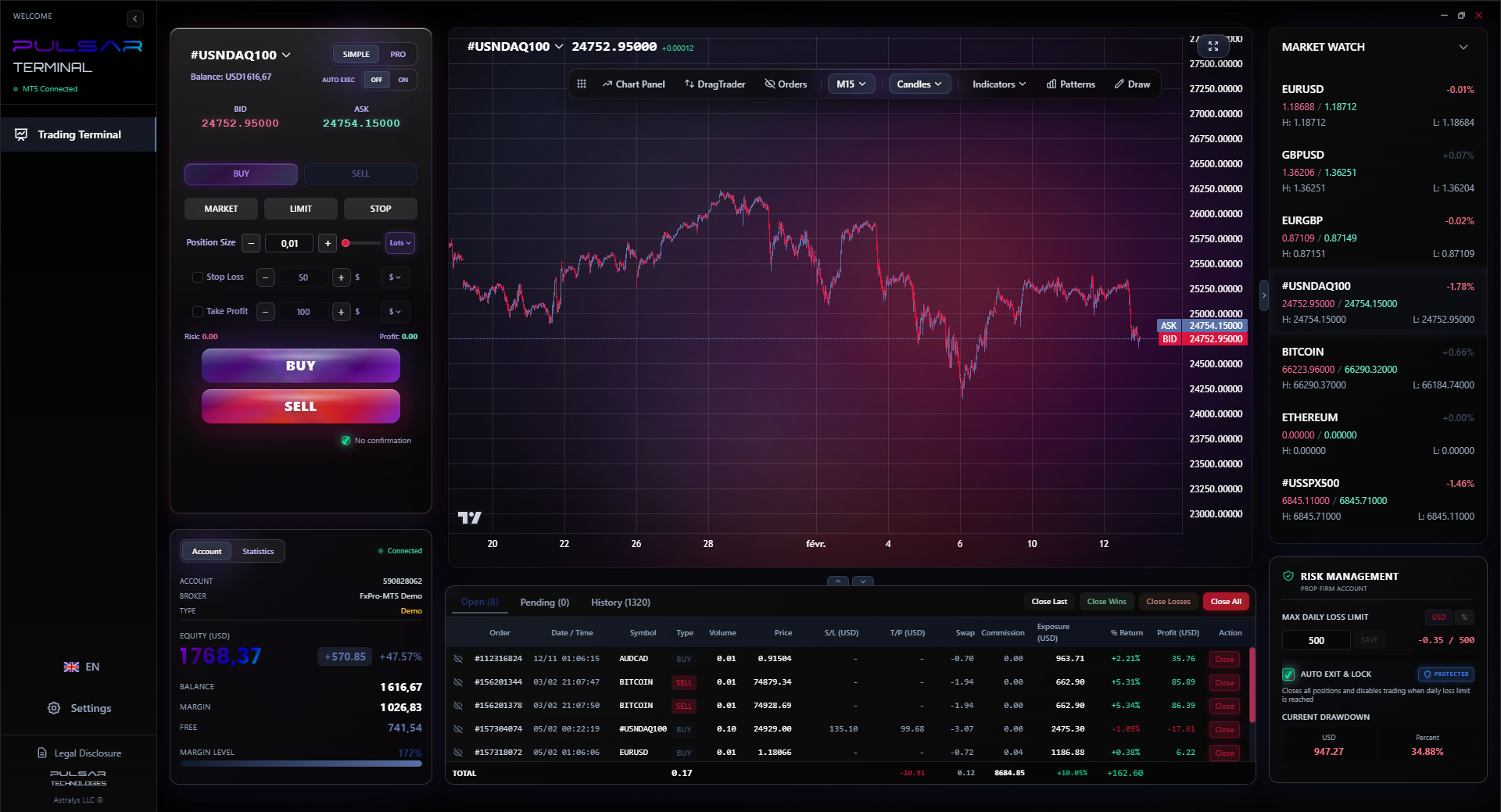
Sticking to a detailed trade plan with partial closures and breakeven stops is non-negotiable in a prop firm environment, which is why I use Pulsar Terminal to automate those rules directly on my MT5 charts.
Pulsar Terminal
Công cụ MT5 tất-cả-trong-một: đặt lệnh kéo-thả, multi-TP/SL, trailing stop, grid trading, Volume Profile và bảo vệ prop firm. Hơn 1.000 trader sử dụng mỗi ngày.
This is the final decision point. Let's be brutally honest about who each model serves.
Choose the TRADITIONAL CHALLENGE if:
- You are new to futures or prop firm trading.
- You have a history of impulsive trading or revenge trading.
- Your capital is limited (the fees are lower).
- You need the structured pressure to forge your discipline.
- You view the challenge as paid education.
The challenge is the boot camp. It's unpleasant, but it builds resilience. That 5-10% pass rate exists because most people's strategies and psyches aren't strong enough. The challenge reveals that cheaply.
Choose the INSTANT FUNDING route (cautiously) if:
- You are a consistently profitable trader with at least 2 years of verified track record.
- You have already passed prop firm challenges in the past and understand the ruleset cold.
- You have a specific, commission-aware strategy ready to deploy on larger simulated capital.
- You can afford to lose the 2-3x higher fee without it impacting your life.
- You have the self-control to impose stricter rules than the firm requires.
The instant account is a tool for a seasoned professional to access a larger capital simulation. It is not a lottery ticket. If you're not already profitable, it's a very expensive way to discover that you're not.
Pro Tip: Do a traditional challenge first. Even if you can afford the instant. Prove to yourself that you can operate within the rules under pressure. Then, if you want to scale, consider an instant account for a second, separate strategy. Never use instant funding as your first exposure to the prop firm model.
💡 Mẹo của Winston
If you wouldn't risk $500 on a single trade in your personal account, don't pay $500 for an instant funding fee. The principle of capital preservation is the same.
“The regulatory clouds gathering mean your due diligence must now include the firm's compliance posture, not just their profit split.”
The instant funding futures prop firm is a fascinating innovation in a competitive space. For the right trader - the disciplined, experienced, process-driven veteran - it can be a legitimate way to simulate trading larger size and earn a profit share faster.
But let's call it what it is for the majority: a sophisticated trap. It monetizes impatience. It sells the dream of skipping the hard part, knowing that the hard part is where most failures are safely contained. The higher fee is a premium paid for the right to fail faster and more expensively.
The regulatory clouds gathering mean the entire landscape could shift. Your due diligence now must include the firm's compliance posture and financial stability, not just their profit split.
My advice? Slow down. The market isn't going anywhere. If you have a real edge, prove it in a $10,000 challenge for $50. Learn the rules. Build the discipline. Then, and only then, consider scaling. The path to sustainable funding isn't instant. It's earned, one controlled trade at a time. The firms that survive the coming regulatory wave will be looking for those kinds of traders - the ones who understand that speed is the enemy of consistency.
FAQ
Q1Are instant funding futures prop firms legal in the United States?
They operate in a regulatory gray area. They are legal as service-based businesses where you pay for an evaluation, not as investment managers handling client funds. However, the CFTC is actively scrutinizing them and may reclassify them as Commodity Trading Advisors (CTAs), which would require registration, audits, and stricter rules. Their current legality is stable but under threat.
Q2What's the catch with instant funding?
The main catch is psychological and financial. You skip the discipline-forging evaluation phase, making you more prone to reckless trading with the larger simulated capital. Financially, the upfront fee is 2-3x higher than a standard challenge, and ongoing commissions/fees significantly eat into your effective profit split, often turning an advertised 80% split into a 65% take-home rate.
Q3How much does an instant funding account typically cost?
For a $50,000 simulated futures account, expect to pay between $500 and $1,000 upfront. This compares to $150-$300 for a traditional evaluation of the same size. Costs scale with account size, and you must also budget for monthly platform/data fees ($25-$50) and per-trade commissions ($0.50-$2.00 per contract).
Q4Can I actually withdraw money from an instant funding account?
Yes, but only after you've reached the firm's specified profit target (often a first target before regular payouts begin). You then receive a split (e.g., 80%) of the simulated profits you generated, paid from the firm's own capital. Remember, you are not trading real client money; you're being paid based on your demo performance.
Q5What happens if the CFTC shuts down my prop firm?
This is a real risk. If the firm is shut down or ceases operations, any pending payouts may be frozen or lost. Your upfront fee is almost certainly gone. This is why due diligence on the firm's regulatory standing and financial stability is now as important as evaluating their trading rules.
Q6Is instant funding better than a traditional challenge for a beginner?
Absolutely not. It's worse. A beginner needs the structured pressure and lower-cost failure of a traditional challenge. Instant funding removes the training wheels before you can balance, leading to faster, more expensive failure. It's designed for experienced traders who have already proven they can pass challenges.
Q7Do I need a special broker for an instant funding prop firm?
No, you don't choose the broker. The prop firm provides you with access to their trading platform (often a customized version of common software) and their own simulated brokerage environment. You cannot connect your own IC Markets or Pepperstone account to their system.
Bài học của Prof. Winston
Điểm chính:
- ✓Instant funding fees are 200-300% higher than evaluation fees.
- ✓Commissions can reduce an 80% split to a 65% effective take-home.
- ✓Only 5-10% of traders pass standard evaluations; instant funding doesn't improve this.
- ✓The CFTC may reclassify prop firms as CTAs by 2026, changing everything.
Bài viết này hữu ích thế nào?
Nhấp vào ngôi sao để đánh giá
Nhận định giao dịch hàng tuần
Phân tích & chiến lược miễn phí hàng tuần. Không spam.
Về tác giả
James Mitchell
Chuyên gia Phân tích Giao dịch Cao cấp
Hoạt động tại New York với hơn 9 năm kinh nghiệm giao dịch. Tập trung vào các cặp USD chính, thử thách prop firm và bối cảnh pháp lý tại Mỹ.
Bình luận
Cảnh báo rủi ro
Giao dịch các công cụ tài chính tiềm ẩn rủi ro đáng kể và có thể không phù hợp với tất cả nhà đầu tư. Hiệu suất trong quá khứ không đảm bảo kết quả trong tương lai. Nội dung này chỉ mang tính chất giáo dục và không nên được coi là lời khuyên đầu tư. Hãy luôn tự nghiên cứu trước khi giao dịch.
Bạn cũng có thể thích

Cara Trading Forex Sukses: 7 Prinsip dari Trader Profesional
Cara trading forex sukses dengan 7 prinsip trader pro: manajemen modal, disiplin, journal trading, backtest. Data nyata, bukan janji profit palsu.
Jam Trading Forex Terbaik untuk Trader Indonesia: Panduan Lengkap dengan Tabel Waktu
Panduan jam trading forex untuk trader Indonesia. Tabel 4 sesi dunia, jam emas 20:00-00:00, sesi mana yang harus dihindari. Data akurat + tips dari trader berpengalaman.
Top 5 Sàn Forex Uy Tín Nhất 2026: Review Jujur dari Trader Indonesia
Top 5 sàn forex uy tín 2026 untuk trader Indonesia. Review jujur: spread, deposit, withdraw, dukungan lokal. Exness, XM, IC Markets & lebih.
Tải Pulsar Terminal
Tất cả các công cụ tính này được tích hợp trong Pulsar Terminal với dữ liệu thời gian thực từ tài khoản MT5 của bạn.
Tải Pulsar Terminal