


I bought my first Jim Brown forex book back in 2015, hoping for a secret formula.

David van der Merwe
Nhà giao dịch Thị trường Mới nổi ·  South Africa
☕ 10 phút đọc
Bạn sẽ học được:
- 1Who is Jim Brown in the Forex World?
- 2A Look at the Core Strategies & The Local Reality Check
- 3Cost vs. Value: What Are You Really Buying?
- 4What Good Trading Education Actually Looks Like (For South Africans)
- 5Better Than a Book: The Tools & Brokers That Actually Help
- 6How to Build Your Own System (Without Buying One)
- 7The Final Verdict on Jim Brown Forex Books for South Africans
I bought my first Jim Brown forex book back in 2015, hoping for a secret formula. I was trading USD/ZAR, convinced I could outsmart the market. The book promised a 'systematic approach.' I followed a setup religiously, entered at 14.85, and watched it run straight to 15.30 against me. That was a R8,000 lesson. It wasn't the book's fault, not entirely. It was my blind faith in any single source of truth. This review isn't about bashing an author. It's about figuring out if Jim Brown's material, or any educational material for that matter, has a place in a South African trader's toolkit, where use is capped at 30:1 and the Rand does its own chaotic dance.
Let's clear this up first. Jim Brown isn't a mythical trading guru plastered on billboards. He's an educator who's built a business around selling trading courses, books, and software, primarily through his website ForexTradersDaily. His content often focuses on specific set-ups, like the 'Turtle Soup' strategy, and promotes the use of his proprietary indicators and scanners.
For a South African trader, the immediate red flag is that this content is almost exclusively US-centric. The examples, the broker references, the market hours discussed - they assume you're trading from New York or London. There's zero adaptation for our time zone (which is actually a great advantage), our regulatory environment with the FSCA, or the unique volatility of pairs like USD/ZAR. Reading it feels like getting driving lessons for the Autobahn when you need to navigate the potholes of Jo'burg.
His marketing is effective, I'll give him that. It hooks new traders with the promise of clarity and structure. But here's the thing I learned the hard way: no book, not even a whole library of Jim Brown forex books, can replace screen time and managing your own psychology. Buying a strategy is not the same as understanding price action. I once paid $297 for a course that taught me less about the market than losing R5,000 on a bad EUR/USD trade did. The loss taught me about my own panic threshold; the course just gave me a checklist.

💡 Mẹo của Winston
A book can give you a map, but it can't walk the path for you. The potholes on the South African trading road are unique. Your experience is the only true guide.
“Buying a strategy is not the same as understanding price action.”
Jim Brown's material often revolves around a few key concepts. Let's break them down with a South African lens.
The 'Turtle Soup' and Similar Setups
This is a mean-reversion strategy, looking to fade breakouts that fail. In theory, it's sound. In practice, especially on our local brokers' platforms, you need to account for spreads and execution speed. On a pair like GBP/ZAR, the spread can be 50 pips or more during volatile sessions. A strategy that aims for 15-pip profits is dead on arrival before you even place the trade. You'd be giving half your target to the broker just to get in and out.
Reliance on Proprietary Indicators
This is a common theme. The strategies are frequently tied to custom indicators you can only get through his service. This creates dependency. What happens if you stop paying the subscription? Your 'system' vanishes. As a trader, your edge should be in your mind, not rented software. I'd rather you master the standard RSI indicator or MACD indicator on your MT4 platform, which are free and available everywhere, including on accounts from brokers like Exness or XM.
The Disconnect with SA Costs
South African traders face specific costs. The FSCA's 30:1 use cap changes position sizing math dramatically compared to the 500:1 some international courses assume. Also,, while some brokers like Tickmill offer raw spreads near 0.1 pips on EUR/USD, most local traders start on standard accounts where spreads on majors are closer to 1 pip. A strategy that doesn't factor in a 1-2 pip spread as a significant cost of doing business is flawed from the start for our context.

Warning: Be extremely wary of any educator who sells you a strategy that only works with their custom tools. It's a business model, not an education model. Your goal is independence, not perpetual subscription.
“Your edge should be in your mind, not rented software.”
Let's talk numbers. A typical Jim Brown forex book or course can range from $50 to over $500. At today's exchange rate, that's R900 to R9,000+. For a new trader in South Africa, that's a significant chunk of capital that could be your initial deposit.
I made this mistake. I spent $199 (about R3,600 at the time) on a 'advanced price action' course. The content wasn't terrible, but it was generic. It didn't answer my specific questions: How do I handle the liquidity drop during the SA lunch hour? What's the best session for scalping strategy given our timezone? The real value I've found has always been free: the FSCA's educational resources, broker webinars from Pepperstone or IG that sometimes focus on emerging markets, and the brutal, unpaid education of a trading journal.
Consider this alternative investment: Take that R3,600. Open a demo account. Then, open a live micro account with a minimum deposit, say R700 with XM. Trade with real, tiny money. The emotional lessons you learn from that R700 account - the fear, the greed, the frustration - will teach you more about being a trader than any $500 book ever could. Use a free position size calculator religiously. That's a better investment.
“Your edge should be in your mind, not rented software.”
Forget chasing gurus. A solid trading education for a South African should be built on these pillars, none of which require a famous name on the cover.
- Regulations First: Understand the FSCA, the 30:1 use limit, and what client fund segregation really means. Know how to verify your broker's FSP number. This protects you more than any trading signal.
- Market Mechanics: Learn how the ZAR is influenced by local politics, commodity prices (platinum, gold), and SARB decisions. Pair this with understanding global drivers for majors like the EUR/USD guide.
- Risk Management as a Religion: This is non-negotiable. Your first, second, and third lesson should be about position sizing, stop losses, and the psychology of loss. Knowing what a margin call is and how to avoid it is worth ten strategy books. A tool that can help automate this discipline is useful.
- Platform Proficiency: Become a master of your chosen platform, whether it's MT5, TradingView, or cTrader. Learn how to place orders, set alerts, and draw basic support/resistance. This is your cockpit.
- Community & Mentorship (The Right Kind): Find local trading communities or reputable international ones where traders share charts and ideas, not just wins. A good mentor won't sell you a system but will question your trades and make you justify your decisions.

Pro Tip: The best educational resource is your own trade history. Review every single trade. Ask: Why did I enter? Was the setup clear? Did I follow my rules? Why did I exit? This boring, repetitive work builds more skill than any secret strategy.
💡 Mẹo của Winston
The most expensive education is the one you ignore. A R100 book on psychology, fully absorbed, is worth more than a R10,000 'secret system' you don't understand.
“The best educational resource is your own trade history.”
Instead of spending money on another Jim Brown forex book, invest your time in finding the right broker and tools that give you a real edge. Here’s a quick comparison of what matters for a SA trader:
| Feature | Why It Matters for You | Example Brokers (FSCA Regulated) |
|---|---|---|
| Low Spreads on Majors | Directly impacts profitability of short-term strategies. | FP Markets, IC Markets, Tickmill |
| ZAR Denominated Account | Avoids currency conversion fees on deposits/withdrawals. | Many, including IG, AvaTrade |
| Reliable Execution | Slippage can kill precise strategies like scalping. | Pepperstone, IC Markets |
| Advanced Order Types | Essential for sophisticated risk management. | Most MT4/5 brokers offer this. |
| Quality Education & Analysis | Look for brokers that provide market analysis relevant to EM/SA. | IG, FXTM |
Also,, the right software can automate the discipline books only preach. For instance, managing a swing trading position with multiple take-profit levels and a trailing stop is a manual headache on vanilla MT5. Automating that removes emotion and ensures you stick to a plan.
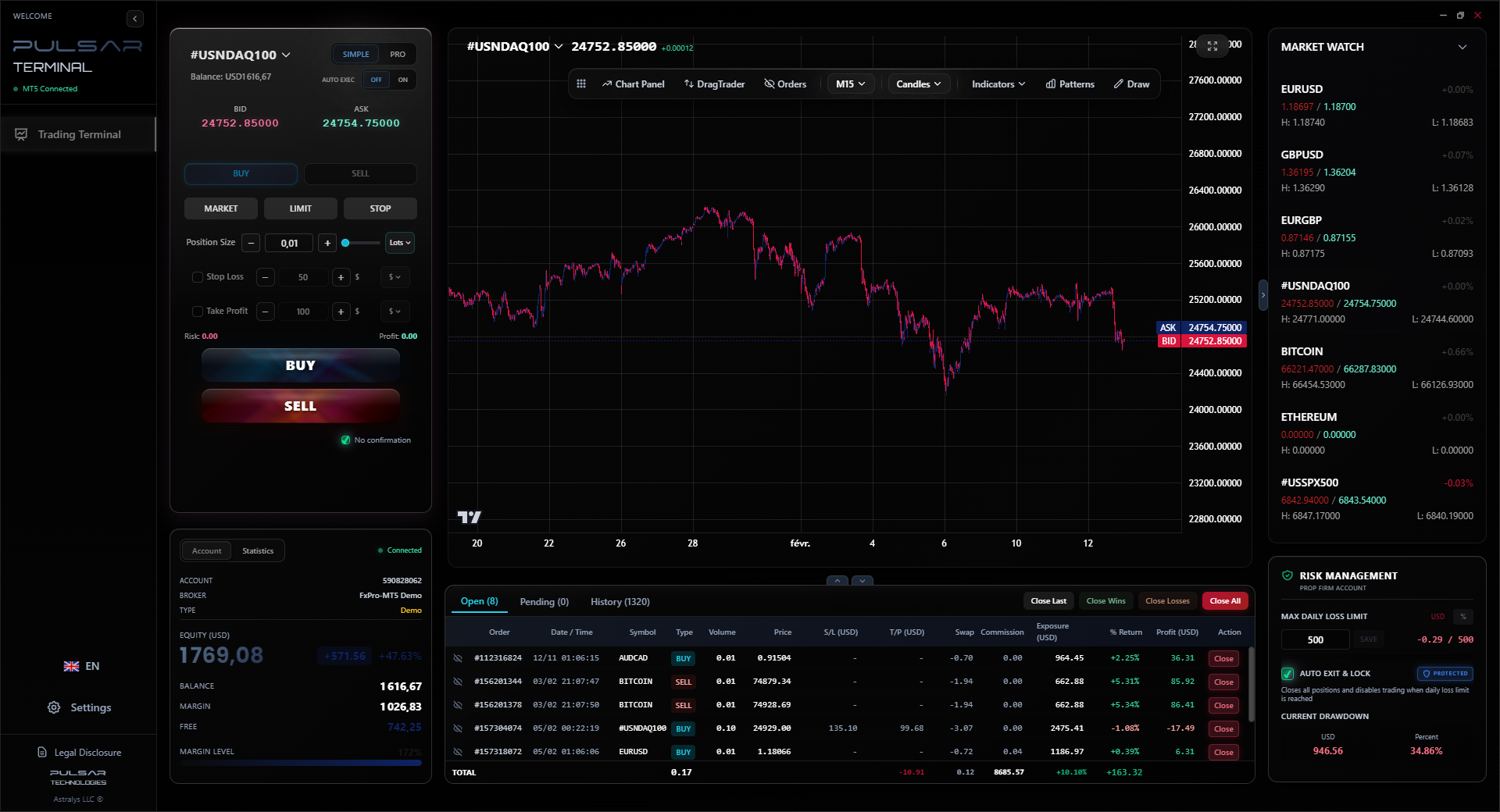
This is where a tool like Pulsar Terminal shines. It integrates directly with MT5, letting you set complex order structures with a drag-and-drop. Think about a grid strategy on XAU/USD guide (gold), where you want to scale in at certain levels and take partial profits automatically. Doing that manually while also managing your psychology is a tall order. A tool that handles the mechanics lets you focus on the analysis.
Building a disciplined system is one thing; executing it flawlessly under pressure is another. Tools like Pulsar Terminal automate complex order and risk management directly on MT5, turning your trading plan into mechanical action.
Pulsar Terminal
Công cụ MT5 tất-cả-trong-một: đặt lệnh kéo-thả, multi-TP/SL, trailing stop, grid trading, Volume Profile và bảo vệ prop firm. Hơn 1.000 trader sử dụng mỗi ngày.
“The best educational resource is your own trade history.”
This is the ultimate goal. Your system should fit your personality, your schedule, and your risk tolerance. Here's a blueprint, not a bought recipe.
Step 1: Define Your Parameters. Are you a night owl who can trade the New York open? Maybe scalping strategy is for you. Do you only have weekends to analyze? Then swing trading is your friend. Be brutally honest.
Step 2: Choose Your Battlefield. Don't trade 28 pairs. Pick two or three. Maybe EUR/USD for its liquidity and USD/ZAR for your local knowledge. Master them. Understand what a typical daily spread definition and range is for each.
Step 3: Find a Repeatable Setup. This is where price action study comes in - and you can learn this for free. Look for 3-5 clear conditions that must be met before you trade. Example: "I only buy USD/ZAR on a pullback to the 4-hour EMA 50, if there's a bullish divergence on the 1-hour RSI, and only if the daily trend is up." Write it down.
Step 4: Cement Your Risk Rules. This is non-negotiable. I risk no more than 1% of my account on any single trade. My stop loss is always placed at a logical level where my setup is invalidated. I use a position size calculator for every entry. No exceptions. Ever.
Step 5: Backtest and Forward Test. Test your system on historical data (backtest), then trade it on a demo account for a month (forward test). Then, trade it with tiny real money. If it survives all that, you might have something. My first profitable system came from combining a simple moving average crossover with support/resistance levels on the 1-hour chart for GBP/USD. It wasn't fancy, but I understood it inside and out because I built it.
“No book can teach you to stay calm when USD/ZAR spikes 2% on a rumor.”
So, should you buy Jim Brown forex books?
My take: They represent a structured, packaged form of education. There's likely some useful information in there about discipline and specific patterns. The danger for a South African trader is threefold: (1) the material isn't localized, (2) it can create a costly dependency on proprietary tools, and (3) it might convince you that trading success is about finding the right 'holy grail' system to purchase, rather than the hard, internal work of building discipline.
If you are absolutely new and need a structured starting point, and you can get one of his books for a very low cost (think under $20), it might provide a basic framework. But immediately start translating that framework to our market. Adjust for spreads, for use limits, for session times.
However, I believe your money and, more importantly, your time are better spent elsewhere. Learn the global fundamentals. Master your platform. Paper trade until you are consistently not losing. Then trade micro lots. Use free online resources, broker seminars, and books on trading psychology (not strategy) from authors like Mark Douglas. Your greatest asset isn't a secret indicator; it's your ability to stay calm when USD/ZAR spikes 2% on a political rumor. No book can teach you that. Only experience can.
Focus on becoming a competent, disciplined trader who understands the South African landscape. That's the only 'system' worth owning.
FAQ
Q1Is Jim Brown a scam?
Not a scam in the illegal sense. He runs a legitimate business selling trading education and software. The question is value. For a South African trader, the cost of his courses is high relative to the generic, US-focused content provided. The real risk is buying the idea that a purchased system is the key to success, which it isn't.
Q2What is the best forex trading book for beginners in South Africa?
Skip the 'strategy' books at first. Start with "Trading in the Zone" by Mark Douglas to master your psychology. Then, use the free educational sections from FSCA-regulated brokers like IG or Pepperstone, which often have content tailored to understanding markets and platform basics. Learn about the pip definition and risk management before any fancy strategies.
Q3Can I use Jim Brown's strategies with South African brokers?
Technically yes, but you'll need major adjustments. Strategies designed for 0.1 pip spreads and 500:1 use will fail on a standard account with 1.5 pip spreads and 30:1 use. You must re-calculate every position size, target, and stop loss for our local cost structure. The core idea might work, but the execution details are completely different.
Q4What should I look for in a forex trading course as a South African?
Look for courses that teach principles, not just setups. Prioritize content on risk management, trading psychology, and market structure. Any course that doesn't extensively cover how to size positions and manage losses is worthless. Bonus points if the educator acknowledges different global markets or even mentions emerging market currencies.
Q5Are there any good South African forex trading educators?
There are credible local analysts and mentors, but be even more cautious. The local space has its share of 'get-rich-quick' hype. Look for educators who emphasize the FSCA rules, realistic returns, and risk management. Often, the best practical insights come from the analysis teams at established international brokers with local offices, as they understand both global and local drivers.
Q6How much money do I need to start forex trading in South Africa?
You can start with very little. Brokers like XM allow a minimum deposit of $5 (approx. R90). However, I strongly advise you start with at least R2,000-R5,000. This isn't to trade big, but to absorb the real costs (spreads, occasional slippage) and small losses without blowing your account. It makes the experience real. Always use a position size calculator to keep risk tiny.
Bài học của Prof. Winston
Điểm chính:
- ✓Localize every strategy: adjust for 30:1 use & ZAR spreads.
- ✓Value principles over purchased setups.
- ✓Risk 1% max per trade. No exceptions.
- ✓Master free tools (MT5, RSI) before buying anything.
- ✓Your trading journal is your best teacher.
Bài viết này hữu ích thế nào?
Nhấp vào ngôi sao để đánh giá
Nhận định giao dịch hàng tuần
Phân tích & chiến lược miễn phí hàng tuần. Không spam.
Về tác giả
David van der Merwe
Nhà giao dịch Thị trường Mới nổi
Trader tại Johannesburg với 11 năm kinh nghiệm về tiền tệ thị trường mới nổi. Chuyên về cặp ZAR, giao dịch theo quy định FSCA và phân tích thị trường Nam Phi.
Bình luận
Cảnh báo rủi ro
Giao dịch các công cụ tài chính tiềm ẩn rủi ro đáng kể và có thể không phù hợp với tất cả nhà đầu tư. Hiệu suất trong quá khứ không đảm bảo kết quả trong tương lai. Nội dung này chỉ mang tính chất giáo dục và không nên được coi là lời khuyên đầu tư. Hãy luôn tự nghiên cứu trước khi giao dịch.
Bạn cũng có thể thích

Cara Trading Forex Sukses: 7 Prinsip dari Trader Profesional
Cara trading forex sukses dengan 7 prinsip trader pro: manajemen modal, disiplin, journal trading, backtest. Data nyata, bukan janji profit palsu.
Jam Trading Forex Terbaik untuk Trader Indonesia: Panduan Lengkap dengan Tabel Waktu
Panduan jam trading forex untuk trader Indonesia. Tabel 4 sesi dunia, jam emas 20:00-00:00, sesi mana yang harus dihindari. Data akurat + tips dari trader berpengalaman.
Top 5 Sàn Forex Uy Tín Nhất 2026: Review Jujur dari Trader Indonesia
Top 5 sàn forex uy tín 2026 untuk trader Indonesia. Review jujur: spread, deposit, withdraw, dukungan lokal. Exness, XM, IC Markets & lebih.
Tải Pulsar Terminal
Tất cả các công cụ tính này được tích hợp trong Pulsar Terminal với dữ liệu thời gian thực từ tài khoản MT5 của bạn.
Tải Pulsar Terminal