


Let's be brutally honest: most people in Johannesburg who try forex trading lose their money.

David van der Merwe
Nhà giao dịch Thị trường Mới nổi ·  South Africa
☕ 10 phút đọc
Bạn sẽ học được:
Let's be brutally honest: most people in Johannesburg who try forex trading lose their money. They get sold a dream by slick Instagram gurus and end up funding a broker's new yacht. But here's the controversial truth - it's not the market's fault. It's a complete lack of understanding of the local rules, costs, and the sheer discipline required. I've seen it all from Sandton to Soweto. This guide isn't about getting rich quick. It's about showing you, a Johannesburg forex trader, how to navigate the legal minefield, pick the right tools, and build a strategy that doesn't rely on luck. I'll prove that with the right framework, you can be part of the minority that actually succeeds.
Trading in Jo'burg isn't the wild west. Forget those offshore bucket shops promising 1000:1 use. If you're trading here, you play by South African rules, and they are strict for a reason. The Financial Sector Conduct Authority (FSCA) is your new best friend and worst nightmare rolled into one. They're the ones who decide if a broker can take your money.
Your first and only non-negotiable step is checking the FSCA's public register. Don't just take a broker's word for it. I learned this the hard way early on, trusting a "regulated" broker that was licensed in some obscure island territory. It took months to get my withdrawal. If they aren't on the FSCA list as a licensed Financial Service Provider (FSP), walk away. It's that simple.
Now, let's talk about the real kicker: tax. This is where most casual traders get obliterated. SARS doesn't care if you're trading from your flat in Rosebank or a coffee shop in Maboneng. If you're trading frequently, those profits are taxable income. Not capital gains. Income. That means it gets added to your salary and taxed at your marginal rate. You must keep a careful record of every single trade, deposit, and withdrawal. I use a simple spreadsheet, but a dedicated journal works. When SARS comes knocking (and they will if you start making consistent money), "I forgot" isn't a defense.

Warning: The South African Reserve Bank (SARB) has exchange controls. It is illegal to use an unapproved channel to move money offshore to an international broker. If your broker isn't FSCA-regulated, you're likely breaking the law just by funding your account. Stick to local, regulated entities or international brokers who are properly licensed here.
The use cap of 30:1 for retail clients might feel limiting if you've heard stories from elsewhere. Good. It's supposed to. That limit has probably saved more Johannesburg forex traders from instant ruin than any trading course ever could. It forces you to use sensible position size calculator.
“A R70 account is a toy. Spreads and costs will consume it before you learn a thing.”
Everyone looks at the spread. Smart traders look at the total cost of doing business. Let's break down what it actually costs to trade from Johannesburg, in Rands and sense.
Broker Spreads & Commissions
You'll see two main account types: spread-only and commission-based. A "tight spread" of 0.0 pips sounds great until you see the $7 round-turn commission. You need to calculate the effective cost.
Let's use a real example from my trading last quarter. I was scalping EUR/USD on an ECN account with a local broker. The raw spread was 0.1 pips, with a $5 commission per lot. On a standard lot ($100,000), that commission is 0.5 pips. So my effective entry/exit cost was 0.6 pips (0.1 + 0.5). On a spread-only account advertised at 0.8 pips, I'd have paid more. Always do the math.
Here’s a quick comparison of typical costs for a standard lot (100k) trade on EUR/USD:
| Cost Type | Spread-Only Account | Commission-Based Account |
|---|---|---|
| Spread | 0.8 pips | 0.1 pips |
| Commission | R0 | ~$5 (approx. 0.5 pips) |
| Total Effective Cost | 0.8 pips | 0.6 pips |
The Hidden Bank Fees
This is the silent killer for Johannesburg forex traders. You deposit R10,000. Your broker shows R10,000. But what did it cost you to get it there? Your local bank charges for the international payment (if your broker's account is offshore, even if they're FSCA regulated). I've seen fees from Capitec or Standard Bank range from R250 to over R500 for the wire, plus a possible currency conversion spread if you're funding a USD account.

Example: You deposit R15,000. Bank fee: R350. You immediately start trading with R14,650. You're already down 2.3% before you've even placed a trade. You need to make that back just to break even. Always factor this into your risk management.
Overnight Fees (Swap Rates)
Holding a trade overnight? You'll pay or earn a swap rate. These can be brutal on certain currency pairs, especially if you're swing trading and holding for weeks. I once held a AUD/JPY short for three weeks. The negative swap ate up nearly 30% of my eventual profit. Check the swap calculator on your platform before you let a trade run over Wednesday night (when triple swaps are charged).

💡 Mẹo của Winston
Your first R10,000 in the market is tuition, not investment. Expect to pay it to learn. The goal is to keep the tuition fees as low as possible.
“The biggest enemy of the Johannesburg forex trader is ego. I've been there.”
With over 200,000 traders in SA, brokers are fighting for your attention. Flashy ads mean nothing. You need to look at cold, hard facts. Regulation is the first filter, but it's not the only one.
Platform & Execution: You'll likely use MetaTrader 4 or 5. It's the standard. But does your broker's version have frequent requotes or slippage during the London open? Test it with a demo account during volatile news events. A good local option like Khwezi Trade is FSCA regulated and offers MT5 with ZAR accounts, which simplifies the bank fee headache. For international brokers with strong local licenses, my experience with IC Markets and Pepperstone has been positive regarding execution speed and reliability.
Minimum Deposits: You can start with R70? Great. But should you? No. A R70 account is a toy. Spreads and costs will consume it. A realistic minimum for practicing proper risk management is R1,500 to R5,000. This allows you to trade micro lots (0.01) and actually learn without blowing up in a day. Some brokers like XM offer cent accounts, which are fantastic for absolute beginners to get a feel for the market with real, but tiny, money.
Customer Support: Can you get someone on the phone in Johannesburg during market hours? Or are you stuck with a 24-hour email ticket to a call center in another hemisphere? When you have a margin call issue at 10 PM, this matters.

Pro Tip: Don't be seduced by high use offers. The FSCA cap is 30:1 for major pairs for a reason. Any "professional" account offering you more is just asking you to lose money faster. If you need more than 30:1 to make your strategy work, your strategy is wrong.
“Your first R10,000 in the market is tuition, not investment.”
Forget the complex indicators you see on YouTube. The most reliable money I've made for clients in Johannesburg comes from combining a few core concepts with ruthless discipline. Here's a framework, not a holy grail.
The Foundation: Price Action & Key Levels
I draw daily and weekly support/resistance lines. That's it. No fancy algorithms. I look for where the price has reversed or stalled multiple times in the past. The Johannesburg market hours (we're GMT+2) overlap nicely with the London session. This is when liquidity and volatility pick up.
My bread and butter is waiting for price to approach one of these key levels during the Asian session (quieter time), then watching for a rejection candle (like a pin bar or engulfing pattern) as London traders come in. I enter on a break of that candle's high/low, with a stop loss just beyond the key level.
Confirmation, Not Prediction
I don't predict. I react. I use the RSI indicator (set to 21 periods, not the default 14) to check for divergence. If price is making a new high at a resistance level, but RSI is making a lower high, that's a potential reversal signal. I also glance at the MACD indicator on the 1-hour chart to gauge momentum shift. But the final decision is always the price action at the level.
A Real Trade Example
In early March, XAU/USD (gold) was approaching a major weekly resistance at $2080. It had failed there twice before. As London opened, price tapped $2079.80 and formed a clear 4-hour bearish engulfing candle. RSI showed bearish divergence. I entered short at $2077.50 after the candle closed.
- Stop Loss: $2085.50 (above the weekly high). Risk: $800 per standard lot.
- Take Profit 1: $2060 (previous support). Closed half position here for +$1,750.
- Take Profit 2: $2045. Moved stop to breakeven. Position ran and hit TP2 for a total gain of ~$3,250 on the full lot size.
This is where tools matter. Manually moving a stop to breakeven and managing partial closes is clunky on standard MT5. This process is why I now rely on automation.
Warning: This isn't a signal service. This is a process. You will have losing trades. The win comes from your risk/reward. My stop loss is always 1x risk. My first take profit aims for 2-2.5x risk. This means I can be wrong half the time and still be profitable.
💡 Mẹo của Winston
The FSCA register is free. A lawyer to get you out of a scam is not. Spend 10 minutes checking now, save yourself R50,000 and a heart attack later.
“Your first R10,000 in the market is tuition, not investment.”
The market doesn't care about your braai plans, your car payment, or your desire to prove something to your friends. The biggest enemy of the Johannesburg forex trader is ego. I've been there. I doubled an account in a week and thought I was a genius. I promptly gave it all back plus more the next week trying to chase that high.
You have to separate your self-worth from your P&L. A losing trade isn't a personal failure. It's a cost of doing business. The goal is to be consistently profitable over hundreds of trades, not to nail every single move.
FOMO (Fear Of Missing Out) is huge here. You see the USD/ZAR rocketing and you jump in late, only to buy the very top. Discipline means waiting for your setup, even if it means watching 50 pips go by without you. There will always be another trade.
Finally, talk to someone. Not for tips, but for accountability. Find a serious trading friend (not an Instagram guru) and review each other's trades. Explain why you took them. It forces you to confront your own excuses. The isolation of trading from home can lead to terrible habits.
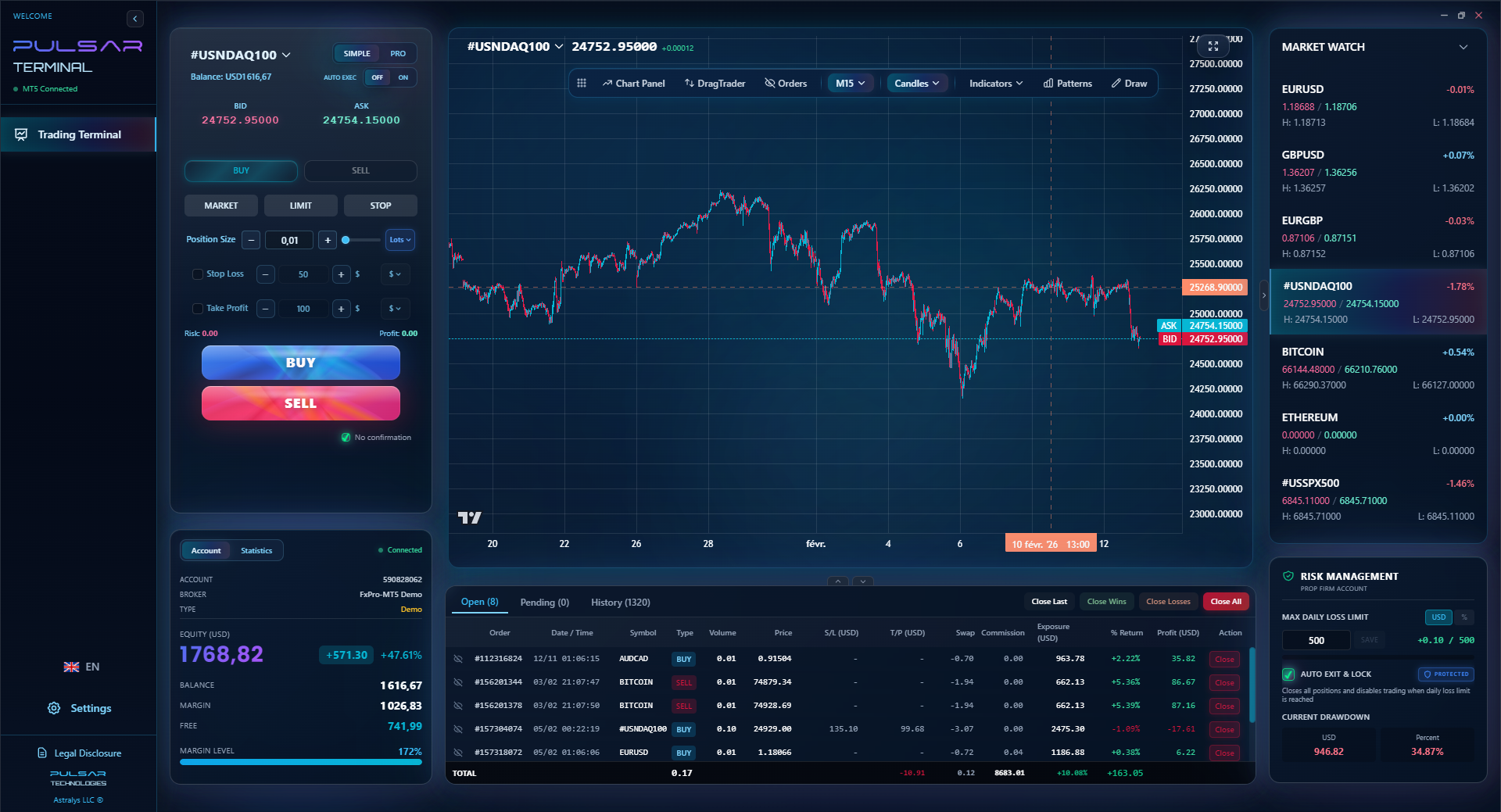
Manually managing partial closes and breakeven stops is where most emotional mistakes happen, which is why automating these rules with a tool like Pulsar Terminal is non-negotiable for serious traders.
Pulsar Terminal
Công cụ MT5 tất-cả-trong-một: đặt lệnh kéo-thả, multi-TP/SL, trailing stop, grid trading, Volume Profile và bảo vệ prop firm. Hơn 1.000 trader sử dụng mỗi ngày.
“The right tool isn't about giving you signals. It's about enforcing your discipline.”
Your broker's basic MT5 platform is like a blunt knife. It works, but a chef uses sharper tools. Over the years, I've paid for countless indicators and "smart" systems. 99% are garbage. The tools that made a real difference did one thing: they automated the boring, repetitive tasks where I made emotional mistakes.
Trade Management Automation: This was my game-changer. Manually dragging stop losses, calculating partial closes, setting breakeven stops - I'd mess it up under pressure. I'd move a stop loss too early out of fear, turning a winner into a loser. A proper trading terminal should handle this based on your pre-set rules.
Advanced Charting: While MT5 has drawing tools, advanced features like Volume Profile or Market Profile are often missing. These help you see where big institutions are buying and selling, adding a huge edge to finding those key levels I talked about.
Pattern Recognition: I'm decent at spotting flags and triangles, but after 6 hours at the screen, your eyes get tired. A tool that can scan and highlight potential patterns across multiple timeframes saves immense mental energy.
The right tool isn't about giving you signals. It's about enforcing your discipline and freeing up your brain to focus on analysis, not button-clicking. It turns your trading plan from a Word document into an executable system.
💡 Mẹo của Winston
If you can't explain your trade setup in one simple sentence (e.g., 'buying at weekly support with a bullish pin bar'), you shouldn't be in the trade. Complexity is the enemy of execution.
FAQ
Q1Is forex trading legal in Johannesburg?
Yes, absolutely. But it must be done through a broker licensed by the Financial Sector Conduct Authority (FSCA). Trading with an unregulated offshore broker can violate SARB exchange controls and offers you no protection.
Q2How much money do I need to start forex trading in South Africa?
Technically, as little as R70 with some brokers. Practically, to trade with proper risk management (using micro lots and surviving drawdowns), you should start with at least R1,500 to R5,000. A more serious starting capital for a standard account is R5,000 to R20,000.
Q3How are my forex trading profits taxed by SARS?
If you trade frequently, SARS views this as a business. Your net profits are considered taxable income and are added to your other income, taxed at your marginal rate. You must declare it and keep detailed records of all trades, deposits, and withdrawals.
Q4What is the maximum use I can use?
For retail traders, the FSCA caps use at 30:1 for major forex pairs like EUR/USD. This is a protective measure. Brokers may offer higher use on "professional" client accounts, but qualifying for this is strict and the risks are exponentially higher.
Q5Can I use international brokers like Exness or IC Markets?
You can, but only if they hold a specific FSCA license as an Over-the-Counter Derivative Provider (ODP). Many big names like Exness and IC Markets do have this local licensing. Never use their global entity if it's not FSCA-regulated.
Q6What's the biggest mistake new Johannesburg traders make?
Two things: ignoring local regulations/tax, and using way too much use. They treat trading like a casino, betting big on small account sizes to try and make life-changing money in a week. It always ends the same way.
Q7Is the ZAR/USD pair a good one to trade?
It can be, but it's highly sensitive to local political and economic news. It's less liquid than majors like EUR/USD, which can mean wider spreads and more volatile swings. I'd recommend mastering a major pair first before tackling exotic pairs like USD/ZAR.
Bài học của Prof. Winston
Điểm chính:
- ✓Always verify FSCA license # on the public register.
- ✓Start with at least R1,500 for realistic micro-lot practice.
- ✓Factor in ALL costs: spread, commission, and bank fees.
- ✓Use the 30:1 use cap as a protective gift, not a limit.
- ✓SARS taxes trading profits as income - keep every record.
Bài viết này hữu ích thế nào?
Nhấp vào ngôi sao để đánh giá
Nhận định giao dịch hàng tuần
Phân tích & chiến lược miễn phí hàng tuần. Không spam.
Về tác giả
David van der Merwe
Nhà giao dịch Thị trường Mới nổi
Trader tại Johannesburg với 11 năm kinh nghiệm về tiền tệ thị trường mới nổi. Chuyên về cặp ZAR, giao dịch theo quy định FSCA và phân tích thị trường Nam Phi.
Bình luận
Cảnh báo rủi ro
Giao dịch các công cụ tài chính tiềm ẩn rủi ro đáng kể và có thể không phù hợp với tất cả nhà đầu tư. Hiệu suất trong quá khứ không đảm bảo kết quả trong tương lai. Nội dung này chỉ mang tính chất giáo dục và không nên được coi là lời khuyên đầu tư. Hãy luôn tự nghiên cứu trước khi giao dịch.
Bạn cũng có thể thích

Cara Trading Forex Sukses: 7 Prinsip dari Trader Profesional
Cara trading forex sukses dengan 7 prinsip trader pro: manajemen modal, disiplin, journal trading, backtest. Data nyata, bukan janji profit palsu.
Jam Trading Forex Terbaik untuk Trader Indonesia: Panduan Lengkap dengan Tabel Waktu
Panduan jam trading forex untuk trader Indonesia. Tabel 4 sesi dunia, jam emas 20:00-00:00, sesi mana yang harus dihindari. Data akurat + tips dari trader berpengalaman.
Top 5 Sàn Forex Uy Tín Nhất 2026: Review Jujur dari Trader Indonesia
Top 5 sàn forex uy tín 2026 untuk trader Indonesia. Review jujur: spread, deposit, withdraw, dukungan lokal. Exness, XM, IC Markets & lebih.
Tải Pulsar Terminal
Tất cả các công cụ tính này được tích hợp trong Pulsar Terminal với dữ liệu thời gian thực từ tài khoản MT5 của bạn.
Tải Pulsar Terminal