


I remember my first 'big' trade back in 2014.

David van der Merwe
Nhà giao dịch Thị trường Mới nổi ·  South Africa
☕ 10 phút đọc
Bạn sẽ học được:
- 1Understanding the SA Regulatory Jungle (It's Not That Scary)
- 2Building on a Foundation of Real Market Numbers
- 3Core Lessons No One Teaches You (But You Must Learn)
- 4Developing a SA-Friendly Trading Plan
- 5Advanced Execution: Managing the Trade
- 6Common Pitfalls for South African Traders
- 7Curating Your Education Path
I remember my first 'big' trade back in 2014. USD/ZAR was at 10.85, and I was convinced it was heading to 11.50. I threw R20,000 into a position without a stop loss, riding that 'gut feeling.' Two days later, a surprise SARB announcement sent the Rand strengthening. I watched helplessly as my account bled down to R12,500 before I finally panicked and closed. That R7,500 lesson taught me more than any YouTube guru ever could. Online forex trading lessons aren't about finding a magic button; they're about building a system that survives the South African market's unique volatility. Let's talk about what actually works here.
Before you even look at a chart, you need to know the rules of the game here. Trading forex is completely legal in South Africa, but you've got to play by the FSCA's book. The Financial Sector Conduct Authority is your watchdog, and they're actually pretty good at their job. Every legitimate broker operating here needs an FSP (Financial Service Provider) license from them.
You can and should check this on the FSCA's public register. If a broker can't show you their FSP number, walk away. Fast.
Here's the big one that catches new traders: exchange controls. You, as a South African resident, cannot legally speculate directly against the Rand (ZAR) outside of authorized channels. This means you can't just set up a bucket shop betting on the Rand's downfall. What you can do is use your foreign capital allowance (R10 million per annum) to fund an international trading account with a properly licensed broker, and trade major pairs like EUR/USD or GBP/USD. That's the legal pathway.

Warning: I've seen 'brokers' pop up offering insane use on USD/ZAR to local traders. That's a massive red flag. If it sounds too good to be true and involves direct ZAR speculation with a shady firm, it probably is illegal. Stick to FSCA-licensed entities or reputable international brokers that accept South African clients.
And yes, the taxman cometh. Profits from trading are considered income by SARS. You need to declare them. Keep a detailed trade journal from day one; it'll save you a world of pain come tax season. I learned this the hard way after a good year left me scrambling to reconstruct my trades for my accountant.

💡 Mẹo của Winston
The market's job is to find the most money. Your job is not to be that money. Risk management isn't a feature of your strategy; it IS your strategy.
“Online forex trading lessons aren't about finding a magic button; they're about building a system that survives the South African market's unique volatility.”
Let's get specific about the market you're stepping into. South Africa isn't a small player. We're the biggest forex market in Africa, with daily trading volumes often blowing past $80 billion. The Rand itself is the 18th most traded currency globally, making up about 1% of all forex volume. That's significant liquidity, but it also means we're sensitive to global shocks and local politics.
The market is growing fast, too. It was valued at over $3.8 billion in 2024 and is expected to near $6.9 billion by 2033. That growth brings opportunity, but also more noise and more 'get-rich-quick' schemes targeting new traders.
What This Means for Your Trading
That liquidity is a double-edged sword. On good days, you get smooth execution on major pairs. On bad days, when local data hits or global risk sentiment sours, the ZAR pairs (like EUR/ZAR, GBP/ZAR) can gap and move violently. I don't recommend beginners start with these exotic pairs. The spreads are wider and the moves can be brutal.
Start with the majors. EUR/USD is the classic for a reason. The spreads are tight (often under 1 pip on a good ECN account), and the market depth is enormous. You can practice your strategy without the added complexity of Rand volatility. I made my first consistent profits trading EUR/USD, not trying to outsmart the local market.

Example: Let's talk cost. If you trade EUR/USD with a 1.0 pip spread on a standard lot (100,000 units), your transaction cost is $10. On EUR/ZAR, the spread might be 50 pips. That same trade now costs you 50 times more just to break even. That's a huge hurdle for a new trader. Use our position size calculator to see how these costs eat into your potential profit on different pairs.
“A stop loss isn't a sign of weakness; it's a pre-defined cost of being wrong.”
Forget the fancy indicators for a minute. The real online forex trading lessons are about psychology and risk. This is where I see most South African traders fail.
Lesson 1: Your Stop Loss is Your Best Friend. My R7,500 mistake happened because I didn't use one. A stop loss isn't a sign of weakness; it's a pre-defined cost of being wrong. You decide what that cost is before you enter the trade. A good rule of thumb is to never risk more than 1-2% of your account on a single trade. On a R10,000 account, that's R100-R200. It forces you to be precise with your entry and keeps you in the game after a few losses.
Lesson 2: Position Sizing is Everything. Just because you can open a R50,000 position with 500:1 use doesn't mean you should. High use is a tool, not a strategy. It amplifies your gains AND your losses. When I was starting out, I used way too much use. A 20-pip move against me would cause panic. Now, I size my positions so that even a 50-pip stop hit feels like a manageable business expense, not a disaster. This is the single most important skill in trading.
Lesson 3: The Market Doesn't Care About Your Opinion. You might be a patriotic South African who believes in the Rand's strength. The market might be pricing in political risk and selling it off. You have to trade what you see, not what you feel. This means learning to read price action and confirm your bias with tools like the RSI indicator for momentum or the MACD indicator for trend changes. I've lost money trying to argue with the chart. It always wins.
💡 Mẹo của Winston
A wide [spread definition](/en/glossary/spread) is a tax on impatience. If you're constantly trading exotic pairs or jumping in during quiet sessions, you're just making your broker rich.
“A stop loss isn't a sign of weakness; it's a pre-defined cost of being wrong.”
A trading plan is your business plan. Without it, you're just gambling. Here's a simple framework you can adapt.
1. Your Market & Session: Are you a scalping strategy trader catching 10-pip moves during the London/New York overlap (3 PM - 5 PM SAST)? Or are you a swing trading type, holding for days? Be honest about your time commitment. I tried scalping while holding down a day job. It was a stress-fueled failure. I'm a better swing trader.
2. Your Edge: What's your reason for entering a trade? Is it a bounce off a key support level on the 4-hour chart? A breakout from a consolidation pattern? It must be clear, repeatable, and testable. My edge, for example, often involves waiting for price to reach a key daily level and then looking for reversal candlestick patterns with RSI divergence. Boring, but it works.
3. Your Risk Rules: Write these down:
- Max risk per trade: 1% of account.
- Max daily loss: 3%. If I hit this, I shut down the platform for the day.
- Minimum Reward-to-Risk: I aim for at least 1.5:1. Meaning, if I risk R100, my profit target is R150 or more.
4. Your Broker & Tools: Choose a broker that fits your plan. Need tight spreads for scalping? Look at IC Markets review or Pepperstone review. Starting with a small account? Exness review or XM review offer very low minimum deposits. Your tools should help you execute your plan flawlessly, not confuse you with 50 indicators.
“You might be a patriotic South African who believes in the Rand's strength. The market might be pricing in political risk and selling it off. You have to trade what you see, not what you feel.”
Entering a trade is easy. Managing it is the art. This is where most free online forex trading lessons stop, but it's where the pros make their money.
Let me give you a real example from last month. I went long on XAU/USD (gold) at $2320.50. My stop was at $2310.50 (risking $1000 on my position size). My first profit target was at $2335.50. Why multiple targets? To bank partial profits and reduce risk.
When price hit $2335.50, I closed half my position for a nice gain. Then, I moved my stop loss on the remaining half to my original entry price ($2320.50). This is called a 'breakeven stop.' Now, my remaining trade is risk-free. The market can do what it wants; worst case, I walk away with the profit from my first half.
Price then rallied further to $2350, where I closed the rest. By scaling out, I captured more of the trend than if I'd had one full exit at $2335.50.

Pro Tip: Manual trailing stops are powerful. If you're in a strong trend, consider moving your stop loss to follow recent swing lows (in an uptrend) or highs (in a downtrend). This locks in profits while giving the trade room to breathe. Doing this manually on MT5 is clunky, which is why many serious traders look for tools to automate it.
This kind of active trade management turns a simple 'win or lose' bet into a strategic process. It's the difference between hoping you're right and knowing you have a profitable exit plan no matter what. Understanding your pip definition and how it translates to Rands is crucial for this level of precision.
💡 Mẹo của Winston
Your first profit target should always be to get to breakeven. Closing half your position at a pre-set profit and moving your stop to entry turns a gamble into a free roll.
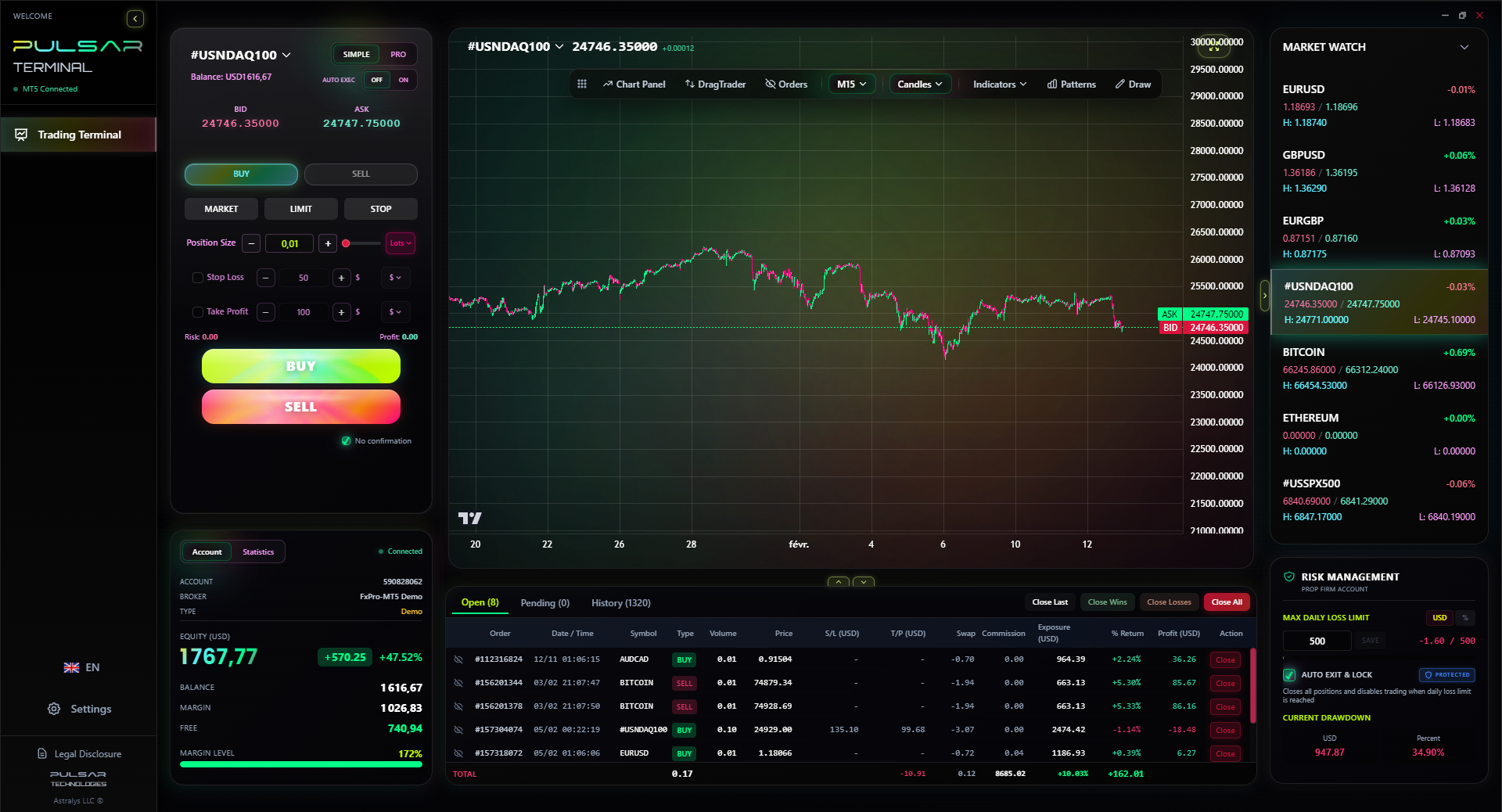
Managing complex exits with partial closes and breakeven stops is critical, and tools like Pulsar Terminal automate this directly on your MT5 platform, turning advanced risk management into a single click.
Pulsar Terminal
Công cụ MT5 tất-cả-trong-một: đặt lệnh kéo-thả, multi-TP/SL, trailing stop, grid trading, Volume Profile và bảo vệ prop firm. Hơn 1.000 trader sử dụng mỗi ngày.
“You might be a patriotic South African who believes in the Rand's strength. The market might be pricing in political risk and selling it off. You have to trade what you see, not what you feel.”
We have our own unique set of traps here. Let's call them out.
The 'ZAR Obsession': Feeling you have an edge on the Rand because you live here. Local news is noise. The big moves are driven by global dollar strength, commodity prices (we're a resource economy), and risk sentiment. Trading USD/ZAR successfully requires understanding global macro, not just local politics.
Chasing Prop Firm Dreams: Prop firm challenges are everywhere. They promise you a huge account if you pass a profit target with strict drawdown rules. The secret? Their rules are designed to make you fail. The daily loss limits force you to stop trading after a few bad trades, often right before the market might reverse in your favor. If you go this route, you need iron-clad discipline and a strategy built for high win rates, not home runs. The risk of a margin call or breach is high.
Ignoring the True Cost: It's not just the spread. It's the overnight financing charges (swap rates), especially if you're holding ZAR pairs. These can eat into your profits on longer-term trades. Always check the swap rates on your broker's platform before holding a position over Wednesday night (when triple swaps are charged).
Trading Around SARB Announcements: The South African Reserve Bank's interest rate decisions cause massive volatility. Unless you're an experienced news trader with a direct feed, it's often smarter to be flat (no positions) during these events. The initial spike can hit your stop loss before the market settles into its real direction.
“Entering a trade is easy. Managing it is the art.”
The internet is full of garbage and gems. Here's how to filter it.
Start with the Boring Stuff: Read the FSCA's basic guides for investors. Understand what a CFD is, what use means, and what your rights are. This foundational knowledge will protect you from scammers.
Find Practitioners, Not Pretenders: Look for educators who show real, verifiable trade histories (not just screenshots of profits). They should talk openly about losses, risk management, and the psychology of trading. If someone is only selling a 'secret system,' run.
Backtest, Then Forward Test: Don't trust a strategy you see online. Take it to a chart, go back in time, and see how it would have performed. Then, try it in a demo account for at least a month. I spent three months demo-trading a strategy I liked before risking a single cent. It saved me from adopting a flawed approach.
Community with Caution: Trading forums and Telegram groups can be useful, but they're also echo chambers of greed and fear. Never let someone else's analysis override your own plan. Use them for idea generation, not trade signals.
The best online forex trading lessons are a mix of structured learning and painful, personal experience. You have to put in the screen time. There's no royalty-free shortcut to understanding how price moves. Start small, protect your capital, and focus on consistency over jackpots. That's how you build a trading career that lasts, right here from South Africa.
FAQ
Q1Is forex trading legal and safe in South Africa?
Yes, it's completely legal, but safety depends entirely on you using an FSCA-licensed broker. Always verify the broker's FSP number on the official FSCA register. Trading with unregulated offshore entities is risky and may violate exchange controls.
Q2How much money do I need to start forex trading in South Africa?
You can start with very little. Some brokers offer accounts with minimum deposits as low as $5-$10 (roughly R90-R180). However, I strongly recommend starting with at least R2,000-R5,000 in a demo account to practice properly. When you go live, start with an amount you can afford to lose completely - that's the reality of the learning curve.
Q3What is the best forex trading strategy for beginners in SA?
Forget complex strategies. Start with price action on higher time frames (like the 4-hour or daily chart) on a major pair like EUR/USD. Learn to identify clear support and resistance levels, and practice setting trades with a strict 1% risk rule and a clear stop loss and take profit. A simple swing trading approach around these levels is far more sustainable than trying to scalping strategy from the beginning.
Q4Do I pay tax on forex trading profits in South Africa?
Absolutely. The South African Revenue Service (SARS) views trading profits as income. You are required to declare your net profit (profits minus losses and expenses) in your annual tax return. Keep detailed records of all your trades from day one.
Q5Can I trade USD/ZAR as a South African?
This is a grey area you must be careful with. South African exchange control regulations prohibit residents from speculating directly against the Rand outside of authorized channels. It is safer and fully legal to use your foreign investment allowance to fund an account with a licensed broker and trade major international pairs like EUR/USD or XAU/USD guide (gold).
Q6What's the biggest mistake new South African traders make?
Using excessive use. Just because a broker offers 500:1 doesn't mean you should use it. High use magnifies losses and can wipe out a small account in minutes with a normal market move. It also destroys your psychology, making you panic at every small fluctuation. Start with low use (10:1 or 20:1) and focus on proper position sizing instead.
Q7How do I choose a reliable forex broker in South Africa?
First, check for FSCA regulation. Then, compare key practical factors: the spreads on the pairs you want to trade (like EUR/USD guide), deposit/withdrawal methods (EFT, credit card), customer support responsiveness, and the trading platform (MT4/MT5 are industry standards). Read detailed, unbiased reviews like our Exness review or Pepperstone review to see how they perform for traders like you.
Bài học của Prof. Winston
Điểm chính:
- ✓Verify FSCA license before depositing any money.
- ✓Never risk more than 1-2% of your account per trade.
- ✓Start with major pairs, not exotic ZAR crosses.
- ✓Declare all trading profits to SARS.
- ✓use is a tool, not a strategy.
Bài viết này hữu ích thế nào?
Nhấp vào ngôi sao để đánh giá
Nhận định giao dịch hàng tuần
Phân tích & chiến lược miễn phí hàng tuần. Không spam.
Về tác giả
David van der Merwe
Nhà giao dịch Thị trường Mới nổi
Trader tại Johannesburg với 11 năm kinh nghiệm về tiền tệ thị trường mới nổi. Chuyên về cặp ZAR, giao dịch theo quy định FSCA và phân tích thị trường Nam Phi.
Bình luận
Cảnh báo rủi ro
Giao dịch các công cụ tài chính tiềm ẩn rủi ro đáng kể và có thể không phù hợp với tất cả nhà đầu tư. Hiệu suất trong quá khứ không đảm bảo kết quả trong tương lai. Nội dung này chỉ mang tính chất giáo dục và không nên được coi là lời khuyên đầu tư. Hãy luôn tự nghiên cứu trước khi giao dịch.
Bạn cũng có thể thích

Cara Trading Forex Sukses: 7 Prinsip dari Trader Profesional
Cara trading forex sukses dengan 7 prinsip trader pro: manajemen modal, disiplin, journal trading, backtest. Data nyata, bukan janji profit palsu.
Jam Trading Forex Terbaik untuk Trader Indonesia: Panduan Lengkap dengan Tabel Waktu
Panduan jam trading forex untuk trader Indonesia. Tabel 4 sesi dunia, jam emas 20:00-00:00, sesi mana yang harus dihindari. Data akurat + tips dari trader berpengalaman.
Top 5 Sàn Forex Uy Tín Nhất 2026: Review Jujur dari Trader Indonesia
Top 5 sàn forex uy tín 2026 untuk trader Indonesia. Review jujur: spread, deposit, withdraw, dukungan lokal. Exness, XM, IC Markets & lebih.
Tải Pulsar Terminal
Tất cả các công cụ tính này được tích hợp trong Pulsar Terminal với dữ liệu thời gian thực từ tài khoản MT5 của bạn.
Tải Pulsar Terminal