


Everyone's looking for the best prop firm, but they're asking the wrong question.

James Mitchell
Chuyên gia Phân tích Giao dịch Cao cấp
☕ 12 phút đọc
Bạn sẽ học được:
- 1What Is a Prop Firm, Really? (It's Not What You Think)
- 2The Real Numbers: Why Most Traders Fail
- 3What to Actually Look For in Prop Firm Reviews
- 4The Coming Regulatory Storm (2025-2026)
- 5A Realistic Look at Top US-Facing Firms
- 6A Simple Strategy to Actually Pass the Challenge
- 7Red Flags: How to Spot a Bad or Shaky Firm
- 8The Final Verdict: Is a Prop Firm Worth It For You?
Everyone's looking for the best prop firm, but they're asking the wrong question. The real issue isn't which firm is 'best' - it's understanding that 95% of traders fail their challenges, and most funded accounts never see a payout. I've traded with six different firms over the years, and I've watched more traders blow up than succeed. This isn't about finding a golden ticket; it's about understanding the business model, the real numbers, and whether you have the discipline to survive. Let's cut through the marketing and look at what actually happens.
A proprietary trading firm gives you capital to trade in exchange for a profit split. Sounds simple, right? Here's the catch: you're not a client. You're a contractor being evaluated. The firm's primary revenue isn't from your trading profits - it's from the evaluation fees you pay to take their challenge. This creates a fundamental misalignment of interests that most traders miss.
Think of it like a casino that charges you an entry fee to play blackjack, but you only get to keep 80% of your winnings. The house makes money whether you win or lose, as long as people keep buying chips. In 2023, I paid $299 for a $50,000 challenge with a well-known firm. I passed, but I watched over 90% of the traders in my cohort fail and re-buy the challenge. That's the business.

Warning: Don't confuse prop firms with brokers. A broker like IC Markets or Pepperstone executes your trades for a commission or spread. A prop firm provides capital and takes a cut of your profits. They are not regulated in the same way.
The funded account isn't 'real' money in the traditional sense. You're trading the firm's capital in a simulated environment, and they pay you based on your simulated profit. It's a performance-based contract, not a brokerage account. This distinction matters more than ever with new regulations coming.
Let's talk about the statistics that prop firm marketing pages don't highlight. These aren't guesses; they're aggregated from industry reports and my own tracking of trader communities.
The Evaluation Phase:
- Pass Rate: 5-10%. Some firms, like Apex, claim a 15-20% first-time pass rate, which is still brutally low.
- Average Challenge Cost: $100 to $500, depending on account size.
- Typical Rules: You'll face a profit target (often 8-10%), a maximum daily loss (around 5%), and a maximum overall loss (around 10%). Violate any once, and you're out.
The Funded Phase:
- Payout Rate: Only about 7% of funded accounts ever receive a payout.
- Average Payout: Roughly 4% of the account size. So, that $100,000 account? The average payout is around $4,000. The Funded Trader reports a higher average of $7,000, but that's still a fraction of the 'headline' account size.
- Profit Split: Usually 80/20 in your favor. Some offer 90/10 or even 100% for the first chunk of profits.
Why Do Traders Blow Up?
It's not bad luck. It's psychology and poor position size management. The challenge rules are designed to exploit common trading mistakes. The daily loss limit forces you to stop trading after a bad start - something most amateur traders can't do. They revenge trade and blow the account. The profit target makes you greedy when you're close, leading to overtrading.
I failed my first two challenges for exactly these reasons. On the second one, I was up 7% on a $25k account, needing just 3% more to pass. I got impatient, took a huge scalping trade on EUR/USD without a stop, and gave back all my profits in one session. The $150 fee was gone. That experience taught me more than any winning trade ever did.

💡 Mẹo của Winston
Your first goal in a challenge isn't to hit the profit target. It's to survive for two weeks without hitting the daily loss limit. Survival first, profits second.
“Only about 7% of funded accounts ever receive a payout. The average payout is roughly 4% of the account size.”
Forget the flashy websites and influencer promotions. When you read prop firm reviews, you need to dig into these five concrete areas. Your profitability depends on them.
- Profit Split & Payout Terms: Is it 80/20? 90/10? How is the profit calculated? Do they deduct spreads and commissions first? What's the minimum payout threshold? How often can you withdraw? Weekly payouts are a huge psychological boost.
- Challenge & Account Rules: This is where they get you. Scrutinize the:
- Profit Target: 10% in 30 days is standard, but some are lower (easier) or higher (harder).
- Daily Loss Limit: Usually 5%. Is it based on your starting daily balance or your overall account balance? The former is stricter.
- Maximum Drawdown: Usually 10%. Is it trailing? A trailing drawdown that moves up with your profits is much tougher than a static one.
- Time Limit: Most give you 30 days, but some offer unlimited time, which is far less stressful.
- Trading Platform & Instruments: Do they offer MT5, which is superior for swing trading with its depth of market? Or just MT4? Can you trade the instruments you're good at? Some firms restrict major news trading, which kills certain strategies.
- Support & Scaling Plan: If you're profitable, how quickly can you grow your account? A good scaling plan adds capital after consistent profits. Bad ones have opaque or non-existent plans.
- Withdrawal Method & Speed: This is critical. Can you get paid via crypto (fast) or only bank wire (slow)? I prioritize firms that pay in USDT within 48 hours. Waiting 2 weeks for a bank transfer is agony.

Example: Firm A has a 10% profit target, 5% daily loss, 10% max loss, 30-day limit. Firm B has an 8% profit target, 5% daily loss, 10% max loss, no time limit. All else being equal, Firm B's challenge is objectively easier to pass because the pressure of the clock is removed.
This is the single most important thing happening in prop trading, and most traders are completely unaware. The unregulated wild west era is ending. Here’s what’s changing and why it matters to your money.
The SEC's New "Dealer" Rule (2024): The SEC now says firms that are regularly buying and selling securities as part of their business must register as dealers. Many prop firms trade equities and ETFs. If they fall under this rule, they'll need to register with the SEC and FINRA, meet strict net capital requirements, and submit to examinations. This could make their business model prohibitively expensive overnight.
The CFTC's Move: The CFTC is looking at classifying evaluation-based prop firms as Commodity Trading Advisors (CTAs). This means registration, audits, and formal risk disclosures. If you're trading futures or forex, this affects you directly.
What This Means For You:
- Firm Closures: An estimated 80-100 firms closed between 2023-2024. Over 40% of unregulated firms reportedly shut down in 2025. Your funded account could vanish if the firm isn't prepared.
- Rule Changes: Firms that survive will likely have to change their challenge rules, payout structures, and allowed instruments to comply. Your strategy might suddenly become invalid.
- Safety: Regulation isn't all bad. It brings transparency to profit splits and payout practices. It weeds out the outright scams.
My advice? Right now, prefer firms that are already taking steps toward compliance or are based in jurisdictions with clearer frameworks. Your $5,000 payout is worthless if the firm disappears before processing it.
“The daily loss limit is a forced discipline mechanism. The traders who pass are the ones who stop trading the moment they approach that limit.”
Based on my experience and constant monitoring of trader forums, here’s a no-BS take on a few major players. This isn't sponsored; it's what I've seen and heard.
| Firm | My Take (The Good & The Bad) | Best For... |
|---|---|---|
| Topstep | The OG futures prop firm. Highly structured, excellent educational resources. Their "Trading Combine" is a known quantity. However, their rules are strict (trailing drawdown), and their profit split starts at 80/20 until you hit certain milestones. Payouts are reliable. | Futures traders who want a clear, established path and don't mind a rigorous evaluation. |
| Apex Trader Funding | Known for more flexible rules (one-time reset options, no daily loss limit on some accounts). They have a huge selection of account sizes. Payouts are generally good, but some users report slower customer service during high volume. Their pass rate is touted as higher, which aligns with their more forgiving rules. | Traders who want flexibility and might need a second chance during the eval. |
| The Funded Trader | Gained popularity for high profit splits (up to 90%) and various challenge models. They've had some well-publicized disputes over rule interpretations in the past. Seems to have stabilized. Offers crypto payouts. | Traders chasing higher splits and comfortable with a firm that has had growing pains. |
| TakeProfit Trader | Simple, straightforward rules (no time limit, static drawdown). This makes their challenge one of the easiest to pass from a psychological standpoint. They're newer, so the long-term track record on scaling and payouts is still being written. | Beginners or traders who panic under time pressure. |
Remember, the "best" firm is the one whose rules best fit your personality and strategy. A swing trader needs no time limit. A scalper needs tight spreads and fast execution, which you can check in reviews for platforms like cTrader on Pepperstone.
💡 Mẹo của Winston
If a firm's rules page is longer than a software license agreement, walk away. Complexity is often a mask for unfairness.
You don't need a fancy strategy. You need discipline. Here's the boring, methodical approach that works.
Phase 1: The Grind (First 75% of Target)
- Position Size: Use a position size calculator. Risk no more than 0.5% of your account's starting balance per trade. On a $50k account, that's $250. This gives you a huge buffer before hitting the daily loss limit.
- Trade Frequency: Aim for 1-3 high-quality trades per day. No more. Overtrading is the #1 killer.
- Target: Small, consistent wins. Use a 1:1.5 risk-to-reward ratio. If you risk $250, aim for $375. Do this 15 times, and you're at 5.6% profit.
Phase 2: The Finish Line (Last 25%)
- Reduce Risk: Once you're at 7.5% profit on a 10% target, cut your risk per trade in half. Now you're risking 0.25%. The goal is to not give back hard-earned profits.
- Be Patient: Wait for your absolute best setup. If you don't see it, don't trade. You have time.
The Mental Game:
- Daily Loss Limit is a Circuit Breaker: If you hit 80% of your daily loss limit (e.g., you're down $400 on a $500 daily limit), STOP TRADING FOR THE DAY. Close the platform. This is the single hardest but most important rule.
- Ignore the "Account Balance": Focus only on your risk per trade and your progress toward the target percentage. The dollar amount is a distraction.

Pro Tip: Use a trading journal. Log every trade, the reason for it, and your emotional state. When I finally passed, I reviewed my journal and saw I failed 70% of my trades taken after 4 PM my time. I made a rule: no trades after 3 PM. My consistency improved immediately.
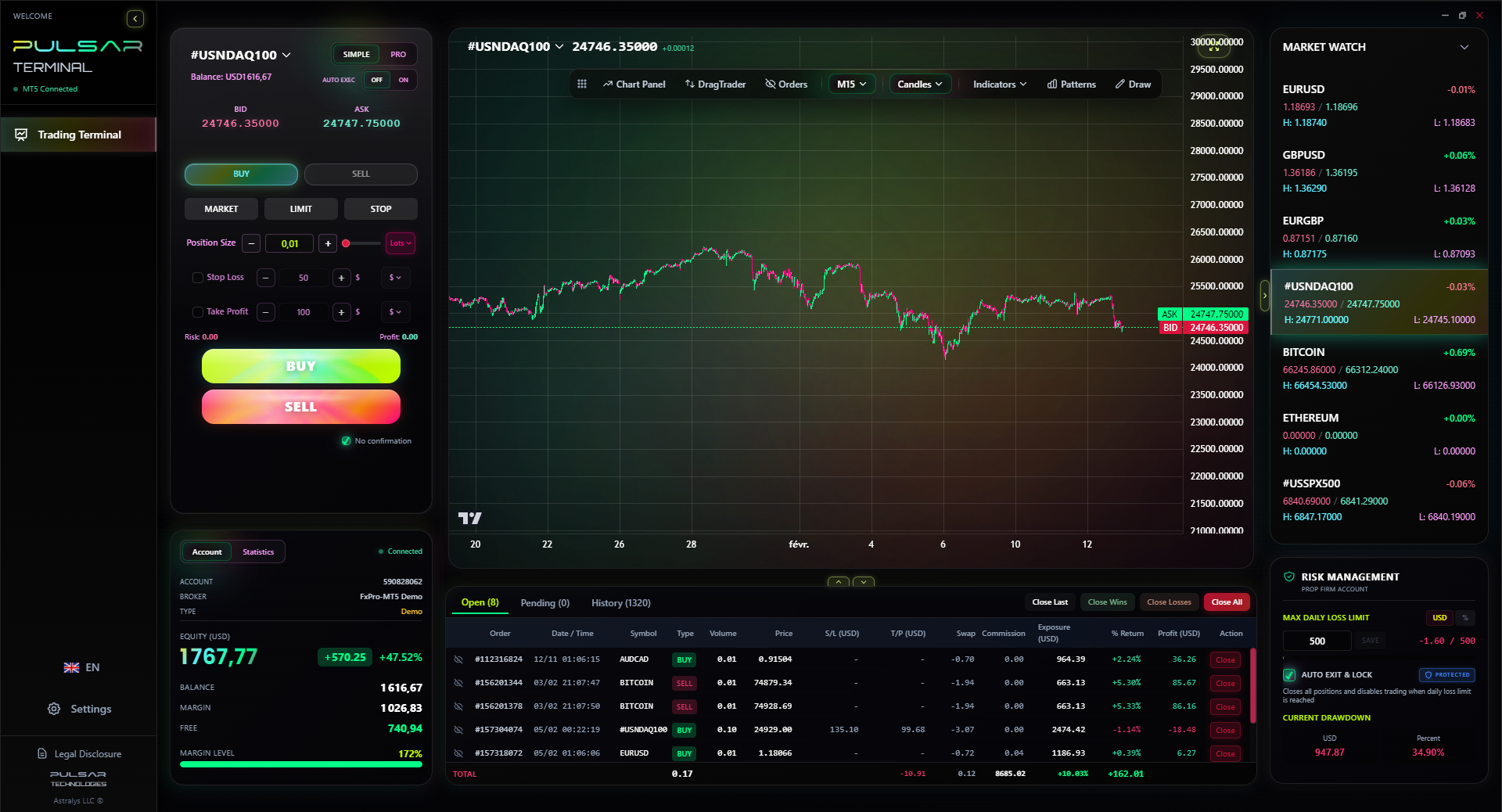
Managing a prop firm challenge requires robotic discipline for daily loss limits and drawdowns, which is exactly what Pulsar Terminal's prop firm protection module automates on your MT5 platform.
Pulsar Terminal
Công cụ MT5 tất-cả-trong-một: đặt lệnh kéo-thả, multi-TP/SL, trailing stop, grid trading, Volume Profile và bảo vệ prop firm. Hơn 1.000 trader sử dụng mỗi ngày.
“Your first goal in a challenge isn't to hit the profit target. It's to survive for two weeks without hitting the daily loss limit.”
Not all prop firms are created equal. Some are poorly run, and others are borderline scams. Here’s what should make you walk away.
- No Clear, Written Terms: If the challenge rules, profit split, or payout process are vague or constantly changing, run. Everything must be in a formal agreement.
- Overly Complicated Rules: If you need a lawyer to understand the drawdown calculation, it's probably designed to fail you.
- Poor or Slow Communication: You email support with a simple question and get a canned response after 5 days. This is a preview of how payout requests will be handled.
- Too Good to Be True Offers: "Pass our challenge in 1 day!" "Keep 100% of profits forever!" These are marketing hooks with hidden caveats.
- No User Reviews or Testimonials: A complete lack of independent discussion online is suspicious. Conversely, a flood of identical positive "reviews" on one site is likely fake.
- Pressure to Buy "Add-ons": Upselling you on expensive "one-time reset" or "express evaluation" fees before you even start trading is a sign their revenue model depends on it.
- History of Payout Issues: Search the firm's name + "payout problem" or "withdrawal delay." A few complaints are normal; a pattern is a major red flag.
I almost joined a firm in 2022 that offered a 95% split. The rules seemed fine. But a deeper search on a trader forum revealed multiple users had been waiting over 45 days for payouts, with support going silent. I saved my money. A few months later, that firm dramatically changed its rules and froze all withdrawals for a "system upgrade" that lasted months. Trust, but verify.
💡 Mẹo của Winston
Before you pay a fee, find three independent, verifiable payout proofs from the last 30 days. No proofs, no trust.
So, should you do it? Let's be brutally honest.
Yes, if:
- You have a proven, disciplined trading strategy with a positive expectancy, but lack the capital to make meaningful profits.
- You possess the emotional control to follow strict rules (especially daily loss limits) without exception.
- You treat the evaluation fee as a one-time educational cost you are willing to lose.
- You understand the regulatory risks and choose a firm with a solid track record.
No, if:
- You're still developing your strategy. Use a demo account or a very small live account first. Blowing $200 on a prop challenge is stupid if you're still figuring out how the MACD indicator works.
- You have trouble with discipline in your personal trading. The prop firm rules will magnify your flaws, not fix them.
- You need the money. Trading under financial pressure is a guaranteed way to fail.
- You believe this is a "get rich quick" scheme. The average payout stats tell the real story.
For me, it was worth it. After my early failures, passing gave me the confidence that I could trade under pressure. The capital allowed me to make profits I couldn't have with my own savings. My first funded account payout was $2,150 from a $50k account. It wasn't life-changing, but it validated the process. Just know what you're getting into. It's a tough business, and the house always has an edge. Your job is to be in that 5% who can beat it.
FAQ
Q1What is the most important rule in a prop firm challenge?
The daily loss limit. It's a forced discipline mechanism. The traders who pass are the ones who stop trading the moment they approach that limit. The ones who fail are the ones who try to 'trade back' their losses and blow the entire account in one session.
Q2Can I trade news events during a prop firm challenge?
It depends entirely on the firm's rules. Many firms restrict trading during major economic news releases (like NFP or CPI) because of the extreme volatility and potential for slippage. Always, always check the firm's specific rules on news trading. Violating this rule is an instant fail, even if the trade is profitable.
Q3How are prop firm payouts taxed in the US?
Payouts are typically treated as self-employment income (on a 1099-MISC or 1099-NEC). You are responsible for paying income tax and self-employment tax (Social Security & Medicare) on your share of the profits. Keep detailed records of all your payouts. Consult a tax professional familiar with trader tax status.
Q4What happens if I pass the challenge but then blow my funded account?
Most firms offer a "reset" option. You pay a fee (often significantly less than the original challenge fee) to reset your account back to its starting balance. Some firms offer a free reset after a certain period of consistent trading. Check the firm's specific funded account rules before you start.
Q5Are there any prop firms that don't have a time limit on the challenge?
Yes, a growing number of firms offer "no time limit" challenges. This removes a massive source of psychological pressure and is generally considered more trader-friendly. Firms like TakeProfit Trader and some account types from Apex Trader Funding offer this.
Q6Is it better to start with a small or large account size challenge?
Start small. The rules and psychology are identical, but the financial risk is lower. A $10k challenge might cost $50-$80. A $100k challenge can cost $500+. Use a smaller account to prove you can pass the rules and develop your process. You can always scale up later through the firm's scaling plan or by buying a larger challenge.
Bài học của Prof. Winston
Điểm chính:
- ✓Pass rates are 5-10%, not 50%.
- ✓Average payout is just 4% of account size.
- ✓The daily loss limit is your #1 rule.
- ✓Regulation will close many firms by 2026.
- ✓Start with the smallest, cheapest challenge.
Bài viết này hữu ích thế nào?
Nhấp vào ngôi sao để đánh giá
Nhận định giao dịch hàng tuần
Phân tích & chiến lược miễn phí hàng tuần. Không spam.
Về tác giả
James Mitchell
Chuyên gia Phân tích Giao dịch Cao cấp
Hoạt động tại New York với hơn 9 năm kinh nghiệm giao dịch. Tập trung vào các cặp USD chính, thử thách prop firm và bối cảnh pháp lý tại Mỹ.
Bình luận
Cảnh báo rủi ro
Giao dịch các công cụ tài chính tiềm ẩn rủi ro đáng kể và có thể không phù hợp với tất cả nhà đầu tư. Hiệu suất trong quá khứ không đảm bảo kết quả trong tương lai. Nội dung này chỉ mang tính chất giáo dục và không nên được coi là lời khuyên đầu tư. Hãy luôn tự nghiên cứu trước khi giao dịch.
Bạn cũng có thể thích

Cara Trading Forex Sukses: 7 Prinsip dari Trader Profesional
Cara trading forex sukses dengan 7 prinsip trader pro: manajemen modal, disiplin, journal trading, backtest. Data nyata, bukan janji profit palsu.
Jam Trading Forex Terbaik untuk Trader Indonesia: Panduan Lengkap dengan Tabel Waktu
Panduan jam trading forex untuk trader Indonesia. Tabel 4 sesi dunia, jam emas 20:00-00:00, sesi mana yang harus dihindari. Data akurat + tips dari trader berpengalaman.
Top 5 Sàn Forex Uy Tín Nhất 2026: Review Jujur dari Trader Indonesia
Top 5 sàn forex uy tín 2026 untuk trader Indonesia. Review jujur: spread, deposit, withdraw, dukungan lokal. Exness, XM, IC Markets & lebih.
Tải Pulsar Terminal
Tất cả các công cụ tính này được tích hợp trong Pulsar Terminal với dữ liệu thời gian thực từ tài khoản MT5 của bạn.
Tải Pulsar Terminal